
When you hear your child might need autism support, you might feel relieved, worried, and have a ton of questions. Many parents search for how to start ABA therapy for my child because they want a clear process, not confusing clinical language.
Applied Behavior Analysis (ABA Therapy) is a behavioral method frequently employed for children with developmental needs and autism. Behavioral approaches deal with the things that happen before and after the behaviour, and they are very common in schools and treatment clinics, as explained by the CDC. ABA is one of the most recognized behavioral approaches for autism support.
This parent guide to ABA therapy covers what it is, when to look into it, how to find one that is qualified, what to expect on an assessment, insurance coverage, and what happens after the sessions start.
What is Exactly ABA Therapy?
ABA Therapy is a structured, individualized approach that helps children build skills they can use in everyday life. It can facilitate communication, social interaction, learning, self-care, routines, play, emotion management and behaviour management.
ABA is an evidence-based behavior treatment that focuses on promoting desired behaviors and reducing behaviors that can get in the way of learning or safety, and monitors progress over time.
ABA teaches useful skills by dividing them into teachable small steps. A therapist can teach a child to seek assistance, to follow a routine, to move to next activity, to play with peers, to use words or communication tools, or to perform daily living skills.
ABA can be tailored to the needs of each child, implemented in a variety of environments, including at home, at school, and community, and can be taught skills that are meaningful in a person’s life.
A strong ABA program should never feel like a one-size-fits-all plan. Treatment should be based on what the child can do well, their needs, preferences, communication style, the family’s priorities and their daily routines.
Who Provides ABA Therapy?
A quality ABA program usually includes a team.
- BCBA: A Board Certified Behavior Analyst designs the treatment plan, oversees therapy, monitors progress, adjusts goals and trains caregivers.
- RBT/Behavior technician: A Registered Behavior Technician or behavior technician provides direct services to the child during sessions supervised by the BCBA.
- Parents and caregivers: Parents are taught ways to help with meals, bedtime, homework, outings, play and daily routines.
How to Start Applied Behavior Analysis (ABA Therapy)
ABA Therapy is an option for parents who feel their child requires structured support to learn functional skills or to decrease behaviors that affect safety, learning, communication, and daily functioning.
Common signs your child may benefit from ABA
A child may benefit from ABA therapy services if they have:
- Communication delays
- Difficulty following routines
- Sustained difficulties with behavior like aggression, self-injury, or regular severe tantrums
- Social skill delays
- Difficulty with transitions
- Self-care skill delays, such as toileting, dressing, brushing teeth, or feeding
- School-readiness challenges
- Trouble asking for help or expressing needs
- Difficulty playing, sharing, waiting, or participating in group activities
ABA is not just about decreasing behaviours. A good plan should encourage the child to communicate, join in, be more independent and be more successful in everyday life.
Do you need an autism diagnosis before starting ABA?
Most insurance plans will need a formal diagnosis, referral or medical documentation of autism to be eligible to cover ABA Therapy. Some providers may also need diagnostic records prior to providing services.
Parents have the opportunity to reach out to ABA providers for guidance prior to finalizing. A provider can describe the paper work that is required, if an evaluation is necessary, and the intake process.
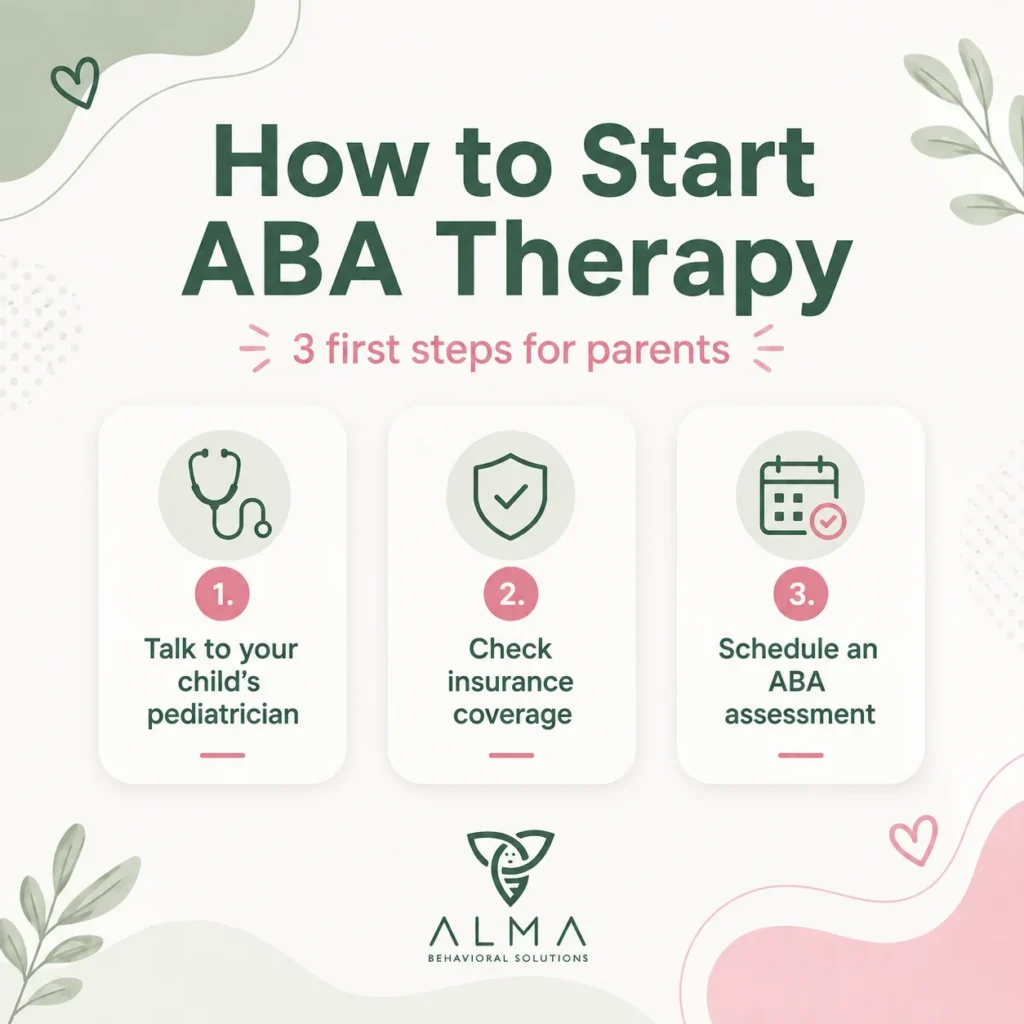
Step 1: Talk to Your Child’s Pediatrician or Specialist
This typically involves consulting with your child’s pediatrician, developmental pediatrician, psychologist, neurologist, or autism specialist.
This step may include:
- Developmental screening
- Autism evaluation
- Referral letter
- Medical documentation
- Therapy recommendation
- Discussion of your child’s communication, behavior, learning, and daily living needs
A pediatrician or specialist may be able to help decide if In Home ABA Therapy is needed and might be able to provide documentation needed for insurance.
Parents who are unsure where to begin can also ask,
“Do you recommend an autism evaluation or ABA referral for my child’s current needs?”
Step 2: Check Insurance and ABA Coverage
Insurance is one of the biggest questions families have when searching for ABA therapy services near me. This is determined by your coverage plan, diagnosis criteria, state regulations, network status, prior authorization and medical necessity requirements.
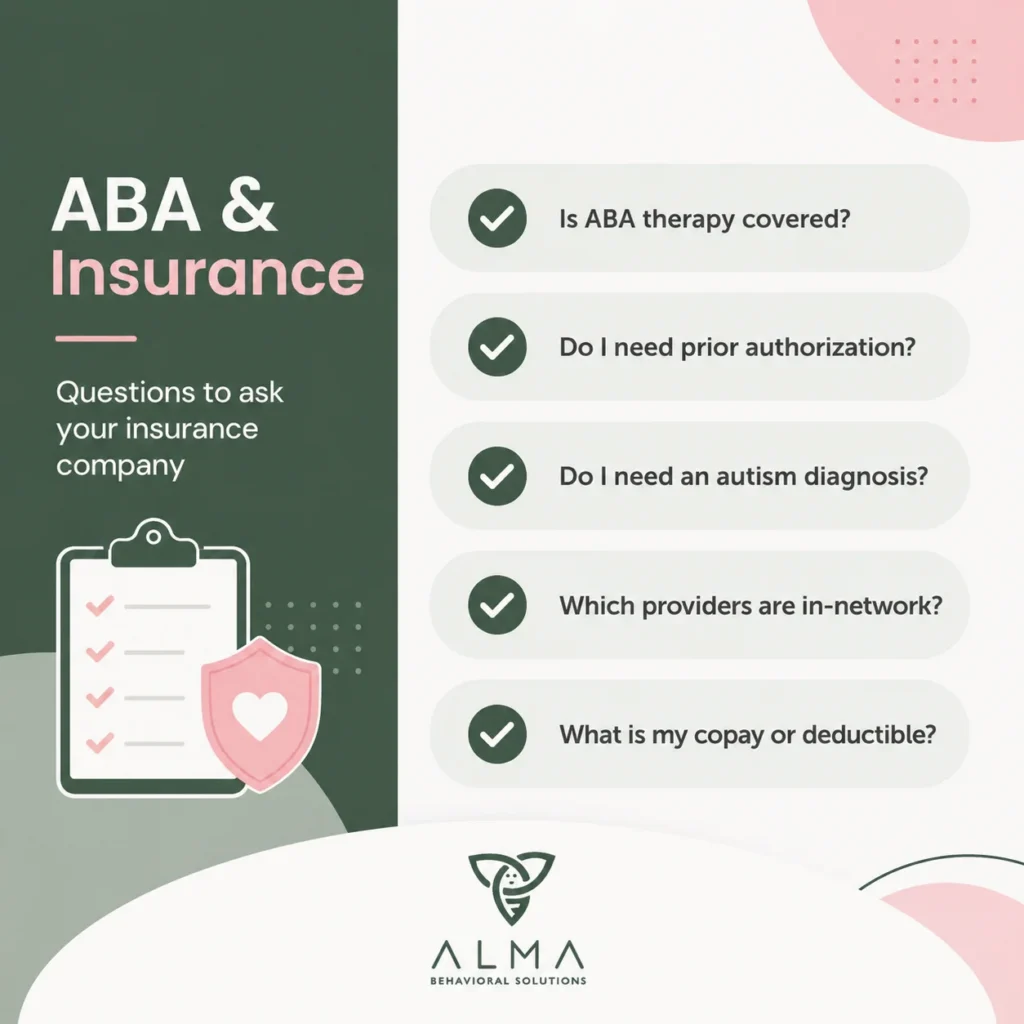
Questions to ask your insurance company
Use this checklist when calling your insurance provider:
- Is ABA Therapy covered under my child’s plan?
- Do I need prior authorization before starting?
- Do I need an autism diagnosis?
- Is a referral or prescription required?
- How many ABA hours may be approved?
- Which ABA providers are in-network?
- What is my copay, deductible, or coinsurance?
- Does it include home-based, center-based, school-based or telehealth services?
- What documents are needed to be approved?
- How often does authorization need to be renewed?
Keep notes during the call. Record the date, representative’s name, reference number and important facts.
What if insurance does not cover ABA?
Other options, such as private pay, school-based support, regional programs, state-funded programs, non-profits, grants, and community programs may also be available for some families.
A qualified ABA provider may be able to help parents know their choices and inform them on what documentation they may require to get approved or appealed.
Find a Qualified ABA Therapy Provider
It’s important to pick the right provider. Parents should look for a team to be qualified, transparent, child-centered and collaborative.
For families searching for ABA Therapy in Los Angeles County, location is important, but fit is just as important. The provider should know your child’s needs, be able to communicate clearly with your family, and be able to let you know how progress will be evaluated.
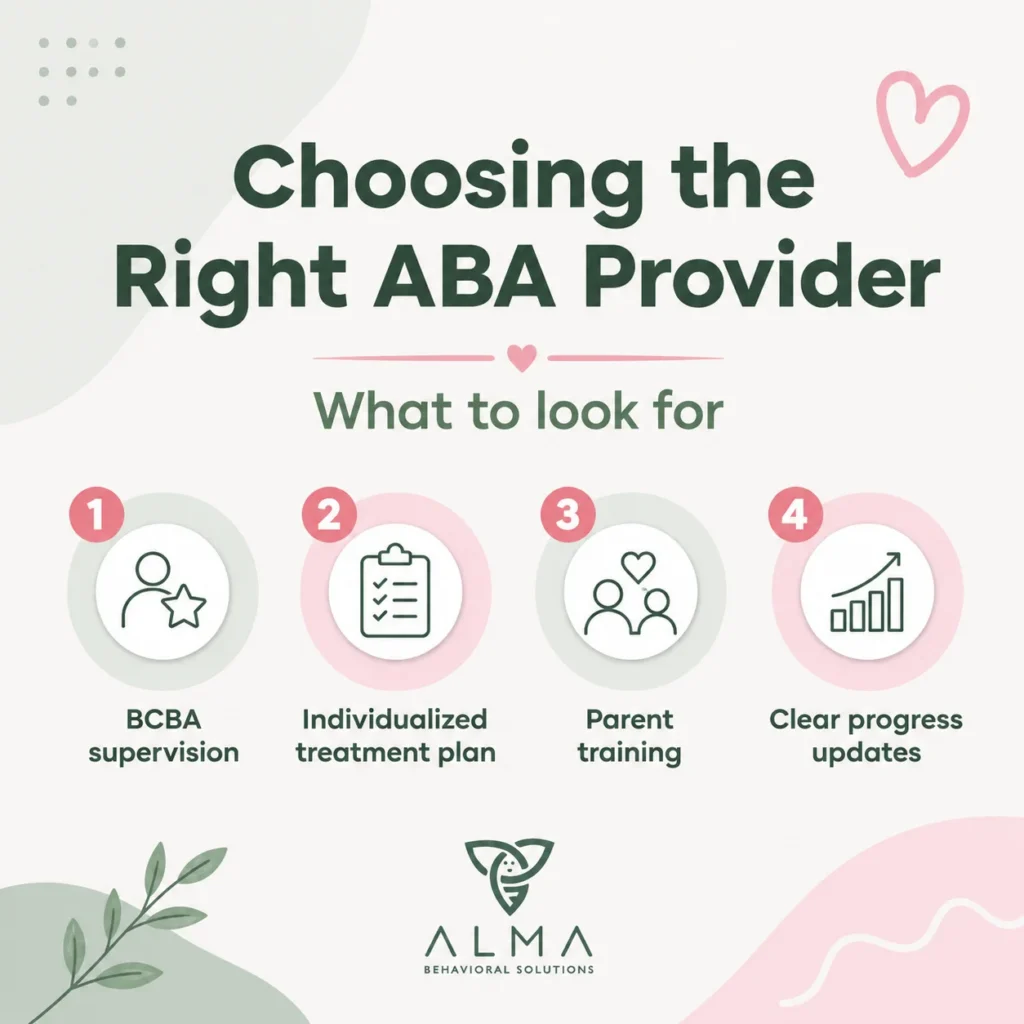
What to look for in an ABA provider
A high-quality ABA provider should offer:
- BCBA supervision
- Individualized treatment plans
- Parent training
- Clear communication
- Data tracking
- Progress reports
- Ethical and child-centered care
ABA Programs can be defined as teaching children skills they are not learning on their own, and parent and caregiver training is provided to assist children’s daily routines.
Red flags parents should avoid
Parents should be cautious if a provider offers:
- The same plan for every child
- No parent involvement
- Unclear goals
- No progress reports
- No explanation of techniques
- Little or no BCBA supervision
- Goals focused only on compliance
- No consideration of the child’s comfort, preferences, wellbeing
- Therapy that feels too rigid or disconnected from real life
The key aspects of a child’s development, safety, communication, independence and quality of life should all be supported by a strong ABA plan. It should not try to “mask” benign autistic characteristics or make a child feel “less autistic.”
Step 3: Schedule an ABA Assessment
The next step after selecting a provider is typically an intake and assessment. This is where the BCBA learns about your child and family before creating a treatment plan.
What happens during the first ABA assessment?
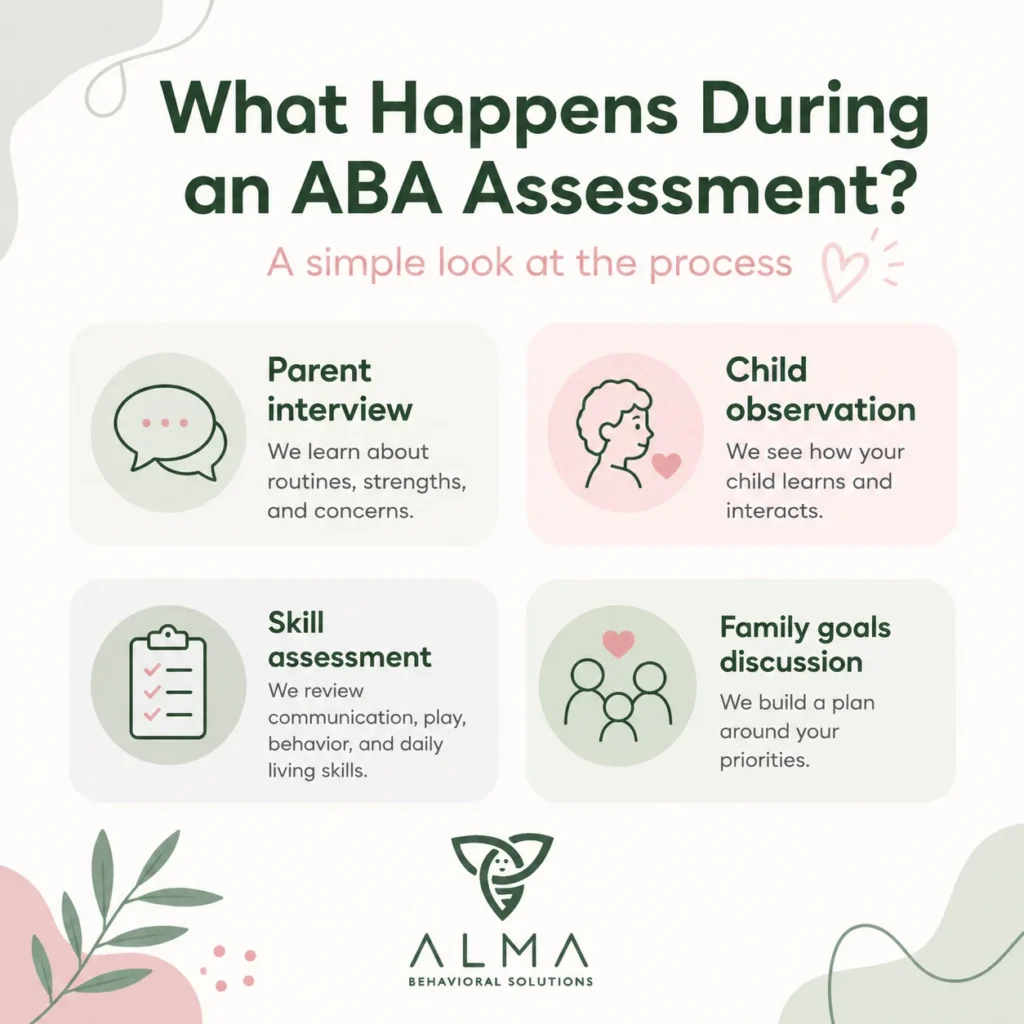
An ABA therapy assessment for children may include:
- Parent interview
- Child observation
- Skill assessment
- Behavior assessment
- Review of medical history
- Review of school or therapy records
- Discussion of family goals
- Assessing strengths, preferences, routines and challenges
The assessment process will enable the BCBA to find out what your child can already do, where the support is required, and what goals are most important to the child.
What questions will the BCBA Ask?
The BCBA may ask:
- What skills do you want your child to learn?
- What behaviors are difficult at home or school?
- What routines are challenging?
- What motivates your child?
- How does your child communicate?
- What helps your child calm down?
- What situations lead to frustration or distress?
- What does your child enjoy?
- What are your current family goals?
Honest answers enable the BCBA to develop a plan that is appropriate for your child’s actual situation.
Review the Treatment Plan
The BCBA develops a treatment plan following the assessment. This should be read by parents and questions asked before therapy is commenced.
What should be inside an ABA treatment plan?
A strong ABA treatment plan should include:
- Child’s current skill level
- Measurable goals
- Behavior support plan, if needed
- Recommended therapy hours
- Parent training plan
- Data collection method
- Progress review schedule
- Strategies for home, school, or community generalization
- Safety considerations
- Plan for updating goals over time
Autism Speaks notes that ABA programs are designed around the individual learner’s skills, needs, interests, preferences, and family situation.
Examples of ABA Goals
ABA goals should be practical and meaningful. Examples include:
- Requesting help
- Following one-step directions
- Toilet training
- Minimizing communication frustration related tantrums
- Improving play skills
- Building school readiness
- Learning daily routines
- Waiting for short periods
- Transitioning between activities
- Asking for a break
- Using a communication device or visual support
Goals should be defined and have a positive impact on life.
Start ABA Sessions
When the treatment plan and insurance authorization is in place, sessions can start.
What does an ABA session look like?
Play based learning, reinforcement, communication practice, social skills, daily living skills, structured teaching and natural environment teaching are all components of the ABA session.
A therapist may work on:
- Requesting preferred items
- Practicing transitions
- Learning routines
- Building attention and imitation skills
- Developing play skills
- Practicing self-care tasks
- Using visual supports
- Learning safer replacement behaviors
Sessions should be adjusted based on the child’s response. A child friendly program should contain encouragement, breaks, preferred activities and meaningful reinforcement.
Where can ABA therapy happen?
ABA Therapy may happen in several settings:
- Home-based ABA
- Center-based ABA
- School-based support
- Community-based ABA
- Telehealth parent coaching
Autism Speaks explains that ABA can be provided in different locations, including home, school, and community settings.
Alma Behavioral Solutions can help families in Los Angeles County in determining which setting might be the right fit for their child and family.
Track Progress and Stay Involved
Parent involvement is one of the most important parts of ABA Therapy. Transfer of learning to daily routines is expected.
How progress is measured
Progress may be measured through:
- Session data
- Goal progress reports
- Parent meetings
- Updated treatment plans
- Skill generalization
- Behavior tracking
- Prompt-level tracking
- Regular BCBA review
The CDC notes that ABA tracks and measures progress as part of treatment. This assists the team to understand what is working and what needs to change.
Why parent training matters
Parent training facilitates family support of learning outside of therapy. Parents can receive training on encouraging communication, transition planning, addressing challenging behavior, visual supports and independent skills while completing routines.
Daily practice may happen during:
- Meals
- Bedtime
- Morning routines
- Bathing and dressing
- School preparation
- Grocery shopping
- Park visits
- Sibling play
- Community outings
Small moments throughout the day can become meaningful learning opportunities.
Adjust the Plan as Your Child Grows
ABA Therapy should change as the child changes. Don’t let a treatment program be static.
When should ABA goals change?
Goals may change when:
- Child achieves current objectives
- Family priorities shift
- School needs change
- New behaviors appear
- Communication improves
- The child requires less assistance
- It’s more difficult to start a new routine.
- The child is ready for more advanced skills
To ensure that therapy is ongoing to facilitate the child’s development, wellbeing and everyday functioning, it is important to review this regularly.
Safe and Child-Centered ABA: What Parents Should Know
A helpful ABA program should be individualized, positive, respectful, and focused on meaningful skills. Parents are welcome to ask questions, observe sessions as appropriate and raise concerns.
Quality ABA should focus on:
- Communication
- Safety
- Independence
- Emotional wellbeing
- Skill building
- Family priorities
- Real-life routines
- Respect for the child’s strengths and needs
Parents should voice their concerns if therapy is very structured, if goals are inappropriate, if the child is always upset, or if there is not clear progress.
ABA Therapy Checklist for Parents
Before starting ABA Therapy, parents should:
- Confirm diagnosis or referral
- Check insurance coverage
- Find a BCBA-supervised provider
- Ask about the assessment process
- Review treatment goals
- Understand therapy hours
- Request parent training
- Monitor progress every month
- Ask how goals will support daily life
- Confirm how often the BCBA updates the plan
- Ask how therapy will stay child-friendly and respectful
This checklist can help parents feel more prepared when contacting an ABA provider.
Final Thoughts: Starting ABA Therapy with Confidence
Parents don’t have to know all of this the very first day they start ABA Therapy, but it can be overwhelming to get started. Evaluating your child, selecting an appropriate provider, navigating insurance and being involved in your child’s success are the most crucial first steps.
Alma Behavioral Solutions supports families looking for compassionate, individualized ABA Therapy in Los Angeles County. To find an ABA therapy provider near me, or if you are just wondering how to get started, our staff can help you, answer your questions and help your child develop meaningful skills in daily life.
To learn more about autism care and child behavioral support, call Alma Behavioral Solutions at (747) 250-8494 or email info@almabehavioralsolutions.com. Early guidance can enable families to proceed, clearly and confidently, to the next steps.
Questions to Ask an ABA Provider Before Starting
Parents can ask:
How many years of ABA experience do you have?
Look for a provider with experience supporting children with needs similar to your child’s.
Will a BCBA supervise my child’s plan?
A BCBA should create, supervise, and update the treatment plan.
How will parents be provided with updates?
Open communication enables parents to know how the child is doing and to be involved.
Do you provide parent training?
Parent training helps children use skills outside therapy sessions.
How do you handle challenging behavior?
The provider should explain positive, ethical, and individualized strategies.
How do you make therapy child-friendly?
Motivation, play, breaks, comfort and respect for the child should be incorporated into the therapy.
How do you measure progress?
The team should collect data and provide progress updates.
Can therapy goals support school readiness?
ABA can be useful for routines, communicating, taking instructions, social skills, waiting, going through transitions and participating in classes.
How do I start ABA therapy for my child?
The first step is to consult with your child’s pediatrician, developmental specialist, psychologist or autism service provider. Next, review insurance coverage, collect documentation, reach out to an ABA provider, set up an evaluation and review treatment plan.
Do I need a diagnosis before ABA therapy?
Many insurance plans require a formal autism diagnosis before approving ABA Therapy. However, parents may continue to reach out to providers for guidance until a referral or evaluation.
How long does ABA therapy take to start?
The timeline will vary based on evaluation records, provider availability, scheduling for evaluation, insurance authorization and staffing. Families start up very early or they may have to wait longer depending on the waitlist for providers and paperwork.
How many hours of ABA therapy does my child need?
The number of hours is determined by the child’s insurance, family schedule, assessment, goals and needs and the child’s age. A BCBA should recommend hours based on your child’s individual needs.
What happens during the first ABA assessment?
The BCBA typically conducts an interview with parents, observes the child, reviews developmental history, medical history, and skills, and discusses concerns with parents and family goals.
Does insurance cover ABA therapy?
ABA Therapy can be covered under many insurance plans as long as it is deemed medically necessary, which will depend on the insurance plan and location. It is important for parents to inquire about diagnostic criteria, if required, prior authorization, network providers, copays, deductibles, and approved hours.
What should parents expect from ABA therapy?
Parents can expect an individual plan, measurable objectives, frequent progress monitoring, parenting education and strategies to support the child to develop practical skills in everyday life.
How do I know if ABA therapy is working?
If your child is making measurable progress towards goals, using new skills in everyday life, communicating more effectively, needing fewer prompts or showing fewer interfering behaviors, then ABA may be working.
Can ABA therapy happen at home?
Yes. ABA Therapy may be delivered at home, clinic, school, community and/or parent coaching if appropriate. The optimum setting will be determined by the needs and goals of the child and his/her family.
What questions should I ask before choosing an ABA provider?
Ask about BCBA supervision, parent training, individualized goals, progress reports, safety practices, therapy settings, experience with your child’s needs, and how the provider keeps therapy child-centered.