
What if therapy could help your child ask for a break, get ready for school, or handle a change in plans with greater confidence? CDC estimates have recently concluded that approximately one child in 36 children in the U.S. is diagnosed with autism, and there is a need for effective, individualized supports.
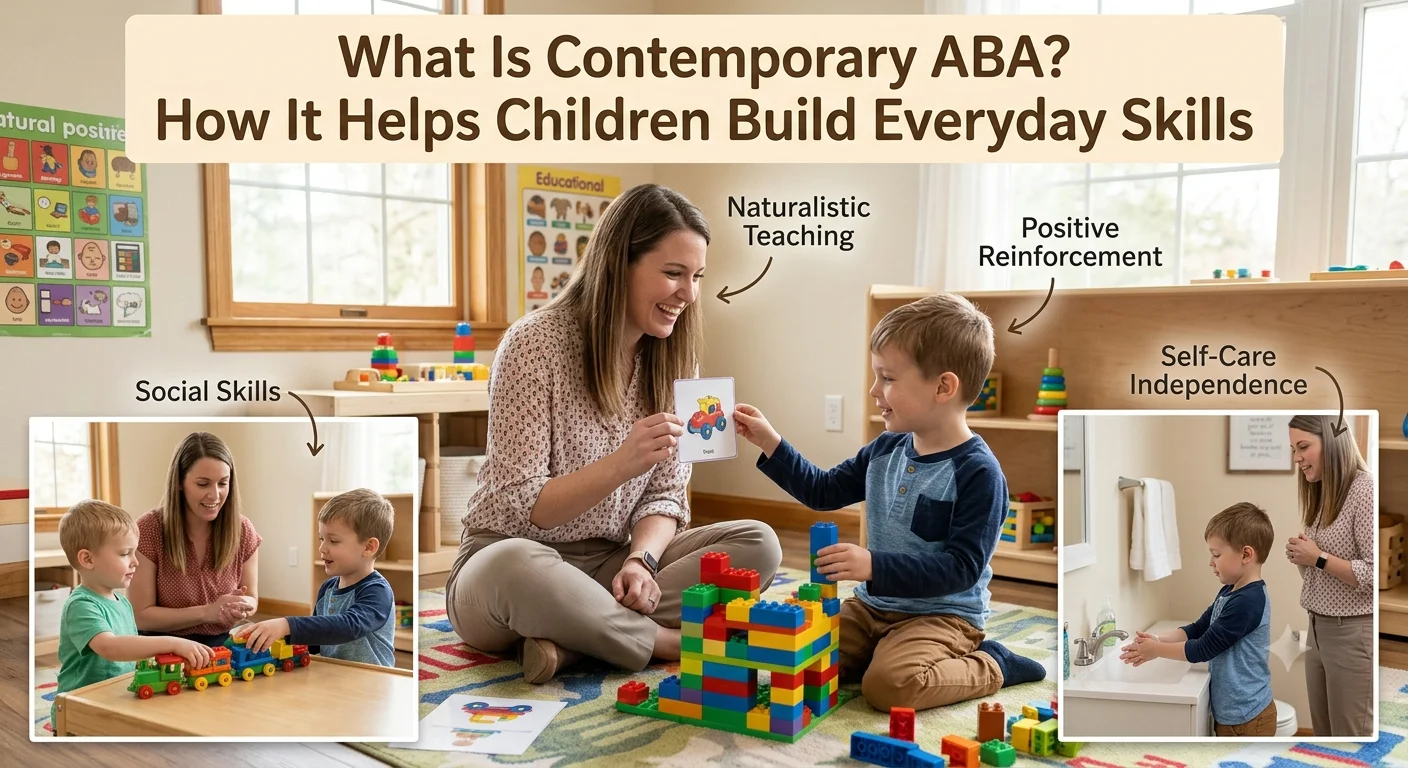
Modern ABA emphasizes the acquisition of skills in real-world settings: communication, self-care, emotional skills. It focuses on positive reinforcement and acknowledges the individual strengths, interests and development of each child.
Early, individualized behavioral intervention is evidence-based to enhance language, adaptive skills, and social engagement. Modern ABA brings the natural learning opportunities, making skills more meaningful and useable in everyday life.
This guide explains what Contemporary ABA is, how it works, and what to consider when researching ABA Therapy in Los Angeles, CA.
What Is Contemporary ABA?
Defining Contemporary ABA Therapy
Contemporary ABA is a modern, individualized use of Applied Behavior Analysis that combines positive reinforcement, natural learning opportunities, family collaboration, and progress monitoring to help children build communication, self-care, safety, social, and daily living skills while respecting their preferences and well-being. The scientific basis is given by behaviour analysis. Still, support is applied flexibly and linked to relevant daily activities like to ask for support, use the AAC device, or take part in the morning routine. The current practice guidance focuses on individual assessment, planning, implementation and evaluation.
What Makes an ABA Approach Contemporary?
In contemporary ABA, person-centered care is represented; goals are set based on child’s needs and family priorities. Key features include:
- Autonomy and Choice: Emphasizes meaningful choices and respects assent by recognizing signs of comfort or distress.
- Natural Learning: Often uses play-based strategies and Natural Environment Teaching to build functional communication and adaptive skills.
- Positive Reinforcement: Applies reinforcement in natural, meaningful ways connected to the child’s interests.
- Family Involvement: Caregivers are actively involved in planning and supporting skill development.
- Ongoing Progress Review: Progress is regularly reviewed and generalisation of skills in daily settings is emphasised.
Importantly, modern ABA isn’t a different science, but rather how the science of behavior analysis is used to enhance measured outcomes while keeping emotional wellbeing in mind.
How Contemporary ABA Differs From Older ABA Approaches
Why ABA Practices Have Changed
Some older ABA programs were very directive and adult-centred. Some historical approaches placed too much emphasis on compliance or behavior reduction. Consent, masking, stimming, and goals being chosen without the person’s involvement have all been concerns validly raised by autistic self-advocates and families.
Responding to these perspectives with listening, looking at current evidence and enhancing ethical practice is the modern practice. Families looking for ABA Therapy in Pasadena, California should inquire how a provider honors differences in communication, encourages meaningful choice, and honors assent.
Traditional ABA vs. Contemporary ABA Therapy
| Area | Older or rigid applications | Contemporary ABA |
| Goal selection | Often professional-directed | Collaborative and individualized |
| Primary focus | Compliance or behavior reduction | Communication, safety, independence, and quality of life |
| Teaching style | Highly structured | Flexible, naturalistic, and play-based when appropriate |
| Child’s role | Mainly follows adult directions | Preferences, choices, and assent are considered |
| Reinforcement | Often external rewards | Individualized and natural reinforcement where possible |
| Harmless stimming | Sometimes targeted for reduction | Usually respected unless it presents significant risk |
| Family role | Limited in some models | Active collaboration and caregiver support |
| Skill use | May focus on therapy performance | Prioritizes use across daily environments |
Core Principles of Contemporary ABA Therapy
Person-Centered Goals, Choice, and Assent
Goals should increase safety, ease of life, independence, and fun for the child.
Examples of goals may include:
- Communicating pain
- Getting dressed
- Asking to stop an activity
- Participating in school routines
Assent is the ability to observe willingness in words, gestures and body language. Families seeking ABA Therapy in Glendale, CA should inquire as to what will occur if a child refuses an activity or requires another type of assistance.
Positive Reinforcement and Natural Motivation
If a helpful skill is followed by something that is meaningful, it will be more likely to occur again. Natural reinforcement is directly linked with the action.
Examples include:
- Giving a requested toy after a child asks for it
- Providing a break when a child communicates the need for one
Communication, waiting, problem solving can be supported with preferred interests. The aim is to stimulate learning not to control the child.
Family Collaboration, Data, and Generalization
Caregivers assist to prioritise through everyday activities.
Examples of focus areas include:
- Morning routines
- Mealtimes
- Sibling interactions
- School participation
- Safety skills
Clinicians gather data, adjust ineffective strategies and practice skills among people and places. Data must complement the clinical judgment and not overrule family feedback or well being. Current CASP assessment guidance highlights adaptive functioning, quality of life, individual circumstances, maximizing benefit, and minimizing possible harm.
How Contemporary ABA Helps Children Build Everyday Skills

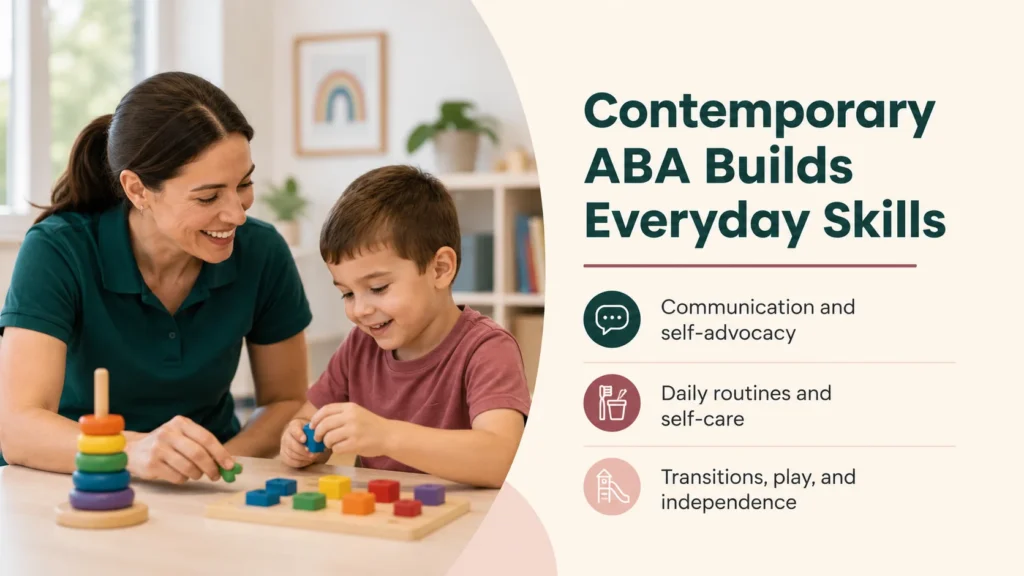
Functional Communication and Self-Advocacy
Communication assistance to request needs, ask for help, to refuse or express discomfort. Speech, gestures, signs, pictures, and AAC are all valid. Families should ensure providers support the child’s preferred communication method.
Self-Care and Home Routines
Simple steps are used for dressing, teeth brushing, and tidying up at night. Gradual support, prompts and visuals are used by therapists. Using in home ABA, these routines can be practiced in a natural environment.
Transitions and Emotional Regulation
Transitions can be challenging due to overwhelm or uncertainty. Visual schedules, choices and warnings can aid. Children can be taught to seek assistance, to take breaks or to use calming techniques.
Play, School, Safety, and Community Participation
Through play skills such as taking turns and participation are developed. Pupils’ aims in school are routines and organisation. Community skills are based on safety and independence in settings.
Social Interaction and Peer Engagement
Support helps children start interactions, share, and follow group rules. Confidence is gained in social situations. Providers should encourage peer engagement in real-life situations.
Safety Awareness and Independence Skills
Children develop the skill to identify danger, safety rules and getting help. Teaching includes routines and identifying safe adults. The objective is independence with supervision/supervision as needed.
In the more distant future, a 2002 study by Drexel University predicted that between 707,000 and 1.116 Million young adults would be diagnosed with autism in the decade prior to 2029. The estimate was made based on past information and is an estimate, not the current number of students. Highlighting the importance of communication, self advocacy, safety, and daily living skills in adulthood.
How Modern ABA Therapy Teaches Everyday Skills
Assessment and Collaborative Goal Setting
The first step for a BCBA is to get to know the child’s strengths, communication preferences, daily habits, sensory preferences, and family needs. Assessment also considers situations that may lead to distress and gathers baseline information. This process allows for individualized objectives that reflect the needs encountered in the real world and not a one size fits all approach.
Breaking Skills Into Manageable Steps
Task analysis breaks skills into smaller steps, which therapists use to divide skills. They model, prompt, and use visual support to teach, reinforcing and reducing support gradually as they go along. This is a strategy to encourage independence and it supports evidence based practices like prompting, reinforcement and functional communication.
Teaching Through Play and Natural Routines
Natural Environment Teaching is now used in natural activities in modern ABA. Skills are practised in play, mealtimes and dress and during outings. Reinforcement is connected to the activity, making learning meaningful. A child can practice asking, taking turns and solving problems during play, for instance.
Measuring Progress and Generalizing Skills
Therapists document progress, independence and skill utilization in settings. They modify their plans, adapt and change their goals as necessary, and continuously make skills relevant to family life.
How Parents and Caregivers Support Progress
Choosing Goals That Fit Family Life
- Identify Real-Life Priorities: Goals are chosen in collaboration with the caregiver, on the basis of the normal activities of a day like mornings, meals, bedtime, school preparation and community outings.
- Share Family Insights: Families are important contributors to what is working, what is difficult, and what is important for the comfort and independence of their child.
- Focus on Meaningful Outcomes: Goals are not abstract targets, but practical, respectful goals of family values, relevant to life.
Using Strategies Without Turning Home Into a Clinic
- Keep It Manageable: Families can do one or two priorities during their natural routines and not attempt to run therapy all day long.
- Use Simple Supports: Caregivers can provide some choices, provide visual cues, encourage verbal communication, or provide short reminders or cues for transitions.
- Stay Flexible and Realistic: Strategies should be incorporated into a person’s life and not oppressive.
- Share Feedback: Strategies are adjusted and outcomes improved based on observation by the caregiver.
Coordinating Support Across Settings
- Build a Collaborative Team: The team includes parents, BCBAs, behavior technicians, teachers, therapists and others; all working towards the same goals.
- Ensure Consistency: Coordination assists in minimising mixed expectations and enhances the use of skills at home, school and in the community.
- Promote Generalization: Children are more likely to use skills in different environments when support is aligned.
- Integrate Services: Parent Support, In-Home ABA Therapy, School Consultation, and Direct Therapy can work together to create a consistent and supportive approach.

Respect, Neurodiversity, and Ethical Contemporary ABA
How Contemporary ABA Addresses Past Criticism
Contemporary ABA programs acknowledge past concerns and actively work to improve practice. Key responses include:
- Prioritizing child choice and participation in goal setting
- Reducing emphasis on compliance and increasing focus on independence
- Avoiding forced eye contact or unnecessary behavioral control
- Emphasizing quality of life over outward appearance
The programs are geared toward achieving meaningful results like communication, safety and daily living skills.
Respecting Stimming and Sensory Regulation
Stimming can help children regulate emotions and sensory input.
- It could help concentration, relaxation or pleasure.
- Harmless stimming is generally respected
- Intervention is considered only if safety is at risk
Providers work toward understanding the meaning of behaviors and providing support for alternative ways to be safe.
Responding to Distress and Honoring Assent
Avoidance or refusal is a way that children express distress. Providers should:
- Identify possible causes like fatigue, confusion, or sensory overload
- Adjust tasks or environments
- Teach communication for breaks or help
There should be no automatic increases in demands. BACB and CASP ethical guidelines are consistent with respectful and assent-based care.
Supporting Self-Advocacy Without Encouraging Masking
Contemporary ABA encourages children to:
- Express preferences and say no
- Request support or accommodations
- Communicate discomfort
Progress is being measured in terms of independence and comfort, rather than hiding of autistic characteristics.
What Does Meaningful Progress Look Like?
Small Changes That Improve Daily Life
Routines become easier and more comfortable with small, meaningful changes. Progress can be in the form of asking for assistance when they become overwhelmed, to take more steps alone or making a more gradual transition without assistance. A child may communicate boundaries, join family routines, etc., with a new caregiver. Other examples include asking for a break, using headphones, or applying safety skills in the community. This is a growth in independence, communication and confidence.
How Progress Is Measured
There are several indicators of progress. Clinicians collect baseline data and track skill accuracy or frequency over time. They also consider the timeliness, self-reliance, and transfer of skills to individuals and contexts. Family observations provide insight into real-life changes. Progress is assessed also in terms of ‘impact on quality of life’. Goals are reviewed regularly and are suitable and effective.
How Long Does Contemporary ABA Therapy Take?
The length of therapy varies by child. Duration varies according to goals, level of skill, support needs, progress and family priorities. Some children may require short term support and others may require longer services. Providers should check in with students on a regular basis and modify programs rather than set out fixed schedules.
How to Find High-Quality ABA Therapy Near Me
Signs of a Contemporary, Child-Centered Program
Sign 1: Individualized Care
The child is assessed in detail and goals are set to support the child’s strengths, needs, and daily activities, ensuring that therapy is meaningful and relevant.
Sign 2: Qualified Supervision
The program is managed by a Board Certified Behavior Analyst (BCBA), who helps with treatment planning, monitoring progress, and supervising staff to ensure quality and ethical practices.
Sign 3: Family Collaboration
Caregivers are included in goal setting and receive regular updates, along with practical strategies to support skill development in everyday situations.
Sign 4: Respectful and Responsive Approach
The provider respects the child’s methods of communication, offers AAC as appropriate, and adjusts teaching strategies to the child’s level of comfort, preferences and signs of distress.
Questions to Ask an ABA Provider
Clinical and Ethical Questions
- How is a treatment goal determined?
- How do you involve my child in decisions?
- How do you recognize and respond to assent withdrawal?
- How do you approach stimming?
- Do you support AAC and non-speaking communication?
- How do you respond when a child becomes distressed?
- How are goals reviewed and changed?
Practical and Family Questions
- Who supervises the treatment team?
- What is the frequency of progress meetings?
- How are parents supported?
- Where can services take place?
- How do skills get practiced in between sessions?
- How do you collaborate with schools or other professionals?
- How do you help verify insurance benefits?
Warning Signs Parents Should Notice
- Using the same program for every child or focusing goals mainly on obedience
- Promising guaranteed results or claiming that ABA cures autism
- The suppression of benign stims, or the forced use of eye contact:
- Ignoring signs of distress, discouraging parent questions, or providing unclear supervision and limited access to progress information
- Lacking a plan for skill generalization or setting goals aimed at making a child appear neurotypical instead of supporting meaningful, functional skills
Explore Contemporary ABA With Alma Behavioral Solutions
Care for families must be based on their child’s strengths, way of communicating, routine, and goals. Alma Behavioral Solutions provides personalised ABA Services throughout Southern California, such as direct ABA therapy, in-home therapy, parent coaching, school consultation, and private consultation.
Our team follow evidence-based practices and emphasizes collaboration with families to ensure goals are practical and relevant to everyday life. Parents interested in learning more about Contemporary ABA Therapy, insurance coverage or the assessment process can Call (747) 250-8494 or email info@almabehavioralsolutions.com. Talking with a provider can assist a family determine if the approach is suitable for their child’s needs and values.
Frequently Asked Questions About Contemporary ABA Therapy
Is Contemporary ABA the Same as Modern ABA Therapy?
The terms usually describe individualized, current applications of behavior analysis. Both emphasize positive reinforcement, natural learning, collaboration, and useful skills. The label alone does not guarantee respectful care. Parents must enquire about the way the provider deals with consent, language barriers, anxiety and individual tastes.
Is Contemporary ABA Evidence-Based?
The evidence-based behavior-analytic practices chosen for each goal are used in contemporary ABA. Data is used to make judgements and changes. Evidence does not imply a one method fits all. Family input, security, quality of life and preferences are still relevant.
What Everyday Skills Can ABA Help Teach?
Communication, hygiene, transitions, play, safety, school participation, and self-advocacy are some examples of goals. Targets should be useful to the child and family. Relevant programmes are linked to actual behaviour and not just to good performance. Progress can be increased independence or improved communication in a relevant activity.
Does Contemporary ABA Try to Stop Stimming?
Don’t automatically prescribe the extinction of harmless stimming in contemporary ABA. Movement or sound can be used for regulation, focus, communication, and enjoyment of an activity. If there is a threat to serious injury or danger, intervention may be considered. Clinicians need to be aware of the function of the behavior and work on the underlying needs first.
Can Contemporary ABA Help a Non-Speaking Child?
Yes, modern ABA can promote communication without focusing on speech. A child can employ gestures, signs, pictures, communication boards or AAC to communicate. Therapy can assist requests, refusals, comments, help-seeking and reporting discomfort. Co-ordination with a speech-language pathologist may also be beneficial.
How Long Does Contemporary ABA Therapy Take?
All children are unique and there is no one correct sequence. The length and intensity depends on the goals, skills, support needs, progress, family priorities and clinical recommendations. Plans should be updated on a regular basis. Families should be given information about progress and suggested changes in services.