
A child’s day is full of small skills that can feel big: getting dressed, holding a pencil, brushing teeth, sitting through class, eating different foods, or calming the body after a hard moment.
Occupational therapy supports children in developing everyday life skills in a real-life context. In California, occupational therapists and occupational therapy assistants help people develop, improve, or restore functional daily living skills, according to the California Board of Occupational Therapy.
Need for support is growing. According to the U.S. Bureau of Labor Statistics (BLS), occupational therapist jobs are expected to increase at a rate of 14% from 2024 to 2034, which is faster than the average growth rate for all careers.
The focus for families is straightforward: to support a child to be more confident at home, at school, in play, and in the community. At Alma Behavioral Solutions, we feel that support needs to be clear, respectful, and focused on actual day-to-day needs.
What is Occupational Therapy?
Occupational therapy, often called OT, is a healthcare service that helps people develop, recover, or maintain the skills needed for daily living and participation in meaningful activities. In this context, the word “occupation” refers to everyday tasks and roles, not just employment.
Occupations are activities that children engage in, like playing, learning, eating, using the toilet, writing, attending school and interacting with others. Occupations for adults can include work, home, self-care and community activities.
The occupational therapy approach is a holistic one which encompasses physical abilities, cognitive abilities, sensory processing, emotional regulation, habits, routines and environmental factors. OTs employ evidence-based strategies to facilitate functional independence and participation in everyday life.
What Does an Occupational Therapist Do?
Occupational therapists evaluate challenges, strengths, and develop individual plans to enhance participation at home, school, and in the community.
Common responsibilities of an occupational therapist include:
- Assessment of motor skills, sensory processing and daily activities
- Developing individualized therapy plans based on the child’s needs and goals
- Teaching fine motor skills such as writing, cutting, and using utensils
- Supporting self-care tasks like dressing, feeding, and grooming
- Helping children manage sensory sensitivities or sensory-seeking behaviors
- Improving coordination, balance, and body awareness
- Teaching strategies for emotional regulation and transitions
- Modifying settings, equipment or activities to promote independence
- Coaching parents and caregivers on how to support skills at home
- Collaborating with teachers, therapists, and healthcare providers to support the child’s overall development
How Occupational Therapy Helps Children in California
Pediatric occupational therapy supports children in the development of their daily living skills at home, school and community. It has been utilized for children who have autism, ADHD, developmental delay, sensory differences, and motor issues.
Fine Motor Skills and Handwriting
Fine motor skills are those requiring small hand and finger movements, such as those required to write, cut and use utensils. Children with delays may not like to write or may become fatigued. OT helps improve hand strength, coordination, and confidence.
Self-Help Skills and Daily Routines
Self-help skills include feeding, dressing, toileting, and grooming. OT implements a structured approach and supports children’s independence with simple supports in daily activities.
Sensory Processing and Regulation
Some may be sensitive to sensory input and others may be looking for more. OT helps identify these patterns and provides strategies so children can feel more comfortable and regulated.
Emotional Regulation and Participation
OT helps children to regulate emotions, transition and remain engaged with daily life activities using routines and coping strategies.
Occupational Therapy for Autism, ADHD, and Sensory Processing Differences
Occupational therapy (OT) helps neurodivergent children take part in daily life with more ease. It emphasizes actual skills such as self-care, play, school work, movement, emotional management, home, school and community routines.
Children sometimes have trouble with loud noises, textures, changes, attention, and multi-step tasks. OT recognizes these challenges, and creates practical support. The aim is not to change the child, but to make him or her feel more regulated, independent and supported in his or her daily life.
Autism Support
OT helps autistic children with daily skills and sensory needs. Supporting aspects can be dressing, feeding, play, handwriting and transitions. The neuro-diversity-based approach values the child’s strengths and doesn’t attempt to downplay the autistic elements.
Focus areas:
- Self-care (dressing, brushing teeth, toileting)
- Fine motor (writing, utensils, buttons)
- Play and participation
- Sensory regulation
- Transitions
ADHD Support
ADHD children have problems paying attention, organizing, controlling their impulses, and with routines. OT uses structure and simple strategies to make tasks easier.
Common supports:
- Visual schedules
- Movement breaks
- Step-by-step tasks
- Reduced distractions
- Clear routines
If a child needs to finish homework: Example: short work periods, quiet space, breaks.
Sensory Needs
Some children want sensory input and others don’t want it.
Seeking:
- Jumping, spinning, crashing
- Chewing or constant movement
- Wanting deep pressure
Avoiding:
- Covering ears or eyes
- Avoiding textures or messy play
- Overwhelm in busy places
OT supports families by providing information about patterns and how to use tools such as movement, calming routines, environment changes etc.
Sensory Overload
Sensory overload occurs when information is more than the individual can handle.
Signs:
- Crying, hiding, running away
- Covering ears or eyes
- Meltdowns or shutdowns
These are distress behaviors and NOT intentional behavior problems.
OT helps prevent overload with:
- Breaks
- Calm spaces
- Predictable routines
- Visual supports
Family Support
Caregivers are key to success. OT provides simple strategies for daily routines that can be used outside the therapy session.
Examples:
- Adjust lighting or noise
- Use visual schedules
- Add movement breaks
- Create calm spaces
- Prepare for transitions
Signs Your Child May Need Occupational Therapy Support in California
Consider occupational therapy if a child’s sensory needs, motor skills, self-care skills or school activities are impacting their participation in daily activities.
Motor and Coordination Challenges
OT can assist in pencil grasp, scissors, buttons, zippers, catching a ball, climbing, balance and using two hands together. These can impact academic studies, play, dressing and self-confidence.
Sensory Sensitivities or Sensory Seeking
For some children, sounds, lights, textures, foods, smell, touch or movement have a strong reaction or effect. Some may be craving movement, pressure, spinning, climbing, chewing and more. OT supports families to learn about sensory patterns and develop simple supports for home, school and community.
Emotional Regulation and Overload
If your child frequently feels overwhelmed with transitions, places and activities, changes of routine or sensory input, then they may need support. Signs can range from crying, hiding, running away, covering their ears or eyes, meltdowns, shutdowns or taking a longer time to calm down from stressful situations.
Daily Living Skill Difficulties
OT can help children who find dressing, feeding, toileting, brushing their teeth, grooming, sleeping and eating difficult. All these skills are a daily part of independent living and small barriers can impact the general family routine.
School and Classroom Participation Challenges
OT can support a child who has difficulty with handwriting, sitting for activities, following a routine, organizing materials, transitioning between activities, or finishing homework in class. A child might be aware of what to do but require assistance with the motor, sensory, attention or regulation skills required to take part.
What Happens During an Occupational Therapy Evaluation?
During an occupational evaluation, the therapist will be able to gain insight into how a child is involved in everyday life. It examines the child’s strengths, problems, habits, sensory issues, motor skills and family’s priorities.
The evaluation isn’t just a check off list of things that a child can or can’t do. It’s the concept of figuring out what makes simple tasks easier or not so easy, and then creating meaningful therapy goals based on that information.
Parent and Caregiver Conversation
Typically, the evaluation starts with questions regarding the child’s life. The OT will inquire about home schedules, school issues, eating, clothing, toileting, play, sleep, sensory sensitivities, changes, and behaviors.
Caregiver input is important. A child might excel in one environment and not another, so the therapist needs to know the specifics of the situation.
Observation of Daily Skills
The OT can watch the child moving, playing, using their hands, following instructions, reacting to frustration, and reacting to sensory input.
This may include looking at:
- Fine motor skills, such as grasping, drawing, or using small objects
- Gross motor skills, such as balance, posture, and coordination
- Visual-motor skills, such as copying shapes or using both eyes and hands together
- Self-care skills, such as dressing, feeding, or grooming when relevant
- Regulation skills, such as attention, transitions, and emotional responses
Through observation the therapist can see what the child can already do and where help might be needed.
Sensory and Regulation Review
Many OT evaluations include a closer look at sensory processing. The therapist might want to know what the child’s reaction is to sound, touch, light, movement, textures, foods, smells, and hectic environments.
Some children do not need sensory input, some need input and some display a combination of both. Knowing these patterns can help the OT suggest strategies that will accommodate the child’s home, school and community environment.
Standardized Tools When Needed
If helpful, an OT can use standardized assessments or checklists, or ask questions on a caregiver questionnaire. These tools can give more information about motor skills, sensory processing, visual-motor development, self-care, or school-related skills.
Observation and the input of caregivers is typically added to these results. The score does not tell about the child. It’s just one component of a larger whole.
Goal Setting and Therapy Recommendations
After the evaluation, the OT explains the findings and discusses next steps with the family. Goals should be practical, functional and have a real-life link.
This can include being able to dress themselves more easily, hold a cup or fork more comfortably, tolerate grooming, enhance handwriting, transition easier, or find strategies to support the prevention of overload.
A well put together OT plan should help the child to be more at ease in their daily activities rather than just do activities in the OT room.
What to Expect During Occupational Therapy Sessions
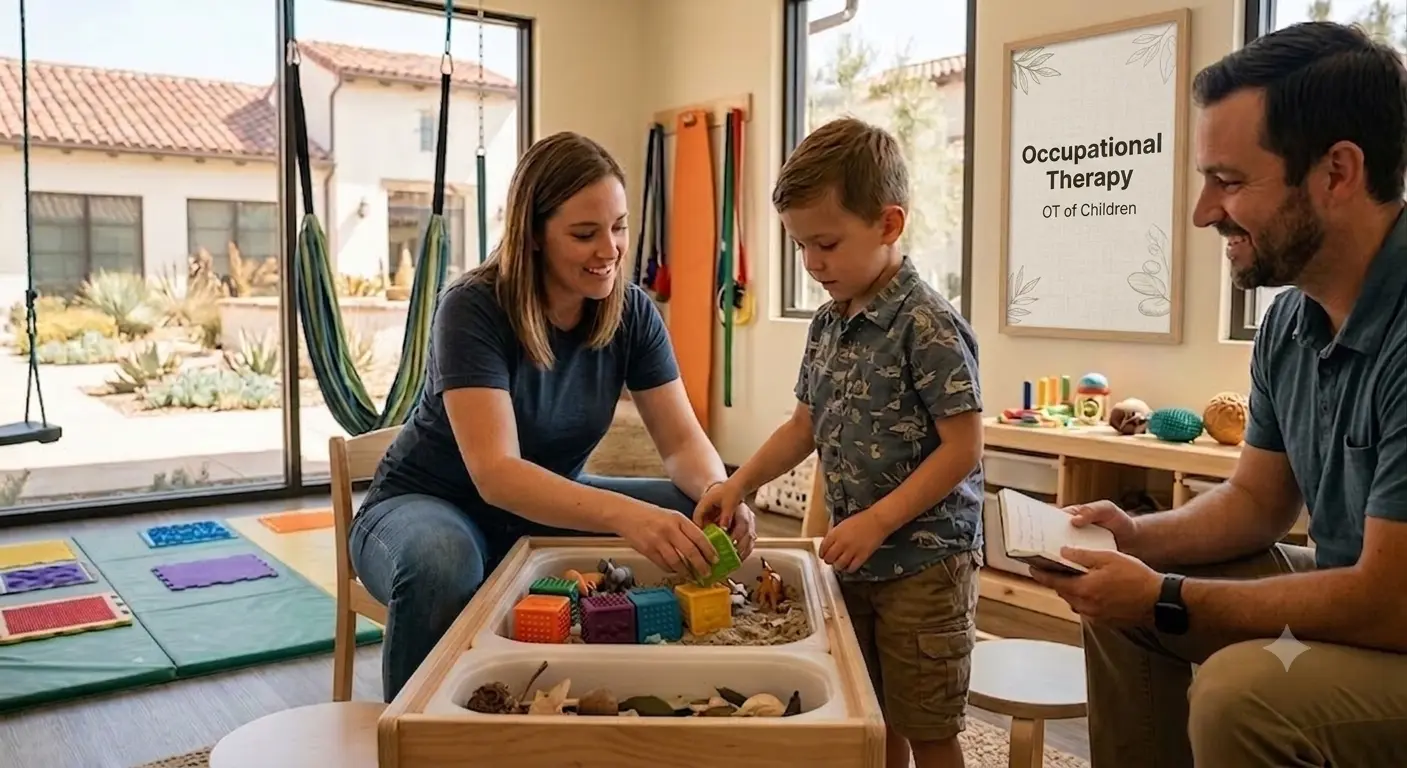
Occupational therapy sessions are based on goals, developmental level, and everyday problems. Activities may seem fun, but are selected for a purpose. Typically, the emphasis is on teaching the child skills to move, self-regulate, complete school activities and perform daily routines.
Purposeful Play and Skill Practice
Play is a common therapy tool used in pediatric OT because it is a way for kids to learn. Games, puzzles, obstacle courses, drawing, building activities or pretend play can be used by a therapist to assist with coordination, attention, problem solving, and motor planning.
The activity is purposeful and not random. It is chosen to help the child practise a skill in an age-appropriate way.
Movement and Sensory Regulation
Structured movement, deep pressure, calming routines and sensory breaks may be part of some sessions. These strategies can help children who seek movement, avoid certain input, or become overwhelmed by sound, touch, light, or busy environments.
The therapist might also modify the space, pace or task requirements for the child to keep him/her regulated and engaged.
Fine Motor and Daily Living Skills
OT can involve practicing hand strength, hand grasp, coordination, handwriting, utensils, buttons, zippers, grooming skills, or other self care skills.
These skills will help children to be independent at home, participate in school and feel confident when they are involved in everyday activities.
Caregiver Guidance
Support from the caregivers is frequently included in the session. The therapist can tell you what they are working on, simple home strategies, or some small changes to routines.
Children have the opportunity to practice outside of the therapy room so they can have opportunities to apply skills in real-life situations.
Understanding the Difference Between Occupational Therapy and Other Child Development Services
Throughout the course of a family’s journey, they may hear about OT, PT, speech therapy and ABA therapy. These services can be used to support different aspects of development and may be used together.
OT Vs. Physical Therapy
Physical therapy focuses on: Large body movements, strength, balance, posture, walking, mobility, and gross motor development.
Occupational therapy focuses on: Daily participation, self-care, sensory regulation, fine motor skills, hand writing, feeding, toileting, play and school routine.
Simple difference: The bodily support system of the PT. OT supports how the child uses movement, coordination, and regulation to participate in everyday activities.
OT Vs. Speech Therapy
Speech therapy focuses on: Communication, language, speech sounds, social communication and occasionally feeding or swallowing when this can be done by the provider.
Occupational therapy focuses on: Oral motor involvement, sensory reaction to food, eating habits/schedules, self-feeding, regulation and body readiness for daily activities.
How they connect: Speech therapy and OT are often effective when performed together, particularly when the child’s communication, feeding, sensory and regulating needs are all impacted.
OT and ABA: How They Can Work Together
ABA therapy focuses on: Behaviour, learning, communication, routines and developing skills through individual support plans.
Occupational therapy focuses on: Sensory, motor, daily living skills, self-care, play, school participation and functional independence.
How they connect: For a child who is struggling with brushing his teeth, OT can provide sensory and motor assistance and ABA can provide assistance with routine, step-by-step practice and cooperation. Consistent support is provided for the child and family when providers work together.
Occupational Therapy Services and Support Pathways in California
California families can access occupational therapy through various settings based on a child’s needs, age, goals, eligibility, and coverage. Services can be provided at clinics, in the home, early intervention, school, hospital, outpatient treatment or via telehealth as appropriate.
Where Children May Receive OT Services
Clinic-based OT:
Structured environments, access to specialized equipment for sensory and motor and feeding interventions.
Home-based OT:
Centrally explores daily routines in the child’s natural environment; including dressing, feeding, play and transitions.
School-based OT:
Enables access to educational activities such as handwriting, classroom equipment, seating and sensory strategies.
Telehealth OT:
Provides distance coaching of caregivers, home plans and strategies. Providers must hold a valid California license.
Common Access Pathways for Families
Families may access OT through:
- Private insurance
- Medi-Cal managed care plans
- School-based services (IEP or school evaluation)
- Early intervention programs
- California Children’s Services (if eligible)
- Referrals from pediatricians or specialists
- Private pay providers
Depending on the pathway, there may be requirements including referrals, evaluations, and medical necessity documentation.
Insurance and Medi-Cal Coverage
Coverage will vary in the context of the child’s plan, diagnosis, therapy goals and medical necessity. Families should verify aspects like in-network providers, prior authorization requirements, copays, and visit caps.
California Children’s Services and Medical Therapy Program
California Children’s Services supports eligible children with certain medical conditions. The Medical Therapy Program offers OT, physical therapy and other services to children with qualifying neurological and musculoskeletal conditions. Eligibility may vary, and should be verified with local county programs.
School-Based OT and Educational Eligibility
School-based OT focuses on supporting a child’s ability to participate in educational activities. Services are provided when the school team determines OT is necessary for access to learning. Objectives can be for participation in the classroom, handwriting, use of classroom materials, transitions, independence in school tasks, etc.
Autism and Developmental Support Resources in California
Regional Centers, School Districts, Healthcare Providers and Behavioral Health services can provide additional supports to families. The California Department of Developmental Services offers resources for autistic individuals, families, and professionals.
Practical Tips for Families
To navigate services more effectively:
- Keep copies of evaluations and reports
- Confirm referral or authorization requirements
- Ask for details in writing about coverage.
- Understand differences between school-based and medical OT
- Report daily problems with the routines
The structured documentation allows providers to determine needs and match services with them.
How to Find the Right Occupational Therapist in California
Families can decide to find an occupational therapist a bit easier if they know what to expect. The right provider must be licensed, experienced, respectful and goal-oriented to help make progress in the real world.
A good OT should be able to communicate goals verbally, involve the caregivers and be aware of the child’s strengths, sensory needs and daily activities.
Check California Licensure
Occupational therapists and occupational therapy assistants in California are regulated by the California Board of Occupational Therapy.
Families can ask:
- Is the provider licensed in California?
- Is the license in force and up to date?
- Does the provider have pediatric experience?
- Does the provider work with children who have similar needs?
Licensure is important because it can be used to ensure that the therapist is licensed in California.
Look for Pediatric Experience
There is specialist knowledge needed when working with children. The pediatric OT should have an understanding of children’s development and learning through play, routines and interaction.
Key indicators include:
- Use of age-appropriate activities
- Ability to engage children effectively
- Excellent communication with carers
- Focus on skills used in everyday life
Ask About Relevant Experience
For children with special needs like those with autism, attention deficit/hyperactivity disorder (ADHD), or sensory differences, it is critical to find a therapist that has experience in those issues.
Families can ask how the therapist supports:
- Sensory processing challenges
- Emotional regulation
- Daily routines and transitions
- Fine motor and self-care skills
The therapist should work with respect and strengths based approaches that allow the child to be individual and unique.
Choose Family-Centered Care
Therapy is effective and involves the caregivers. Families should understand the goals and how to support progress outside of sessions.
Support may include:
- Guidance for home routines
- Practical strategies for daily activities
- Regular updates on progress
This approach helps skills carry over into real-life situations.
Make Sure Goals Are Practical
Therapy goals should focus on improving participation in everyday activities.
Examples include:
- Dressing more independently
- Eating with greater comfort
- Managing school-related tasks
- Handling daily routines with less difficulty
Functional, clear goals aid families to understand how therapy can help the child.
Are Occupational Therapists Licensed in California?
Yes. Occupational therapists must be licensed to practice in California. Licensure provides families with assurance of education, training, exam and professional standards.
For parents, the bottom line is that the individual who is helping your child be well qualified and licensed.
California Board of Occupational Therapy
In California the practice of occupational therapy is regulated by the California Board of Occupational Therapy.
Families can use the Board as a resource to:
- Check licensing information
- Review consumer resources
- Understand professional expectations
- Verify a provider’s qualifications to work in California
This can be helpful when choosing an OT for a child with developmental, sensory, motor, or daily living needs.
Education, Certification, and Practice Standards
Often, occupational therapists earn a nationally accredited education program, fieldwork experience and national certification prior to obtaining licensure in their state.
These standards are significant because the need for pediatric OT may be complex and may include:
- Sensory processing
- Fine and gross motor skills
- Self-care routines
- Feeding support
- School participation
- Emotional regulation
A licensed OT should be able to articulate the child’s goals, employ safe and effective strategies and relate therapy to a child’s participation in the real world.
How Occupational Therapy Fits Into a Child’s Broader Care Plan
When occupational therapy is integrated into the whole support system of the child, it is most effective. The sensory needs, communication, movement, behaviour, feeding, sleep and school habits of a child can all impact each other.
At Alma Behavioral Solutions, we look at the whole child, not just one skill in isolation. The aim is to facilitate therapy strategies to be understood in real life.
Family Involvement
Children use skills outside of therapy and caregivers are important in making progress.
OT may help families with:
- Morning and bedtime routines
- Mealtime or feeding concerns
- Homework setup
- Bathing and grooming
- Transitions between activities
The strategies should be easy, realistic and simple to use within normal family routines.
Team Coordination
For some children, OT can be utilized in conjunction with other services, such as ABA therapists, speech therapists, physical therapists, teachers, pediatricians, or school teams. Coordinated support ensures consistency of support across settings and understanding of goals of the child.
Skills That Carry Into Real Life
OT is more than just doing activities in session. The actual objective is to assist the child to implement skills in the home, school and community.
Progress may look like:
- Eating a food in a new texture
- Asking for a break
- Opening a container
- Sitting for a little longer
- Completing one more step of a routine
- Joining play with more confidence
It’s important to remember that little by little it makes a big difference for independence.
FAQs About Occupational Therapy in California
What skills can pediatric occupational therapy support?
Pediatric occupational therapy assists children with their fine motor coordination, handwriting, feeding, dressing, toileting, grooming, sensory regulation, attention, play, and daily routines. Goals are tailored to the child’s age, abilities, and family priorities to improve participation at home, school, and in the community.
Can occupational therapy help autistic children with daily routines?
Yes, occupational therapy can help autistic children manage routines like dressing, hygiene, eating, transitions, and school participation. Therapists can implement sensory strategies, visual supports, environmental modifications and caregiver guidance to support the child’s strengths and needs and foster independence.
How is sensory processing addressed in OT?
Occupational therapists evaluate a child’s reactions to sensory stimulation like sound, touch, movement and sight. They can suggest things such as movement breaks, calming techniques, environment changes or progressive exposure to difficult sensations to help regulate and participate.
Is OT useful for school-related challenges?
Yes, OT can help with school-related skills including handwriting, posture, attention, organization, and classroom transitions. School-based OT is working on helping students access learning, whereas clinic-based OT can be directed at more general daily living skills.
Will insurance cover occupational therapy in California?
Coverage is based upon the child’s health insurance plan, diagnosis and medical necessity. Services can be provided via private insurance, Medi-Cal, California Children’s Services, early intervention programs or school based services. Families should check directly with their provider or school district.
How do I know if an OT provider is qualified in California?
Make sure the occupational therapist or assistant is licensed by the California Board of Occupational Therapy. It is also beneficial to find a provider who has experience in pediatric care and in the areas that are pertinent to the child’s needs.
Final Thoughts: Helping Children Build Skills for Everyday Life
Children may need support with areas such as handwriting, sensory processing, feeding, dressing, attention, transitions, or emotional regulation. Occupational therapy is about creating manageable steps and developing skills to function in meaningful ways in daily life.
Alma Behavioral Solutions prioritizes individual care, respect, and a focus on children’s environments. Children can gain more independence, better participation in daily activities and skills that will assist long term development with a coordinated care plan and working together with families and providers. To learn more or speak with our team, call Alma Behavioral Solutions at (747) 250-8494 or email info@almabehavioralsolutions.com.