
Could your child’s repeated words be more than “copying”? Many families are first introduced to echolalia when a child echoes questions, cartoon lines, songs or phrases from activities in everyday life.
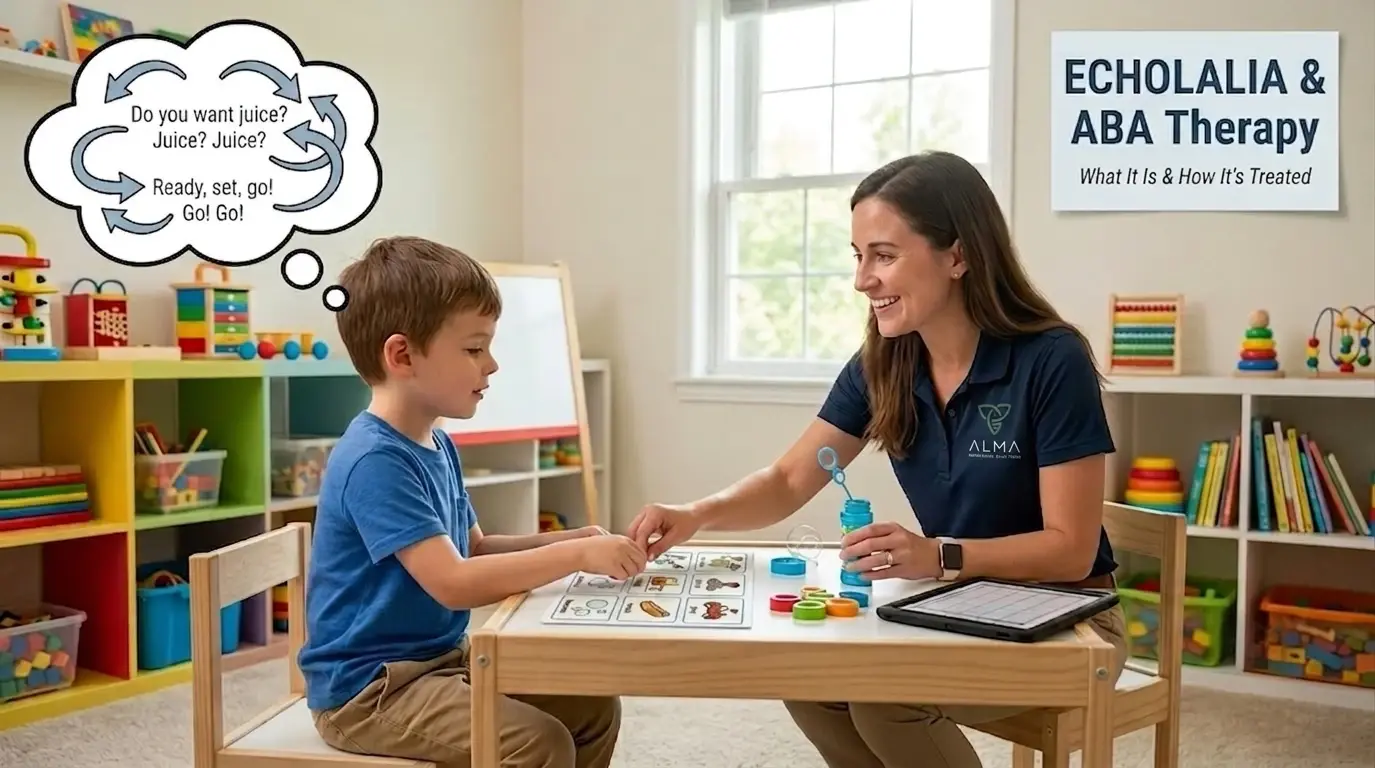
Echolalia can feel confusing at first. A parent may ask, “Do you want juice?” and the child may repeat, “Do you want juice?” instead of answering yes or no. However, in many instances those repeated words are not random. They may be a child’s way of communicating, processing language, requesting something, or calming their body.
Research shows echolalia is common in autism, but estimates vary widely. A recent rapid review found primary echolalia prevalence estimates among autistic children and youth ranged from 25% to 91%, partly because studies define and measure echolalia differently.
This guide describes what echolalia is, how it manifests in autism, the types of echolalia and examples, the role of ABA therapy and Speech-Language Therapy, and when parents may need professional assistance.
What is Exactly Echolalia?
Echolalia is the repetition or echoing of words, sounds, questions or phrases that have been heard previously. The child can repeat right after hearing or hours, days or weeks after hearing it.
Echolalia can be part of typical language development in toddlers. In early learning, many young children repeat words, as they learn speech. According to Cleveland Clinic, the repetitive nature of echolalia usually subsides by the age of 3, and continued repetition after that age may indicate a need to be evaluated.
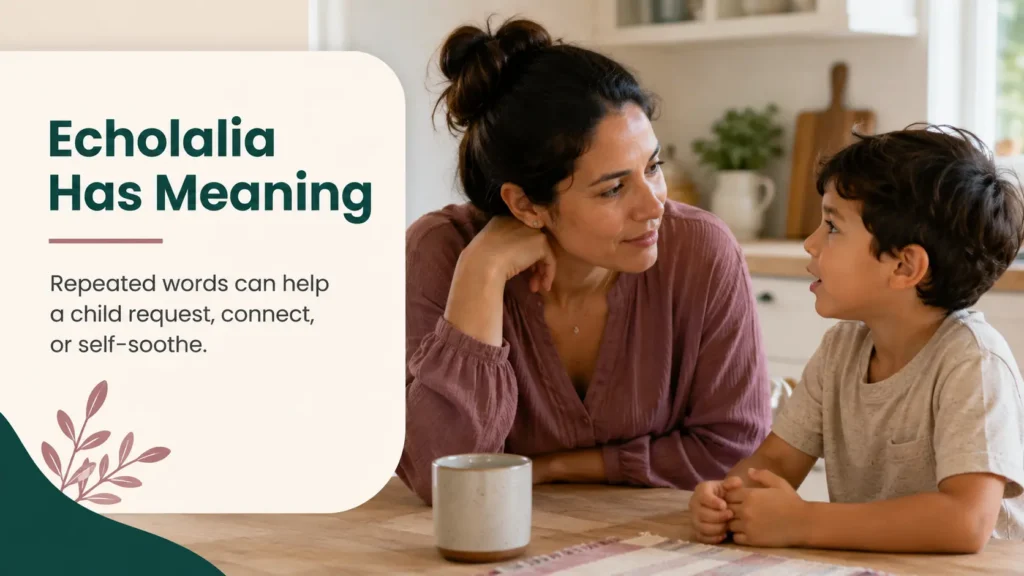
Echolalia in autism might have a function. It may be used to help a child initiate, respond to, comprehend, practice or quiet language, or to enter into a social routine.
Simple example:
Parent asks, ‘Do you want crackers?
Child repeats, “Do you want crackers?
Possible meaning: “Yes, I want crackers.”
If it is repeated, that doesn’t necessarily mean it is the last message. It might be the child’s only means of communicating at that time.
Is Echolalia Always a Sign of Autism?
No. Echolalia is not always a sign of autism.
Children may be repeating words, sounds or phrases as part of their early speech development as they are learning a language.
Echolalia requires more focus if it:
Continues beyond the toddler years
- Limits flexible communication
- Causes frustration
- Appears with other signs of autism
- Appears with speech or language delays
In autistic children, echolalia may serve a purpose. May facilitate communication, sensory regulation, emotional expression, or language processing.
The figures around autism today tell of the search for answers by many families.
- According to CDC’s 2025 Community Report, approximately 1 in 31 children aged 8 years had been diagnosed with autism spectrum disorder (ASD) in 2022 data from the Autism Disease Mapping (ADDM) Network.
- In 2021, WHO estimated that approximately 1 in 127 individuals in the world were estimated to have autism, though the prevalence rates differ amongst studies and regions.
Parents searching for echolalia autism concerns usually want to know if repeated speech is:
- A normal developmental phase
- A possible sign of autism
- Communication skills that requires assistance.
An evaluation can assist if the child needs to say things over and over and has trouble expressing their needs.
A speech-language pathologist or pediatrician, or an ABA provider, can assist in determining the significance of the repetition and what support is needed.
Echolalia in Autism: Why Autistic Children Repeat Words and Phrases
Echolalia in autism is often meaningful. A child might not have the ability to speak the words they would like to use but they can speak a phrase they know.
Some families call these repeated phrases “autistic echoes.” Clinical diagnosis is echolalia, and parent-friendly thought is there may be a memory, feeling, request or routine in the language the child is repeating.
Autistic children may use echolalia to:
- Request food, toys, help, or a break
- Answer “yes” by repeating a question
- Protest or avoid something
- Join a familiar game or social routine
- Practice patterns of speech rhythm, tone or sentence structure.
- Self-soothe during sensory overload or stress
- Process what someone said
- Use a script for spontaneous speech if it comes across as difficult
Example:
Remember, if a child says, “Ready, set, go!” this isn’t for no reason. They may be requesting someone to run, race, swing, jump or play.
When kids repeat a cartoon phrase at a loud gathering, it could be a way for them to help calm themselves down. An upset child may say “Are you okay?” again, when it is comforting, because he has heard the phrase when he was consoled.
Key Types of Echolalia Parents Should Understand
Learning the different kinds of echolalia can guide parents and therapists to be more patient and accurate.
| Echolalia Type | What It Means | Simple Example |
| Immediate echolalia | Repetition right after hearing something | Parent says, “Want water?” Child says, “Want water?” |
| Delayed echolalia | Repetition later | Child repeats a YouTube phrase at dinner |
| Interactive echolalia | Repetition used to communicate | Child says a game phrase to request play |
| Non-interactive echolalia | Repetition not clearly directed to others | Child repeats lines while calming down |
| Mitigated echolalia | Changed or adapted repetition | Child says “Want out” from “Let’s get out of here” |
| Unmitigated echolalia | Exact repetition | Child repeats the full phrase exactly |
Immediate Echolalia
Immediate echolalia is when a child echoes what he heard soon after. A parent may ask, “Do you want milk?” and the child repeats, “Do you want milk?”
This may mean yes. It can also be the child is thinking about the question, or that they don’t know the answer yet. Parents can help the child learn the words to use for milk by modelling them: “I want milk.”
Delayed Echolalia
Delayed echolalia is when the child echoes words or phrases at a later age. It can be from a parent, teacher, sibling, TV, video, song, book or past routine.
A child can later hear a cartoon line hours after and remember it because it’s associated with excitement, comfort, hunger, fear or a memory. Delayed echolalia can be observed in children when language is acquired in bigger chunks or scripts.
Interactive Echolalia
Interactive echolalia is repetition of words for connection or communication. A child can say, “Let’s go!” to ask for an exit or “Your turn!” to take a turn in a game. It isn’t a very creative saying, but it can still be a true communication.
Non-Interactive Echolalia
Non-interactive echolalia may not seem directed toward another person. A child can echo back a line when they are overstimulated, playing alone or walking.
This does not necessarily mean that the speech has no effect. It can help the child regulate, practice language or work out thoughts.
Mitigated and Unmitigated Echolalia
The unmitigated echolalia is where the child repeats the word or phrase verbatim.
Mitigated echolalia means the child changes part of the phrase. Can be an indicator of language growth as the child is starting to incorporate the script.
Example:
- Original phrase: “Let’s get out of here.”
- Mitigated phrase: “Want out.”
It’s simple details that can be big improvements.
Echolalia Examples: What Your Child May Be Trying to Say
Parenting skills can be enhanced when parents see examples of echolalia. Words can’t always convey the information.
| What the Child Says | What It May Mean | Helpful Parent Response |
| “Do you want juice?” | “I want juice” or “yes” | “I want juice.” |
| “Ready, set, go!” | “Play with me” | “You want to play. Ready, set, go!” |
| “Are you okay?” | “I feel upset” or “help me” | “You feel upset. I can help.” |
| A cartoon phrase | Excitement, stress, or comfort | Notice the situation and respond calmly. |
| “All done?” | Wants to stop or leave | “All done. You want a break.” |
Parents do not have to sound out every word, phrase or sentence. The first step is noticing patterns.
These are just a few examples of how families who are considering ABA Therapy in Northridge, CA can monitor the before and after effects of repeated speech. Those details enable a BCBA to see the function of the echolalia.
What Is the Difference Between Echopraxia and Echolalia?
Echolalia and echopraxia are often confused because both involve automatic “echo” responses. The difference is in what the child repeats.
Echolalia is the repetition of speech. A child might echo words, phrases, sounds, questions or scripts from someone else’s conversation, a show or another child.
Echopraxia means repeating movement. A child may automatically copy a:
- Hand gesture
- Facial expression
- Body movement
- Physical action
The only difference is that echolalia is echoing words and echopraxia is echoing actions.
Echopraxia is a type of imitation that is not intentional. Children imitate others in their learning, although the imitation may be more automatic and may be related to neurological dysfunctions or motor control dysfunctions.
They can occur in autism, Tourette’s syndrome, schizophrenia or some neurological diseases. They can be about communication, sensory issues, mirroring or self-regulation in the case of autism.
If communication, learning, behaviour or daily life is affected by repeated speech or movement then professional support may be required.
What Is the Difference Between Palilalia and Echolalia?
Palilalia and echolalia are both forms of repetitive speech with different sources of repetition.
Echolalia is repeating words or phrases others are saying.
The “echo” comes from outside the child.
Palilalia means repeating one’s own words or phrases.
The “echo” comes from the child’s own speech.
A child can repeat back what parents just say. A child with palilalia may repeat their own final word or phrase, such as:
“I want to go outside, outside, outside.”
Palilalia may be seen in:
- Autism spectrum disorder
- Tourette’s syndrome
- Parkinson’s disease
- Some dementias
- Certain brain injuries
The difference between them is rather trivial: echolalia repeats other people’s speech; palilalia, the repetition of one’s own speech.
A child might experience echolalia, palilalia or neither, or both. These patterns may communicate various clinical information particularly when they involve communication, behavior or activities of daily living.
How Echolalia Connects to Gestalt Language Processing
Echolalia can be closely connected to the way some children learn language. Sometimes a child doesn’t construct words when speaking. Larger chunks of language, such as phrases, scripts, songs, routines or familiar sentences, are the first objects some children learn as language. This is commonly known as gestalt language processing.
Sometimes the repeated word or words have some significance before it is divided up into little ones. For example, a child may say, “Time to roll!” when they want to leave, because they heard that phrase during car rides and connected it with going somewhere. This expression can be shortened, made more flexible or combined with other words later.
Scripts and echolalia are mentioned in ASHA related literature in relation to the acquisition of language by some gestalt language learners. There is also a continuing discussion of delayed echolalia and gestalt language processing in the field of ASHA in 2025, so assessment on an individual basis is key.
Speech-Language Therapy can help identify how a child is learning language. Motivation, practice and generalization of communication skills can be facilitated through daily routines using ABA therapy.
Research using Global Burden of Disease 2021 data has also projected autism-related global burden trends to 2030, reinforcing the need for early identification, communication support, and family-centered care. These projections do not relate to echolalia, but to autism generally.
When Does Echolalia Need Professional Support?
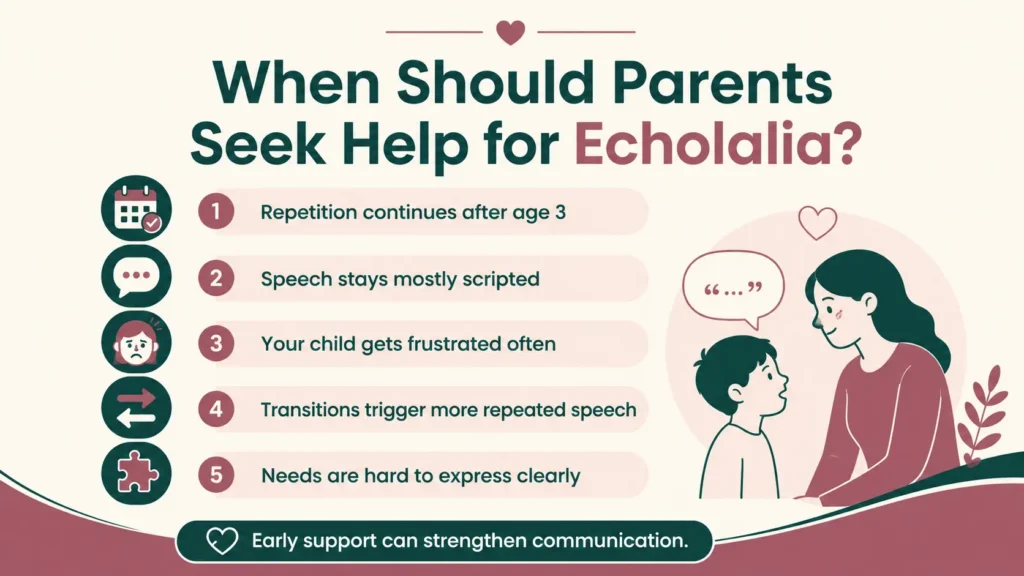
Echolalia does not always need treatment. Support might be useful if repeated speech is frustrating or restricting a child’s communication.
Parents may want guidance when:
- Echolalia continues beyond toddler years
- The child mainly relies on repeated phrases to communicate
- Repeat speech occurs during stress, transitions or sensory overload.
- Child cannot request needs, assistance or breaks in a clear way
- At home, school or day care, communication fails frequently.
- Echolalia appears with speech delay or other autism signs
Families can find out what is going on by contacting a pediatrician, speech-language pathologist, BCBA or autism therapy provider. The most salving plan starts with the question: “What does this child want to say?”
Echolalia Treatment: Key Goals and Support Strategies
Echolalia treatment should not automatically mean stopping a child from repeating words. The desired treatment outcome is to aid the child in becoming more clear, flexible and comfortable in communication.
The first step to good support is to know why echolalia is occurring. Child may be requesting, refusing, practicing, self-soothing or attempting to participate.
Helpful echolalia support may focus on:
- Teaching clearer requests
- Stretching out repetitions into flexible language.
- Minimizing frustration in communication.
- Helping parents respond to repeated speech
- Facilitating communication at home, school and in the community
- Using visuals, gestures, AAC, or speech when appropriate
- Coordinating ABA therapy and Speech-Language Therapy
A quality plan should be individualized. Children who echo due to anxiety may require a different level of support than children who echo when participating in a snack, toy or break request.
Echolalia in ABA Therapy: How ABA Helps Build Functional Communication
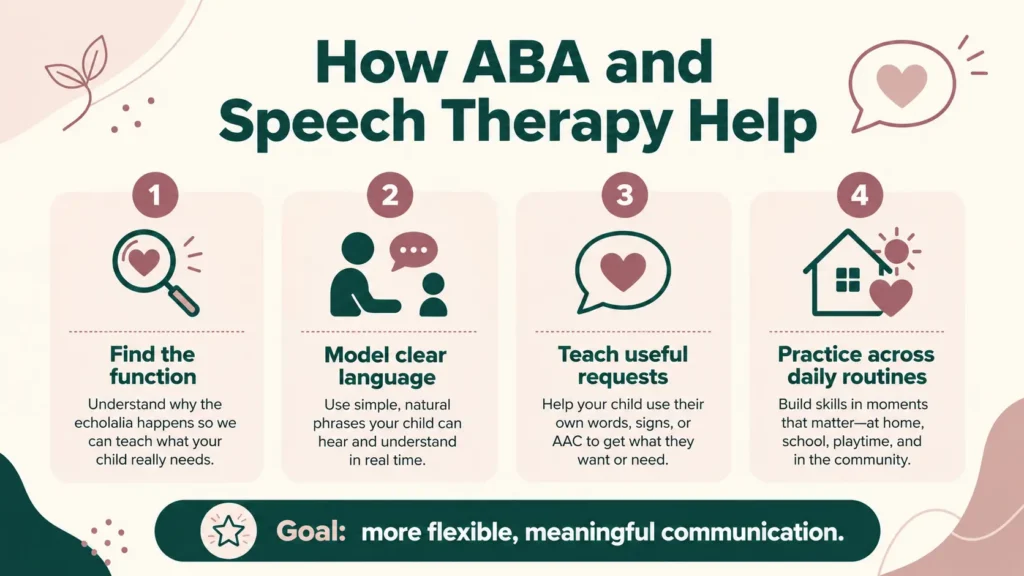
Echolalia in ABA Therapy should begin with understanding. ABA professionals need to consider what is occurring before the echolalia, after the echolalia, and what might be the gains or communication the child is able to make through the echolalia.
Functional Assessment Comes First
A BCBA can observe the child during play, meals, transitions, therapy or family routine. May record times of day, environment, sensory stimuli, communication partner and emotional state.
This will help the team to determine if the echolalia is a request, to the exclusion, self-soothing, answering, attention-seeking, or to process language.
Functional Communication Training
FCT is also known as functional communication training and teaches a child better ways of communicating.
A child can say, point to or choose:
“I want crackers”
“Help me”
“Break please”
“All done”
“My turn”
“No thank you”
FCT may be used with spoken language, gesture, visuals or communication boards or AAC. The aim is for the communication to benefit the child.
Modeling, Prompting, and Prompt Fading
ABA therapists may model the words a child can use. A therapist might turn “Do you want cookies?” into “I want cookies.”
Prompts may be verbal, visual, gestural or modeled. Over time prompts are gradually withdrawn and the child is able to communicate without as much assistance.
Reinforcement for Meaningful Communication
Reinforcement is the response made to communication that teaches the child that what they say or do is important.
If a child requests “break,” the therapist may accommodate the break as necessary. The therapist can provide bubbles when a child requests some, and then keep playing. These natural reactions will make communication useful and motivating.
Script Training and Script Fading
Some children need to be taught some simple scripts for familiar situations. Later, these scripts can be adapted and faded for the child to use language flexibly.
A child may first learn “I want ___.” Later, the child may use “Can I have ___?” or “I need ___.” The goal is not robotic speech.
Generalization Across Home, School, and Community
Communication skills shouldn’t be limited to therapy sessions. Children require practice with parents, siblings, teachers, peers and caregivers.
For families receiving ABA Therapy in Beverly Hills, CA, generalization helps children use communication during real routines like getting dressed, asking for snacks, playing outside, or transitioning to school.
How Speech-Language Therapy Supports Echolalia
Speech-Language Therapy can play an important role in echolalia support. The speech-language pathologist can evaluate expressive language, receptive language, vocabulary, comprehension, articulation, social language and script language.
SLPs may help children:
- Understand language
- Expand repeated phrases
- Build flexible sentence patterns
- Use gestures, visuals, or AAC
- Improve social communication
- Develop more spontaneous language
For goals that are aligned, goals for both services can be met together. An SLP can provide language targets and ABA can assist the child to practice the targets within his/her daily routine.
What Parents Can Do at Home When a Child Uses Echolalia
Parents can help with echolalia by reacting in an exploratory rather than correcting manner. A clue might be repeated speech and shouldn’t be turned off.
Listen for the Meaning Behind the Echo
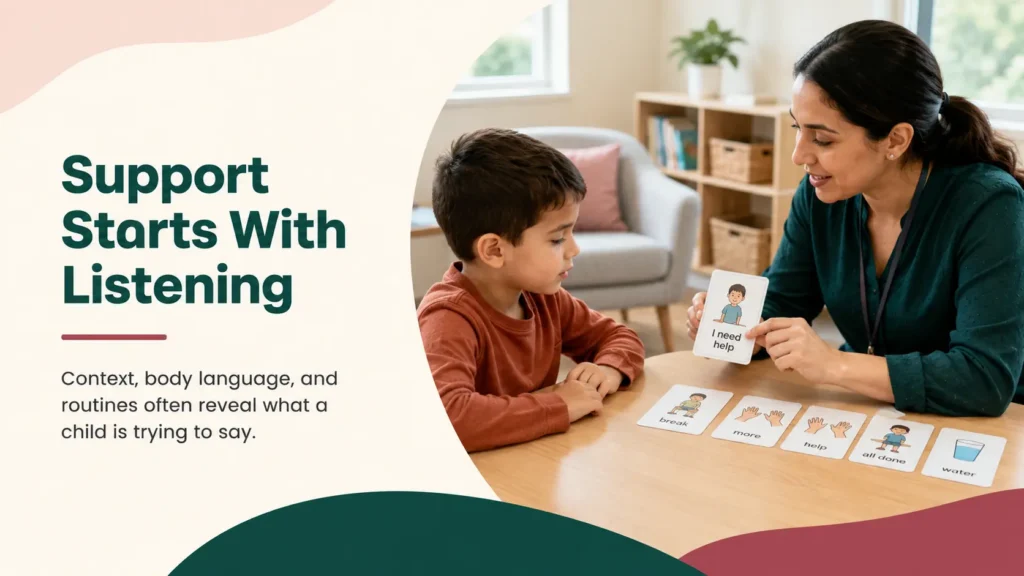
Pay attention to the phrase before the Noun Phrase. Was the child pointing, crying, smiling, touching, covering their ears or moving towards something?
Body Language, timing and environment will give clues to what the child may be trying to communicate.
Model the Words Your Child May Need
Use short phrases the child can copy and eventually adapt.
Child: “Do you want water?”
Parent: “I want water.”
Child: “All done?”
Parent: “I’m all done.”
Offer Simple Choices
This can help children to have choices and lessen their pressure.
Try:
“Juice or water?”
“Blocks or book?”
“Swing or slide?”
“Snack or all done?
Use Visual Supports When Helpful
Pictures, visual schedules, communication boards, gestures, and AAC can support communication. Visual tools don’t take the place of speech. These can help them to calm down and develop word knowledge.
Give Extra Processing Time
Stop after asking a question. If the question is conveyed too rapidly the child may get overwhelmed and start to echo. Calm pause will provide the child with more time to process and respond.
Celebrate Communication Attempts
The attempt can be verbal, echoed, indicated or pointed or selected using a device. Be responsive to your child’s attempts to communicate.
Parent coaching can often be useful for families seeking ABA Therapy in Los Angeles, CA to ensure that these therapies are implemented in daily life.
What Parents Should Avoid When Responding to Echolalia
Echolalia can be frustrating when parents do not understand what their child means. However, some answers may make communicating difficult.
Try to avoid:
- Punishing repeated speech
- Saying “stop repeating me”
- Assuming the child is being rude
- Ignoring every echo
- Forcing immediate answers
- Asking long, complicated questions
- Trying to eliminate echolalia without understanding its function
It is useful to stop and listen, make language easier and demonstrate what the child might be saying.
How Alma Behavioral Solutions Supports Echolalia in Autism
Alma Behavioral Solutions assists families to understand the purpose of echolalia through BCBA provided assessments unique to each child.
- Parent Training: Alma Behavioral Solutions offers parent training to assist parents in responding to echolalia and promoting communication within the home.
- Communication Goals: Alma Behavioral Solutions creates functional, individualized communication goals that are practical.
- Therapy Approach: Alma Behavioral Solutions uses natural reinforcement, visual supports, and evidence-based ABA strategies to encourage meaningful communication.
- Collaborative Care: Alma Behavioral Solutions collaborates with speech therapists, educators, and other professionals when appropriate to support the child’s overall development.
- Child Support: Alma Behavioral Solutions supports children in requesting items, asking for breaks, making choices, participating in routines, and expressing emotions.
- Individualized Plans: Alma Behavioral Solutions creates care plans based on each child’s needs, strengths, family routines, and communication style.
- Local Services: Alma Behavioral Solutions offers a warm, family-centered approach for families seeking ABA therapy in Glendale, Burbank, Northridge, Studio City, Granada Hills, Beverly Hills, Pasadena, and Los Angeles.
Contact Alma Behavioral Solutions for Echolalia and ABA Therapy Support
If your child repeats words, phrases, or scripts and you are unsure what they may be trying to say, Alma Behavioral Solutions can help you better understand the function behind echolalia and create a supportive ABA therapy plan.
Alma Behavioral Solutions offers families compassionate and individualized ABA therapy with an emphasis on communication, daily living skills and meaningful progress. For more information about echolalia support, parent training or ABA therapy services, please contact (747) 250-8494 or email info@almabehavioralsolutions.com.
Families looking for ABA therapy support in Glendale, Burbank, Northridge, Studio City, Granada Hills, Beverly Hills, Pasadena, or Los Angeles can reach out to Alma Behavioral Solutions for guidance.
Frequently Asked Questions About Echolalia
What is echolalia in autism?
Echolalia in autism refers to the repetition of words, phrases, or sounds that a child has heard before. The repetition may follow right after hearing something or sometime hours or days later. Echolalia may be a means of communication, language processing, or expressing needs in autistic children when original sentences are difficult to form.
Can you have echolalia and not have autism?
Yes. Sometimes toddlers who are still learning language, or those who do not have autism, engage in the behavior of echolalia. Normal speech development for some children involves the repetition of words or phrases. If it persists into the early childhood years, affects communication or if it is accompanied by speech delay, sensory differences or social differences it may need evaluation.
Does echolalia mean a child is autistic?
No. Echolalia alone does not mean a child is autistic. Children use word echoing as a strategy to learn speaking. For people with autism, the repetition of words may persist or be used for a particular purpose, like requesting, self-soothing or handling the language. A professional evaluation can help clarify what is happening.
Can echolalia be cured?
Echolalia is not something that always needs to be “cured.” It is a means of communication or a language learning step for many children. Therapy can support a child in expanding repeated phrases to more flexible communication. The aim is to promote better communication, not just prevent repetition.
Is echolalia normal for a 3-year-old?
Echolalia may persist until about age 3, particularly when children are learning language. If the 3-year-old speaks primarily in phrases and not words, or speech appears delayed, however, it may be beneficial to consult a pediatrician, speech-language pathologist, or autism specialist.
How can I help my child with echolalia at home?
First, consider echolalia a form of communication. Watch the situation, body language, and what your child may be trying to say. Limit your talk with your child to brief phrases, such as, “I want water” or “help me.” Provide options, visuals, pause after asking questions and praise every attempt.
Can echolalia go away with therapy?
While it may sometimes be desirable to stop echolalia altogether, it may be helpful to reduce or change it with the proper support. Children can learn to use language more flexibly, request needs clearly, and communicate with less frustration with the use of a combination of ABA therapy and Speech-Language Therapy. Some children use scripts as they become more proficient in communication.