ABA THERAPY SUPPORT IN SOUTHERN CALIFORNIA
Compassionate ABA Therapy for Autism and Family-Centered Support
Alma Behavioral Solutions provides autism care designed to help children build communication, social, emotional, behavioral, and daily living skills with support that feels structured, respectful, and family-centered.
Our autism services are built around your child’s needs, your family’s goals, and real-life progress. Through ABA therapy for autism, parent collaboration, and skill-building strategies, our team helps children practice meaningful skills at home, in school, and in the community.
What is Autism Care Therapy?
Autism care therapy is structured support for children with autism spectrum disorder who may need help with communication, social interaction, behavior, emotional regulation, play, daily routines, and independence.
For many families, the goal is not to change who a child is. The goal is to help the child communicate needs, participate more comfortably in daily life, reduce barriers to learning, and build meaningful skills in a supportive environment.
Ready to understand what support may look like for your child?
ABA Support
Individual ABA therapy for autism gives children focused support with skills such as communication, following routines, play, transitions, safety, and learning readiness. Therapy sessions are guided by clear goals, careful observation, and ongoing progress tracking.
Social and Play Skills
Children may practice turn-taking, sharing space, joining play, understanding social cues, flexible play, and peer interaction in a supportive way.
Daily Living Skills
Support may include dressing, toileting routines, hygiene, mealtime skills, self-care, cleanup routines, and age-appropriate independence.
Positive Behavior Support
Behavior support begins with understanding why a behavior is happening. The team looks at communication needs, sensory triggers, transitions, attention, access to items, avoidance, and environmental factors before building a plan.
ABA Autism Therapy Services We Provide
Alma Behavioral Solutions offers autism services that are practical, individualized, and focused on real progress in daily life.
ABA Autism Therapy
ABA autism therapy uses the science of learning and behavior to teach meaningful skills in small, manageable steps. Sessions may focus on communication, social play, adaptive learning, behavior support, routines, and independence. Progress is monitored over time so therapy can be adjusted based on what is working for your child.
Parent Training and Family Guidance
Parents and caregivers are a major part of the process. Our team provides practical guidance so families can support skills outside of therapy sessions. Parent training may include strategies for transitions, communication, reinforcement, routines, behavior prevention, and emotional regulation.
Social Skills Support
Social skills support can help children practice peer interaction, turn-taking, flexible play, greetings, conversation, shared attention, and group participation. Goals are selected based on the child’s developmental level and real-life needs.
Daily Living Skills Support
Children may need help building independence with self-care, dressing, feeding routines, hygiene, bedtime routines, cleanup, and daily responsibilities. Therapy helps these skills become easier, more predictable, and more manageable.
Behavior Support
Behavior is often a form of communication. Our team works to understand what a child may be trying to express and teaches safer, more effective replacement skills. Support may include reducing unsafe behaviors, improving transitions, increasing tolerance, and building communication alternatives.
School Readiness Support
School readiness may include sitting for short activities, following classroom routines, participating in group learning, asking for help, waiting, sharing, and transitioning between activities. Families searching for autism schools near me or autism services near me often benefit from therapy that supports classroom participation before and during school placement.
Reasons Families Choose Alma Behavioral Solutions
Choosing autism therapy near me can feel overwhelming. Families want a team that understands their child, communicates clearly, and builds a plan that feels realistic.
Compassion-First Care
Clear Communication
Individualized Treatment Plans
Experienced Clinical Oversight
Family Collaboration
Clear Communication
Our Autism Therapy Process
Starting autism care can feel like a big step, but the process should feel clear and supportive.
1. Initial Consultation
The first step is a conversation about your child, your concerns, your goals, and what support your family is looking for. Families may reach out after a diagnosis, while waiting for an evaluation, after school concerns, or when daily routines feel difficult.
2. Assessment and Care Planning
The team learns about your child’s communication, play, behavior, daily living skills, social needs, sensory needs, and learning style. A personalized therapy plan is created with goals that are specific, measurable, and meaningful.
3. Insurance Authorization
Our team helps guide families through the insurance authorization process when ABA therapy is covered through their plan. Clear documentation and treatment recommendations help support the next steps.
4. Therapy Sessions Begin
Therapy may focus on communication, behavior support, social skills, school readiness, routines, and independence. Sessions are built around your child’s goals and adjusted as progress is made.
5. Parent Training and Progress Reviews
Families receive guidance and updates so skills can be supported outside therapy. Progress reviews help the team decide what to continue, change, or expand.
6. Ongoing Therapy and Progress Reviews
Therapy sessions begin with continuous supervision, data collection, and regular progress reviews to ensure goals remain meaningful and effective.
Developmental Skills Our Autism Care Team Supports
Autism care should focus on skills that matter in real life. Alma Behavioral Solutions helps children build skills that support home life, school participation, safety, and independence.
Communication
Social Skills
Play Skills
Daily Routines
Emotional Regulation
School Readiness
Autism Therapy Near Me in Southern California
Behavior technician services can help children strengthen everyday skills that support learning, independence, and family life.








Autism Support for Schools, Daycare, and Learning Settings
Children often need support across more than one environment. Skills learned in therapy should connect to home, daycare, school, and community settings.
School Readiness
Therapy can help children prepare for classroom expectations such as sitting for short lessons, following routines, transitioning between activities, and participating with peers.
Daycare Collaboration
When appropriate, families can use therapy recommendations to support smoother daycare routines, communication, peer interaction, and behavior prevention.
Family Guidance for Learning Environments
Parents searching for autism schools, autism schools near me, or support for school placement often need help understanding what skills their child may need for learning success.
Parent Education: Autism Comparisons Families Often Search
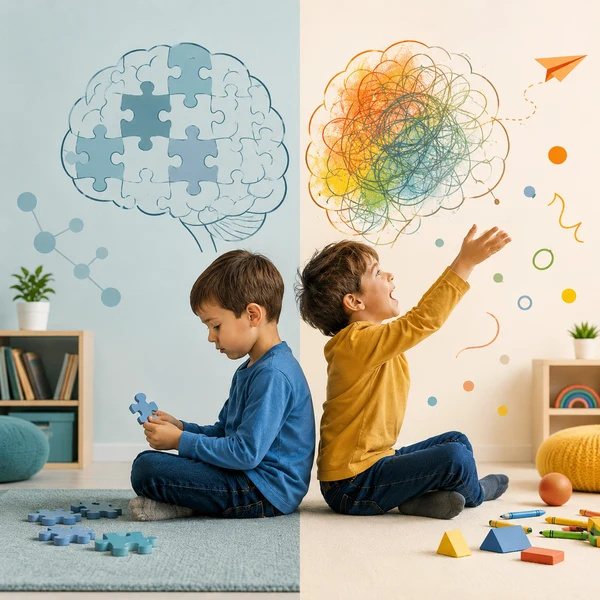
Autism vs ADHD
Autism and ADHD can both involve attention differences, emotional regulation challenges, sensory needs, and difficulty with routines.
Autism more commonly includes social communication differences, restricted or repetitive behaviors, sensory differences, and strong preference for sameness. ADHD is more closely related to inattention, impulsivity, hyperactivity, and executive functioning challenges. Some children have both autism and ADHD, so a professional evaluation is important.
Autism vs Down Syndrome
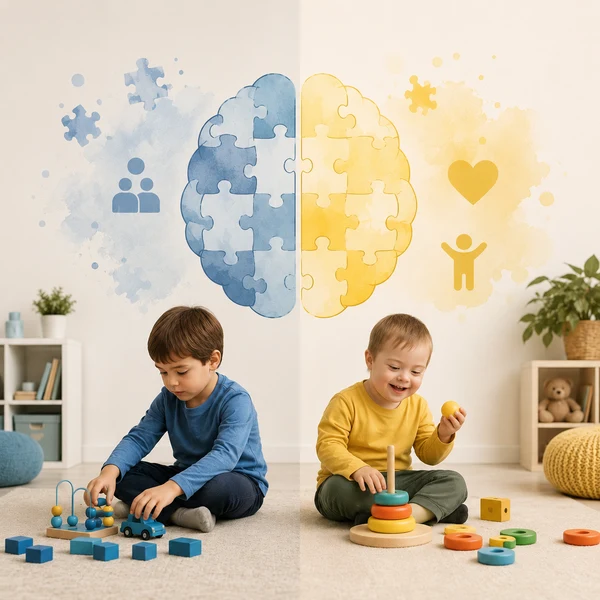
Autism and Down syndrome are different conditions. Down syndrome is a genetic condition caused by an extra copy of chromosome 21.
Autism is a neurodevelopmental condition involving social communication differences, restricted or repetitive behaviors, and sensory patterns.
Some individuals with Down syndrome may also have autism. Care planning should be based on the child’s full developmental profile, not only one label.
Speech Delay vs Autism
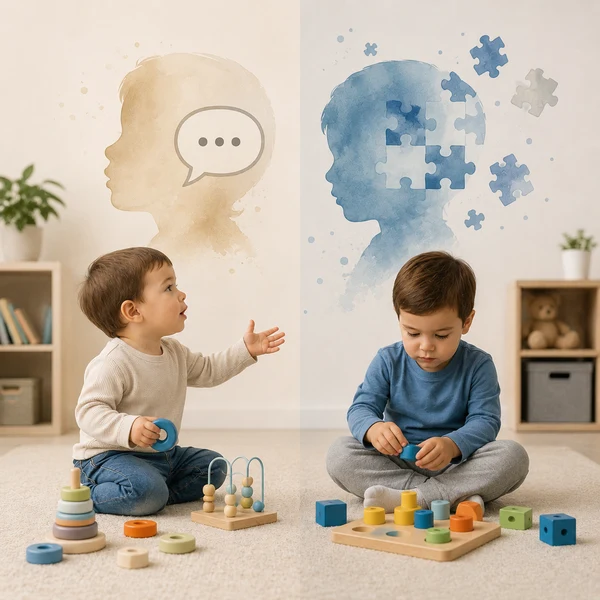
A speech delay means a child is developing spoken language later than expected. Autism may include speech delay, but it can also involve differences in social communication, gestures, routines, and repetitive behaviors.
A child with speech delay may still show strong social engagement but with autism may need support.
OCD vs Autism
OCD often involves intrusive thoughts and repetitive behaviors done to reduce anxiety or prevent a feared outcome.
Autism-related routines or repetitive behaviors may be connected to predictability, sensory comfort, special interests, or difficulty with change. A qualified clinician can help determine what is driving the behavior and what support is most appropriate.

Sensory Tools and Safety Supports Families Ask About
Sound-Reducing Headphones for Autism
Sound-reducing headphones for autism may help some children manage loud or overwhelming environments such as stores, school events, traffic, or crowded spaces. They are not a cure or treatment for autism, but they may support comfort and reduce distress in specific sensory situations.
Autism Sensory Steamroller
An autism sensory steamroller is a deep-pressure sensory tool some families ask about for children who seek firm pressure. Deep pressure may feel calming for some children, but safety, supervision, proper use, and professional guidance matter. Families should consult an occupational therapist or qualified provider before using sensory equipment.
Autism Safety Helmet
An autism safety helmet may be discussed when a child has head-banging, frequent falls, seizure-related safety needs, or other injury risks. A helmet should only be considered with professional guidance. The goal is to protect the child while also addressing the reason the unsafe behavior is happening.
Autism Support for Adults, Testing, and Career Questions
Autism Signs in Adults
Autism signs in adults may include lifelong social communication differences, strong routines, sensory sensitivities, intense interests, difficulty with change, social fatigue, masking, or challenges in work and relationships. Adults who suspect autism should seek guidance from qualified diagnostic professionals.
Autism Testing for Adults
Autism testing for adults is usually completed by trained clinicians using developmental history, interviews, standardized tools, and clinical judgment. Online tools may help someone decide whether to seek evaluation, but they do not confirm a diagnosis.
Autism Spectrum Quotient Test
The Autism Spectrum Quotient test is a screening questionnaire sometimes used for self-reflection or research. It is not a diagnosis. Anyone concerned about autism should consult a qualified professional for a full evaluation.
Careers for People With Autism
Careers for people with autism should be strengths-based. Many autistic individuals bring strong attention to detail, pattern recognition, technical interests, creativity, reliability, or deep subject knowledge.
Frequently asked questions
Is ABA therapy for autism evidence-based?
ABA therapy for autism is widely used as an evidence-based approach for teaching skills and supporting behavior change. Strong ABA programs are individualized, compassionate, family-centered, and focused on practical progress.
Can autism care help with speech delay?
Autism care can support functional communication, such as requesting help, following directions, and expressing needs. Speech delay should also be evaluated by a qualified speech-language professional, and some children benefit from both ABA therapy and speech therapy.
Can therapy help with sensory challenges?
ABA therapy can help children build coping skills, routines, communication strategies, and safer responses around sensory challenges. Occupational therapy may also support children with sound, touch, movement, or sensory processing needs.
Do you help with school readiness?
Yes. Autism care therapy can support classroom routines, transitions, following directions, sitting for learning activities, group participation, peer interaction, and asking for help when needed.
Are sound-reducing headphones helpful for autism?
Sound-reducing headphones for autism may help some children feel more comfortable in loud or overstimulating places. They are not a treatment for autism, but they can be part of a sensory support plan when used appropriately.
Is an autism safety helmet recommended?
An autism safety helmet may be considered when a child has a real risk of head injury, such as head-banging, frequent falls, or medical safety concerns. Families should speak with qualified professionals before using one and also address the reason behind the unsafe behavior.
Can someone with autism drive a car?
Yes, some autistic people can drive safely, while others may need more support or may choose not to drive. Driving readiness depends on attention, judgment, reaction time, sensory comfort, motor skills, and the ability to follow road rules safely.
Is lining up cars a sign of autism?
Lining up cars can be one possible autism-related behavior, especially when it happens repeatedly or with strong distress if the order is changed. On its own, it does not confirm autism, so parents should look at communication, social interaction, sensory patterns, play, and routines together.
What is respite care for autism?
Respite care for autism gives parents or caregivers temporary relief while a trained provider supports the child in a safe environment. Respite care for a child with autism may help families rest, manage stress, attend appointments, or support siblings while knowing their child is cared for.

Meet Our Founder:
Alisa Badryan has been a passionate advocate in the field of Applied Behavior Analysis (ABA) since 2008.
Over her years of experience, she witnessed a troubling trend, a decline in quality care driven by profit-first models.
With a deep commitment to patient-centered care, Alisa founded Alma Behavioral Solutions to bring care back to its core: compassion, integrity, and results that truly change lives.
Her vision was clear to create an ABA program rooted in individual growth, family partnership, and calm, nurturing environments where children can progress at their own pace.
Alma is not just a company, it’s a community built on empathy, trust, and dedication to every child’s potential.
Looking for Autism Care Therapy Support?
Searching for autism therapy near me, child autism therapy near me, ABA therapy for autism, or autism services near me can bring up many providers. Families may also see names such as Key Autism Services while comparing options.
The right provider should offer clear communication, individualized planning, qualified oversight, family involvement, and goals that connect to daily life.
Alma Behavioral Solutions provides autism care and ABA autism services for families in Southern California who want compassionate, practical, and evidence-informed support.