
What does autistic mean? Being autistic means having autism spectrum disorder (ASD), a lifelong neurodevelopmental condition and form of neurodivergence. Autism impacts an individual’s communication, social interactions, sensory processing, and interest or routine engagement. Each autistic individual is unique and has their own set of strengths, preferences, challenges, and support needs.
Understanding autistic traits helps families recognize differences without making assumptions about a person’s abilities or future. There are some traits that are observable early in childhood and others that are apparent later. Individual behaviors alone cannot establish an autism diagnosis.
Key Takeaways
· Autism is a spectrum, it is not just one personality or one ability level.
· Signs of autism vary by person and age.
· Screening identifies concerns, qualified professionals make diagnoses.
· Respectful support focuses on communication, comfort, independence and involvement.
What Does Autistic Mean?
The word autistic describes someone whose development and experiences fit the characteristics of autism. Clinicians use autism spectrum disorder for the diagnosis, while many people use autistic as part of their identity. The phrase ‘autism disorder’ sometimes appears, but the clinical term is autism spectrum disorder.
While autism can impact on conversations, sensory comfort, relationships, daily routines and so on, it doesn’t determine a person’s intelligence, personality, interests or possibilities.
Is Being Autistic an Illness?
No. The phrase autistic illness is misleading because autism is not an infection or disease needing a cure. An autistic person might also have anxiety, epilepsy, sleep problems or other major health issues that require proper treatment. Support meets real needs but doesn’t make an individual’s identity a problem.
What is the difference between autistic person and person with autism?
Autistic person: Identity-first language recognizes autism as part of someone’s identity.
Person with autism: Person-first language places the word person before the diagnosis.
Both terms appear in everyday use. Many autistic advocates prefer identity-first language, but preferences are individual. When possible, ask the person which wording feels right and respect their choice.
What Does the Autism Spectrum Mean?
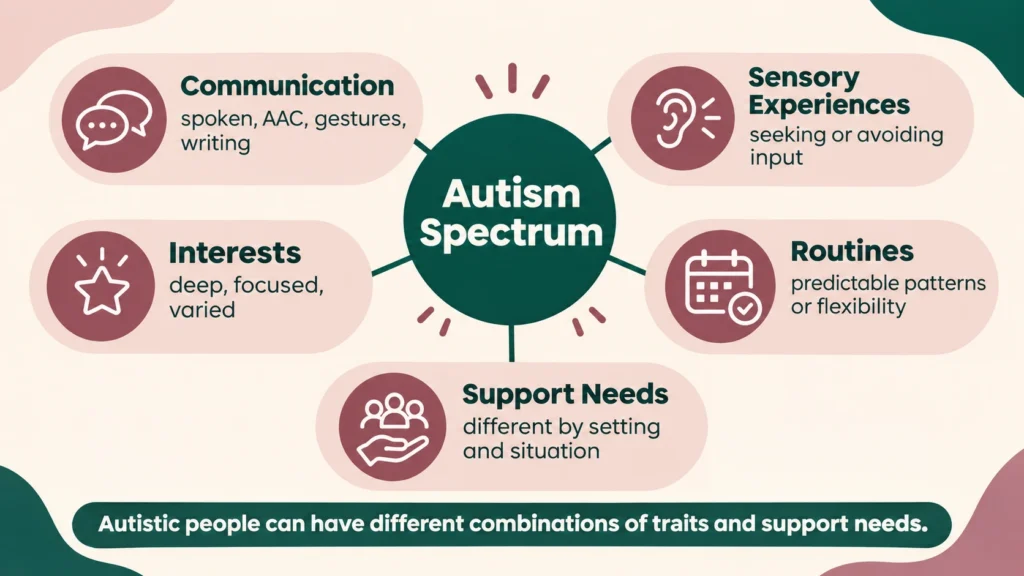
The autism spectrum disorder diagnosis covers many different profiles. It is not a line running from “a little autistic” to “very autistic.”
One person may be comfortable speaking in groups, while another may prefer using a communication device and enjoy lively spaces. Communication and sensory experiences, interests and daily support needs can vary separately.
Support needs also depend on the environment and available accommodations.
The National Autistic Society describes autism as a lifelong difference and there is a great deal of variability among people with autism.
Are There Different Types or Levels of Autism?
Historical names: Asperger syndrome, autistic disorder, and PDD-NOS were formerly separate diagnostic labels. These presentations are currently grouped within the autism spectrum disorder in DSM-5-TR.
Support levels: Clinicians can indicate a Level 1, 2, or 3 support level for each diagnostic domain. These do not reflect an individual’s intelligence or value and support needs may evolve.
Avoid treating support levels as fixed predictions about someone’s life.
Common Autistic Traits and Symptoms of Autism
The main symptoms of autism, described clinically as characteristics, involve social communication differences and restricted or repetitive patterns of behavior or interests, including sensory features.
They come in a variety of forms. A checklist cannot diagnose someone.
Social Communication and Interaction Differences
Autistic traits involving communication may include:
· Different use of gestures, facial expressions, or conversational pauses.
· Differences in joint attention, such as how a child shares an interesting discovery.
· Finding implied meanings or rapidly changing group conversation difficult.
Some autistic people speak fluently; others use gestures, writing, or augmentative and alternative communication (AAC). Eye contact is not a reliable measure of caring or empathy. Someone may want friendships while expressing that interest differently.
Repetitive Behaviors, Routines, and Focused Interests
Common signs of autism may include:
· Stimming: Repetitive movements or noises that can help to enhance enjoyment or regulation.
· Echolalia: Repeating heard words or phrases, sometimes to communicate.
· Focused interests: Spending substantial time on meaningful subjects or activities.
· Predictable routines: Preferring familiar sequences and/or advance warning of change.
Repetition isn’t always bad. When behaviors are injurious or seriously distressing, consider their purpose and alternative supports instead of stopping the behavior.
Learn more about Echolalia and Autism.
Sensory Processing Differences
Symptoms of autism can include heightened or reduced sensitivity to sound, light, touch, smell, taste, and movement. Some people seek movement or strong sensations; others avoid certain inputs. Both can happen within the same individual.
Example: A child hates to hear loud noises at school, but loves to swing outside. Offering a quieter space or a planned break can support participation without forcing the child to endure distress.
Strengths and Individual Differences
Personal strengths, relationships and interests co-exist with autistic traits. There are certain people who like detailed information, creative problem solving, predictable work and others who don’t.
No talent is a diagnostic requirement. Someone may be able to do something well in one area but require a lot of support in another. Recognizing both matters.
| Characteristic | Everyday Example | Helpful Understanding |
| Social communication | Prefers written instructions | Different communication methods are valid. |
| Routines and repetition | Repeats a familiar phrase | Repetition may communicate or regulate. |
| Sensory processing | Avoids buzzing fluorescent lights | Changing the environment may reduce discomfort. |
The CDC’s autism signs and symptoms guidance offers more developmental examples, and states that individual signs are not diagnostic.

What Are the Signs of Autism at Different Ages?
Signs of autism may be noticed in toddlerhood, school, or adulthood. Autism does not begin at the time of diagnosis.
Autism Signs in Toddlers
Possible autism signs in toddlers include:
· Using fewer gestures or pointing less often to share interest.
· Differences in responding to their name or sharing attention with a caregiver.
· Repeated play, keen interests or unexpected responses to sensory input.
· Communication developing differently from expected milestones.
Some autistic toddlers use spoken language; others communicate through gestures, pictures, or sounds.
These examples are not an exhaustive list. If a child’s skills have been lost, promptly consult with a healthcare professional regarding the change.
Signs of Autism in School-Age Children and Teens
In older children, autistic traits may become more noticeable as school and friendships grow complex:
· Finding unspoken social rules or fast group conversations hard to follow.
· Being overstimulated by the crowd, the noise, or sudden change of the class schedule.
· Turning to familiar interests or routines for comfort and predictability.
· Masking differences at school, then feeling exhausted or distressed afterward.
Masking is the modification or concealment of natural behaviours to meet social norms. It can make support needs less visible, not less important.
Signs of Autism in Adults
Possible signs of autism in adults include:
· Preferring straightforward communication and clear expectations.
· Needing sensory accommodations or time to recover after demanding experiences.
· Deep interests, repeated routines, or discomfort with sudden changes.
· Masking at work or socially, sometimes leading to exhaustion or autistic burnout.
Some women and members of under-recognized groups may not receive an assessment until adulthood. These patterns can be the subject of exploration, but can also occur with other experiences and are not, on their own, diagnostic.
What Causes Autism?
Autism spectrum disorder has complex developmental and biological origins. There is a strong indication of genetic factors, with other factors potentially playing a role in differences in development. But there are no single reasons that explain all autistic persons. The older phrase ‘causes of autistic disorder‘ refers to the same research topic.
Important distinctions include:
· Genetics: Many genetic variations can play a role; family history alone cannot predict an individual’s experiences.
· Biology and development: Prenatal and developmental influences are explored by researchers but correlation does not imply causation.
· Parenting: Autism is not caused by a lack of affection, poor parenting, or someone’s choices.
· Vaccines: Claims that vaccines cause autism are not supported by high-quality scientific reviews.
There is no reliable evidence that a special diet, detox or unproven product can prevent or cure autism. Medical issues should be talked with experienced healthcare providers.
How Is Autism Diagnosed?
An autism diagnosis is made by qualified professionals who consider developmental history, current experiences, clinical observations, and established criteria such as those in the DSM-5-TR.
Autism Screening vs. Formal Diagnosis
Developmental screening: Brief questions and observations identify children who may benefit from closer evaluation. The American Academy of Pediatrics suggests screening for autism at 18 and 24 months, plus developmental monitoring.
Formal diagnostic evaluation: A trained clinician or team, which may include a developmental pediatrician or psychologist, considers developmental history, communication, behavior, context, and diagnostic criteria. Assessment tools can aid in clinical judgment, but cannot replace it.
A screen cannot confirm an autism diagnosis and a negative screen does not eliminate the possibility of autism when there are questions.
Can an Online Autism Spectrum Test Diagnose Autism?
No. An online autism spectrum test or quiz cannot confirm or exclude autism. The phrase ‘spectrum autistic test’ is also used online, but it is not a clinical diagnosis.
Questionnaires can be used to describe people’s experiences, but the outcomes are dependent on the questionnaire, age group, interpretation and the overlapping conditions.
A professional evaluation will give a more thorough understanding. Think of online results as a starting point to a conversation, not a decision.
Steps to Take if You Notice Possible Autism Signs
If you notice persistent signs of autism, take these steps:
1. Observe patterns. Notice communication preferences, routines, sensory needs, and situations that cause difficulty.
2. Write down examples. Record what happened, when, and what helped, including strengths and successful accommodations.
3. Speak with a professional. Consult a pediatrician or other trained health professional about concerns.
4. Discuss evaluation and support. Ask about diagnostic assessment and helpful accommodations or services, even while waiting for an appointment.
How Can You Support an Autistic Child or Adult?
Effective autism support begins with listening to the person, understanding barriers, and respecting their preferences. Useful strategies differ from one individual to another.
Respect Communication Needs and Preferences
The autistic traits may influence a person’s needs or language processing. Helpful approaches include:
· Use clear language: Explain expectations directly and allow processing time.
· Offer communication options: Respect speech, gestures, pictures, writing, or AAC devices.
· Honor choices: Listen to requests, refusals and when they feel uncomfortable.
· Work collaboratively: When extra communication assistance is desired or required, speech-language professionals can assist.
Avoid expecting eye contact and don’t expect verbal communication to be the primary mode of exchange. Self-advocacy includes being able to say no.
Create Sensory-Friendly Environments
Address symptoms of autism involving sensory discomfort by adjusting surroundings when possible:
· Sound: Offer quieter areas or suitable hearing protection.
· Light and texture: Increase or decrease brightness, seating or clothes as desired.
· Breaks: Allow for space for movement, quiet time or sensory tools.
A distressed response to too much input doesn’t necessarily mean intentional misbehaviour. Ask what helps rather than applying the same accommodation to everybody.
Support Daily Routines and Independence
When autistic traits make unexpected changes difficult, try three flexible strategies:
1. Clarify expectations: Use simple directions, demonstrations, or Visual Schedules For Autism.
2. Prepare for transitions: Provide advance warning, explain changes, and provide meaning and choices.
3. Practice useful skills: Support dressing, asking for help, mealtimes, or other personally relevant activities.
Independence doesn’t have to mean doing everything alone. Accessible tools, the right support, and control of options can be as important.
Explore Individualized Professional and Family Support
Some families of autistic children may need the help of educators, psychologists, speech-language pathologists, occupational therapists, or an ABA professional.
A Board Certified Behavior Analyst (BCBA) can help plan individualized goals when ABA is appropriate. Collaboration with caregivers, learner consent, learner autonomy, and continuous monitoring are elements of respectful services.
Common Autism Misconceptions and Representation
Misunderstandings about autistic traits can shape how people are treated. Five points matter:
· Intelligence: Autistic people have varied cognitive profiles; autism does not predict intelligence.
· Empathy: Different communication or expression does not mean someone cannot care about others.
· Independence: Support needs differ and may change. Assistance does not diminish a person’s dignity.
· Cures: Autism is a lifelong neurodevelopmental condition and is not a disease to be eradicated.
· Representation: There should be a diversity of autistic experiences represented, not one stereotype.
Mattel released an autistic Barbie in 2026, in collaboration with the Autistic Self Advocacy Network. While no one doll will necessarily represent all, thoughtful representation can enable children to see disability represented in a positive way.
When Should Families Seek Professional Autism Support?
Families might need guidance when they see signs of autism that tend to be associated with concerns impacting on the family’s everyday comfort, communication, learning, or safety.
Consider discussing:
· Changes or differences in communication and development.
· Chronic sensory discomfort or problems getting to places around the house.
· Challenges with daily activities that the child or family wants help addressing.
· Safety concerns or behaviors signaling unmet needs.
Assessment and therapy are different services; not every autistic characteristic needs intervention.
ALMA Behavioral Solutions offers family-focused ABA and Autism Services for children, emphasizing meaningful skills and collaboration with caregivers in Southern California. A qualified diagnostic professional can advise on assessment when needed.
Frequently Asked Questions About Autism
Am I Autistic?
Recognizing several autistic traits may suggest that learning more about autism could be useful, but it cannot confirm whether you are autistic. A trained clinician can explain your developmental history, what you’re going through now, and if a formal assessment of autism would be beneficial.
Can an “Am I Autistic?” Quiz Tell Me Whether I Have Autism?
No. An online quiz can identify experiences that might be of interest but cannot confirm an autism diagnosis or exclude autism. Wording, other conditions and interpretation can affect results. Discuss questions with a qualified professional experienced in autism assessments.
Can Someone Be Autistic Without a Diagnosis?
Yes. Someone may be autistic without having received a formal diagnosis. Signs in childhood may be ignored, particularly if a person is able to hide differences or not have access to assessment. An evaluation as an adult may clarify their experiences and possible support needs.
Is Autism the Same as a Learning Disability?
No. Autism is a neurodevelopmental condition while intellectual disability is defined by intellectual functioning and adaptive skills limitations. Specific learning disabilities affect particular academic abilities. These conditions can coexist, but this does not necessarily mean that anyone who is autistic is learning disabled.
How Is Autism Different From ADHD?
Autism spectrum disorder involves differences in social communication alongside restricted or repetitive patterns, while ADHD primarily involves attention regulation and hyperactivity or impulsivity. Experiences can be overlapping and a person can have both. If necessary, the differences can be assessed by a qualified professional.
Do Autistic Characteristics Look Different in Girls and Boys?
Sometimes. Girls’ and boys’ autism may be missed because of social expectations, masking, or differences in the recognition of autistic characteristics. However, there is no single presentation for either group. An assessment should consider each person’s history and experiences.
Can Dogs Be Autistic?
Dogs are not diagnosed with autism spectrum disorder using human diagnostic criteria. Repetitive behavior, unusual responses, or social difficulties in dogs may have other explanations. A veterinarian or qualified veterinary behavior specialist can assess concerning changes and recommend appropriate care.
Is Elon Musk Autistic?
Elon Musk publicly stated that he has Asperger syndrome during a May 2021 Saturday Night Live appearance. Asperger syndrome is an older diagnostic term that has become part of autism spectrum disorder. His statement does not justify speculation about undisclosed medical information.