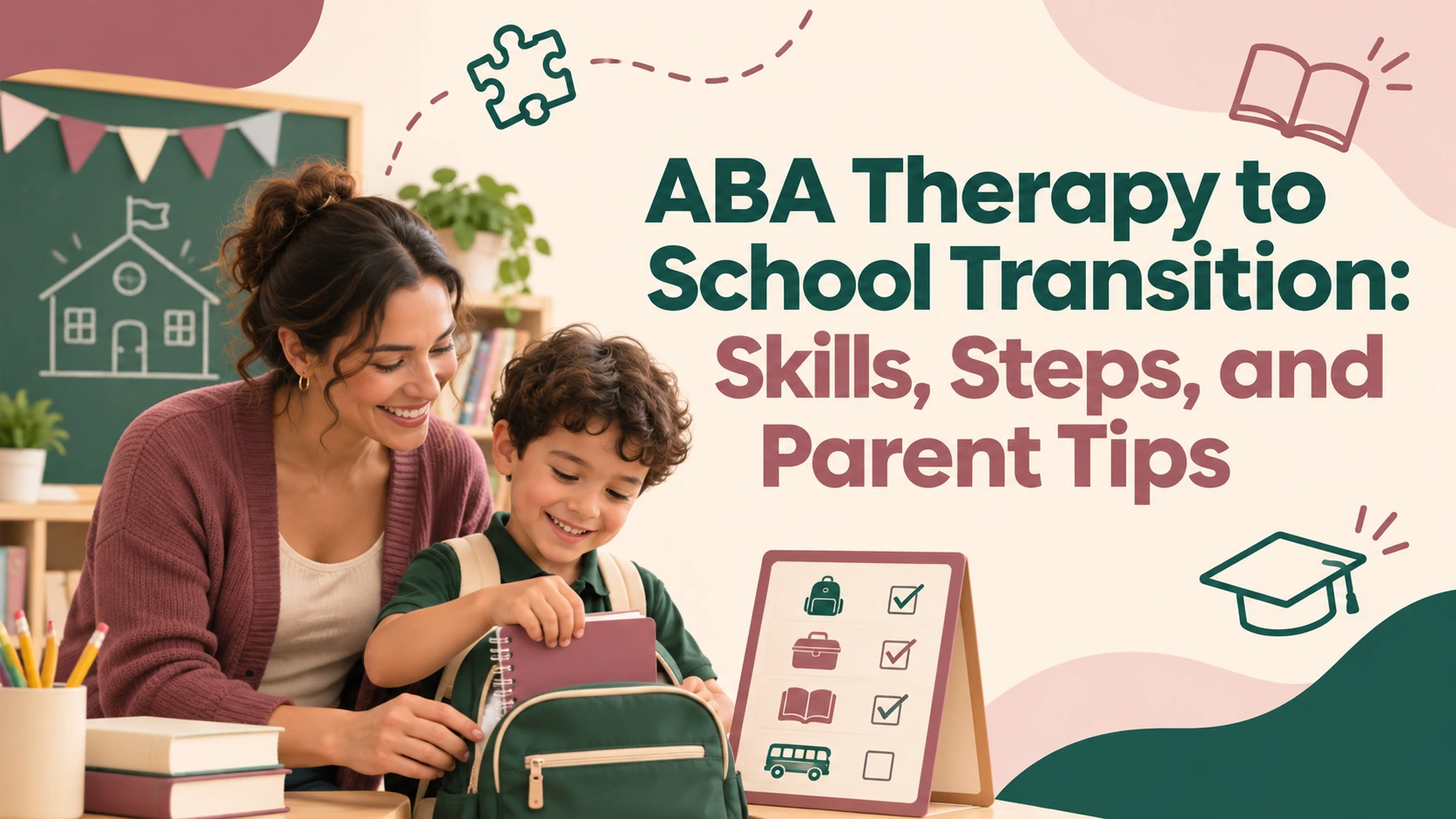

Transitioning from ABA therapy to school involves preparing an autistic child for new routines, relationships, and learning environments while coordinating the support they may need. Starting school does not automatically mean ending Applied Behavior Analysis (ABA) services. A thoughtful ABA therapy school transition is about what a child is good at, how the child likes to communicate, what he or she enjoys, and the child’s access to education, and not on a predetermined list of skills that he or she has to attain before entering the school.
Individualized planning helps families practice helpful routines, get connected with teachers, and determine the fit of clinical services with school.
Key takeaways
• Children do not need to graduate from ABA to attend public school.
• Readiness is about participating with appropriate support and not perfect independence.
• Planning with the family, with adjustments to support as needs change.
What Does Transitioning From ABA Therapy to School Mean?
Transitioning from ABA to school can mean moving from individual or center-based therapy into preschool, kindergarten, or an elementary classroom. School has a different routine, new adults, group activities and sensory experiences.
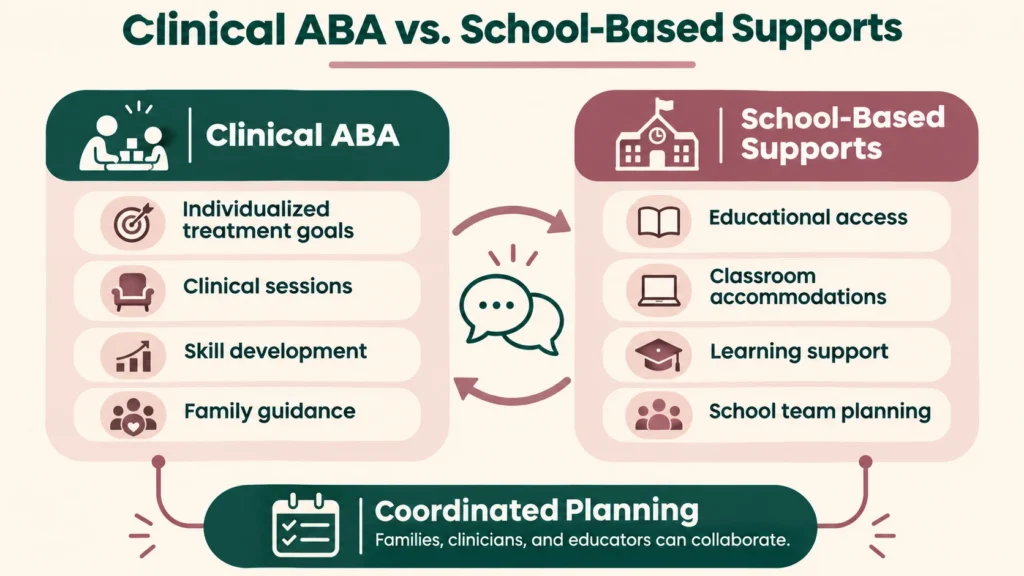
The decision to start school, decrease ABA hours, and terminate clinical services are separate decisions. ABA addresses treatment needs and schools provide educational access and appropriate support.
For example, a child may use a familiar therapy picture card to request help from a teacher. This is the skill generalization: using something that is helpful in a different context. A successful autism transition to school can include continued assistance and accommodations.
ABA graduation is not an enrollment requirement. When planning school, decide which supports are required to travel with the child, including a stable communication system, consistent pick-up arrangements and having access to a quieter room if necessary.
How Does ABA Therapy Prepare Children for School?
What School Readiness Skills Are Taught in ABA Therapy?
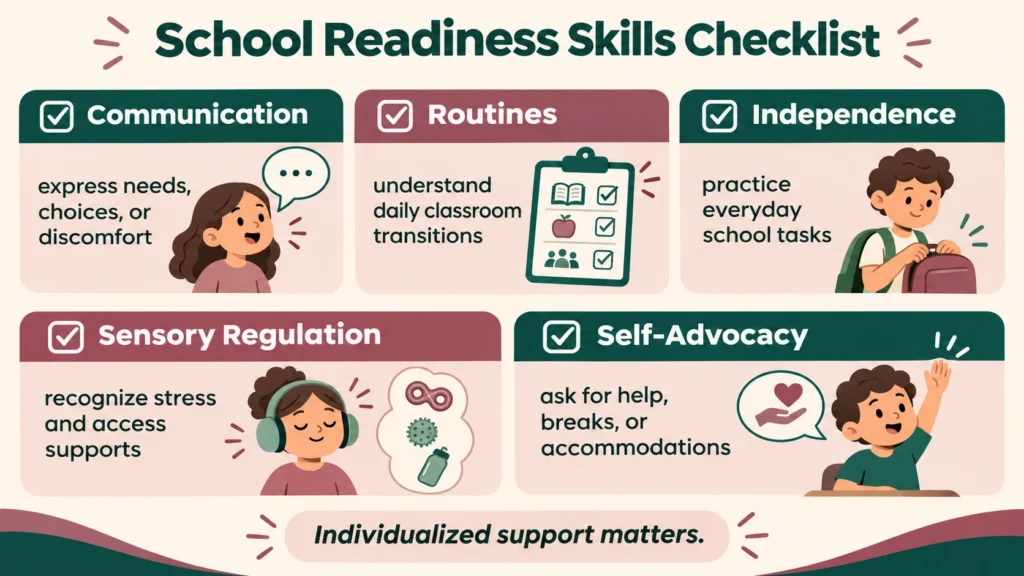
ABA therapy for school readiness may help children practice everyday skills that support access, confidence, and choice. Goals should reflect the child’s priorities.
• Functional communication: Express needs, choices, or discomfort through speech, gestures, pictures, or augmentative and alternative communication (AAC).
• Predictable routines: Use visual schedules or reminders to understand changes between activities.
• Help-seeking: Ask for help, to take a break, extra time, or other means of participation.
• Play and groups: Join activities with support respecting different social styles.
• Daily independence: Do related activities, such as handling personal belongings or opening lunch containers.
• Sensory regulation: Recognize stress and access appropriate accommodations.
• Safety and self-advocacy: Express discomfort, identify trusted adults, and seek assistance.
These school readiness skills for autism are possible learning goals, not conditions a child must meet before attending school.
ABA Therapy and Classroom Skills: Everyday Examples
ABA therapy and classroom skills become connected when children become familiar with the supports they use in real school settings. A visual schedule may be useful for a child to plan for a transition from Art to Recess. They may open a box or seek help at lunch time. In the group time, participation may require the use of headphones or short engagement.
Consider a child who learns to select a “break” symbol on an AAC device during therapy. Later, the child is able to use the same symbol with a teacher when the classroom is overwhelming. Our Direct Therapy Services support individualized skill development.
When Should a Child Transition From ABA to School?
There is no set point in a child’s development at which someone decides they are ready to start school because they are autistic. Access to school is not dependent on completion of the ABA. An autism transition to school should consider the child’s needs and the educational options available to the family.
Important planning factors include:
• Communication and sensory needs: Which supports does the child find helpful and comfortable?
• School arrangements: Is there a discussion of enrollments, evaluations, and supports in the classroom?
• Family routines: What about transportation, rest, meals and therapy appointments?
• Clinical goals: Would continuing, adjusting, or ending ABA be appropriate to discuss with the BCBA?
• Child preferences: Which adults, activities, routines, or environments feel welcoming or stressful?
If it is a complex transition, it may take months to coordinate; first-day routine can be practiced closer to the time of school opening.
How to Transition From ABA Therapy to School: 7 Practical Steps
Planning Before the First School Day
A flexible ABA to school transition plan allows everyone to understand the child’s needs without becoming a rigid program.
1. Strengths and Support Needs Review. Determine interests, means of communication, comforting routines, sensory needs and safety issues. Invite your child to participate in ways that work for them.
2. Speak with the BCBA. A Board Certified Behavior Analyst (BCBA) may review the relevant clinical goals, determine skills that can be transferred to school, and discuss any adjustments in therapy. An RBT may share observations with the supervising BCBA.
3. Contact the school early. Inquire about enrollment, orientation, evaluations and support. An ABA provider’s recommendation is not required.
4. Write a practical transition plan. Make a single page profile of the person’s communication preferences, strengths, sensory accommodations, helpful strategies, important contacts, and review dates. Assign clear follow-up responsibilities. Discuss when classroom needs or the child’s wishes change, who will review the plan. Our School Consultation services can assist in the effective coordination of family and school teams.
Supporting the Transition and First Weeks
5. Make the setting familiar. If available, visit the school, meet key staff, look at classroom photos, or use a short visual story about arrival and pickup. Listen to your child’s feedback and comfort.
6. Practice useful daily activities. Pack a bag, select a snack, communicate on a card or plan a schedule change. Practice should be short, fun and voluntary. Assist or modify tasks before the child can do them on his or her own.
7. Check in and adjust. Ask teachers what supports are working, and notice your child’s comfort, energy, communication, and willingness to engage. A simple home-school note can highlight successful strategies and concerns to revisit. Share private clinical records only with appropriate permission and consent. The child’s account of the school day is heard alongside of adult observations.
These autism school transition strategies should evolve with the child. When a plan creates distress, change the supports rather than insisting on the schedule.
How Can Parents Prepare an Autistic Child for Kindergarten?
Families preparing autistic children for school can use routines as low-pressure opportunities to become familiar. The goal is to be predictable and find a reliable method of communicating needs. Kindergarten readiness for autistic children varies from one child to another.
| Activity | Target Skill | How Parents Can Practice |
| Morning visual schedules | Predictable routines | Use photos or symbols to preview getting ready. |
| Getting ready and packing a backpack | Organization and independence | Practice choosing and placing familiar items with help when needed. |
| Snack and lunch routines | Communication and self-care | Practice asking for help with lunch containers and communicating food preferences. |
| Asking for help or a break | Functional communication | Model speech, gestures, pictures, or AAC during daily activities. |
| Arrival and classroom transitions | Familiarity with change | Preview arrival with school photos, a visual story, or a visit when available. |
| Play and shared activities | Participation and choice-making | Use preferred games with flexible turn-taking and ways to participate. |
| Sensory breaks | Self-regulation | Identify preferred quiet spaces, movement breaks, or sensory tools. |
Activities should match the child’s communication, sensory profile, and energy level. The same visual support may be needed at home and in school or a child may need assistance from an adult. In-home ABA Therapy is provided when clinically appropriate to individualized skills, within their daily routines.
School-Based Evaluations, IEPs, and 504 Plans: What Parents Should Know
How Can Parents Request a School-Based Evaluation?
Parents can request a school-based evaluation from their public school or district. Include written request of any educational concerns including communication, learning, sensory support etc. and retain copies of responses and consent forms.
Clinical ABA evaluations help determine treatment, school evaluations help determine educational needs and eligibility.
In California, districts generally must provide a proposed assessment plan within 15 calendar days of referral, with specified school-break exclusions and possible agreed extensions. Initial assessment and IEP processes generally have 60 days after parental consent, with exceptions. See the California Department of Education’s special education guidance. Check applicable timelines with your district.
IEP vs. 504 Plan: Understanding School Supports
An IEP for autism may be developed when a child qualifies for special education under the Individuals with Disabilities Education Act (IDEA). Section 504 is a civil rights law that protects eligible students with disabilities. Eligibility depends on evaluation findings and applicable criteria.
| Support Pathway | What It May Provide |
| Individualized Education Program (IEP) | Special education, individualized goals, related services, and necessary accommodations for eligible children under IDEA. |
| Section 504 plan | Individualized accommodations and, when required, related aids or services supporting appropriate educational access. |
Supports can relate to AAC, sensory access, communication, learning, or behavioral needs. Parents should share their views and asks educational team to explain proposed services.
A BCBA may provide relevant clinical information; however, educational decisions are the responsibility of the school team. See the U.S. Department of Education’s Section 504 Guidance.
Can a Child Continue ABA Therapy While Attending School?
Yes. ABA therapy after starting school may continue when it is clinically appropriate and works for the family. Attendance does not determine clinical discharge. Clinical ABA and school-based educational services are funded and managed separately.
| Support Option | How It May Work |
| ABA outside school hours | Clinically appropriate sessions may continue outside classroom time. |
| Adjusted ABA schedule | Clinical teams may modify session frequency or treatment goals according to individual needs. |
| School consultation | Families and educators may coordinate helpful supports when authorized. |
| School-provided behavior support | Educational teams determine necessary supports; private clinical access is not automatic. |
| Planned ABA discharge | Clinical services may conclude through individualized review and planning. |
ABA therapy in school settings is not automatically available in every classroom. School consultation may be used to support use of clinical recommendations with school routines for some families, whilst the teacher and school team remain responsible for educational decisions. Consider the child’s stamina before scheduling appointments.
ABA Therapy School Transition Checklist
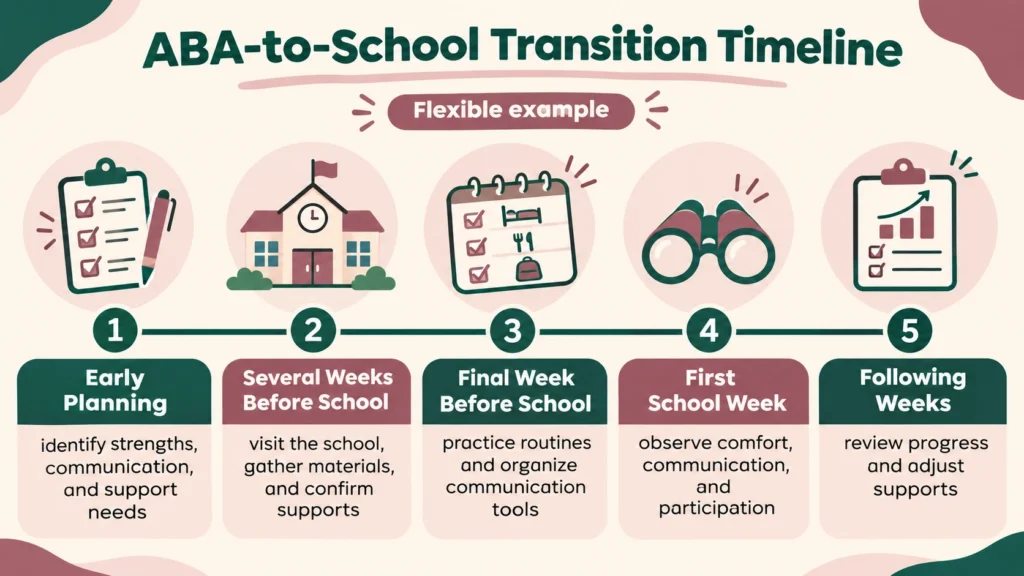
| Timeline | Parent Action | School/Therapy Coordination |
| Early planning | Identify strengths, communication methods, sensory needs, and family priorities. A school transition checklist for autism can track these needs. | Contact the school and discuss evaluations and current ABA goals. |
| Several weeks before school | Gather photos, visual supports, and familiar comfort items. | Confirm school contacts, available visits, and any agreed information sharing. |
| Final week before school | Practice chosen routines and organize supplies, transportation, and communication tools. | Confirm first-day assistance, pickup plans, and communication methods. |
| First school week | Notice comfort, fatigue, participation, and how the child expresses needs. | Share useful observations and address immediate support gaps. |
| Following weeks | Review what works, what causes stress, and what needs to change. | Revisit educational and clinical supports when appropriate. |
What Should Families Do if the School Transition Is Difficult?
A noisy lunchroom or an unpredictable schedule can overwhelm a child. A difficult autism transition to school is a reason to examine the environment and support, not to blame the child or assume they cannot attend.
• Look for patterns: Notice when distress occurs and consider sound, lighting, communication barriers, fatigue, transitions, or social pressure.
• Honor communication: Consider words, gestures, a refusal, AAC messages and other signs of distress as feedback from the child’s experience.
• Change the supports: Ask about visual previews, quieter spaces, flexible participation, sensory tools, or predictable breaks.
• Work as a team: Collaborate with teachers and relevant clinicians when appropriate. Our Parent Support can help families consider realistic routines and communication strategies.
• Review progress together: If difficulties persist, request a review of support and individualized professional advice.
Prioritize safety, access and well being over removing all obvious reactions to stress.
Frequently Asked Questions About ABA Therapy to School Transition
Does a Child Have to Finish ABA Before Starting School?
No. ABA completion is not required for public school attendance. There are several options for transition from ABA to school: continuing, reducing or stopping clinical services, enrollment and educational eligibility are different. School access should not await clinical discharge.
Who Should Be Involved in Creating a Transition Plan?
Parents, the child when appropriate, teachers, school staff, and the BCBA may help create an ABA to school transition plan. Other specialists or an RBT may contribute relevant observations. Sharing identifiable clinical information requires appropriate consent.
Is ABA Therapy Automatically Available in Every Classroom?
No. School-based ABA therapy is not automatically provided in every classroom. Educational supports are organized by schools, private treatment will follow different requirements. School consultation or provider involvement may be possible with the necessary permissions and agreements.
What Information Should Parents Share With Teachers?
Describe your child’s strengths and interests, preferred ways of communicating, helpful routines, AAC support needs, sensory accommodation needs and appropriate safety needs. A brief profile can support school transition strategies for autism without unnecessary medical disclosure. Include your child’s own preferences whenever possible.
How Is a School Evaluation Different From an ABA Assessment?
A school-based evaluation looks at educational needs and possible eligibility for school services. A clinical ABA assessment guides individualized treatment goals and decisions. Both can inform planning, but they serve different purposes.