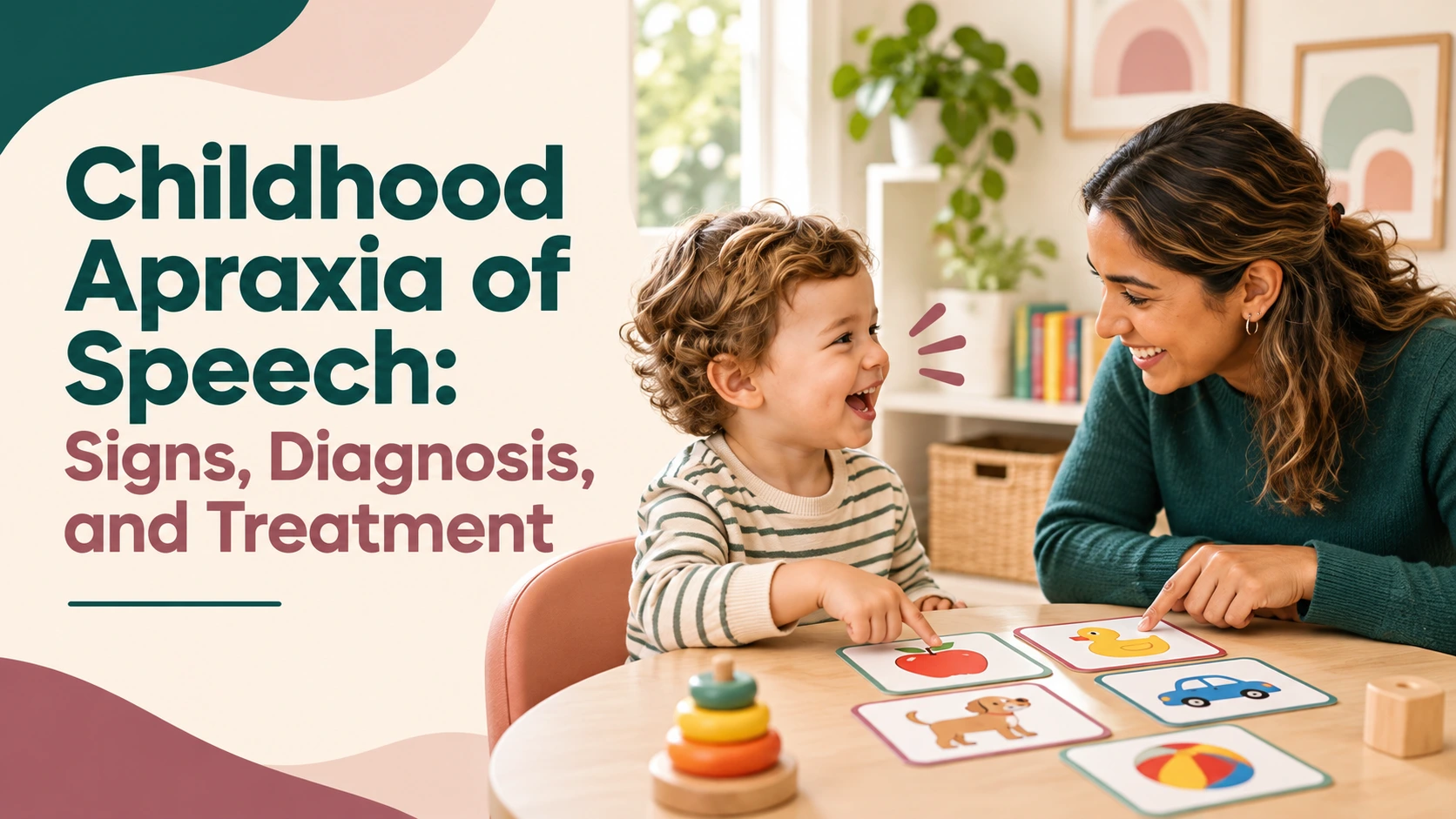

Childhood apraxia of speech (CAS) is a neurological motor speech disorder that makes it difficult for a child’s brain to plan and coordinate the movements needed for clear speech. Children may know what they want to say but struggle to produce the words consistently. Families can seek appropriate support if they are aware of the signs, evaluation process and treatments.
Key Takeaways of Childhood Apraxia of Speech
· Childhood apraxia of speech impacts motor planning, but not intelligence.
· No single speech sign confirms CAS.
· A qualified speech-language pathologist (SLP) evaluates and treats suspected CAS.
· Speech therapy, augmentative and alternative communication (AAC), and family support can enhance communication in daily life.
What Is Childhood Apraxia of Speech?
Childhood apraxia affects the brain’s ability to organize the precise movements of the lips, tongue, and jaw for speech. The muscles are not necessarily weak; the problem is movement planning, as the NIDCD explains.
For example, A child may say ‘puppy’ distinctly the first time and then say it differently the next time. Other conditions can be similar. CAS alone does not indicate a child’s understanding or intelligence. A child can have clear ideas but struggle to sequence the sounds needed to express them. Some children may also have separate language difficulties.
Early Signs of Childhood Apraxia of Speech
The early signs of childhood apraxia of speech vary. Clinicians consider inconsistent sound errors, disrupted transitions between sounds, and unusual speech stress (prosody). ASHA cautions that no single feature confirms CAS.
Early Signs of CAS in Babies and Toddlers
Possible CAS symptoms in toddlers include:
· Limited sound variety: Few consonants or syllables.
· Changing attempts: A well known word sounds different each time it is attempted.
· Imitation difficulty: Copying sounds or words is hard.
· Sequencing difficulty: Combining sounds is harder than saying one sound.
Other delays can cause similar signs. No checklist will diagnose CAS. Parents can record specific examples to share with an SLP.
Signs of Childhood Apraxia in Older Children
In older children, speech apraxia may involve:
· Inconsistent errors: Sounds change when words are repeated.
· Interrupted transitions: Sounds do not flow smoothly.
· Unusual stress: Word or sentence emphasis differs from expected language patterns.
· Complexity: Longer words are harder than shorter ones.
A child may communicate clearly through gestures while still having trouble with speech.

What Causes Childhood Apraxia of Speech?
The cause of childhood apraxia is often unknown. Possible contexts include:
· Unknown cause: No clear underlying condition is identified.
· Genetic or developmental conditions: CAS may co-occur with certain genetic or neurodevelopmental conditions.
· Neurological injury: Sometimes CAS follows an early brain injury.
Parenting, effort, and bilingualism do not cause CAS. Clinicians may benefit from family history and developmental information to guide them in their understanding of potential factors.
How Common or Rare Is Childhood Apraxia of Speech?
Childhood apraxia of speech is relatively uncommon. ASHA cites an estimated prevalence of approximately 1 in 1,000 children ages 4–8. This estimate does not apply to all age or developmental groups.
Childhood Apraxia of Speech vs. Speech Delay
With apraxia vs speech delay, symptoms may overlap. “Speech delay” means later-than-expected speech development, not a specific diagnosis.
| Condition | Main area of difficulty | What an SLP may notice |
| CAS | Planning speech movements | Disrupted transitions, stress differences, inconsistent production |
| Speech delay | Speech developing later than expected | Delayed skills with varying underlying causes |
| Phonological disorder | Using the sound patterns of a language | Patterned sound errors, sometimes inconsistent |
| Dysarthria | Controlling or executing speech movements | Weakness or coordination difficulties affecting speech |
These are not diagnostic tests; conditions can overlap.
How Is Childhood Apraxia of Speech Diagnosed?
A childhood apraxia of speech diagnosis comes from a qualified SLP experienced in pediatric motor-speech assessment. Speech production, language, and responses to cues are assessed by clinicians, but there is no online quiz for CAS. They also consider whether another speech sound disorder better explains the pattern.
How Do Speech Therapists Assess Suspected Apraxia in Toddlers?
An SLP assessing apraxia of speech in children may:
1. Review history: Discuss milestones, health, observations and home languages.
2. Consider hearing: Arrange screening and identify other factors.
3. Observe speech: Listen to repetitions, sound combinations and rhythm.
4. Use dynamic assessment: Try models and cues to assess responses.
5. Plan next steps: Discuss findings, therapy and reassessment.
Children younger than three can be evaluated and receive help. With limited speech, a definite diagnosis may not yet be possible. Support can also start as the clinician is collecting additional information. Apraxia Kids recommends seeking an experienced SLP rather than waiting for a particular birthday.
Childhood Apraxia of Speech Treatment Options
Childhood apraxia of speech treatment focuses on building more accurate, reliable speech movements while supporting communication now. An SLP tailors approach and techniques. No time frame or results are promised. Motor-based interventions focus on word sequences of real words; however, children may require assistance in language, participation, or alternative communication as well.
How to Treat Childhood Apraxia of Speech With Speech Therapy
In speech therapy for childhood apraxia of speech, an SLP guides speech movements through:
· Targets: Useful words and phrases chosen with the child and family, such as a name or request.
· Practice: Repetition with clinician selected visual, auditory or tactile cues to facilitate accurate movements.
· Feedback: Adjusting help as skills develop and gradually supporting more independent speech.
Drills involving blowing or chewing should not be used in place of motor-speech drills.
Speech Therapy Techniques: DTTC, ReST, NDP3, and PROMPT
Apraxia speech therapy may use:
· DTTC (Dynamic Temporal and Tactile Cueing): An SLP provides models of words, coaches the child, and slowly fades cues. This may help a child who needs significant movement support.
· ReST (Rapid Syllable Transition Treatment): Well planned multisyllabic practice words focus on transitions and stress patterns, frequently for children who will need more challenging speech tasks.
· NDP3 (Nuffield Dyspraxia Programme): Constructs words, phrases and connected speech from simpler sounds and syllables, using practised, structured learning.
· PROMPT: A trained clinician uses touch-based cues to support speech movement. Evidence for its CAS-specific effects is more limited than for some motor-based protocols.
An SLP chooses the approach and practice frequency based on each child. Progress checks are used to decide if change is needed for cues, targets or methods.
Apraxia of Speech Goals and Potential Benefits
Apraxia of speech goals should be measurable and meaningful:
· Accuracy: Saying chosen words consistently.
· Intelligibility: Making speech easier to understand.
· Communication: Requesting, sharing, or joining in using speech or AAC.
For example, a clinician might measure how often a child says a target phrase accurately across several sessions, then look for success during everyday activities. An SLP is able to monitor progress and adjust goals.
How Parents Can Support Their Child at Home
Home practice for childhood apraxia should follow an SLP’s plan and not feel like a test.
· Functional words: Use clinician-selected daily words.
· Play: Build relaxed opportunities into routines.
· Respond: Welcome gestures, signs, pictures, and speech.
· AAC access: Never require speech before meeting basic needs.
At snack time, for example, a parent might model “more” while accepting a gesture or picture request. Short, positive opportunities are preferable to pressuring a child to repeat words. Alma offers Parent Support for broader family and behavioral goals alongside SLP care.
Autism and Childhood Apraxia of Speech
Autism and childhood apraxia of speech are different conditions, although some children experience both. Limited speech alone does not establish CAS; evaluation must consider overall communication. Learn about Whole-Child Autism Care.
Can a Child Have Both Autism and Apraxia of Speech?
Yes. Childhood apraxia may occur with autism, but is not a part of the autism diagnosis. Prevalence findings are mixed. Motor speech is viewed in relation to language and developmental needs by an SLP.
Can ABA Therapy Replace Speech Therapy for Apraxia?
No. Speech therapy for childhood apraxia of speech requires an appropriately qualified SLP. ABA may support functional communication, but it does not replace motor-speech treatment. Read about the distinct roles of ABA and speech therapy for autism.
When Should Parents Seek a Speech Evaluation?
Parents should consider a professional speech evaluation when their child shows persistent early signs of childhood apraxia of speech or struggles to communicate clearly. Some signs that may warrant an assessment include:
· Inconsistent pronunciation: If a word is pronounced differently on each repetition.
· Difficulty combining sounds: Struggling to move smoothly between syllables or produce longer words.
· Unusual speech patterns: Speaking with unexpected pauses, stress, or rhythm.
· Limited speech progress: Making little progress with spoken words or becoming frustrated when trying to communicate.
A pediatrician can recommend a qualified speech-language pathologist (SLP) for further assessment. In California, families may also explore early intervention services or school-based evaluations based on their child’s age and eligibility.
Frequently Asked Questions about Childhood Apraxia of Speech
Can AAC Help Children With Childhood Apraxia?
Yes. AAC for childhood apraxia of speech can include gestures, picture boards, or speech-generating devices. It supports communication alongside therapy and does not inherently prevent speech development. An SLP can help select an accessible system based on the child’s preferences and skills.
Can Children Outgrow Childhood Apraxia of Speech?
Childhood apraxia of speech is not something that children just outgrow like many temporary childhood problems. Therapy can improve communication, although some difficulties may persist. It’s about meaningful participation not about children taking the same developmental course.
How Long Does Childhood Apraxia of Speech Treatment Take?
There is no fixed timeline for childhood apraxia of speech treatment. Duration varies according to the needs, progress and goals of the child. An SLP can adjust treatment over time and explain what signs of progress families can watch for.
Does Childhood Apraxia of Speech Affect Intelligence?
No. Childhood apraxia is a speech motor-planning disorder, not a measure of intelligence. A child may know more than they can say; separate assessment of learning and communication. Don’t use this as an indicator of diminished capacity.
Can Growing Up Bilingual Cause Childhood Apraxia of Speech?
No. Using two languages does not cause speech apraxia. Families are able to continue their home languages. The SLP takes into account every language when selecting targets and words at home may be meaningful to the family.
Get the Right Support for Childhood Apraxia of Speech
Childhood apraxia of speech may make speaking challenging, but families can seek guidance. An experienced SLP can evaluate suspected CAS, select motor-speech treatment, and recommend home support. Progress can include clearer speech or effective AAC. Family observations of successful communication in the day can contribute to the treatment goals.
Coordinated care helps professionals collaborate and achieve shared family goals for children who require additional behavioral or developmental services. Alma Behavioral Solutions offers ABA and caregiver support, not a substitute for CAS-specific speech therapy.
Get Guidance for Your Child’s Communication Needs. Contact Alma Behavioral Solutions to discuss its family and behavioral support options.