

Who spends the most time helping a child practice communication, daily living, and coping skills during ABA therapy?
In many programs, that person is a Registered Behavior Technician, commonly called an RBT. The BACB reported 246,109 RBT certificants at the end of 2025, about 25% more than the 196,579 reported one year earlier. In this guide, you will learn what an ABA Registered Behavior Technician is, how the certification process works, what to expect on the exam, and why families should review the support they’re providing their child.
What Is a Registered Behavior Technician
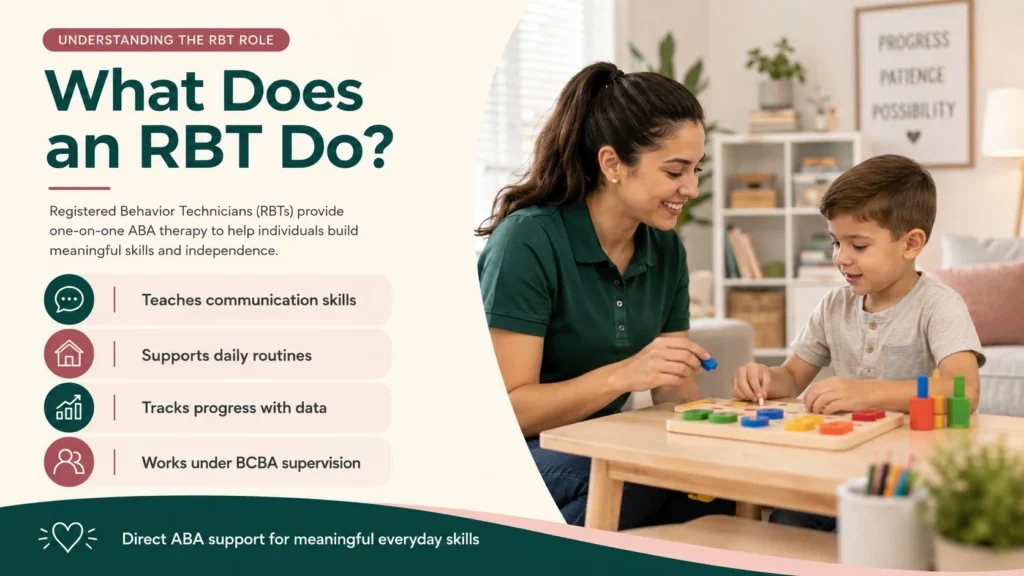
A Registered Behavior Technician (RBT) is a paraprofessional who attains certification through the Behavior Analyst Certification Board (BACB). RBT Services are direct behavior analytic services provided under close, continuous supervision of a qualified behavior analyst. They support clients in rehearsal and provide the approved procedure for behavior support, gather data and record client session activities. RBTs do not diagnose conditions and are not authorized to create treatment plans or provide ABA services.
How an RBT Fits Into the ABA Therapy Team
The supervising BCBA evaluates the client’s need, sets up individual goals, monitors progress, analyzes and sees data, and makes clinical decisions. The RBT implements those plans into daily activities using structured teaching, play, routines and natural learning opportunities.
When working directly with clients, RBTs can observe differences in communication, skill development, participation or responses while on treatment. They document these observations and share them with the supervising BCBA. The BCBA will give this direction, and parents, teachers and other professionals can also provide informative content. Families that receive ABA Therapy in Glendale CA might then have regular contact with an RBT, but be supervised by a BCBA.
Behavior Technician RBT Vs BCBA Differences
A behavior technician is a job role, and a Registered Behavior Technician is a BACB credential. Depending upon the employer, the payer, and local needs, a behavior technician can provide direct support without being an RBT. An RBT has completed specific training, assessment, examination, ethics, and supervision requirements. It is important that providers of the ABA Therapy in Burbank, CA make it clear to the family the qualifications and duties of each member on the team.
| Role | Main responsibility | Independent clinical practice |
| Behavior technician | Provides assigned direct support and may not hold RBT certification | No |
| Registered Behavior Technician | Implements supervised ABA services and maintains BACB certification | No |
| Board Certified Behavior Analyst | Assesses needs, designs treatment, analyzes data, and supervises services | Within legal and professional scope |
What Does a Registered Behavior Technician Do
A Registered Behavior Technician provides a service to clients to carry out programs developed by a supervising clinician. Core duties include teaching skills, following approved procedures, collecting data, and documenting outcomes. The responsibilities depend on the communication needs, priorities, treatment plan, safety to be considered and the age of the client. RBT services need to be personalized, respectful and meaningful to goals.
Implement Individualized ABA Programs
An RBT reviews procedures, prepares materials, and implements the intervention plan created by the BCBA. These may be used when teaching, such as reinforcement, prompting, task analysis, naturalistic teaching, or other strategies. Technician implements techniques routinely and states concerns rather than altering plans. Learning can happen during play, routines, or community experiences in the context of ABA Therapy in Northridge, CA.
Teach Communication and Functional Life Skills
Safety skills, participation in routines, transitions, and speech or alternative communication may be supported through RBTs. There may be goals that include dressing, hygiene, feeding, toileting, play, turn taking, coping, or self advocacy. If a child is reaching for a snack, to help they may request it more specifically. Children receiving ABA Therapy in Studio City, CA should work on goals based on individual needs.
Collect Objective Data and Document Sessions
Accurate data allows the BCBA to monitor progress and determine if changes are necessary. An RBT may record frequency, duration, latency, prompting levels, independent responses, or skill accuracy. Technicians can make changes to records and session notes. The information acquired throughout ABA Therapy in Granada Hills, California ought to be descriptive in nature without assumptions or judgmental language use.
Follow Ethical and Professional Boundaries
RBTs should keep confidentiality, maintain professional boundaries, accurately represent credentials and work within training. They can perform assigned procedures, gather data, report observations and communicate supervised. They are not qualified to diagnose autism, plan treatment, alter goals without consent, make guarantees, or make independent recommendations. The BACB expectations focus on the maintenance of dignity, compassion, assent, cultural responsiveness, data integrity and supervisor’s communication.
What to Expect During an ABA Session With an RBT
ABA sessions are modeled according to the child’s individualized treatment plan and may involve play activities, daily routines, communication practice and structured learning activities. The RBT develops rapport, teaches the child assigned skills, follows approved procedures, and records the child’s responses. Activities and teaching methods may vary based on the child’s goals, preferences, and current support needs.
Before, During, and After the Session
Common features to a session include:
- Reviewing current goals, previous notes, and safety information
- Receiving relevant updates from the parent or caregiver
- Preparing visual supports, activities, and preferred materials
- Helping the child transition comfortably into the session
- Practicing communication, self-care, social, adaptive, or safety skills
- Clearly using approved prompts and reinforcement
- Recording responses, progress, and levels of assistance
- Completing session documentation
- Reporting clinical or safety concerns to the supervising BCBA
A Parent-Friendly Session Example
Children can become agitated when play time is over. The RBT can remind the child, let them know in advance, and demonstrate a schedule.
The RBT supports the communication response as specified in the treatment plan and notes the supports that worked. The data is subsequently reviewed by the supervising BCBA who determines if there are any clinical needs to be made.
How RBTs Support Children and Families
Supporting Meaningful and Individualized Progress
RBTs help clients practice skills selected in the treatment plan and supervised by a BCBA. These supports can be directed towards:
- Functional communication and self-advocacy
- Self-care and daily routines
- Coping, safety, and participation
- Social interaction and independence
Attaining a good result is a gradual process which is influenced by the client, their objectives, treatment type and continuing support throughout. Harmless autistic behaviors or a lack of freedom from behaviors that are important for life are not the aim of respectful ABA. Goals should promote the clients daily functioning and be aligned with their needs, preferences and priorities in his/her family.
Support Across Home, Clinic, School, and Community Settings
RBTs may provide services in settings identified in the treatment plan:
- Home: Routines, and caregiver assisted practice, and communication
- Clinic: Structured teaching and skill development
- School: Transitions, classroom participation, and communication
- Community: Safety, waiting, buying and asking for assistance.
Generalization and independence can be enhanced at skills through mastery in the correct context.
How to Become a Registered Behavior Technician Without Unnecessary Delays
Becoming an RBT involves more than completing a course and scheduling an exam. Candidates will need to plan the access of training, competency assessment, employment and supervision prior to investing in these. An organized pathway can keep documents from expiring, certificates from being rejected, and training and certification breaks from occurring.
Confirm Your Full Certification Pathway First
Before enrolling in a course, identify how you will complete the Initial Competency Assessment. The 2026 requirements stipulate that services of the applicant, responsible assessor, and the client must be linked in some way, such as by job or contract, during the assessment. This implies that a candidate might not be able to employ an unrelated assessor and employ any kind of client.
Ask a training provider or prospective employer:
- Do you arrange the Initial Competency Assessment?
- Are there appropriate clients to play?
- Who is the responsible assessor?
- Is the organization’s hiring process done before or after certification?
- Who will be monitoring the exam after it’s over?
For candidates who are undertaking independent on-line training it is particularly important to clarify these things early on.
Evaluate Training Quality, Not Only Price
If one is to learn in 2026, that training has to be rigorously identified in terms of responsible trainers and how active learning is integrated into the training. Demonstrations, video, demonstration, quizzes, discussion, role-play, and feedback are used in training. Assigned readings alone cannot count toward the 40 instructional hours.
Check that the completion certificate will include:
- Your name and BACB ID
- Training start and completion dates
- Total instructional time
- The responsible trainer’s name and certification number
- Trainer verification or company branding
- The required 2026 eligibility statement
The responsible trainer must retain training records for at least seven years, and the BACB may audit the program. If the certificates lack information, a low cost certificate will not be of any benefit.
Schedule the Competency Assessment Carefully
The competency assessment can take place across one or several sessions. Assessment is a part of the job, it can be a real client, a role play or a real interview depending on the specific tasks. Observation can take place face to face, live cam recorded or recorded specially for observation.
If candidates do not show the skill, they can then be given feedback and retake the skill a later time. The full evaluation should be taken at the completion of training or at least 90 days prior to applying for certification. Delaying the application too long may require completing the assessment again.
Prevent Application and Testing Problems
The BACB entry into the BACB website must contain the same name as that provided in the candidate’s government issued identification. A name discrepancy can prevent entry to the Pearson VUE testing center. Please review the confirmation information, find the testing center in advance, and arrive about 30 minutes prior to the appointment.
Testing if necessary should be requested on an application form with documentation to accompany. BACB review typically takes 10–14 days and may take longer if additional documentation is required.
Candidates approved will be given a 12 month window of opportunity to take the exam, with a maximum of 8 attempts. There are seven day restrictions before the next attempt.
Plan for Active Status After Passing
Passing the examination does not immediately permit someone to work as an active RBT. When the credential is first added it is inactive until a qualified supervisor or requirements coordinator adds the RBT as a supervisee to the BACB portal. The Credential and Supervised status is then shown in the Certificant Registry.
Candidates are required to check with an employer prior to accepting client assignments or promoting themselves as an active RBT.
What to Know About the RBT Exam
This section should cover testing details instead of repeating the question count, content table, or study topics explained earlier.
Before Scheduling the Exam
Candidates schedule after authorization by the BACB by Pearson VUE. Name in the BACB portal must match government-issued ID at check-in. Accommodations requests must be made when the application is filled out for certification and be approved prior to scheduling.
What to Expect on Exam Day
Candidates should arrive approximately 30 minutes prior to the start of the meeting. Check-in includes identity verification, agreements, a photograph, and a palm-vein scan. All personal property, food, notes, calculators, and watches should be outside the testing room. Breaks are permitted, but the examination clock continues running.
Results, Retakes, and Scheduling Changes
Candidates get a pass or fail grade in the test center. If a candidate does not succeed with the first attempt, retake applying is required and this candidate can only test after 7 days. You can make up to 8 trials within the 12-month authorisation. If appointment must be cancelled or rescheduled, at least 48 hours in advance, fees may apply within 30 days.
Skills and Career Demand for Registered Behavior Technicians
RBT work requires more than knowing ABA terms. The technician is required to be consistent in responding to the client’s and family’s needs while responding to the supervising clinician’s.
Skills That Support Effective RBT Practice
Work-readiness skills include:
- Objective observation: Describe behaviour without presumer.
- Accurate documentation: Record data and session details.
- Professional communication: Record observations and seek advice.
- Emotional regulation: Remain calm during difficult situations.
- Adaptability: Adjust activities within the approved plan.
- Physical readiness: Participate safely in play, movement, or community activities.
- Cultural responsiveness: Honor family values, language, routines and the way people communicate.
Technical procedures can be learnt but reliability, ethical conduct and openness to supervision are factors which affect the quality of the services.
What Current BACB Data Suggest About Demand
BACB data show continued growth in RBT certification activity. The number of RBT certificants rose from 196,579 at the end of 2024 to 246,109 at the end of 2025. First-time exam participation also increased from 90,741 to 109,341. These are an indicator of increasing credential use and not by themselves a measure of job openings, salaries or demand in a city. Candidates should compare postings, schedules, supervision quality, travel expectations, benefits, and advancement opportunities before choosing a position.

How Parents Can Evaluate an RBT and ABA Provider
How to Verify RBT Certification
Parents may request the provider to verify the credentials of the technician and notify them of the supervising BCBA. The BACB Certificant Registry allows the public to check certification status and reportable disciplinary actions, and the registry is updated daily. Families also may want to ask the frequency with which the supervisor observes sessions, reviews data, and informs families of treatment changes. With the certification verifying basics have been accomplished, fit, digniture, and comfort matters remain.
Signs of High-Quality RBT Support
Look for an RBT who:
- Treats the client with patience, compassion, and respect
- Implements individualized plan and not improvising clinical changes
- Records data accurately and objectively
- Responds appropriately when withdrawing assent or being distressed
- Communicates concerns to BCBA timely
- Works with sensitivity to cultural differences, communication styles and sensory requirements
- Respects confidentiality and boundaries
- Avoids promising guaranteed or rapid results
- Accepts feedback, observation, and continued training
Frequently Asked Questions About RBTs
Is an RBT the Same as an ABA Therapist
The term “ABA therapist” is used informally and broadly to encompass people with various credentials and responsibilities. RBT is a specific certification issued by the BACB. An RBT can render direct, supervised services, but can not plan or deliver therapy independently. Families must inquire about the qualifications and supervision of anyone who provides services to them.
Does Every ABA Program Include an RBT
Not every ABA program uses the same staffing model. Direct services may be provided by an RBT, behavior technician, BCaBA, BCBA, or another qualified team member depending on clinical needs, funding requirements, staffing, and service setting. Parents should have a clear picture of who will care for their child. The supervising clinician should also discuss the quality monitoring of implementation.
Can an RBT Support Teenagers and Adults
The children, teens and adults need to be trained and supervised in the proper delivery of RBT services when the individual is working with children, teens, and adults. Goals may involve communication, community safety, employment readiness, self-care, coping, relationships, or independent living. Services should be age and priority/preference appropriate. Child-focused teaching materials should not be used automatically with older clients.
Can Parents Ask an RBT to Change a Treatment Goal
While parents may voice concerns, priorities, and observations to their RBT, the RBT cannot implement a clinical goal on their own. The RBT should pass the request to the supervising BCBA. The BCBA will be able to review info, confer with family and determine if the plan should be altered. Any safety or dignity issues that are urgent must be reported immediately.
Can More Than One RBT Work With the Same Child
Goals, setting, service hours or schedule may cause some clients to have more than one RBT. The supervising BCBA should train team members and monitor consistency. Families need to be aware of who is involved and how information is communicated. A coordinated team can value added to limit confusion and assist programme implementation in a more consistent manner.