
Introduction
Who spends the most direct time helping a child practice communication, daily living, social, and learning skills during ABA therapy?
In many programs, that professional is a behavior technician. According to BACB data, there were 246,109 Registered Behavior Technicians (RBTs) at the end of 2025, of which 82,681 were newly certified in 2025.
This guide covers the role, supervision, 2026 RBT certification requirements, the RBT exam, and anticipated changes after 2026.
What Is a Behavior Technician?
A direct-care person who has been qualified to implement part of the Applied Behavior Analysis treatment plan is a behavior technician. An RBT, also known as a Registered Behavior Technician, is a national paraprofessional credential given by the Behavior Analyst Certification Board. RBTs are not to be independent practitioners and must be under an approved supervision system. These services can be offered to help them communicate, learn, participate in society or to be independent, and to react safely in daily situations.
Behavior Technician Vs Registered Behavior Technician
Behavior technician is a term that can refer to a job, and Registered Behavior Technician is a BACB credential. BT and RBT are sometimes used interchangeably by employers, but they are not interchangeable.
| Behavior Technician | Registered Behavior Technician |
| General employment title | Formal BACB certification |
| Training may vary by employer | Meets standardized BACB requirements |
| May still be completing certification | Completed training, assessment, application, and examination steps |
| May not appear in the BACB registry | Certification status can be verified through the BACB |
What Does a Behavior Technician Do?
Duties vary based on client’s age, objectives, service environment and treatment plan. Common behavior technician duties include:
- Running structured or play-based teaching activities
- Practicing communication, social, and daily living skills
- Using approved prompting and prompt-fading procedures
- Delivering reinforcement according to the plan
- Implementing assigned behavior-support procedures
- Collecting behavioral and skill-acquisition data
- Writing objective session notes
- Reporting meaningful observations to the supervisor
- Supporting skills to be applied to routines and settings
A behavior technician may assist a child to request a break, to follow a routine, to take turns, to wait a short time or to finish a part of a self-care task. The RBT documents what happens in the session and the supervisor clinician analyzes the data and determines if treatment is to be altered.
What a Behavior Technician Cannot Do Independently
Behavior technicians are employed by a supervising BCBA or other qualified behavior analyst. Their job is to put into practice the agreed treatment plan, gather data and make observations.
A behavior technician cannot independently:
- Diagnose autism or another condition
- Make a clinical evaluation.
- Create, revise, or discontinue a treatment plan
- Add new goals or change intervention procedures
- Recommend or adjust medication
- Analyze clinical information independently.
- Include a definite outcome or timeframe for treatment
Any question related to safety, assessment, progress or changes in the program should be directed to the supervising clinician. It is also advised that technicians seek advice when a situation is not covered by the written plan or is beyond their training.
Where Behavior Technicians Work
Depending on the client’s treatment plan and needs, their behavior technicians may be able to offer ABA therapy services in a variety of settings.
These are typical service settings:
- Homes: Facilitating communication, self-care, routines and family involvement in the child’s natural setting
- ABA clinics: Providing structured teaching, play-based learning, and individualized skill development
- Schools: Helping children participate in classroom routines and use functional skills in educational settings
- Community settings: Practicing safety, communication, social participation, and independence in real-life situations
The location of the service should be based on the clinical need, family preferences, provider availability and any authorizations required.
How an RBT Supports a Child’s ABA Therapy
An RBT offers one-to-one assistance directly with the person, providing support to the person in accordance with the clinician’s treatment plan. In sessions, the RBT teaches assigned skills, implements approved procedures, records data and communicates data to the clinical team regarding observations.
RBT Vs. BCaBA Vs. BCBA
Education, Certification, independence, and clinical responsibility are all aspects of the ABA credentials.
| Credential | Primary Role | Level of Responsibility |
| RBT | Implements assigned teaching and behavior-support procedures, records data, and reports observations. | Works under ongoing supervision and does not independently design or change treatment. |
| BCaBA | Provides behavior-analytic services and may supervise RBTs. | Practices under the supervision of a BCBA. |
| BCBA | Conducts assessments, develops treatment plans, reviews progress, makes clinical decisions, and supervises the care team. | May practice independently within the professional’s scope of competence. |
While the RBT may interact with the child the most, the supervising clinician remains responsible for all clinical decisions and oversight. Understanding RBT Vs BCBA roles is important: an RBT delivers direct therapy under supervision, while a BCBA designs, oversees, and adjusts treatment plans. A BCaBA may also support service delivery and supervise RBTs while working under a BCBA. Families should know who is responsible for their child’s treatment plan, who oversees direct services, and whom to contact with clinical questions.
What Happens During a Behavior Technician Session?
The process a RBT typically uses is dependent on the individualized treatment plan of each child, but is generally as follows:
- Prepare for the session: Review Goals, Organize Materials, and get relevant updates to the session.
- Build engagement: Connect with the child and identify appropriate learning opportunities.
- Teach assigned skills: Use approved reinforcement, prompts, visual supports, and other written procedures.
- Collect data: Record the child’s responses and the level of support provided.
- Document and report: Complete session notes and share important clinical or safety concerns through the provider’s supervision process.
Example of the RBT’s Role
A child might be beginning to ask to stop an activity instead of leaving. The RBT creates an appropriate practice opportunity, uses the prompt specified in the plan, reinforces the request, and records what happened.
The RBT does not independently decide to introduce a new procedure or change the goal. The information is reviewed by the supervising clinician and a decision is made to either update the treatment plan or not.
How Families Collaborate With the ABA Team
Family engagement allows the care team to learn about the child’s skills and support needs and how they may vary within the child’s daily routine.
Caregivers can support collaboration by:
- Communicating pertinent changes in sleep, health, medicine, school, schedules and behavior
- Helping to explain what skills would make life easier or safer for them to deal with everyday life
- Asking for clarification about current goals and procedures
- Participating in caregiver training with the supervising clinician
- Sharing whether skills are being used outside therapy sessions
- Reporting issues related to comfort, safety, communication or progress
Any questions that require assessment, treatment changes or clinical interpretation should be directed to the supervising BCBA or BCaBA, respectively. The RBT may make observations and may implement the approved plan; however, it should not make any independent clinical changes.
How to Earn Registered Behavior Technician Certification
To become a Registered Behavior Technician, candidates must be eligible, attend and complete training and assessment, apply to the BACB, and pass the RBT exam.
Meet the Eligibility Requirements
Before applying, candidates must:
- Be at least 18 years old
- Have a high school-level education or equivalent
- Pass a criminal background check
- Pass an abuse registry check
The background and registry checks should be done within 180 days prior to payment of the application fee. An eligible BACB certificant must confirm that the applicant meets these requirements. Fingerprinting is not required by the BACB, although employers, states, schools, or funding sources may require it.
Complete the 2026 40-Hour RBT Training
All applicants who apply after January 1, 2026, will complete training in accordance with the 40 Hour Training Requirements and Curriculum Outline for the RBT 2026.
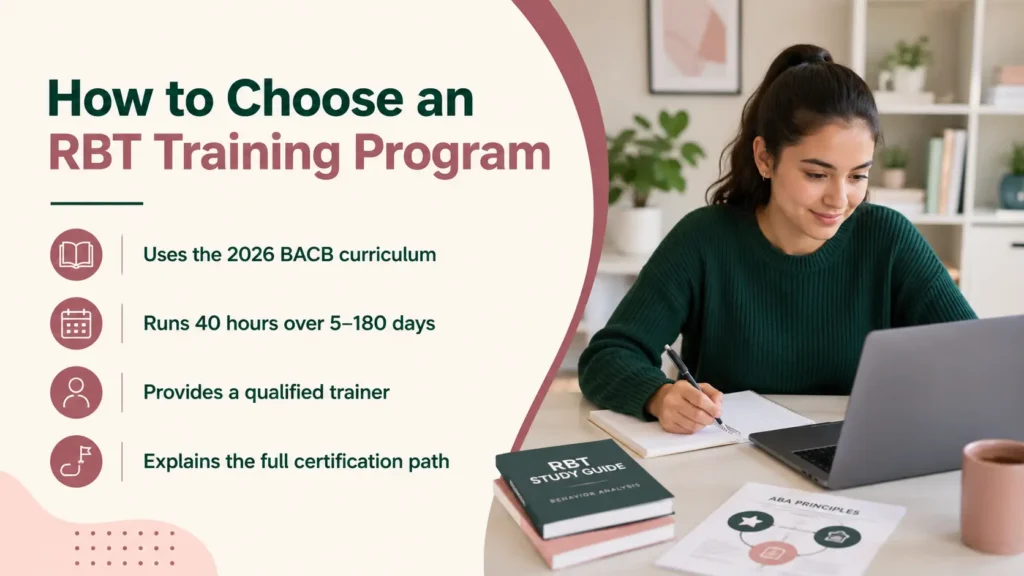
The training must:
- Include at least 40 instructional hours
- Be completed within 5 to 180 days
- Be delivered in person, online, or through a blended format
- Use interactive teaching instead of lectures on reading.
- Be designed and overseen by a qualified BCBA, BCaBA, or BCBA-D who completed the required supervision training
Core topics include ABA foundations, data collection, assessments, behavior-change procedures, documentation, ethics, professionalism, and supervision. The completion certificate should state that the course is eligible for the 2026 requirement and is not being offered by the BACB.
Can RBT Certification Be Completed Online?
The 40-hour training may be completed online. However, completing an online course does not make someone a certified RBT.
Applicants will still need to take a competency assessment and pass the exam at any Pearson Vue testing center and apply to be on the BACB. Beware of programs that claim to be instant or fully online RBT certification programs.
Complete the Initial Competency Assessment
The assessment must be completed after training and within 90 days before applying. Candidates must demonstrate all 19 required tasks, including three skill-acquisition or behavior-reduction tasks with a client.
A qualified BCBA or BCaBA oversees the assessment. Other tasks may be evaluated through client observation, role-play, or a live interview. The applicant is responsible for meeting the organizational relationship requirements set by the BACB as are the participating clients and the assessor.
Apply and Pass the RBT Exam
Candidates will upload their training certificate, competency assessment and eligibility attestation via the BACB portal.
Current 2026 fees are:
- BACB application fee: $65
- Pearson VUE examination appointment: $45
The BACB recommends allowing about two weeks for application processing. After passing, the RBT must have a qualified supervisor or requirements coordinator listed with the BACB before practicing or representing themselves as active.
RBT Exam Format, Topics, and Preparation
The RBT exam assesses the knowledge and hands-on practice skills to work safely with supervision. Candidates testing in 2026 are examined using the RBT Test Content Outline, 3rd Edition.
Current RBT Exam Format
The computer-based examination will be given via Pearson VUE and will consist of:
- 85 multiple-choice questions
- 75 scored questions
- 10 unscored pilot questions
- 90 minutes of testing time
- Four answer choices per question
The 90 minutes will encompass the test tutorial, test questions, and any final review.
| Content Area | Scored Questions | Exam Percentage |
| Data Collection and Graphing | 13 | 17% |
| Behavior Assessment | 8 | 11% |
| Behavior Acquisition | 19 | 25% |
| Behavior Reduction | 14 | 19% |
| Documentation and Reporting | 10 | 13% |
| Ethics | 11 | 15% |
Behavior Acquisition is the largest domain, followed by Behavior Reduction. Candidates are advised to be prepared to answer the full outline, not one content only.
RBT Exam Statistics and Preparation
BACB data for 2025 show:
- 109,341 first-time candidates took the RBT examination
- 75% of first-time candidates passed
- 54,674 retake examinations were completed
- 38% of retakes earned a passing grade
These are historical results—these do not guarantee the performance of the individual applicant.
Preparation should include:
- Reviewing every domain in the current Test Content Outline
- Revisiting the concepts covered during the 40-hour training
- Incorporating measurement, prompting, reinforcement, documentation and ethical decision making.
- Learning about questions that are designed to assess the reaction of an RBT in actual services
- Practicing weaker concepts, rather than just definitions.
Candidates should use current 2026 materials and not study using resources that are based on the previous RBT Task List. Examination questions are confidential, so websites claiming to offer actual or guaranteed test questions should not be trusted.
Supervision, Ethics, and RBT Certification Maintenance
To maintain the RBT credential, RBTs must continue to meet the current recertification requirements, follow the RBT Ethics Code, and have qualified supervision.
Ongoing Supervision Requirements
An RBT must receive supervision equal to at least 5% of their monthly behavior-analytic service hours.
Monthly supervision must include:
- Two or more live, real-time contacts
- At least one individual supervision meeting
- At least one observation of the RBT providing client services
- No more than 10 RBTs in an allowed group meeting
Supervision can include live video (when legally allowed) but not recorded video or passive (no real-time) supervision. RBTs working for multiple organizations must meet the full supervision requirements separately at each organization.
Ethics and Professional Boundaries
RBTs must:
- Ensure client confidentiality and respect for dignity.
- Record data and session information accurately
- Follow approved treatment procedures
- Work within their training and competence
- Maintain appropriate professional boundaries
- Request supervision if concerns are beyond the treatment plan
RBTs may not independently change interventions or make clinical decisions. If there is a concern about ethics, safety, or treatment, this should be reported to the BCBA/BCaBA right away.
RBT Recertification Changes Beginning in 2026
All RBTs will need to take the Recertification Competency Assessment one final time before they start the next two-year cycle of recertification.
After certifying or recertifying in 2026:
- Certification is renewed every two years
- RBTs must earn 12 professional development units
- All PDUs can be earned from qualifying workplace training, ACE events, or behavior-analytic university training.
- Client-specific supervision cannot also count as professional development
- The two-year recertification fee is $50
For 2026, most RBTs will be recertified in 2028, not 2027. Always verify requirements and deadlines via the BACB portal and the BACB current RBT Handbook.
What Parents Should Look for in a Behavior Technician
Parents should assess a behavior technician’s certification as well as his or her professionalism throughout the day.
Professional Qualities and Certification Verification
A strong behavior technician should be:
- Patient and dependable
- Respectful of the child’s dignity and communication style
- Prepared for sessions
- Accurate when collecting data
- Open to supervision and feedback
- Clear and professional when communicating with families
Certification confirms that an RBT has met the BACB’s minimum eligibility, training, assessment, and examination requirements. However, service quality also depends on effective supervision, appropriate training on the child’s treatment plan, and a good working relationship with the child and family.
Parents can verify an RBT’s current status through the BACB Certificant Registry and should ask:
- Is the Technician now certified and in active service?
- Who is the supervising BCBA or BCaBA?
- How is the technician trained on my child’s program?
- How often does the supervisor observe sessions?
- How are progress and data reviewed?
- How can concerns be reported?
An RBT must have qualified supervision connected to their credential before providing services as an active RBT.
Warning Signs Families Should Not Ignore
Families should raise concerns when a technician:
- Cannot identify their supervisor
- Changes treatment procedures without approval
- Repeatedly fails to document sessions accurately
- Shares private client information carelessly
- Uses threatening, punitive, or disrespectful language
- Does not respond to obvious pain, fear or distress
- Exaggerates certification or professional duties
Documentation and referral to the supervising clinician or provider are encouraged. Emergency and reporting protocols of the organization should be followed immediately for any safety concerns.
Is Behavior Technician Work a Good Career Path?
Teaching assistant jobs may be a good starting position for those who like to work with children or adults, have a structured approach to work, like feedback and like to be guided.
The role may be a good fit for someone who is:
- Comfortable collecting data
- Able to stay calm during challenging situations
- Open to supervision and coaching
- Interested in behavior analysis, education, or healthcare
RBT certification is not dependent upon a college degree, which makes the field relatively accessible. There is real life experience with skill teaching, treatment plan implementation, documentation and professional communication as well.
RBT experience can be applied to future studies to become a BCaBA or BCBA. It takes further study, supervised practice and exams to obtain those credentials.
Candidates should compare before taking up a job:
- Training and supervision quality
- Work schedule and travel expectations
- Pay and benefits
- Caseload support
- Opportunities for advancement
Understanding Behavior Technicians in Southern California
Behavior technicians are directly involved in assisting children to practice communication, daily living, social and safety skills in ABA sessions. They work under the care of a qualified BCBA or BCaBA, under a customized treatment plan, take data and report observations to the clinical team. Families should be aware of the supervisor of the technician, how often services are reviewed, and how treatment decisions are made.
Alma Behavioral Solutions offers families clinically supervised ABA services throughout Southern California. Parents exploring ABA Therapy in Pasadena, CA or ABA Therapy in Los Angeles, CA can contact the team to learn more about behavior technician support, enrollment, insurance, service settings, and supervision. Call (747) 250-8494 or email info@almabehavioralsolutions.com to discuss available care options for your child and family.
Frequently Asked Questions About Behavior Technicians
Is a Behavior Technician the Same as an RBT?
Not always. Registered Behavior Technician is a formal credential from the BACB, while behavior technician is a generic term. A technician could be in the process of certification or be working under another qualification. If a certification is required, families should inquire of the professional’s status and obtain proof of an active RBT credential.
Does a Behavior Technician Need a College Degree?
RBT certification requires a high school-level education or equivalent, not a college degree. Some employers may require experience, CPR training, Coursework, or other qualifications related to this position. The BCaBA and BCBA are advanced positions that involve further education and certification.
How Long Does RBT Certification Take?
The 40-hour training must be completed over at least five days and no more than 180 days. The full timeline also relies on background checks, competency assessment availability, process of the application and examination availability. Students are advised to verify the entire certification process prior to taking an online course or in-person course.
Can RBT Certification Be Completed Entirely Online?
No. The 40 hours of training can be presented and delivered online and portions of the competency assessment could be done remotely using approved methods. There are also necessary practical assessment, BACB application, RBT exam, and supervision. Completion of the Course is not a substitute for active RBT certification.
How Hard Is the RBT Exam?
Preparation and real-life application of concepts affects difficulty. The exam is done on data collection, evaluation, behavior acquisition, behavior reduction, documentation, and ethics. It is often more beneficial to study the current 3rd Edition content outline and do applied examples than simply definitions or flashcards.
Can an RBT Work Without a BCBA?
An RBT cannot work as an independent behavior-analytic practitioner. There must be an approved RBT Supervisor or Requirements Coordinator structure in place to provide qualified supervision. An RBT who does not have a supervisor or coordinator on record is not active and may not practice, bill or be represented as active.
Can Parents Become Registered Behavior Technicians?
Parents may pursue RBT certification if they meet all eligibility requirements. It is not automatically assumed that a parent can become a paid behavior technician for their own child with certification. If services are to be provided, employer policies, payer requirements, clinical appropriateness, ethical relationships and possible conflicts of interest need to be evaluated prior to services.