

Can your child learn practical skills at home, while you learn with your child and a professional from the ABA field, through a video call? This is possible in some families.
When school schedules are full, stress from changing routines, and access to providers close to home are obstacles to traveling to appointments. Parents always want to know what remote care entails.
Virtual ABA therapy for Autism is personalized support using live technology! One clinician could work directly with your child, coach the parent or a mix of both depending on individual needs.
This guide covers formats, session steps, techniques, benefits, safety, and costs. You’ll get to know what questions to ask when you select care that will be comfortable and meet your child’s needs.
Key takeaways
· Remote ABA is not exactly a ‘one-size-fits-all’ approach and should be supervised by qualified professionals, not just an app.
· Caregiver coaching can help bring practice into the home environment.
· Some parent training methods are supported by research, though results differ when it comes to children and the type of service.
· Eligibility for insurance, safety requirements, and children’s willingness to participate all factor.
What Is Virtual ABA Therapy?
Virtual ABA therapy is Applied Behavior Analysis that is provided remotely via live communication, typically via secure video appointments. The intent is to facilitate meaningful learning, not screen time.
Applied Behavior Analysis (ABA) is a method of observation, assessment and individualized teaching to help children communicate, engage in daily activities, be independent and express needs in a safe way. Care plans should take into consideration a child’s strengths, priorities, preferences and right to be there.
The Board Certified Behavior Analyst (BCBA) is usually in charge of assessment and treatment planning. Depending on the approved format, a Registered Behavior Technician (RBT) might participate in services under appropriate supervision. A video or learning app (alone) is not the same as Clinician-directed care.
Our ABA Therapy For Families page explains the broader services that can support children beyond remote appointments.
Types of Virtual ABA Therapy
Telehealth ABA therapy can be delivered in many forms and the best way to do it for your child will depend on their needs. Not all screens need to be interacted with to deliver online.
Direct Virtual Sessions
A clinician can also guide games or short skill training sessions during virtual ABA therapy sessions. This works if child’s objectives are appropriate for distance engagement. A caregiver can provide assistance to materials while not being the therapist.
Caregiver-Mediated Coaching
ABA parent training online allows the BCBA to observe your interactions throughout the day and help you as you learn. You may try to give choices at snack time or modify a difficult schedule. Clinician will still be responsible for guidance.
Hybrid ABA Services
Some families utilize online ABA therapy for coaching, in addition to its in-person services. A hybrid plan may be helpful for home observation, as well as providing care for goals that need direct care. Must be available based on clinical fit and coverage.
How Does Virtual ABA Therapy Work?
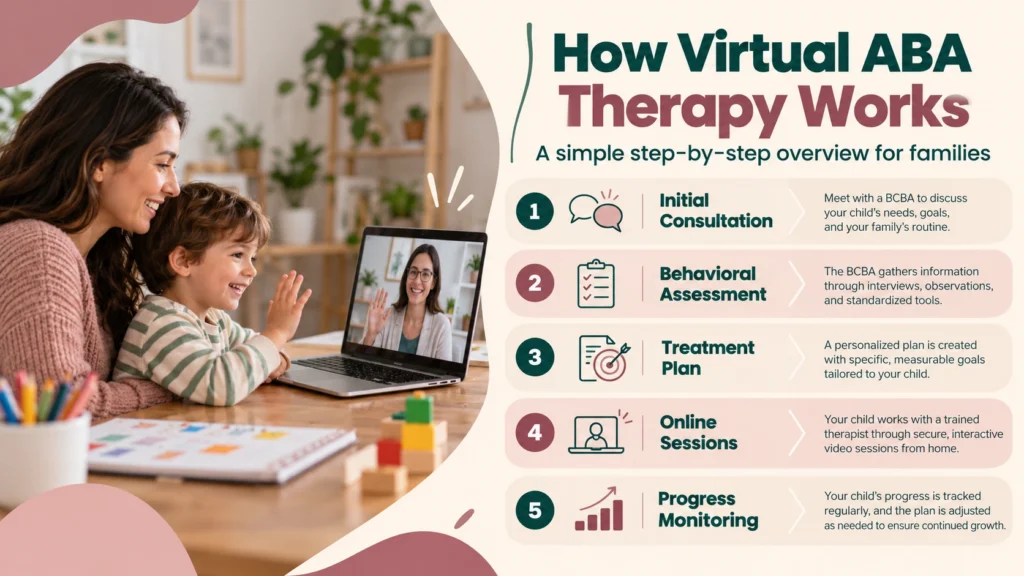
Parents commonly ask, how does virtual ABA therapy work without a therapist physically present? Assessment, professional supervision, clear objectives and periodic re-evaluation are still key elements in the process.
Initial Consultation
Starting virtual ABA therapy means discussing your child’s strengths, communication, concerns, and priorities. A Burbank caregiver, for example, might describe difficult morning transitions. The team should discuss what the next steps are with the family but not commit to immediate enrollment.
Behavioral Assessment
A BCBA can provide a review of caregiver interviews, records, observations, baseline skills, before telehealth ABA therapy. An ABA evaluation will identify treatment needs, but not make an autism diagnosis. Check out our ABA Assessments Information.
Individualized Treatment Plan
A plan for virtual ABA therapy for autism should set meaningful, measurable goals. This can be asking for assistance, having favourite play or helping with a part of a daily routine. Clinician establish goals for progress and adjust instruction.
Online Therapy Sessions
Virtual ABA therapy sessions may include a strategy, an activity that is child-led, and an opportunity for caregiver feedback. Balance between it depends on the format. Breaks should be comfortable and engaging for your child.
Progress Monitoring
Online ABA therapy uses observation and data to track meaningful skills. Your clinician should discuss changes, seek your input, and implement strategies that are not working. There is no pressure to be ‘less autistic’ to progress.
How the Virtual ABA Therapy sessions work?
A typical lesson is more of an interactive session than viewing a lesson on a device. Virtual ABA therapy session should be related to familiar activities with your child.
Example of a Home Session
This online ABA therapy for autism schedule is hypothetical, not an ALMA protocol. Visualise a child practising requests with the us. A Glendale caregse of blockiver places a tablet nearby while the clinician coaches.
| Example activity | Time |
| Caregiver check-in | 5 minutes |
| Child-led play | 10 minutes |
| Guided communication practice | 15 minutes |
| Caregiver feedback | 10 minutes |
| Next-step review | 5 minutes |
Total: 45 hypothetical minutes. Real sessions can vary in length and/or structure.
The Caregiver’s Role
With ABA parent training online, you can schedule activities, communicate and practice strategies with real-time support. Professional responsibility won’t pass to you when it’s a treatment that is remote.
ABA Techniques Used Online
Virtual ABA therapy can employ existing teaching methods as they are appropriate for your child’s goals and the distance format. Methods should continue to be flexible, respectful and individualized.
| Technique | Plain-English purpose | Everyday example |
| Natural Environment Teaching (NET) | Practice within familiar activities | Asking for a favorite toy during play |
| Functional Communication Training (FCT) | Teach a useful way to express a need | Requesting a break when overwhelmed |
| Positive reinforcement | Support a skill with a meaningful outcome | Getting help after clearly requesting it |
| Task analysis | Divide a routine into manageable steps | Learning the sequence for handwashing |
| Prompting and fading | Offer help, then reduce it when possible | Following a picture schedule more independently |
| Discrete Trial Teaching (DTT) | Practice a specific skill in short, structured opportunities | Identifying familiar items during an appropriate activity |
A BCBA uses assessment results and parent feedback to choose strategies. Communication can be verbal, nonverbal, such as gestures, pictures, or augmentative and alternative communication (AAC), and no way to communicate should be considered invalid.
Benefits of Virtual ABA Therapy
The most relevant virtual ABA therapy benefits involve practical access and opportunities for skill practice. Families need to consider these options in relation to their child’s personal circumstances.
· Less travel: Video visits can help reduce travel needs, particularly when a clinic visit interferes with school or work hours.
· Familiar surroundings: Children may practice communication or daily living skills where those skills are needed.
· Caregiver learning: Real-time coaching can help you understand and use agreed strategies between appointments.
· Remote participation options: Some clinical discussions and/or parent-coaching activities may be more easily scheduled remotely.
· Useful routines: Practicing at mealtimes, during play or transitions can make goals relevant to home life.
For example, a parent in Studio City may choose to have a clinician coach them remotely with a challenging bedtime, to gain insight into the actual setting. This is an example only, not a guarantee of what is to come or the availability of local appointments.
Is Virtual ABA Therapy Effective?
Some studies indicated that virtual ABA therapy for autism can benefit some families, especially when it involves caregiver training under the supervision of a therapist. Evidence is promising, but it does not justify universal claims.
Li et al. (2026) found in a 2026 meta-analysis that children who were trained by their caregivers through telemedicine showed improved communication and adaptive skills. Adedipe and Walton (2025) reported low levels of benefits for parent-reported behavior and caregiver outcomes for children with developmental disabilities.
The important distinction: These studies primarily examine remote parent-training approaches. They are not evidence-based that all direct-to-child video programs will have the same results as in-person ABA. Achievement of good outcomes is reliant on the child’s objectives, clinical match, sustained engagement, competent supervision and continuous adaptation. We focus on achieving any progress, rather than committing to specific timelines.
Who Is Virtual ABA Therapy Suitable For?
Families exploring virtual ABA therapy for kids deserve a realistic assessment of fit, not a universal recommendation. Suitability ought to contain comfort and safety, objectives, and caregiver capacity.
Signs of a Good Fit
When a child can do short duration of supported activities, caregivers are interested in coaching, and supported activities are to be conducted in familiar routines, families seeking ABA therapy online may benefit. If a child does not speak, or even sit still during a call, this is not a requirement for them to be considered – the clinician must assess the proposed format.
When Additional Support Is Needed
Telehealth ABA therapy might not be enough when the child requires immediate live assistance, there are safety concerns, or the planned session format causes distress. A family in Northridge may consider providing in-person care for a goal that is not safe to meet via video. Treatment decisions should honor the child’s responses and choices.
How to Prepare for Online ABA Therapy
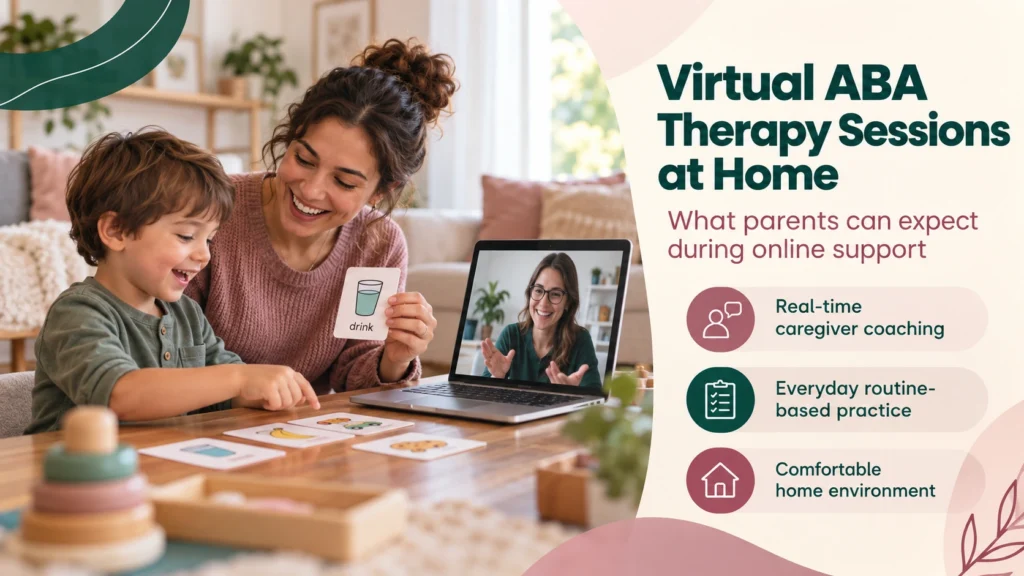
Online ABA therapy doesn’t need expensive equipment or require a completely quiet home. Some simple measures can minimize distractions and enhance comfortable participation.
Before the first appointment:
· Use a cell phone, tablet, or computer with an active camera and microphone.
· Check internet connection and how to join the meeting securely with the provider.
· Choose a comfortable space with appropriate privacy, without forcing your child to stay in one position.
· Keep preferred toys or materials nearby if the clinician has requested them.
· Arrange caregiver availability based on the treatment model.
· Discuss a plan for technical disruptions, breaks or safety concerns.
Just like any family in the community, families in Granada Hills have questions to ask that can be answered practically:
· Who should be present?
· When our child needs space, let us take a break?
· What happens if the connection drops?
Federal Telehealth Privacy Guidance suggests privacy in the setting and reasonable measures to secure devices and communications.
How Much Does Virtual ABA Therapy Cost?
When looking up ABA therapy online, consider the difference between the charge per hour and what you’ll likely pay your family. Insurance rules, approved services, and cost-sharing change the calculation.
Hourly Pricing Factors
Factors affecting price of virtual ABA therapy include clinician type, service type, schedule, and network status. Ask for written rates, such as assessments or coaching separately.
California Insurance Coverage
Check with your plan prior to scheduling telehealth ABA therapy. Medically necessary treatments for behavioral health for youth under 21 are covered by California’s Department of Health Care Services (DHCS) and may be delivered virtually.
| Coverage type | What to confirm |
| Commercial insurance | Behavioral treatment benefits, in-network providers, telehealth rules, prior authorization, deductible, copay, and coinsurance |
| Medi-Cal | Eligibility, clinical recommendation, managed-care process, authorization, and whether the proposed remote service is covered |
| Self-pay | Written hourly rates, billing increments, cancellation terms, and any assessment charges |
California’s Department of Insurance explains autism-treatment protections. Please check individual benefits with your insurance provider and ALMA; general coverage does not mean that all appointments are paid.
Hypothetical Monthly Budget
Potential virtual ABA therapy benefits do not guarantee savings. These numbers are not ALMA rates or averages, but simply assuming $125 an hour for 4 weeks.
| Hypothetical schedule | Calculation | Estimated pre-insurance cost |
| One 1-hour visit weekly | $125 × 4 visits | $500 |
| Two 1-hour visits weekly | $125 × 8 visits | $1,000 |
If there is no deductible or other out-of-pocket expenses, a copay of $25 for four covered visits would be $100 in total. Confirm actual benefits first.
Frequently Asked Questions
It’s common for parents to have questions once they hear about online ABA therapy. These five answers address concerns that are not covered in detail in the main sections.
How Many Hours of Online ABA Therapy Does a Child Need?
The schedule for virtual ABA therapy for kids depends on individualized goals, assessment findings, and clinical recommendations. The hours suggested should be discussed with your provider because they are for a specific reason and the plan should be reviewed when needs change.
Does My Child Need to Stay on Camera Throughout the Session?
Not necessarily. Online ABA therapy for autism can include activities for caregivers that are not specifically supervised by the screen, but rather supervised or coached by the clinician. Expectations for participation should be based on your child’s need, consent and comfort.
Can Online ABA Therapy Support Nonspeaking Children?
Yes, some children who do not use spoken language may participate in ABA therapy online through gestures, pictures, or AAC devices. Suitability depends on individualized assessment and the available clinical support.
Can Virtual ABA Therapy Provide an Autism Diagnosis?
No. ABA parent training online is a support service, and not an autism diagnostic evaluation. Autism is evaluated by a competent diagnostician and treatment needs and treatment goals are assessed by ABA Clinician.
Can Virtual ABA Therapy Sessions Be Recorded?
Recording virtual ABA therapy sessions requires appropriate consent and privacy safeguards. Before sessions, ask if it is OK to record, why it is important to record, how it is going to be secured, and who will have access to recordings.
Explore Virtual ABA Therapy with ALMA
The first step to selecting care should be to start with your child’s needs, rather than the pressure to select a format. Virtual ABA therapy for autism may support meaningful skills in familiar routines.
Support may be one component of a comprehensive remote support plan, which may also include in-person support when necessary.
At ALMA Behavioral Solutions, we specialize in personalized treatment, the involvement of family members, and objectives that take into account your child’s communication and comfort. Beverly Hills and surrounding Southern California families can explore services, eligibility and determine if remote support is clinically suitable for their family.
Explore Our Virtual ABA Therapy Services or Contact Our Team. Please give (747) 250-8494 a call or send an email to info@almabehavioralsolutions.com to learn what happens next, how to verify coverage, and to arrange a consultation to discuss details about you and your child.