
RBT Vs. BCBA: Understanding the Key Differences
If you are looking into ABA therapy for your child or exploring a career in applied behavior analysis, you have probably come across the terms RBT and BCBA. While both play important roles in ABA services, they have different responsibilities.
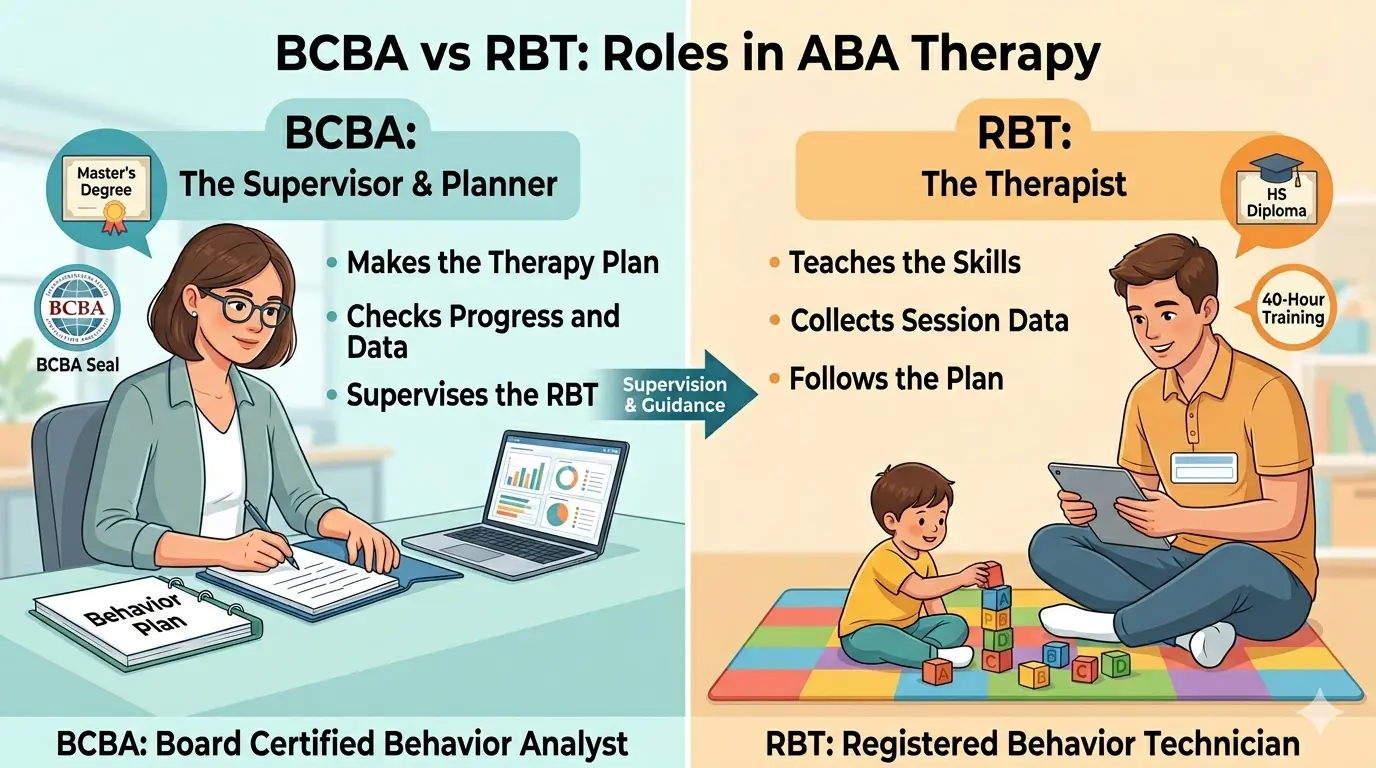
An RBT (Registered Behavior Technician) supports clients and implements treatment plans within therapy sessions, and a BCBA (Board Certified Behavior Analyst) evaluates the need, then creates individualized treatment plans, supervises treatment, and monitors therapy.
It can be helpful for families to understand the difference between an RBT and a BCBA to help them better understand how they are working together to support meaningful outcomes.
Key Takeaways
- RBT stands for Registered Behavior Technician. An RBT is a paraprofessional who implements ABA programs and is closely supervised by another therapist or clinician.
- BCBA stands for Board Certified Behavior Analyst. A BCBA is a graduate-level professional who evaluates the needs, develops treatment plans, oversees RBTs, reviews data, and makes clinical decisions.
- The biggest difference in the RBT vs BCBA comparison is responsibility. RBTs implement plans. BCBAs create, monitor, and adjust those plans.
- These two are synergic. RBTs offer ongoing assistance, and BCBAs analyze data, observe, and engage families to inform care.
- Families can make a difference by selecting an ABA provider that has trained RBTs and qualified BCBAs, which will lead to consistency, communication, and progress.
What are RBTs and BCBAs?
Before we compare RBTs and BCBAs, it helps to understand the basics of ABA therapy.
Applied Behavior Analysis (ABA) is a science-based strategy that addresses learning in humans and the practical, measurable methods of teaching skills. In ABA therapy, children may work on communication, social interaction, daily living skills, emotional regulation, play, and other goals tailored to their individual needs.
What is RBT?
If you are wondering what a Registered Behavior Technician does, the answer is simple.
A trained paraprofessional who is supervised to provide direct ABA services is an RBT. They may often be used one on one with children during therapy sessions, using this time to practise skills, support behaviour plans and to develop independence for children whilst also gathering data on progress.
Typically the RBT will be the most frequent contact child sees. They can assist with the following: communication, directions, coping, social function and daily living.
RBTs do not create treatment plans. Rather, there are plans developed by a supervising BCBA that they implement and receive feedback from the BCBA based on what they see during sessions.
What is BCBA?
A BCBA is a graduate level professional that will evaluate a client’s needs, design individualized treatment protocols, oversee RBTs, analyze data, and provide clinical decisions.
Rather than focusing only on individual sessions, the BCBA looks at the overall picture. They analyse progress and identify any difficulties and decide on next steps and make changes if necessary.
In many cases, a BCBA is the clinical lead, monitoring treatment to ensure it is ethical, data-driven, and results in the most effective treatment for the child’s unique strengths and objectives.
RBTs Vs. BCBAs: Key Differences
When people search for RBT vs BCBA, they usually want to know who does what. The easiest way to think about the difference is that the BCBA, rather than the RBT, makes clinical decisions, creates the treatment plan and oversees the implementation of the treatment plan during therapy sessions. Although their responsibilities differ, both roles are essential and work together to provide consistent, effective ABA services.
a) Roles and Responsibilities
Typically, an RBT will concentrate on implementation. This means the RBT works with the client during sessions and follows the treatment plan created by the BCBA.
Common RBT responsibilities include:
- Carrying out skill-building programs
- Using positive reinforcement strategies
- Collecting data during therapy sessions
- Following behavior intervention plans
- Helping the child practice communication, social, and daily living skills
- Reporting progress, challenges, and concerns to the BCBA
A BCBA is an individual who is involved with assessment, planning, supervision, and clinical decision-making.
Common BCBA responsibilities include:
- Conducting assessments
- Creating individualized treatment plans
- Setting measurable goals
- Training and supervising RBTs
- Reviewing data and monitoring progress
- Updating programs when needed
- Communicating with families and caregivers
- Collaborating with schools, doctors, and other providers when appropriate
In simple terms: The RBT is typically more hands-on during daily therapy sessions, while the BCBA is responsible for designing, supervising, and overseeing the overall clinical direction of care.
b) Autonomy and Decision-Making Authority
An RBT works under close supervision. They take on the treatment plan and remain in their training & role. If a child is not responding to a program, if a behavior changes, or if there are clinical questions for the family, the RBT returns the information to the BCBA.
A BCBA has more decision-making authority. The BCBA can evaluate behavior, adjust goals, adjust treatment, and make clinical recommendations based on the data and clinical judgment.
This distinction is to safeguard the client. It supports consistent RBT support for the child and ensures that direct therapy is provided by a professional with advanced training.
c) Training and Clinical Authority
A training and clinical authority is the education, expertise and responsibility each professional has within the scope of ABA services.
An RBT’s training prepares them to implement behavior analytic services under supervision. RBTs do not diagnose, independently evaluate clients, or develop treatment plans.
A BCBA’s clinical powers are greater. BCBAs are able to assess, design interventions, oversee team members, train caregivers, and adjust interventions according to client progress.
This distinction is one reason ABA teams often include both roles. The RBT provides day to day support that is consistent and the BCBA ensures that services are individualized, evidence based and clinically appropriate.
Education and Certification Requirements for RBTs and BCBAs
Education and certification are another major difference between RBTs and BCBAs. The RBT training path tends to be shorter and is a good start to the ABA profession. A certification exam, supervised fieldwork, and graduate education are all required to obtain a BCBA.
- RBTs Requirements and Training
To become an RBT, candidates must meet the requirements established by the Behavior Analyst Certification Board (BACB).
In general, the process includes:
- Being at least 18 years old
- Having a high school diploma or equivalent
- Completing a 40-hour RBT training program
- Passing a competency assessment
- Passing the RBT exam
- Working under ongoing supervision
- RBT Ethics Code
RBT training includes such fundamental concepts of ABA as measurement, skill acquisition, behavior reduction, documentation and professional ethics.
- BCBA Educational Path and Certification
Advanced education, supervised field work, and certification are required to become a BCBA. Typically, candidates have a master’s degree or higher in a related area or coursework in the field of behavior analysis, plus supervised practical experience.
After meeting these requirements, candidates must pass the BCBA certification exam. This training equips BCBAs with the skills to evaluate behavior, create treatment plans, oversee RBTs and make clinical decisions based on data, while upholding ethical practices.
- Continuing Education and Professional Development
RBTs are supervisory support is provided on an on-going basis to ensure quality of service, enhancements to clinical skills and ongoing accurate and ethical application of treatment plans.
BCBAs also engage in ongoing education to keep up to date on research, best practices, supervision techniques and ethical guidelines within applied behavior analysis.
The desire to continue learning enables the delivery of quality, individualized care based on the latest evidence and empowering client outcomes.
Daily Tasks and Responsibilities
While both an RBT and a BCBA have the same ultimate goal of helping the client to develop meaningful skills and enhance their quality of life, daily work may be very different.
i) What Does an RBT Do Each Day?
There is much to do on an RBT’s day, it is often active, direct and client focused.
The usual routine for an RBT session would involve some amount of material preparation, a greeting, review of the treatment plan, delivery of skill programs, reinforcement of skills, data collection, and assisting the child in practicing important goals.
For instance, an RBT can teach a child to replace crying with a request for a break, take turns in play, follow a morning sequence, or use words, signs or a device to communicate.
The RBT tracks what happens during the session. This data helps the BCBA understand what is working and what may need to change.
The work can be rewarding, but it can also be demanding. RBTs need patience, energy, compassion, and strong communication skills. They can be employed in community, schools, clinics or homes.
ii) What Does a BCBA Do Day to Day?
The daily activities of a BCBA can vary and involve clinical planning, supervising others, reviewing data, communicating with caregivers and direct observation.
A BCBA can observe a therapy session, train an RBT, meet with a parent, review and update a treatment plan, review data graphs, conduct an assessment, or work with a school team.
The BCBA is constantly asking:
- Is this plan helping?
- Is the child making progress?
- Is the goal still appropriate?
- Does the RBT need more support?
- Does the family need more training?
BCBAs also document, deal with insurance requirements, treatment updates and supervision notes. This is one reason that many BCBAs will be burdened with administration. Organized systems and clear communication free up the time for BCBAs to concentrate on providing clinical quality.
RBT and BCBA Collaboration
Collaboration between the RBT and the BCBA is essential to effective ABA therapy. While their roles are slightly different, both professionals share the same objective; assisting the client to develop meaningful skills and make progress in real life.
However, therapy can continue to be individualized, data-driven and responsive to the client’s needs if RBTs and BCBAs collaborate and communicate regularly in a team. This co-operative approach helps to establish a more uniform treatment and experience for the client and gives families a better understanding of their child’s treatment and goals.
Salary and Career Outlook
A BCBA generally has more responsibilities and advanced education than an RBT and thus makes more money. But, the salary for both positions may differ according to the experiences gained, geographic location, employer, and demand for this role in the area.
- RBT Compensation and Growth
As an RBT, you play a vital role in delivering direct ABA therapy services. The salary of an RBT can differ based on their location, experience, and work environment. In areas with strong demand for ABA services, such as many parts of California, RBTs may have access to more competitive pay opportunities.
RBT positions can be an excellent starting point for individuals interested in behavioral health and ABA therapy. The role provides valuable hands-on experience working directly with clients and can help professionals determine whether they want to pursue advanced certifications in the future.
Growth opportunities for RBTs may include:
- Becoming a senior RBT
- Taking on lead technician responsibilities
- Supporting the training of new staff
- Enhancing experiences in a home, clinic, school or community environment.
- Pursuing BCaBA or BCBA certification
There is an ongoing need for behavior technicians, and opportunities for people to get into the field, as well as continue to advance their careers in ABA.
- BCBA Salary and Career Prospects
BCBAs also typically make more money than an RBT, as they are more highly educated, certified, and hold more clinical leadership roles.
The amount of compensation can vary widely according to such factors as geographic location, number of years of experience, specialization, and employer type. In high-demand markets, experienced BCBAs may have access to particularly competitive compensation packages and advancement opportunities.
BCBA career options may include:
- Clinical supervisor
- Program manager
- Clinical director
- School Based Behavior Analyst.
- ABA consultant
- Telehealth supervisor
- Practice owner
- Trainer or mentor
Demand for BCBAs has continued to be high in healthcare, education and private practice settings. This continued need for qualified professionals contributes to positive career prospects for individuals pursuing BCBA certification.
c) Factors Influencing ABA Salaries
Several factors can influence compensation for both RBTs and BCBAs, including:
- Education level
- Years of experience
- Geographic location
- Work setting
- Schedule
- Supervision responsibilities
d) Local demand for ABA services
Different compensation and benefits may exist in each setting. Many of the more advanced BCBAs even start their own businesses, having the potential for higher income, but also business and administrative tasks.
Families still need qualified ABA professionals in various areas, such as in Glendale, Burbank, Northridge, Studio City, Granada Hills, Beverly Hills, and Pasadena:
- Autism support
- Behavioral therapy
- Parent training
- Early intervention services
From RBT to BCBA: Career Progression
Many RBTs eventually consider becoming BCBAs as they gain experience in ABA therapy. An RBT can gain hands-on experience with working with clients, skill acquisition programs, behavior support plans, and the application of treatment plans.
- Transitioning from RBT to BCBA
It will take more education, supervised field experience and certification to become a BCBA. There is no needed duration of engagement in the field for RBTs to become a BCBA, but many find that first-hand experience provides a solid base.
A typical pathway may include:
- Working as an RBT to gain ABA experience
- Completing a bachelor’s degree if needed
- Enrolling in a qualifying graduate program
- Completing required behavior analytic coursework
- Gaining supervised experience in the field.
- Applying for and passing the BCBA certification exam
b) Career Advancement Challenges and Opportunities
Moving from RBT to BCBA can be extremely rewarding and challenging. Issues that are common have to do with balancing responsibilities amongst work, graduate studies, supervised fieldwork, and personal matters.
- Finding quality supervision
- Managing time effectively
- Covering education and certification costs
- Preventing burnout
- Developing advanced clinical skills
These are some of the obstacles, but BCBA certification can lead to opportunities for leadership, supervision, treatment planning, training caregivers, and more clinical responsibility.
c) Building a Long-Term ABA Career
The key to lasting success in the field of ABA lies in ongoing education, development, and effective interpersonal relationships.
Important qualities include:
- Patience
- Active listening
- Organization
- Adaptability
- Professionalism
- Emotional resilience
- Ethical practice
Whether someone remains an RBT or pursues BCBA certification, ongoing education and professional development help support high-quality care and positive outcomes for clients and families.
Technology’s Impact on RBT and BCBA Roles
Technology is changing how ABA teams work. It can be used for data collection, scheduling, documentation, telehealth, treatment planning and team communication.
However, care should always be provided through technology and not be taken in place of clinical judgment.
a) AI Tools for Data Analysis and Treatment Planning
AI tools and digital platforms can facilitate BCBAs with organization of information, review, identification of patterns and draft portions of clinical documentation. This can save administrative time and be a benefit for clinicians to put more effort into client care.
For RBTs, technology can make data collection easier and more accurate. Some teams use a digital system to record their responses, monitor their behavior, and provide information to their supervisors, rather than paper forms.
With careful use, technology can be an effective tool for improving decision making by offering the BCBA greater visibility of progress.
b) Enhancing ABA Telehealth Services
For many families, telehealth has been a lifeline that has increased access to ABA services. It can be particularly beneficial for parent training, caregiver coaching, consultation, supervision and follow up meetings.
For families with busy schedules, telehealth can make it easier to stay connected with the BCBA. It could also be useful to families in regions where face-to-face service is not as readily available.
However, not all services or services for all children are suitable for telehealth. There are children who are in need of in-person assistance. A qualified BCBA should help decide when telehealth is appropriate.
c) Ethical Considerations of Technology Integration
ABA technology must be used responsibly. Ethical issues that need to be addressed are:
- Is client information protected?
- Are records kept private?
- Does the technology help in the care of patients?
- Is the BCBA still reviewing and making decisions?
- Is information shared about the use of tools with families?
While technology can be beneficial, it should not be used as a substitute for good clinical practice, caregiver communication or individual clinical judgment.
RBT or BCBA: Choosing Your Path
If you are considering becoming an RBT vs BCBA because you want to pursue a career in ABA, then it will depend on your desired career trajectory, interests, and goals as well as your timeline.
1: Assess Your Goals and Interests
The RBT role may be a good fit if you enjoy direct work with children, want to start in the field quickly, and like hands on teaching.
If the job appeals to you that involves fielding behavior, developing treatment plans, managing others, and assuming leadership, the BCBA position might be a better option for you.
Ask yourself:
- Do I enjoy direct client sessions?
- Do I want to lead treatment planning?
- Am I ready for graduate school?
- Do I like data analysis and problem solving?
- Do I wish to have a long term clinical leadership role?
Both ways are good. They’re different, that’s all.
2: Consider Work Life Balance
Work life balance can look different for RBTs and BCBAs. RBTs may have schedules based on client sessions, which can include after-school hours, evenings, or weekends depending on the provider.
In some settings, there may be more flexibility for the use of BCBAs, but increased responsibility. They can supervise, document, conduct parent meetings, plan treatment, and make urgent treatment decisions.
Neither role is “easy.” They both call for emotional engagement and professionalism. Pathway #1 is the one that is best for you, based on strengths and future aspirations.
3: Evaluate Long Term Career Aspirations
If you want to build a long term career in ABA, think about where you want to be in five or ten years.
For some, the love of being an RBT is that of working directly with their clients. Others use the RBT role as a stepping stone toward becoming a BCBA.
The BCBA may be the route to take for those who want to pursue a career in clinical supervision or leadership or own an ABA practice in the future.
The Future of RBT and BCBA Roles
There is an increasing need for behavioral health services. Families want more individualized and evidence based care and ABA teams are responding.
1. Growing Demand and Expanding Opportunities:
As awareness of autism and behavioral health needs continues to increase, demand for ABA services is expected to remain strong. Families are now looking for more individualized support, which is driving expansion for RBT’s and BCBAs in other settings, such as home, school, clinic, community, healthcare, and telehealth settings.
2. Evolving Roles and Technology Integration
With the field expanding, BCBAs may have more expanded leadership roles, such as staff training, coaching caregivers, interprofessional collaboration, and supervision of increasingly individualized treatment plans. Meanwhile, RBTs will be actively supporting clients, in addition to implementing programs, collecting data, and observing/ reporting to support clinical decision making.
Technology will also play a larger role in ABA services. Data collection systems, telehealth solutions, and practice management software can make tasks more efficient, boost communication, and cut down on administrative tasks, which allows providers to dedicate more time to their clients and the support of families.
3. The Importance of Continuous Learning
Continuous learning will remain essential for both RBTs and BCBAs. Keeping updated with research, ethical guidelines and evidence-based practices ensures that workers are able to give effective, responsible care and adjust to changes in the profession.
Collaboration between RBT, BCBA, and families will be crucial as ABA continues to evolve to provide meaningful individualized support and enhance the quality of life of the client and family.
Choosing an ABA Provider Near You
If you are a parent seeking for ABA therapy, you don’t need to know all the details of the technical aspects of RBTs and BCBAs. It helps to have the right questions, however.
When speaking with an ABA provider, consider asking:
- Who will supervise my child’s program?
- How often will a BCBA review progress?
- Will my child work with an RBT?
- How are RBTs trained and supervised?
- What will the progress measure be?
- How will you involve our family?
- How will we communicate if something changes?
For more information regarding services, availability or if you think ABA therapy is a right fit for your child, please reach out to Alma Behavioral Solutions.
Call: (747) 250-8494
Email: info@almabehavioralsolutions.com
Frequently Asked Questions
How long does it take to become an RBT?
This time frame can be adjusted according to training schedule, background check and exam availability. The training and certification process can take as little as a few months for many people.
Do RBTs and BCBAs work in the same settings?
Yes. They can both work in homes, clinics, schools, community programs and other locations where ABA services are delivered. They have unique roles, and may work alongside each other in a treatment team.
Can a child receive ABA services without an RBT?
In certain cases, ABA services can be provided by a BCBA or via a caregiver training approach. But, many ABA programs have RBTs because they are direct supports during therapy sessions.
Do BCBAs work with parents and caregivers?
Yes. Parent and caregiver collaboration is a crucial component of ABA services. BCBAs often provide guidance, training, and recommendations to help families support skill development outside of therapy sessions.
Is ABA therapy only for autism?
ABA is often thought of in the context of autism services, although when appropriate, behavior analytic principles can be applied to assist persons with other developmental, behavioral, or learning needs.
What are the characteristics of a good RBT or BCBA?
A strong ABA professional is patient, compassionate, organized, ethical and is continually learning. Other skills that will be beneficial during client and family interactions include effective communication and collaboration.
Can ABA goals change over time?
Yes. ABA programs are designed to evolve as a client develops new skills and reaches milestones. Goals may be revised as progress is made, needs change, family priorities change, and is continually evaluated.
What questions should I ask an ABA provider before starting services?
Ask questions about staff qualifications, supervision, communication, treatment planning, parent involvement and measuring and sharing progress with families.