
What would help you feel confident about the people supporting your child through ABA therapy?
As families start ABA, they may be seeking assurance that professionals are qualified, respectful and ethical in their care of their child. In many ways, questions around issues of trust, privacy, communication and professional conduct are as significant as questions about treatment goals and progress.
With more families seeking help with ABA therapy, it is more important than ever to grasp the ethical principles of good care. Good ethics help to provide services to children which are safe, respectful and child-focused.
We know that families deserve care that is transparent, compassionate, and professional, at Alma Behavioral Solutions. Ethical standards create a safe environment for kids, a sense of security and awareness for parents, and a sense of integrity and purpose for therapy teams.
Understanding the RBT Ethics Code for ABA Services in California Families
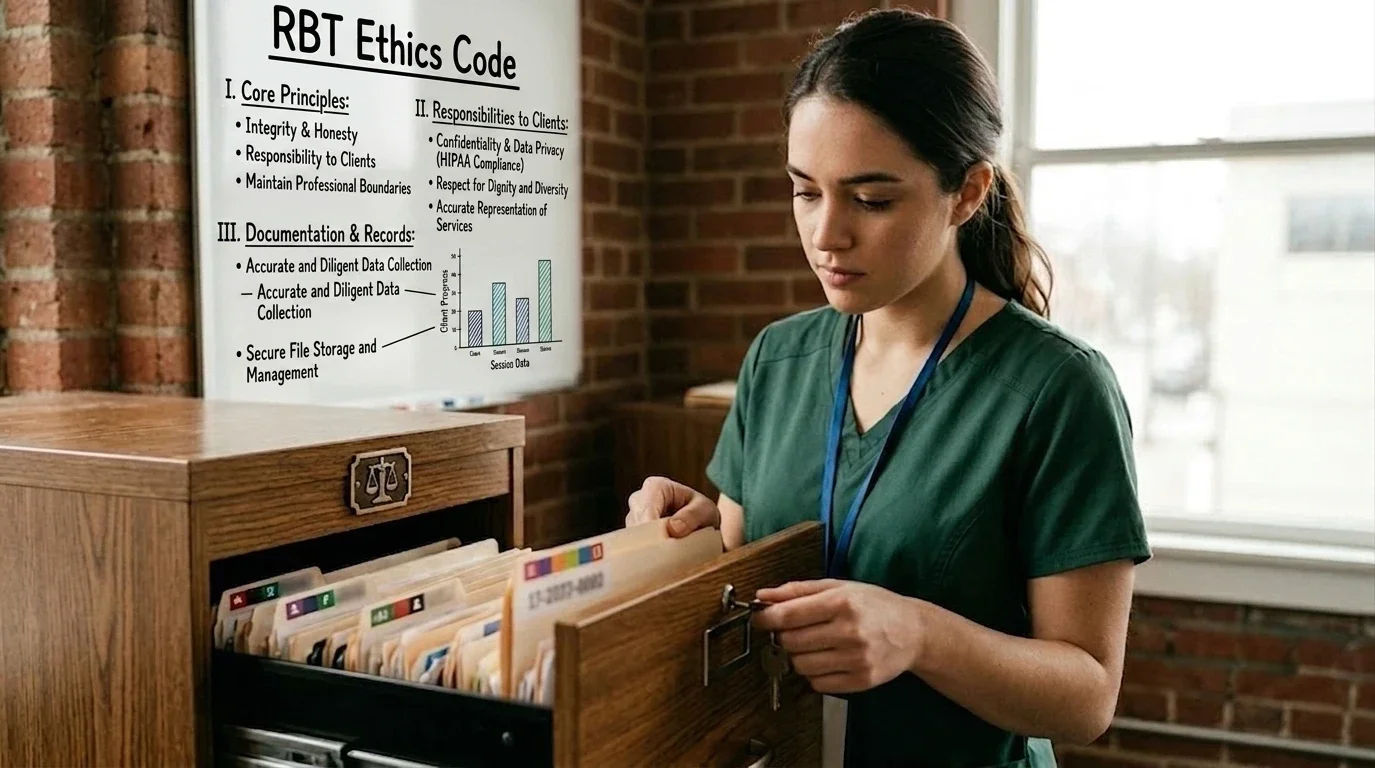
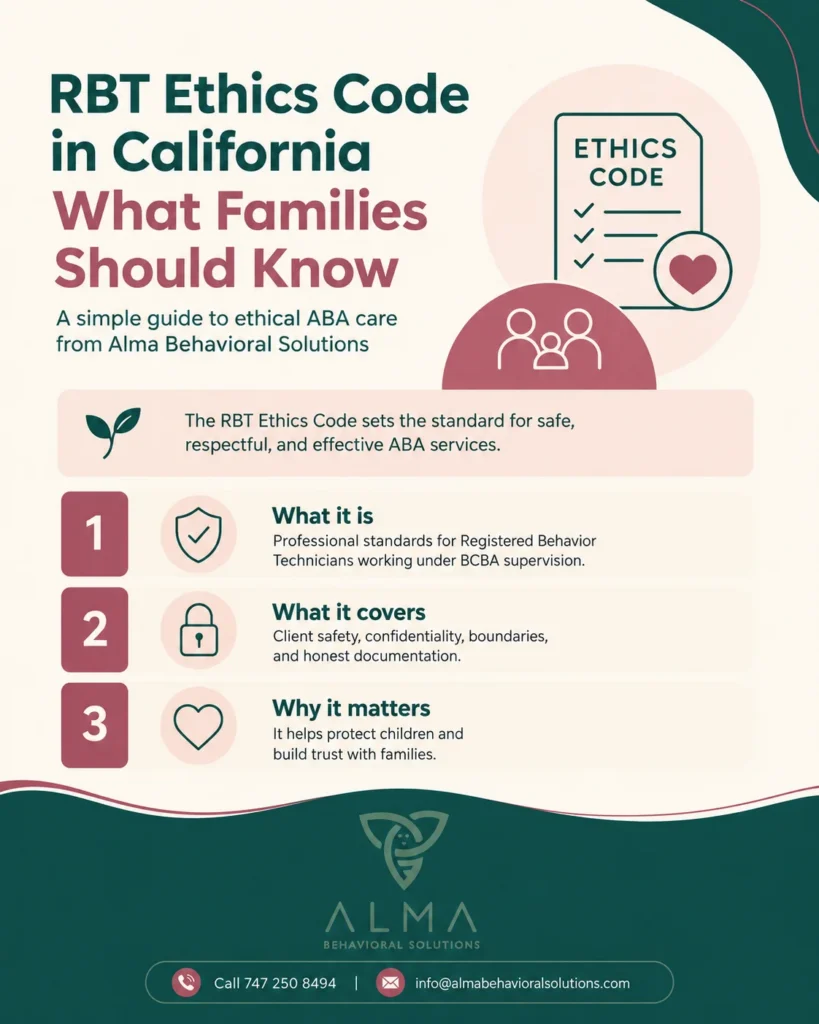
Families are often told about the ethical standards in ABA therapy, but they don’t necessarily understand how these standards relate to daily services. The RBT Ethics Code offers guidance to help RBTs interact professionally with children, families, supervisors, and other members of the care team, while maintaining trust and accountability.
The code fosters safe, respectful and consistent service provisioning. It includes the following elements that are important to know: confidentiality, professional boundaries, honest communication, accurate documentation, and safeguarding client welfare. Developed by the Behavior Analyst Certification Board, the current version took effect on January 1, 2022.
Families also need to be aware that the RBTs are supervised by a BCBA. They deliver direct therapy, however don’t make clinical choices or treatment plans on their own on behalf of their clients.
What Ethical ABA Care Means for Families and Professionals
Ethical ABA care gives families peace of mind that care is provided in a safe, respectful, and transparent manner. To parents it means that decisions are made responsibly and the dignity of their child is maintained throughout.
A child is not just a diagnosis, the behavior goal or a piece of data. All children are different, with their own strengths, preferences, feelings and rights. The child is the focus of all interactions and this is recognised in ethical care.
For professionals, ethics guide everyday situations, such as:
- Protecting confidential information
- Responding appropriately to family questions
- Following treatment plans accurately
- Maintaining professional boundaries
- Facing difficulties and asking for help when needed
Ethical standards provide a sense of reassurance to families that services are delivered based on a set of professional standards as opposed to personal opinions or guesses.
The Role of an RBT in ABA Therapy
A Registered Behavior Technician (RBT) plays a vital role in delivering ABA therapy services under the supervision of a Board Certified Behavior Analyst (BCBA). They have the following main duties:
- Providing direct ABA therapy by implementing behavior intervention and skill-building programs designed by the supervising BCBA during structured and natural learning opportunities.
- Implementing evidence-based ABA skills to teach communication, social interaction, play, self-help and daily living skills with the goal of meaningful progress and independence.
- Gathering and recording detailed data on behaviours, skill acquisition and treatment efficacy to enable clinical team to monitor progress and inform decision making.
- Encouraging positive behaviours change in accordance with intervention plans, providing appropriate reinforcement and assisting to decrease challenging behaviours safely.
- Communicating important observations, concerns, and session updates to the supervising BCBA and other authorized members of the treatment team.
- Maintaining professional and ethical standards by protecting confidentiality, following supervision requirements, staying within their scope of practice, and avoiding independent clinical decisions.
Through these duties, it is possible to provide consistent, safe and effective ABA services to support each client’s individualized treatment goals.
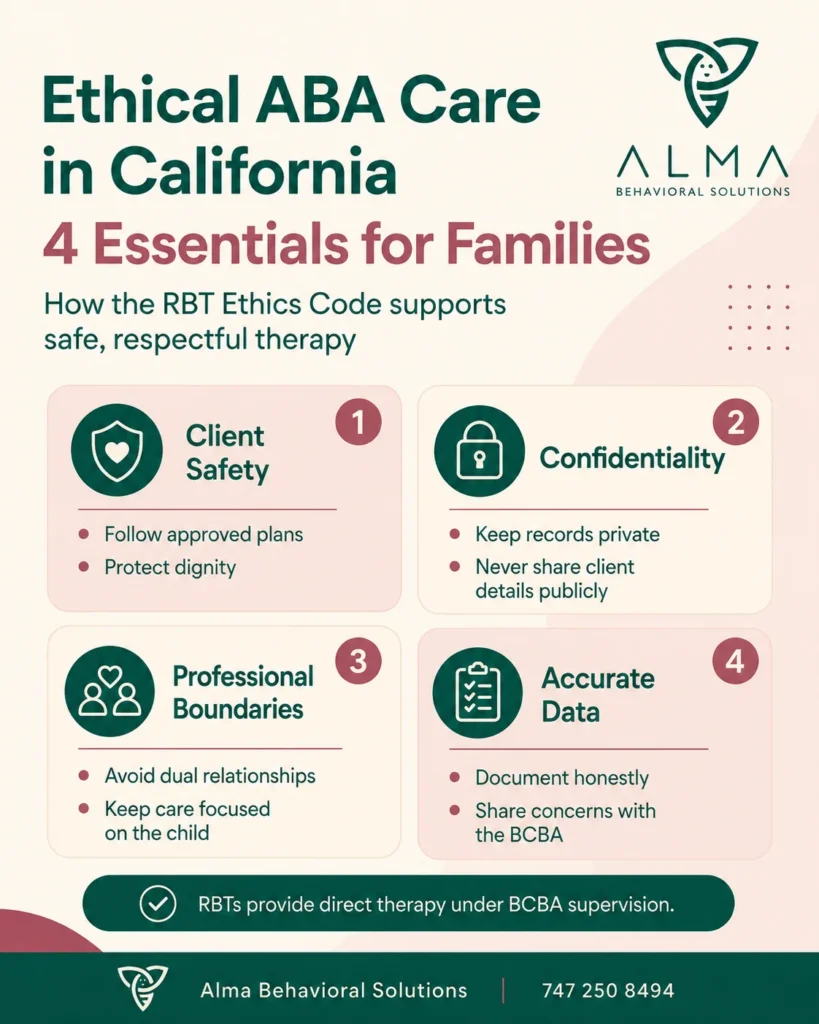
How the BACB Organizes RBT Ethical Standards
Here are the BACB’s standards of ethics divided into three sections. All of these sections help direct the behavior of professionals, client service, and certification responsibilities.
| Section | What It Covers | Examples |
| General Responsibilities | Professional behavior and ethical conduct | Honesty, integrity, respectful communication, and maintaining professional boundaries |
| Responsibilities in Providing Behavior Technician Services | Delivery of safe and effective ABA services | Following treatment plans, collecting accurate data, implementing interventions correctly, and protecting client welfare |
| Responsibilities to the BACB and BACB Required Supervisor | Certification and supervision requirements | Maintaining certification, reporting required information, participating in supervision, and following BACB standards |
All service settings, such as home, clinic, school, community and virtual settings are required to meet these standards.
General Responsibilities for Honest and Professional Conduct
Being professional as an RBT is about more than what happens during a therapy session. It begins with showing up ready, being honest and showing respect to everyone. RBTs have to communicate and be honest, as families count on them to provide support.
RBTs should always represent their skills and qualifications accurately. They should never pretend to have any training or experience that they don’t have, nor place themselves in situations that might lead to conflicts of interest or influence their professional judgment.
It is also necessary to respect the differences of culture. Each family has their own values, routines and expectations. Ethical ABA care acknowledges those differences, listens attentively and ensures the care and keeping of the child with all dignity and well being at heart.
Behavior Technician Service Standards for Safe Client Care
Behavior Technician Service standards help ensure ABA therapy remains safe, ethical, and effective. RBTs will:
- Take medication as prescribed by the BCBA.
- Use approved teaching and behavior strategies correctly.
- Collect and record data accurately.
- Ask supervisor for assistance if questions arise.
Safe care also means ensuring the child is aware of any illness, injury, distress or risk and reporting it as quickly as possible. RBTs should never make independent treatment changes, even when requested by parents.
Rather, concerns should be discussed with the BCBA who is supervising. Effective RBTs balance professionalism with warmth, creating supportive, respectful experiences for children and families.
Supervisor and Certification Responsibilities for RBTs
RBT responsibilities include:
- Work under the supervision of a qualified BCBA or approved supervisor.
- Carry out treatment plans and supervisors’ directions precisely.
- Communicate honestly about client progress, concerns, and challenges.
- Seek guidance when unsure or untrained for a task.
- Participate in required supervision activities and feedback sessions.
- Maintain accurate client records and documentation.
- Maintain up-to-date and accurate certifications.
- Comply with BACB requirements and audit requests.
- Report problems which could impact quality of service or client safety.
- Stop providing services if certification requirements are not met.
Client Safety, Consent, and Confidentiality in ABA Sessions
All therapy decisions must be made for the safety of the client. Children who are receiving ABA therapy are entitled to care that respects their dignity, privacy and welfare.
Consent
Families should understand:
- What services are being provided
- Which goals are being targeted
- Who is involved in care
- How information will be used
RBTs should not assume consent but adhere to the organization’s consent and documentation requirements.
Confidentiality
RBTs are responsible for protecting sensitive information, including:
- Client records and session notes
- Photos and videos
- Assessment results
- Personal and family details
To maintain confidentiality, RBTs should never:
- Discuss client information in public places
- Include information about yourself on social media platforms
- Provide information to unauthorized individuals
- Leave records unsecured
Professional Boundaries and the BACB Gift Policy
Professional boundaries help to maintain focus on the client in therapy. A friendly relationship with families is good, but a personal relationship can be confusing or pressurizing.
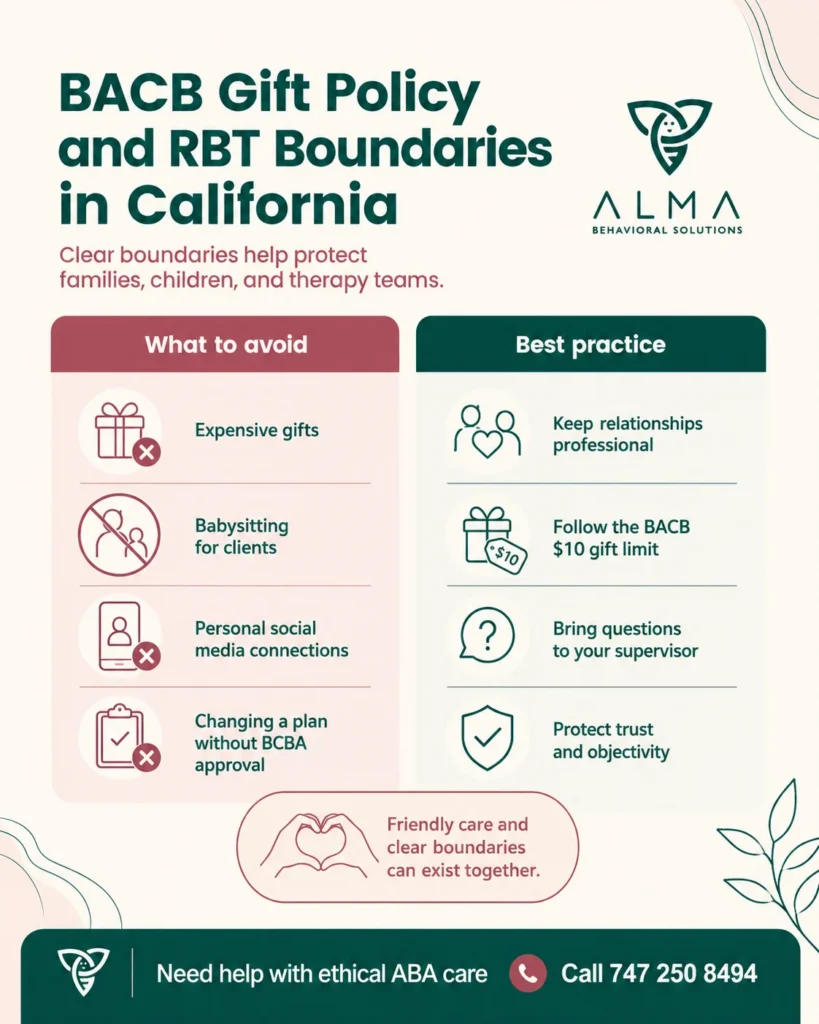
Examples of this include babysitting for an existing client’s family, becoming a personal friend, receiving expensive gifts, attending private family events, or using personal social media. These scenarios can be benign, but it can become an issue where therapy is confused with personal life.
The BACB provides specific guidance regarding gifts. Gifts valued at more than 10 U.S. dollars are not allowed, and stricter employer policies should be followed when they exist. We promote warm communication with clear boundaries as ethical care is good for families and providers.
Ethical and Professional Behavior in Everyday ABA Practice
Some RBT training materials refer to “Ethical and Professional Behavior Part 2”, but the implication is clear. Ethical conduct must be exhibited at all times, not only at training or examination.
An RBT shows professionalism by being prepared, adhering to the treatment plan, taking feedback, and communicating respectfully. They also exhibit professionalism by keeping an honest record, maintaining client confidentiality, and trying to resolve a little problem into a bigger one before it happens.
For example, imagine a session in which a child is tired, upset, and not responding as usual. An ethical RBT doesn’t attempt to make the session look flawless on paper. Rather, they properly record what happened, record any pertinent variables, and report to the supervisor if they need further assistance. Honest documentation assists the team with proper decision making.
Accurate Data Collection and Session Notes in ABA Therapy
Consider data the “road map” to ABA therapy. Even the best treatment plan can go astray if it is not properly informed. Session data is used by BCBAs to assess progress, set targets and make decisions.
RBTs should make observations as soon as possible and without bias. Don’t guess, or add information in later, or exaggerate success. Instead, document what actually occurred during the session.
For example, note if a child was tired, a routine changed, or a new behavior emerged. Good, factual and clear documentation assists with good clinical decisions, and safeguards all involved.
What Families Should Know When a Probe Session Is Conducted
- A probe session or probe trial may be used to ascertain if a child can perform a skill without the need for additional support, teaching or over prompting.
- The information collected enables the BCBA to gain insight into what skills the child has mastered and what skills may require more assistance.
- An RBT can only provide support for activities related to probes under proper training and supervision.
- It is the responsibility of the BCBA to interpret and apply the probe data in the treatment plan.
- The RBT’s job is to take instructions, to support the dignity of the child and to accurately document what happens during the session.
Some people search for “a probe session is conducted to rbt” when trying to understand whether an RBT can run a probe session. In simpler terms, a RBT can help in the execution of probes when they are given under the guidance of a BCBA and are trained appropriately.
Common Ethical Dilemmas RBTs May Face
Treatment Plan Changes:
A parent may ask the RBT to try a strategy that is not included in the treatment plan. The ethical answer is to thank the parent, not make any independent changes, and to seek approval from the supervising BCBA.
Gift Acceptance:
A personal gift may be given by a family. The RBT should adhere to BACB principles and guidelines regarding gifts, and respond politely and professionally.
Social Media Boundaries:
A parent could send a friend request on social media or make a connection online. The RBT should maintain professional boundaries and avoid personal online relationships with clients or their families.
Missing Documentation:
A session note might not be there and someone could request that the RBT do a session note later from memory. The ethical thing to do is to document what is known and nothing more, don’t guess, and follow the documentation rules.
Seeking Guidance:
Many ethical issues can be worked out through communication with the supervising BCBA, adherence to professional standards, and maintaining honesty, client welfare and clear boundaries.
How RBTs Should Respond to Ethical Concerns
A calm reaction can help to keep all parties safe. If an ethical concern is identified, the RBT should stop and write it down, and reach out to the supervising BCBA or clinical leader.
The purpose of documentation is to focus on facts. It is more helpful to report dates, timings, observed behavior, and the actions taken than blame or feelings. RBTs should avoid gossiping about the concern with coworkers or discussing it with people who are not involved.
A helpful response may include these steps.
- Determine what the concern might be.
- Ask the supervising BCBA for guidance.
- Document facts clearly.
- Follow organization policy.
- Keep client safety and privacy first.
How Families Can Identify Ethical ABA Therapy
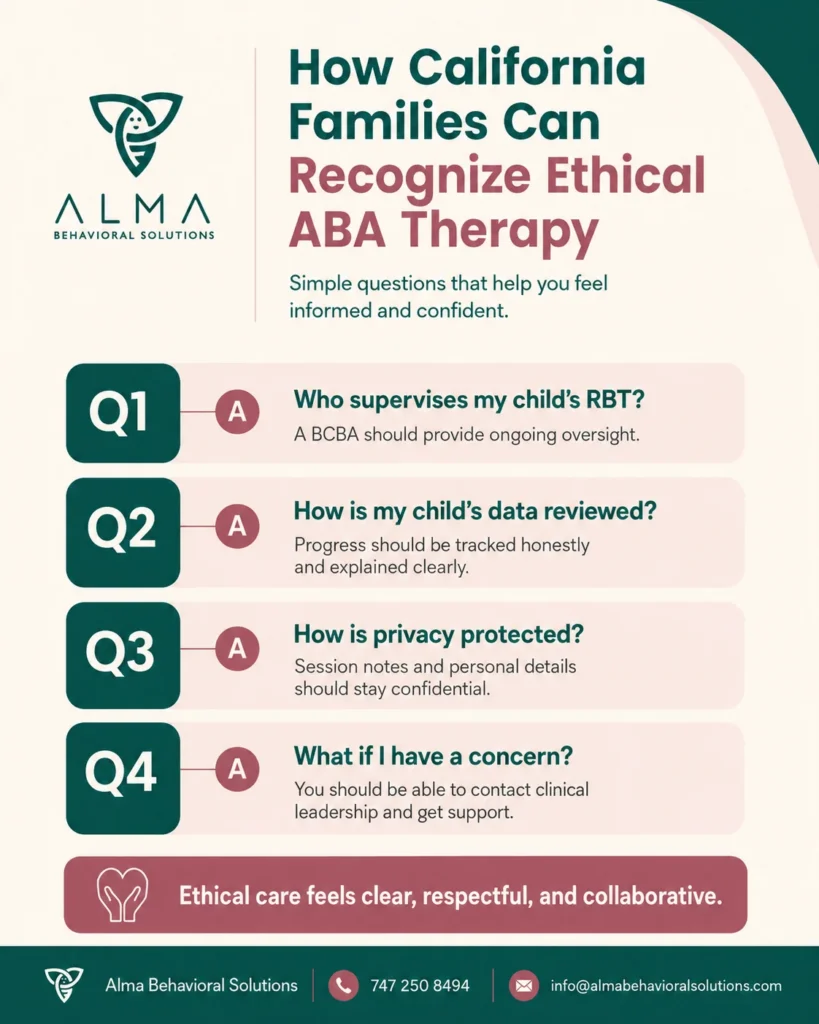
When considering whether a family has found an ethical ABA therapy program, they can look for transparency, supervision, and respect of the family child’s rights. Based on BACB guidelines, RBTs are not expected to make independent clinical decisions, and must work under the supervision of a BCBA.
Ethical care is indicated by the following:
- Explanations of goals and treatment plans are clear.
- Continual involvement and supervision by BCBA.
- Progress updates based on data
- Respecting client privacy and confidentiality.
- Interschool communication with families is respectful.
Some questions parents should ask:
- Who will be in charge of my child’s program?
- How often is supervision provided?
- How is the treatment decided?
- How are concerns dealt with?
How Alma Behavioral Solutions Supports Ethical Care
We care based on trust, compassion and professional responsibility. We feel that therapy should be respectful of children, and not their goals.
Our team upholds ethical care through involvement of supervisors, communicating with families, expectations for documentation and respecting client privacy. When they have concerns or questions about safe or effective care, RBTs are encouraged to ask questions, seek guidance, and communicate.
Families are also an important factor. The therapy team can support parents by responding to their observations, questions and communication of changes at home. The practice of caring is strengthened when families and carers are working together honestly and respectfully.
Final Thoughts on Ethical ABA Practice
Ethical ABA care benefits children, families and professionals. It supports RBTs in their role, supervision, privacy protection, and honest documentation of sessions.
Ethical standards form clarity for a family. Having the confidence that their child’s therapy team respects dignity, communication and accountability.
At Alma Behavioral Solutions, we truly believe in the importance of respect, transparency, and compassion when providing ABA support. We are here to help if you have any concerns about ABA therapy, ethical care or support for your child.
Call (747) 250-8494 or email info@almabehavioralsolutions.com to connect with our team.
FAQs About the RBT Ethics Code and Ethical ABA Care
How do ethics protect children during ABA therapy?
Ethics protect children by ensuring safe, respectful, and evidence-based ABA therapy services. They guide RBTs and BCBAs to maintain confidentiality, follow professional standards, and prioritize each child’s well-being. For families seeking ABA therapy in California, ethical practices help create a secure and supportive treatment environment.
Can parents ask about their child’s therapy data?
Yes. Parents can request to learn how their child’s information is being gathered, reviewed and used for progress measurement in their child’s ABA therapy. An ethical provider of ABA services in California should be able to communicate data clearly and in an understandable fashion. Open communication allows the whole family to be informed, and be part of treatment decisions.
Who supervises an RBT during ABA services?
An RBT works under the supervision of a qualified Board Certified Behavior Analyst (BCBA). The BCBA designs and monitors treatment plan, offers constant guidance. This supervision guarantees that the service provision is effective, ethical and meets the child’s needs.
Should an RBT give advice outside the treatment plan?
No. An RBT should only provide services and guidance that fall within the approved ABA treatment plan and their scope of practice. The supervising BCBA should be contacted for treatment changes, behavior support or clinical advice. This can help to ensure ethical and consistent care.
How should privacy be protected during sessions?
Records should be stored securely, and only be accessed by the private individual, and no one should talk about clients in public places in the name of privacy. Ethical ABA providers follow confidentiality standards to safeguard personal information. Photos, videos and session details should only be shared appropriately.
When should a family contact clinical leadership?
If families have concerns about safety, communication, supervision/control, privacy, or treatment quality, they should contact clinical leadership. Early intervention may help with cooperation and the provision of adequate care. Reputable ABA providers in California encourage open communication and timely feedback.