


What happened immediately before your child cried, left the room, covered their ears, or asked for help?
An antecedent in ABA Therapy is the question of what happens before the behavior. In a sample of children in 16 US communities in 2022, CDC monitoring identified autism in one in 31 children when they were 8 years old, underscoring the need for easily accessible, individualized autism supports for families.
An antecedent is an event, instruction, interaction, internal condition, or environmental change that occurs immediately before a behavior. It is the “A” in the ABC Model of behavior which is defined as antecedent. Patterns may be identified and changes made in the environment by studying this sequence, and useful communication or coping skills may be taught.
| Quick answer: An antecedent in ABA Therapy is anything that happens immediately before a behavior. It could be a request, transition, sound, social interaction, physical condition or environmental change. ABA professionals look at the Antecedents in the ABC model to find patterns and create proactive individualized support.
An antecedent should be considered a cue, not automatic evidence of the cause of a behavior. Multiple factors could be in play, and a single observation will not usually give sufficient information to account for an entire behavioral pattern.

Understanding the ABC Model in ABA Therapy
ABC Model is a structured approach in Behavior Analysis that considers what occurs in the antecedents, behavior, and consequences of a behavior. It helps to answer a common parent question: What did happen before behavior in ABA? It also considers what happened before the behavior and what followed. Clear descriptions facilitate accurate communication by parents, teachers, and clinicians about the same event.
| ABC Component | Meaning | Simple Example |
| Antecedent | What happens immediately before the behavior | A parent says screen time is finished |
| Behavior | The observable and measurable response | The child screams and drops to the floor |
| Consequence | What happens immediately after the behavior | The parent provides five additional minutes |
Antecedent
An antecedent can be an instruction, transition, denied item, sensory experience or social interaction. It establishes the time and place for a reply but it does not mean that the reply will be granted. A child’s reaction to a particular instruction can vary depending on his or her sleep, health, communicative requirements, task difficulty, and past experiences.
Behavior
Describe behavior in observable and measurable terms. Care team members will have more useful information with “Pushed the worksheet away and walked three feet from the table” than with either “acted out” or “became difficult.” Objective descriptions also enable more uniform observations by different observers.
Consequence
A consequence is anything that occurs immediately after the behavior. Does not necessarily imply punishment or negative outcome. Consequences can make a response more likely, less likely or have no meaningful effect on whether it will occur again.
Everyday Examples of Antecedents
Practical examples of autism can be useful in helping parents to get a handle on the concept, but should not be used to diagnose a behavioral function. Repeated observation is required, as the event preceding a behavior could be only one element in the pattern.
Antecedents at Home
A parent says it is time to brush teeth. Child throws the toothbrush, and delay in brushing. The instruction is the immediate antecedent, and other activities that are completed may be relevant, such as fatigue, oral sensitivity, discomfort, or difficulty.
Antecedents at School
A teacher sets a challenging worksheet down on his table. The student pushes it away and leaves their seat, after which the worksheet is temporarily removed. The task presentation occurred immediately before the behavior, but the team would need more data before concluding that the behavior consistently results in escape from difficult work.
Social Sensory and Community Antecedents
A child screams as another child takes a toy. When the room is full, it is louder before another child puts his or her hands over his ears. Sometimes an unexpected switch may occur before a child requests to leave.
Common Types of Antecedents
Behavior Triggers can take many forms. Arrange them by categories, so families can look at the surroundings without having to assume that any single factor is responsible for them.
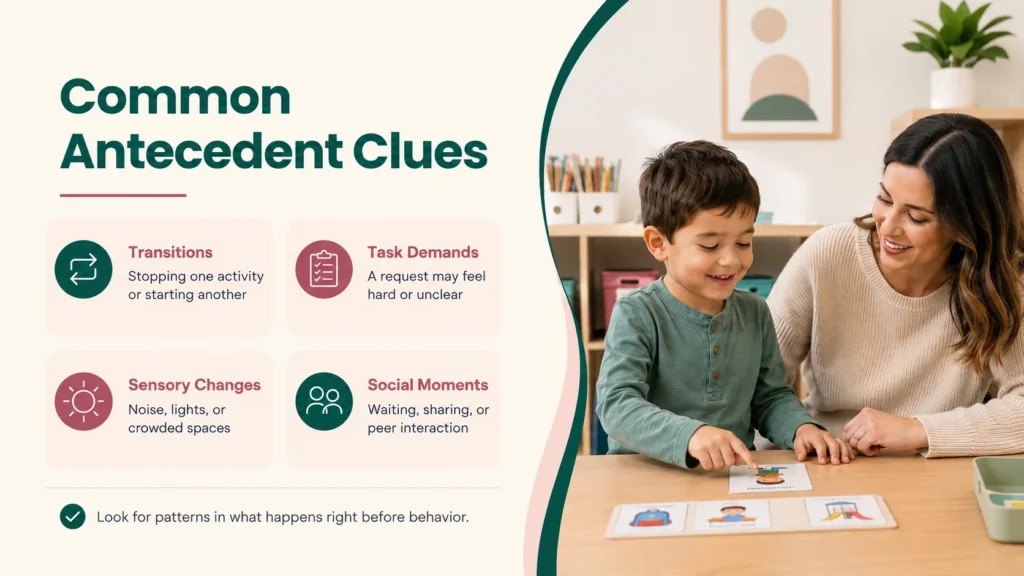
Environmental and Sensory Antecedents
Common examples include:
- Loud or unexpected sounds
- Bright or changing lights
- Crowded spaces
- Strong smells
- Room temperature
- Visual clutter
- Seating arrangements
- Sudden environmental changes
Social and Instructional Antecedents
Social and instructional antecedents can be a task, feedback, waiting for an item, task completion of a preferred activity, interaction with a peer, or multi-step directions. The language, timing, tone, and complexity of the request can all impact how easy it is for the learner to access it.
Internal and Routine-Related Antecedents
Internal antecedents in ABA can be hunger, fatigue, discomfort, anxiety or sensory overload. Not everything that happens inside is visible, and it is important not to assume, without talking, re-reading, or examining medical situations. Common precursors or triggers for routines are an unscheduled change in routine, too quick of a transition, or new activity.
Antecedents and Related Behavior Analysis Terms
Parents frequently find multiple terms when they start to look into the details of ABA Therapy. Knowing the differences between them provides additional context, and helps avoid using one word to cover all aspects of a behavior pattern.
| Term | Parent-Friendly Meaning | Example |
| Antecedent | The immediate event before a behavior | A teacher presents a worksheet |
| Trigger | An everyday term for something associated with a response | A sudden loud noise |
| Setting event | A background condition that changes the likelihood of a behavior | Poor sleep the night before |
| Motivating operation | A condition that changes how valuable an outcome is | Hunger increases the value of food |
| Discriminative stimulus | A cue that signals reinforcement may be available | An “open” sign signals that the store can be entered |
Antecedent and Trigger
There is a common vernacular word, trigger, and a more precise word in the world of Behavior Analysis, antecedent, which means what happens just before a response. Parents are sometimes referred to as providers in provider resources, such as educational material published. It is still important for clinical writing to convey that the immediate antecedent is not necessarily the certain cause of the behavior.
Antecedent Vs Setting Event
The main difference between antecedent vs setting event is its timing and function. Poor sleep can act as a setting event to increase the likelihood of frustration during the morning. The tricky worksheet would be the antecedent that would follow immediately before the behavior.
Motivating Operations
Motivating Operations temporarily change the value of a consequence and influence behavior connected with that consequence. An example of a motivating operation is a lack of food, which could make a snack more worth seeking. Identifying a motivating operation and distinguishing it from stimulus control is one of the basic behavior-analytic competencies listed in the BACB.
Discriminative Stimulus
A discriminative stimulus signals that a specific response is likely to contact reinforcement. A child seeing a break card may learn that handing it to an adult can result in an appropriate break. The card does not force the behavior; it signals that a particular response may work in that situation.
Why Identifying Antecedents Matters
Identifying antecedents enables a care team to intervene prior to the situation escalating. Careful antecedent analysis can facilitate predictability of routines, communication, lessen needless distress, support transitions and increase successful participation.
Beneficial consequences can be:
- Teaching a child to request help or a break
- Changing tasks that are too complex or ambiguous
- Preparing for changes in routine
- Minimising unnecessary barriers to the senses
- Supporting emotional regulation
- Building independence and self-advocacy
- Increasing access to learning and family activities
The aim should not be compliance or to inhibit unharmful autistic traits. Ethical autism support is about safety, communication, meaningful skills, quality of life and respecting the needs and preferences of the child. BACB ethics include a commitment to professional responsibilities towards clients and stakeholders, and Alma’s mission is individualized, family-centered.
How ABA Professionals Identify Antecedents
ABA professionals use observation and data and don’t make assumptions. A Board Certified Behavior Analyst is a graduate-level practitioner who can provide independent behavior-analytic services and supervise RBTs and other team members implementing treatment.
Defining the Behavior Clearly
The first step is identifying one behavior and describing it objectively. Instead of using the term “cries,” you can use a definition like “cries, pushes materials away and leaves the chair.” Good definitions enable various observers to identify the same response.
Collecting ABC Data
ABC data collection commonly records:
- Time and location
- People present
- Activity taking place
- What went on just prior to the event
- The observable behavior
- What happened immediately afterward
- Relevant setting events
ABC data is frequently used as a descriptive part of a Functional Behavior Assessment. The observer lists a short account of each incident, and then looks at multiple observations to see for patterns.
Reviewing Patterns Through an FBA
A Functional Behavior Assessment can include any combination of direct observation, caregiver interviews, teacher input, record review and other assessments. The data gathered is used by the BCBA to hypothesize why the behavior occurs and what to do to support the behavior individually. One ABC entry cannot establish causation by itself.
Antecedent Strategies Used in ABA Therapy
Antecedent Strategies change what happens before a behavior to make successful responding more likely. These strategies should be chosen based on the child’s abilities and preferences, the communication system, the environment, and the possible purpose of the behavior.
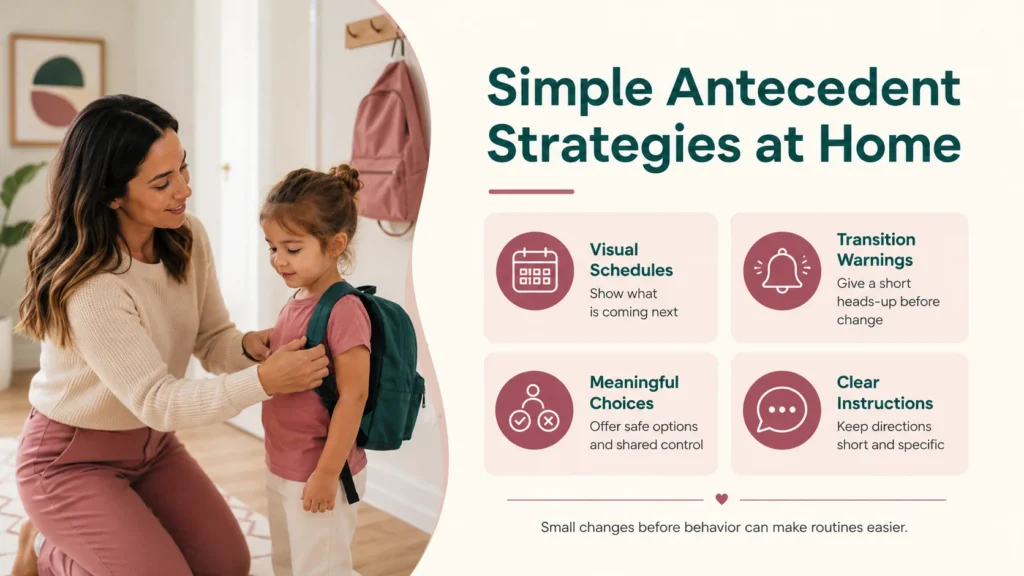
Visual Supports and Preparation
Visual schedules, First Then boards, countdowns, warning and explanation can help to make upcoming activities clearer. If a child is able to visualize the order of things after school when lunch comes, he may find it more predictable.
Meaningful Choices
Expectations can be still maintained with appropriate control provided by Choices. Children may decide on the order in which they do the task, choose the writing tools, where to sit, or how to ask for a break. Options should be valid and developmentally appropriate.
Task and Environmental Adjustments
Common antecedent strategies for autism include:
- Decomposing a long task into smaller parts.
- Using short and clear instructions
- Adjusting task difficulty
- Changing the order or timing of activities
- Minimising distracting noise or clutter
- Offering sensory accommodations
- Providing necessary materials in advance
- Minimising unnecessary physical exertion
Antecedent-based interventions aim to change the environment or activity before the interfering behavior occurs. This practice was endorsed based on the 2024 update of AFIRM, which was informed by the 2020 NCAEP systematic review, drawing on evidence from 47 single-case design studies and 2 group design studies. Studies reviewed included children and adolescents with autism from birth to age 22 and outcomes related to behavior, communication, adaptive skills, play, school readiness, and social development.
Communication and Replacement Skills
Environmental changes are best combined with skills that provide some useful alternative. Reducing the original behavior may not be as effective in teaching a person to request help, more time, decline appropriately, seek clarification or use AAC to address the same need.
How Parents Can Collect ABC Data at Home
Parents do not need to determine why a behavior occurs. Their job is to observe very clearly what is happening that will be of value to the clinical team to see patterns in daily routines.
For each event, note:
- Antecedent: What happened immediately before the behavior?
- Behavior: What did the child do in observable, measurable terms?
- Consequence: What happened immediately afterward?
- Context: Was this about sleeping, getting sick, getting hungry, feeling pain, sensory needs or change of routines?
- Patterns: When was the behavior more or less likely to occur?
Write notes succinct and descriptive. For example:
“The tablet was turned off. The child cried for three minutes. The tablet was returned.”
This is more useful than writing, “The child became angry because they hate limits,” which assumes a cause without enough evidence.
Parental training can assist parents to collect the ABC data accurately, recognize patterns and implement strategies endorsed by the supervising clinician. Professional guidance is especially important when behavior changes suddenly, becomes more frequent, creates a safety concern, or may be related to pain, illness, medication, sleep, or sensory discomfort.
Benefits and Limitations of Antecedent Analysis
Antecedent analysis can assist families and clinicians to plan for their child’s behavior and identify possible patterns that can inform proactive support. It can make a distinction between when a behavior is more likely or less likely, but does not explain why the behavior occurs.
| Potential Benefits | Important Limitations |
| Organizes observations using a clear ABC framework | One observation is rarely enough to identify a reliable pattern |
| Helps identify possible triggers, signals, or environmental conditions | ABC data shows association, not definite causation |
| Supports proactive changes to routines, instructions, or surroundings | The same behavior may be influenced by several variables |
| Improves communication among families, teachers, and clinicians | Internal experiences such as pain, anxiety, fatigue, or sensory overload may not be directly observable |
| Guides individualized prevention and teaching strategies | Infrequent behaviors may be difficult to observe consistently |
| Creates opportunities to teach communication, coping, or replacement skills | Medical, communication, or sensory concerns may require input from other qualified professionals |
| Helps evaluate whether environmental changes are working | Observations may be affected by incomplete or subjective reporting |
Useful because it provides a common language for a situation as described in the antecedent analysis. It is not meant to supplant clinical judgment, medical evaluation, communication assessment or a thorough FBA in cases of complex or potentially dangerous behavior. Patterns should be evaluated periodically and be adjusted as new information is gained.
Supporting Your Child With Individualized ABA Therapy
Understanding what is taking place prior to a behaviour can assist families to better understand their child’s needs and develop more effective daily routines. Alma Behavioral Solutions offers personalized ABA Therapy, effective Parent training, and supportive services for autism in families in Los Angeles and surrounding areas.
Our team works closely with parents to review behavior patterns, collect meaningful ABC data, and develop personalized Antecedent Strategies that support communication, independence, and everyday success. To learn more or schedule a consultation, Call (747) 250-8494 or E-mail info@almabehavioralsolutions.com.
Frequently Asked Questions About Antecedents in ABA
What is an antecedent in simple terms
An antecedent is anything that happens immediately before a behavior. Any behavior that is preceded by a toy being put away, a loud noise, change in lighting, or a peer approaching might be an antecedent. The event provides context, but repeated observations are needed to understand how it relates to the behavior.
What is an example of an antecedent in ABA
Teacher calls out to stop recess and a student does not go into the classroom. The announcement is the antecendent that is observed and the refusal is the immediate antecedent. The team would also analyze the post transition and see if a similar trend emerged at other transitions in life.
Is an antecedent the same as a behavior trigger
There is considerable overlap in daily use of words. The parent-friendly term for an event that immediately precedes a response is “behavior trigger” and the technical term for a response’s antecedent is “antecedent.” Both these terms cannot be used to state that one observation has established the cause.
Can parents use antecedent-based interventions at home
Yes. Some home-based antecedent based interventions can be a visual schedule, warning, clear directions, options, and sensory modifications. When the behavior is persistent, complex or unsafe, the BCBA should assist in the selection of strategies that are best suited to the child’s needs and behavioral function.
How can I find ABA Therapy that uses individualized Antecedent Strategies
Inquire about the methods used by the provider to assess, gather ABC data, engage caregivers, provide replacement communication training, and track progress. Good programs will provide reasons for choosing a strategy and how it will be modified. Seek BCBA supervision, Parent training, respectful goals, and cooperation between home, school and community.