

Is your child “not listening,” avoiding eye contact, struggling with transitions, interrupting often, or melting down after small changes? Many parents observe these signs, and ask themselves, Is it ADHD or autism, or both?
Both ADHD and autism are neurodevelopmental disorders, meaning they impact the way a child develops his or her brain, how he or she learns, communicates and interacts with the world.
In 2024, CDC data reported that 12.0% of U.S. children ages 3 to 17 had ever been diagnosed with ADHD. CDC autism statistics also suggest that approximately 1 in 31 children with autism is diagnosed when they’re 8 years old.
This guide describes the difference between ADHD and autism, common symptoms of ADHD and autism, why autism and ADHD can overlap in children, and when families might need professional help.
Understanding ADHD and Autism as Neurodevelopmental Conditions
Both ADHD and autism are disorders of the brain that can impact children’s learning, communication, attention and emotional regulation, as well as their response to daily routines.
What is ADHD?
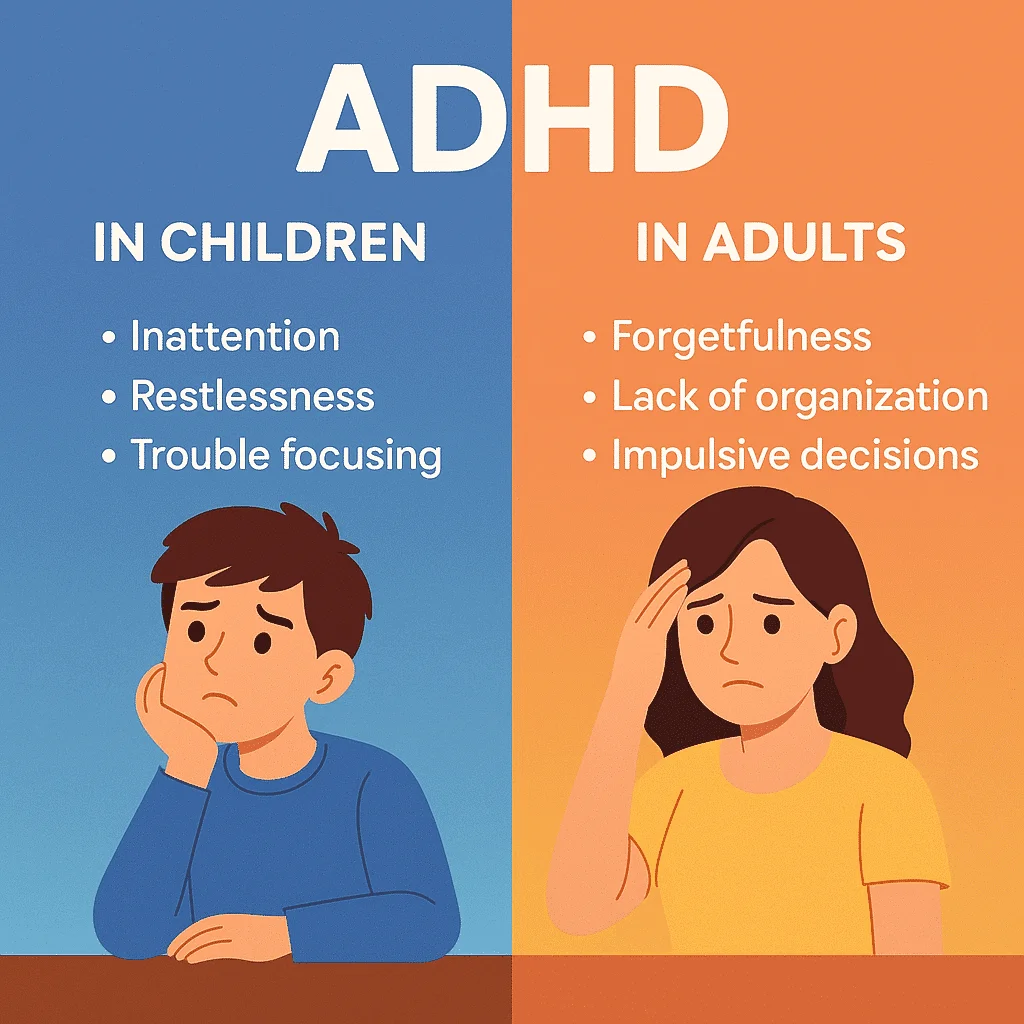
Attention Deficit Hyperactivity Disorder or ADHD is a child behavioral disorder associated with inattention, hyperactivity, and impulsivity. Child may have difficulty focusing, following directions, sitting still, waiting his/her turn, completing tasks.
Some typical symptoms of ADHD are:
- Distractibility
- Restlessness
- Forgetfulness
- Interrupting
- Trouble organizing tasks
Some of the symptoms of ADHD and autism may be similar, making it important to carefully assess symptoms.
What is Autism?
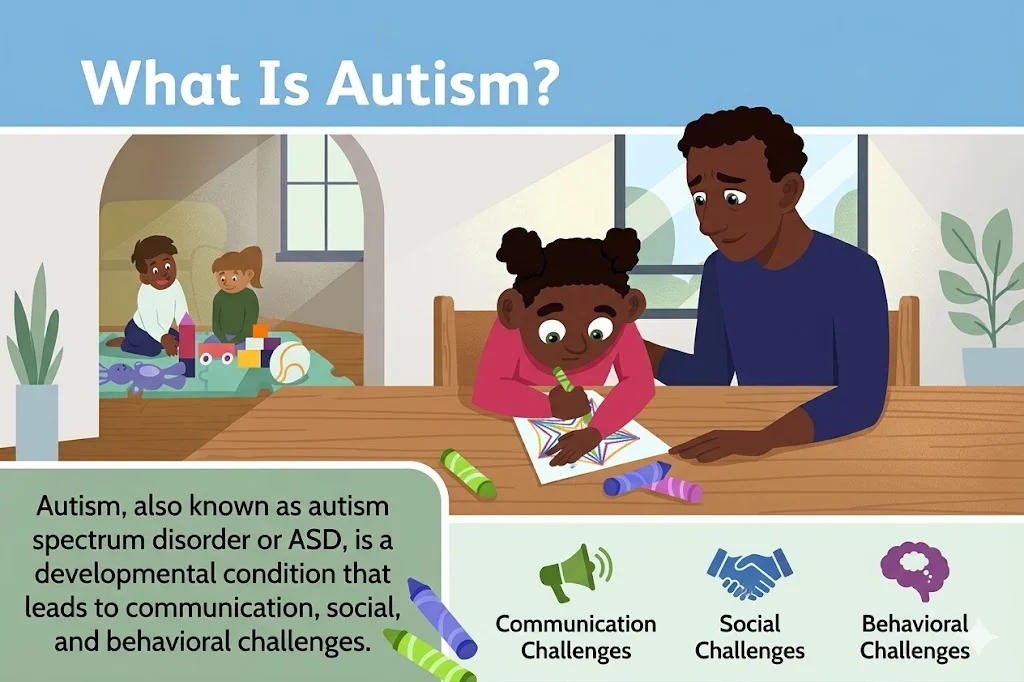
Autism spectrum disorder involves social communication, behavior, sensory processing and routines. In children with autism and ADHD, autism can manifest as not paying attention to social cues, problems with eye contact, transition, or sensory overload.
Typical symptoms of autism are:
- Repetitive behaviors
- Intense interests
- Sensory sensitivities
- Preference for routine
- Communication differences
When you’re talking to a professional about diagnosing autism in kids, you’ll be discussing these patterns over time.
Why ADHD and Autism Can Look Similar in Children
Although they seem similar, ADHD and autism present with overlapping symptoms that impact children’s attention, emotion, social functioning, and daily functioning. Either condition may impact a child’s ability to function at school or during homework, during play dates, at family gatherings, when it is time to go to bed, or when transitioning.
For example, If the child with ADHD is distracted, he or she may be unable to respond when called. An autistic child may not respond as they are processing language in a different way, have a strong interest that they are processing, be over stimulated by the sensory input, or be unsure of what to say.
That’s why it’s important to not define ADHD vs autism based on one behavior. Patterns of communication, attention, sensory needs, social interaction, routines and daily functioning are observed over time by professionals.
ADHD and Autism symptoms: where they overlap
Many ADHD and autism symptoms can overlap, especially in young children. Families and providers may find it challenging to make a diagnosis due to this overlap.
Children with either ADHD or autism may experience:
- Difficulty focusing or staying on task
- Trouble with planning, organization, or time management
- Emotional outbursts or strong reactions
- Social challenges with peers
- Sensory sensitivities or sensory-seeking behavior
- Sleep difficulties
- Trouble with transitions
- Learning or communication challenges
However, there is no overlap without a distinction. An ADHD child may know what not to do, but because of impulsiveness they can’t. An autistic child might not grasp social codes, tone of voice, facial expressions, or what the other person expects in the talk.
Key Difference Between ADHD and Autism
The key difference between ADHD and autism is the fundamental pattern of symptoms. The major link of ADHD is mainly related to attention, hyperactivity and impulsivity. Autism is mainly connected to social communication differences, restricted or repetitive behaviors, sensory sensitivities, and a preference for routine or predictability.
Social Communication and Peer Interaction
Children with ADHD have a desire to have friendships and social connection. They might enjoy playing with peers, but may have issues with interruption, excessive talking, missing details, talking without listening, or acting before thinking.
These may be greater than the social communication difficulties in autistic children. It may be challenging for them to interpret facial expression, feelings, gestures, eye contact, interaction or using pretend play or conversation back and forth.
For example, A child with ADHD may interrupt a friend because they are excited. An autistic child might not know when to talk or might only be able to tell how another child’s feeling by their facial expression.
Attention, Focus, and Hyperfocus
One of the most common problems children with ADHD have is with attention, particularly in situations where the work is dull, tedious, repetitive or unrewarding. It may be particularly difficult to sit still in class, to do homework or chores at home.
An autistic child may exhibit strong interest in special interests. May have a prolonged conversation, read or play in isolation on one subject and struggle to change their focus.
So, a child with ADHD may struggle to focus on many subjects. An autistic child can be very interested in a single favourite topic but can be reluctant to move on to another topic.
Routines, Transitions and Change
ADHD children may get bored with routines, and want to move, be stimulated, or change things up. They might not like being structured as it can be repetitive or dull.
Autistic children often feel safer with sameness and predictability. Sudden changes can result in anxiety, frustration, crying, shutdown or meltdown.
For example, A child with ADHD may complain that the bedtime routine is boring. An autistic child may become distressed if the bedtime routine changes unexpectedly.
Patterns of repetitive behaviours and interests
Repetitive behaviors and restricted interests are hallmark traits of autism. These may include stimming, repeating words or phrases, lining up toys, following rituals, rereading the same book, rewatching the same video, or having a deep interest in a specific topic.
Children with ADHD can also have strong interests, but are more apt to have a rapid change of interest in activities, or need for new stimulus.
Sensory sensitivities and emotional regulation.
Sensory differences are commonly experienced in both ADHD and autism, and are particularly central and common in autism. A child might stuff their ears, be frightened by some pieces of clothing, not like bright lights, don’t like crowds, or be stimulated by smells, textures or noises.
The children with ADHD might also crave stimulation, be active, fidget or have emotional outbursts due to impulsiveness and emotional instability.
ADHD Vs Autism: Side-by-Side Comparison
| Area | ADHD | Autism |
| Main features | Inattention, hyperactivity, impulsivity | Social communication differences, repetitive behaviors, sensory differences |
| Social interaction | May want friends but struggle due to impulsivity or inattention | May struggle with social cues, emotions, gestures, or reciprocal interaction |
| Communication | May talk a lot, interrupt, or lose focus | May have delayed speech, repetitive language, fewer gestures, or difficulty expressing feelings |
| Attention | Difficulty sustaining attention on non-preferred tasks | Intense focus on preferred interests and difficulty shifting attention |
| Routine | May get bored and seek variety | Often prefers sameness and predictability |
| Movement | Fidgeting, restlessness, constant movement | Stimming or repetitive movements |
| Sensory needs | May seek stimulation or overreact to input | Sensory sensitivities are often more central |
| Emotional regulation | Quick frustration or impulsive reactions | Distress may relate to sensory overload, communication difficulty, or change |
Can a Child Have Both ADHD and Autism?
Yes. A child can suffer from both ADHD and autism. This is referred to as co-occurring ADHD and autism and occasionally people refer to it as AuDHD.
Before 2013, diagnostic guidelines did not allow both diagnoses at the same time. It is now recognised that many children fulfil criteria for both today. According to a 2022 review, 50-70% of autistic people might also have ADHD.
This combination can look complex in daily life. A child might crave novelty, be impulsive, or require a lot of stimulation, and might depend on routine, predictability and sameness.
Why do ADHD and autism often co-occur?
Researchers are still studying why this overlap is common. The available information indicates that it may be associated with a common neuro-developmental architecture which influences attention, behaviour, sensory environment and emotional regulation.
Some of the following reasons might be:
- shared genetic influences
- differences in brain connectivity
- executive functioning challenges
- sensory processing differences
- attention and emotional regulation difficulties
For example, a child can exhibit impulsive ADHD-related behaviour and then over-react to noise, change or feeling too much feeling as a result of autism-related needs.
It is not that ADHD and autism are the same. It means some children might require assistance with both.
Join a Personalized ADHD & Autism Therapy Session for Real Growth & Support
Why Accurate Diagnosis Matters for Child Behavioral Disorders
Accurate diagnosis is important since ADHD and autism, and the combined condition of ADHD and autism, can manifest themselves differently and may require different forms of support. Families can make informed choices in regard to home routines, school strategies, therapy, and day-to-day support when they have awareness of what’s causing a child’s behavior.
An accurate diagnosis can help to prevent:
- missed support for social communication
- missed support for attention and impulse control
- misunderstood sensory sensitivities
- delayed school accommodations
- lower confidence from being mislabeled
A child with autism that is misdiagnosed with ADHD might get support for attention but may have issues with social cues, routines, transitions or sensory overwhelm. An ADHD child misdiagnosed as autistic might be denied attention to focus, organization, task completion and impulsivity.
What an ADHD or Autism Evaluation May Include
An evaluation may include:
- parent interviews
- teacher reports
- developmental history
- clinical observation
- behavior rating scales
Professionals may also assess:
- communication and social skills
- attention and impulsivity
- sensory needs
- emotional regulation
- daily living skills
- learning, sleeping or hearing problems
A few providers might use instruments for rating symptoms of ADHD, like the Conners Rating Scale, or the Autism Diagnostic Observation Schedule (ADOS) as part of the assessment process.
Support and Treatment for Autism and ADHD in Children
School’s support for children with autism or ADHD should be grounded in the child’s strengths, diagnosis, symptoms, family routines, school needs and daily challenges. The aim is to not “fix” the child. The aim is to make them feel understood, supported and more confident in every-day life.
Behavioral and Parent Support
Children can be taught to develop routines, emotional regulation, directions to follow and to minimize daily stressors through behavioral strategies. Parent training also provides families with skills for how to respond to challenging moments with clear instruction, positive reinforcement, structure and calm.
10.2. School and Skill-Based Support
School accommodations, visual supports, executive functioning support and social communication support are all useful supports to many children. The strategies can enhance focus, organization, transition, peer interaction and task completion.
10.3. Therapy and Developmental Support
Support can be speech-language, occupational, counselling, sensory, social skills and daily living skill support. ABA therapy may also help children build communication, social, emotional regulation, and everyday life skills when used in an individualized and child-centered way.
10.4. Support for Co-Occurring ADHD and Autism
If your child has both ADHD and autism, he or she might require an integrated approach to addressing both attention and autism-related issues. This can involve regular schedules, sensory modifications, coaching of executive functioning skills, parent training, working with the school, and/or medication for ADHD symptoms as clinically indicated.
How Parents Can Support Their Child at Home
Being a parent to a child with ADHD, autism or both can be overwhelming, but there are small, consistent strategies that can help make life easier. The aim will be to provide structure, ease stress and help your child’s confidence.
- Establish basic schedules to help your child to know what to predict.
- Avoid lengthy explanations and use clear and concise instructions.
- Take on tasks one step at a time, for example, first “put toys in the bin” then “put books on the shelf”.
- Get your child ready for transitions, particularly changing activities or leaving the house.
- Incorporate breaks for movement and decrease sensory input such as loud noises, bright lights, or tight clothing.
- Praise specific positive behavior and focus on your child’s strengths, progress, and interests.
Autism Care with Alma Behavioral Solutions
Alma Behavioral Solutions offers children with autism, ADHD, developmental differences and behavioral concerns compassionate support. Care is based on child’s strengths, needs, communication, sensory profile and daily challenges.
Families are provided with information that enables them to better comprehend their child’s behavior, establish a supportive routine, and select strategies for home, school, and therapy. The emphasis remains on making practical progress, feelings of safety and skills.
Individualized care may involve parent guidance, behavior support, communication-focused strategies, daily living skill support, and working with the caregiver(s) or other professionals. Support is purposefully designed to enable children to feel understood, capable and more confident in their everyday lives.
To learn more about autism care and child behavioral support, call Alma Behavioral Solutions at (747) 250-8494 or email info@almabehavioralsolutions.com. Early guidance can help families take the next step with clarity and confidence.
Final Thoughts
ADHD and autism are distinct neurodevelopmental disorders, and can have overlapping symptoms which can make them difficult to distinguish. Both can impact attention, communication, feelings, social interaction, sensory needs and routines.
Inattention, hyperactivity and impulsivity are the primary symptoms of ADHD. The primary autism-related areas of social communication differences, sensory sensitivities, routines and repetitive behaviors are linked to autism. Child may have ADHD, autism or ADHD + autism.
Families can be better informed about their child’s needs if their child is evaluated and receives individual support. Equipped with these skills, children will be less stressed, better communicators and more confident in their life.
FAQs
Are ADHD and autism the same?
No. ADHD and autism are different neurodevelopmental conditions. ADHD mainly affects attention, hyperactivity, and impulsivity. The primary areas of difficulty for Autism are social communication, sensory processing, routine and repetitive behaviors.
What are common signs of ADHD in children?
Symptoms are difficulty concentrating, forgetfulness, fidgeting, interrupting, acting impulsively, not completing tasks, and not being organized. Symptoms may vary according to the type of presentation that the child has of ADHD.
What are common signs of autism in children?
Autism symptoms can range from lack of eye contact, repetitive behaviors, intense interests, sensory sensitivities, delayed speech, and trouble with social cues, to distress with change. All children with autism are unique.
Can ADHD be mistaken for autism?
Yes. ADHD and autism can both affect social skills, attention, emotions, and behavior. A child with ADHD may appear socially unaware due to impulsivity, but an autistic child may have difficulties due to social communication differences.
Can autism be mistaken for ADHD?
Yes. An autistic child can seem distracted, restless, or inattentive when he or she is overwhelmed, uninterested, or is thinking of or interested in something else. This is why developmental history and professional evaluation are important.
Why do some children have both ADHD and autism?
Research suggests ADHD and autism may share some genetic and brain-development factors. These may be partly responsible for the co-occurring symptoms of both in affecting executive functioning, attention, emotional regulation, sensory processing, and in social behavior.
When should parents ask for an evaluation?
If parents are concerned about difficulties with attention, communication, behavior, sensory, social, sleep or emotional regulation that impact daily functioning, an evaluation is warranted. A professional can determine if the child requires an ADHD referral, a referral for autism or both.