
Introduction
What if better communication does not always mean learning to say more words? Many children with autism are able to communicate by speech, gestures, signs, pictures, AAC, or a combination of these.
When families are learning more about ABA speech therapy for autism, they may wonder about how ABA can support communication without taking the place of speech-language services. Communication can impact independence, safety, relationships, learning and daily activities.
ABA and speech therapy for autism approach communication from different professional perspectives. Structured learning opportunities can be provided as goals are coordinated properly and children can communicate naturally in everyday learning environments.
This guide provides descriptions of evidence-informed speech therapy techniques, ABA communication strategies, verbal operants, AAC, advantages, progress tracking, and how professionals can help facilitate functional communication.
Key Takeaways
Families looking for autism speech therapy services typically want to know what these services can do for them, what role an SLP can play, and what successful progress in communication might look like.
· ABA can teach and strengthen functional communication skills such as requesting, refusing, choosing, commenting, and asking for help.
· Speech-language therapy and ABA are distinct professional services that have different assessment approaches and scopes.
· Useful ABA communication strategies may include FCT, NET, DTT, modeling, prompting, reinforcement, shaping, and generalization.
· AAC can supplement spoken language or provide another effective communication method.
· Progress should focus on functional independence, not simply counting spoken words.
What Is ABA Speech Therapy for Autism?
ABA speech therapy is typically a term used to refer to ABA-based teaching methods to improve functional communication, and not a clinical field in itself known as “ABA speech therapy.”
What Does “ABA Speech Therapy” Actually Mean?
Autism speech therapy is a general term used by families, but the roles of the ABA therapist and speech-language pathologist in relation to communication support differ.
Applied Behavior Analysis is about the learning of skills, the function of communication, and how new responses can become more independent. One child may learn to ask for juice by using a word, a sign, a picture or a gesture or AAC response instead of pulling an adult towards the fridge.
Speech-language pathologists evaluate and work with speech and language, social communication and related communication issues.
What Communication Skills Can ABA Support?
Effective ABA communication strategies are those that will enable the child to communicate more independently in real life situations rather than practicing isolated responses for no reason.
Common objectives can consist of:
· requesting preferred items or activities;
· saying or indicating “no,” “stop,” or “break”;
· asking for assistance;
· making choices;
· labeling meaningful objects or events;
· responding to familiar questions;
· commenting during play;
· communicating discomfort;
· using communication with several people and in several settings.
A child receiving speech therapy for children with autism may have overlapping communication objectives and treatment, but it should be appropriate to the service provider.
Difference between ABA Therapy and Speech Therapy
There is less confusion and you know what to expect if you choose appropriate services based on the knowledge of ABA vs speech therapy.
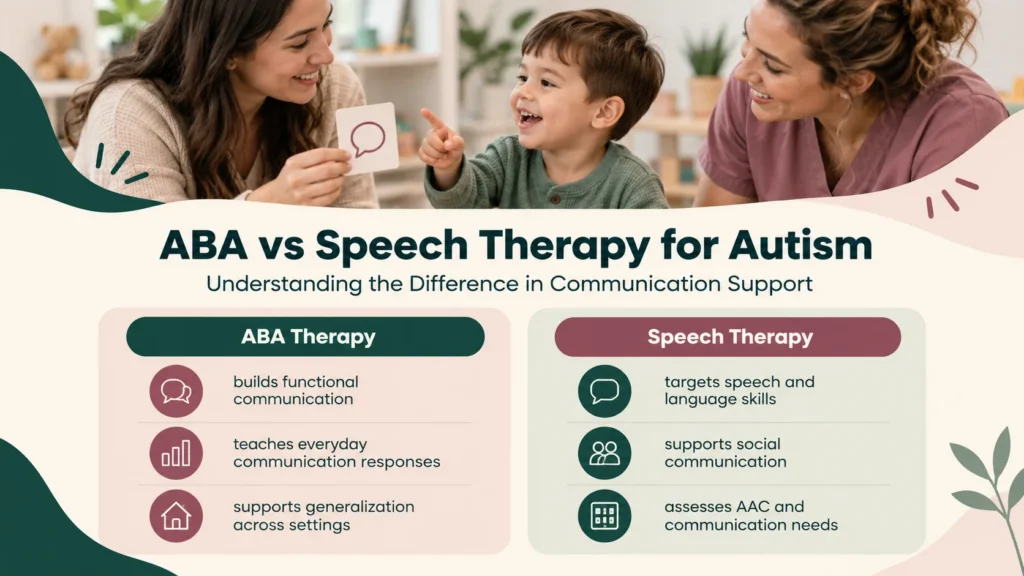
What ABA Therapy Focuses On
Communication is a common area of overlap between the autism intervention of ABA and speech therapy; however, the main purpose of ABA is to teach functional skills, increase independence and facilitate generalization.
ABA programs could focus on requesting, self-advocacy, functional routines, social participation, or on an alternative communication response to challenging behavior. BCBAs write behavior-analytic programs, RBTs work under supervision, not independently.
What Speech Therapy Focuses On
Speech therapy for autism is offered by a qualified speech-language pathologist; it can focus on receptive language, expressive language, speech production, pragmatic language, fluency, or AAC.
An SLP can assess communication systems, communication difficulties, specialized speech-language intervention, and set goals. ASHA explicitly lists AAC assessment and intervention as a part of speech-language pathology practice.
ABA Vs Speech Therapy Comparison
Parents who are looking for autism spectrum speech therapy should consider understanding the roles and yet get a coordinated therapy.
| Area | ABA Therapy | Speech-Language Therapy |
| Main professional | BCBA; supervised RBT | Speech-Language Pathologist |
| Primary lens | Learning, behavior, functional skills | Speech, language, communication |
| Communication goals | Functional use, independence, generalization | Speech-language assessment and intervention |
| AAC involvement | Supports use within appropriate ABA goals | Evaluates and treats AAC-related communication needs |
| Progress tracking | Behavioral and skill-acquisition data | Speech-language measures and clinical observations |
Neither discipline should simply duplicate the other. Professionals remain in scope and there is good collaboration between them with relevant observations and goals shared.
Does ABA Help With Communication?
Goals that are personalized, functional, measurable, and tied to meaningful situations in the child’s life can be supported with ABA speech therapy techniques.
Functional Communication Comes Before “More Words”
Functional communication training for autism emphasizes communication that successfully helps a person express a need, preference, boundary, request, or response.
A good reply to a communication might be:
· saying “help”;
· pressing an AAC symbol;
· handing over a picture;
· pointing toward a preferred item;
· signing “break”;
· indicating “no”;
· communicating pain or discomfort.
Communication should not be considered successful only when it becomes spoken language. A response can only be meaningful if it provides a child with a way to make an impact in the world around them.
Communication Must Work Outside Therapy
Good ABA communication strategies enable a child to apply skills across therapists, room, toy, and structured teaching activities.
If a child asks for assistance in one session then should be able to gradually ask for assistance with a parent, teacher, sibling, or other safe communication partner. Home, school, play and community settings provide practice that fosters generalization, not memorized performance.
ALMA’s guide to Natural Environment Teaching in ABA explains how communication goals can be practiced during familiar routines instead of remaining limited to table-based instruction.
ABA Speech and Communication Techniques
All speech therapy techniques and ABA strategies need to be chosen based on each specific communication need, not as a blanket program that is administered to every autistic child.
Functional Communication Training
Functional communication training for autism teaches a useful response that serves the same purpose as a difficult or inefficient behavior. The aim is to enable communication to be more simple, clearer and effective in everyday life.
Example: A child cries when a container will not open. The therapist teaches the child to request “help” using speech, a sign, picture, or AAC device.
Natural Environment Teaching
Natural Environment Teaching is a speech therapy technique for autism that can be employed to practice communication during normal living activities, like play, eating, dressing, or outdoor play. Skills are introduced when they are appropriate.
Example: During bubble play, the therapist pauses before blowing more bubbles. The child practices requesting “more” through speech, a gesture, sign, picture, or AAC response.
Discrete Trial Training
Discrete Trial Training can be incorporated into structured ABA communication strategies, when a communication skill could benefit from short discrete learning opportunities. Typically, DTT consists of an instruction, a child’s response, and a consequence that is planned.
Example: A therapist shows two pictures and asks, “Which one is a cup?” Child picks up the cup, is reinforced, and continues to practice with other items.
Positive Reinforcement
Positive reinforcement is one of the speech therapy techniques that ABA programs may use to strengthen meaningful communication. A helpful answer leads to some consequence that is important to the child, which raises the likelihood of them communicating on their own.
Example: A child independently asks for the swing. Access to swing is given immediately, of course reinforcing the request.
Prompting With Prompt Fading
Well-planned ABA communication strategies may use prompts temporarily while a child learns a new response. Prompts should be faded as learner becomes more independent to avoid unnecessary reliance on adult.
Example: A therapist initially points to the “break” icon on an AAC device. With repetition, the pointing cue is decreased until the child points to “break” without it.
Modeling
Modeling is a speech therapy skill that can demonstrate to a child what a helpful communication response will look and sound like. The adult models the response without giving extended explanations or asking the adult to imitate it.
Example: A parent says “open” while holding a closed container and models the matching AAC button. The child receives another opportunity to communicate when ready.
Shaping Communication Skills
In ABA speech therapy for autism, shaping is used to reinforce small steps toward an individual communication goal. The small, meaningful improvements can be reinforced rather than expecting a complex response right away, particularly when the learner is learning a new skill.
Example: A child points to juice and then uses a picture symbol and finally, makes an independent request with their communication style.
Generalization for Real-Life Communication
Successful speech therapy for children with autism should help communication work beyond one therapist or treatment setting. Generalization is practicing useful skills with other people, materials, routines and environments so they become part of everyday life.
Example: Child learns to ask for “help” in therapy, then practises the skill with parents at home, teachers at school, caregivers in the community.
Verbal Operants Used in ABA Communication Programs
Verbal Behavior concepts serve as a foundation for ABA speech therapy for autism, enabling speech therapists to understand what the communication is doing and teach appropriate verbal behaviors based on the function rather than the word.
Mand
A mand is a request for something desired or needed and is particularly relevant to autism and functional communication training. Mands can be in the form of speech, sign, picture, gesture, or AAC, depending on the learner’s communication system.
Example: A thirsty child says “water,” signs for water, or selects a water symbol on an AAC device to request a drink.
Tact
A tact is commenting or labelling something that is in the environment, and can be used to help with general autism speech therapy objectives. Tacts are used by children to express observations about objects, people, actions, or experiences in their environment.
Example: A child sees a dog outside and says “dog” or selects the matching AAC symbol. The skill might then be extended to comments like “big dog.”
Echoic
Echoic behavior involves repeating a sound or word heard from another person. Vocal imitation may be appropriate for selected speech therapy techniques as they reflect the individual child’s communication goals; repetition is not a sign of understanding.
Example: A therapist says “ball,” and the child repeats “ball.” This skill can then be practiced as part of meaningful activities instead of being an isolated imitation exercise.
Intraverbal
Intraverbal behavior is the response to another person’s utterance, which is not an echo of their words, thus it is applicable in advanced ABA communication strategies for conversations, questions and social interactions.
Example: An adult asks, “What did you eat for breakfast?” and the child answers, “Pancakes.” ALMA’s intraverbal behavior guide explains this verbal operant in greater detail.
AAC for Autism: Communication Beyond Spoken Words
AAC for autism can provide a reliable communication pathway for people whose speech does not fully meet their daily communication needs, either temporarily or long term.
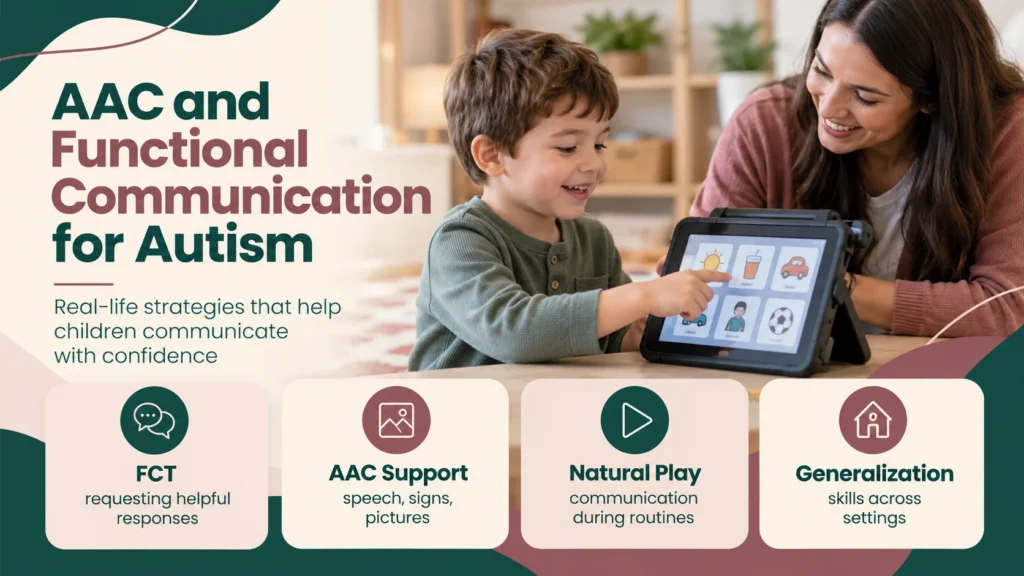
What Is AAC?
Speech therapy for autism can incorporate AAC if speech is required to be supported, supplemented or as a substitute.
Common forms include:
· gestures;
· manual signs;
· communication boards;
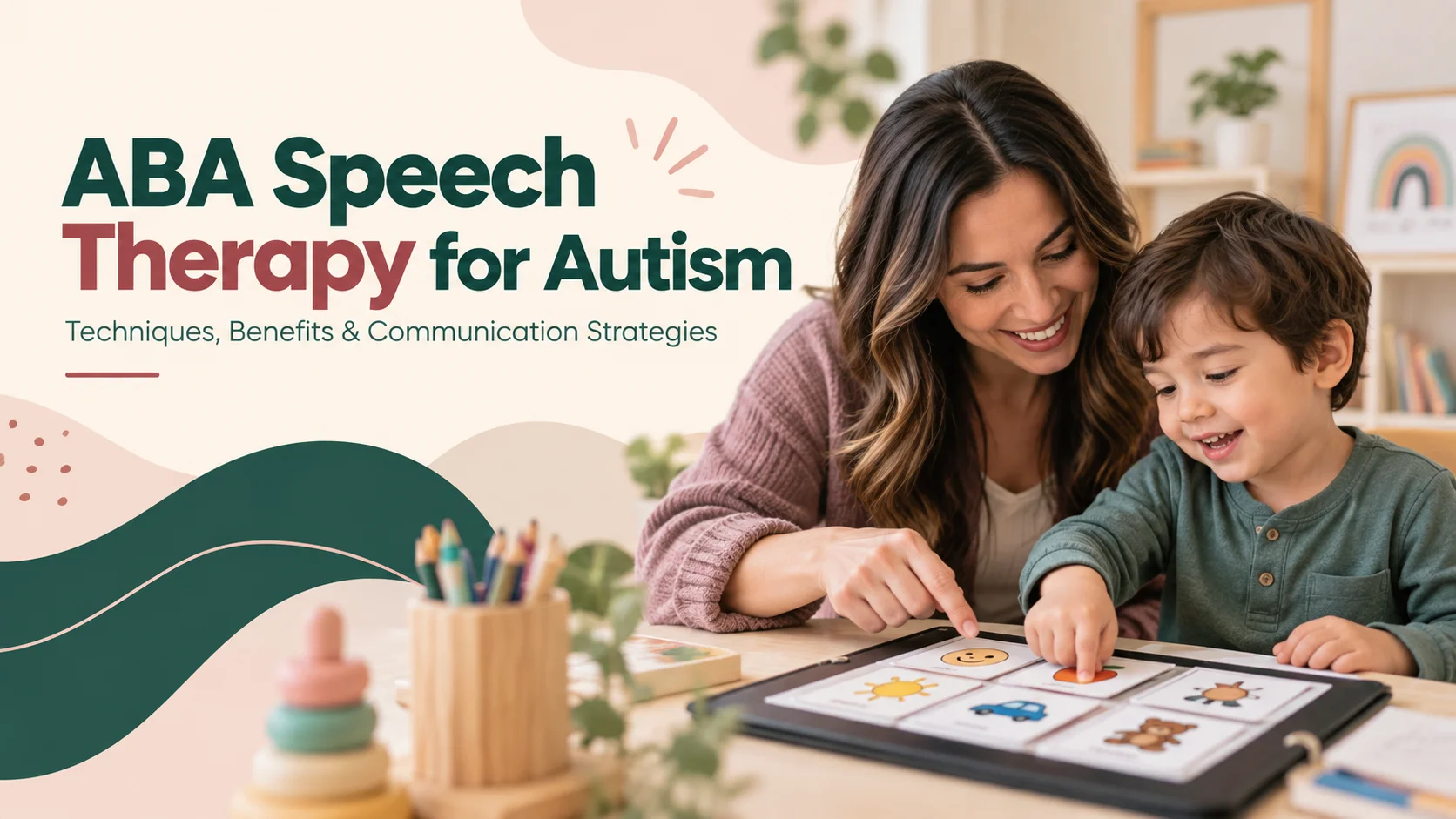
· picture systems;
· PECS;
· letter boards;
· speech-generating devices;
· communication apps.
ASHA’s definition of AAC is very broad and includes when speech is not present or is not functioning.
How ABA Can Support AAC Use
Appropriate ABA communication strategies can help a child practice an established AAC system during functional situations such as requesting, refusing, commenting, or seeking assistance.
When these goals are within the behavior plan, ABA professionals can be involved in consistent device access, independent initiation, prompt fading, and generalization. Qualified speech-language expertise should be involved in the selection/clinical evaluation of the communication system when indicated.
The SLP’s Role in AAC
Working with professionals is especially significant when the child’s communication plan entails using AAC for autism.
ASHA defines the role of the SLP in AAC as:
· Screening
· Comprehensive assessment
· Treatment planning
· Intervention
· Family training
· Collaboration
ABA staff can then back-up relevant communication goals without going outside of their scope.
Can AAC Help Autistic Children Communicate?
Yes. When speech is not reliable and children are able to convey needs, ideas, choices, feelings and social messages through AAC, it is helpful.
Benefits of ABA Communication Strategies for Autism
Effective ABA communication strategies are designed around useful outcomes that help a child to express themselves, join in with routines, and communicate with increased independence.
Potential benefits may include:
· more independent requesting;
· clearer refusal or boundary-setting;
· better access to help;
· greater choice-making;
· less reliance on adult prompts;
· improved use of communication across settings;
· stronger participation in family routines;
· increased self-advocacy;
· better transfer of learned skills into real situations.
When considering autism spectrum speech therapy, families should not solely assess the length of their child’s vocabulary. Progress can be as simple as saying “stop” to an adult or asking for a break using AAC, or asking for support before frustration escalates.
An 8-Step Process for Building Functional Communication
A well-designed plan for ABA and speech therapy for autism always begins with the individual learner and ends with the techniques, prompts, communication modalities and measurable outcomes.
Step 1: Understand Current Communication
Effective speech therapy for autism starts by finding out how the child currently communicates via speech, gestures, signs, pictures, AAC, or behavior. Effective communication, miscommunication, preferred partners, and communication needs are important to note by the caregiver and clinician.
Step 2: Complete Appropriate Assessments
ABA speech therapy for autism planning should include assessments that match each professional’s scope. A BCBA can assess behavioral functions and skill performance and an SLP can assess the speech, language, social communication and AAC needs to inform coordinated goals.
Step 3: Choose Meaningful Communication Goals
ABA communication strategies should focus on goals that improve everyday life. Priorities can involve seeking assistance, declining unwanted activities, making decisions, requesting breaks, reporting discomfort or communicating during play, with decisions based on priorities with family and the child’s preferences.
Step 4: Select an Appropriate Communication Method
AAC for autistic children can be considered when speech is not consistently reliable to meet the child’s communication goals. Communication may use speech, sign, gestures, pictures, devices, or a combination of methods as appropriate based on ability, preference, accessibility and professional judgement.
Step 5: Teach the Skill Systematically
Speech therapy techniques and ABA teaching procedures should match the skill being taught. Structured trials can promote early learning and naturalistic teaching can provide effective practice through play and routine. Progress data is used to evaluate the effectiveness of the approach selected.
Step 6: Build Independence
Functional communication training for autism should be structured so that unnecessary adult support is decreased as child becomes more confident. Clinicians can monitor prompt level, spontaneous communication, response times, success, and guide the learner to verbal independence from the prompt.
Step 7: Practice Across Everyday Settings
Practicing ABA communication strategies outside of the therapy setting is important to facilitate skills transfer. Children can learn to use communication within school experiences, home activities, playground play and community experiences, making learned responses more flexible and useful.
Step 8: Review Progress
ABA and speech therapy for autism goals should be reviewed regularly as communication needs change. Teams have access to progress information, family observations, independence, generalization, and relevant SLP input to update goals that are mastered, ineffective, or no longer meaningful.
How Is Communication Progress Measured?
Good ABA speech therapy for autism outcomes should reflect useful changes in communication, independence, and participation rather than relying only on the number of spoken words learned.
Useful indicators can include:
· independent communication attempts;
· successful requests or refusals;
· spontaneous help-seeking;
· independent AAC use;
· fewer prompts;
· communication with new partners;
· generalization across environments;
· maintenance over time;
· successful communication during difficult situations;
· caregiver-reported changes in everyday routines.
ALMA’s discussion of Contemporary ABA also highlights generalization in real-world settings, choice, family involvement, progress monitoring, and meaningful skills.
Get Individualized ABA Communication Support
Communication support must match how a child expresses needs, makes decisions, joins in on routines and interacts with others, not a set idea of what communication should be. ABA speech therapy for autism is most beneficial when it is not the only approach used, when communication is individualized, and when working with speech-language professionals is warranted.
Alma Behavioral Solutions offers personalized ABA care, centered on real-world communication, independence, family priorities, and life-long progress. The ALMA team can meet with a family in Glendale and the surrounding communities in Southern California to talk about assessment, parent support, service options, or the need for services to be coordinated.
To learn more, Call (747) 250-8494 or email info@almabehavioralsolutions.com. Talk to the clinical team to find out which ABA services might be a good fit for your child’s communication goals.
Frequently Asked Questions About Autism Speech Therapy
At What Age Can Speech Therapy Start for Autism?
Speech therapy for children with autism can begin when communication needs are identified; there is no universal age that fits every child. An SLP can assess the timeline based on development, communication profile, family concerns and assessment.
How Often Does an Autistic Child Need Speech Therapy?
The frequency of speech therapy for autism depends on the child’s communication needs, goals, clinical assessment, other services, and daily schedule. Families need to follow the individual recommendations and not assume a certain number of sessions is right for everyone.
Can ABA Help With Echolalia?
ABA communication strategies may support functional communication related to echolalia, but repeated language should first be understood in context because it can serve communicative or regulatory purposes. ALMA offers a dedicated echolalia and ABA guide.
Can Speech Therapy Help an Autistic Child Who Already Talks?
Yes. Speech therapy for autism can be focused on receptive language, conversational skills, social communication, speech clarity, understanding nonliteral language, or communication breakdowns. Spoken sentences do not automatically equate with the fulfilment of all communicative needs.
When Should Communication Goals Be Reassessed?
Goals need to be revisited with autism ABA speech therapy when skills are achieved, progress plateaus, ways of communicating change, new locations demand new skills or priorities in the family evolve. Review maintains intervention functions, individualization and relevance.