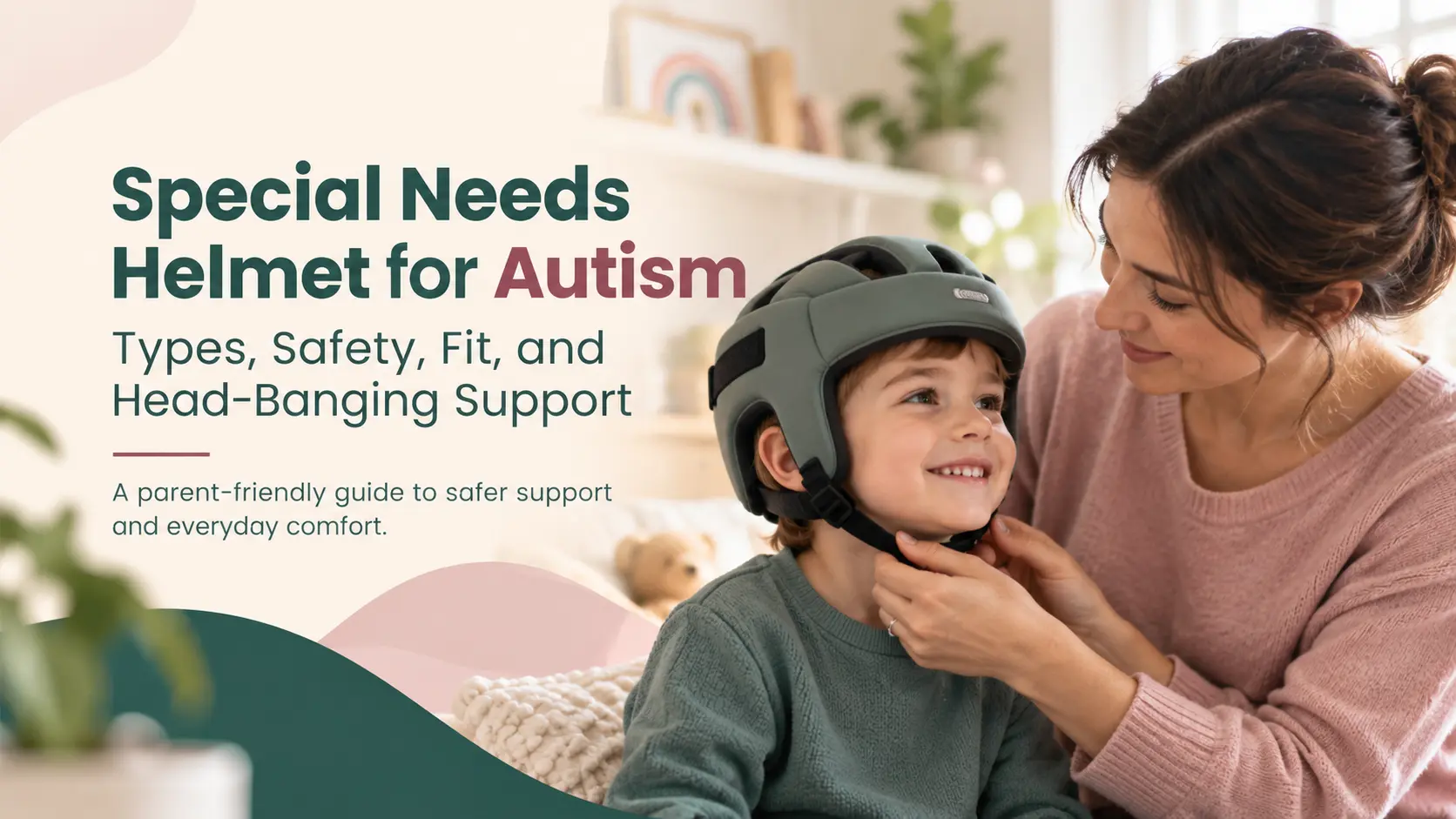

A special needs helmet is protective headgear used when head-banging, falls, seizures, or similar concerns create an injury risk. The right helmet depends on impact location, coverage, fit, comfort, intended use, and professional guidance. A helmet may reduce injury risk, but it does not treat autism or the underlying cause of head banging.
Could the correct head protection minimize risk of injury as a family tries to understand what’s going on?
Repeated head impacts, falls, or other safety concerns can make everyday routines stressful for children with autism and their caregivers.
In certain cases, a special needs helmet can be used as an additional layer of protection, but selecting a helmet for a special need isn’t just about getting a helmet that fits.
This guide provides information about types of helmets, fit, comfort, safety planning, head-banging supports and when professional input can assist families to make safer choices.
Key Takeaways
· A helmet for head banging is designed to reduce injury risk, not treat the behavior itself.
· Helmet type should be similar to the area and pattern of potential impact.
· Appropriate fit, coverage, ventilation and comfort are important for use.
· Head banging could have behavioral, communication, sensory, environmental or medical causes.
· Safety equipment is best used in conjunction with an overall plan of individual support.
What Is a Special Needs Helmet?
A special needs helmet is protective headgear that a person might require for additional protection due to repeated impacts, falls, movement problems or other safety concerns.
Special-needs headgear can have varying combinations of padding, side coverage, rear coverage, face coverage, retention systems, and materials, all of which are different from a standard recreational helmet. Depending on the child, some will require light protection for daily activities and others may require more extensive protection.
An autism helmet is not a treatment for autism. This usually refers to protective equipment that will be used in conjunction with an autistic child’s individual risk for head injury.
A good helmet should serve three purposes:
· Appropriate protection for the specific risk
· Provide secure positioning whilst moving
· Reasonable comfort during the situations in which it is needed
When Might a Helmet Be Considered?
A protective helmet for autism may be discussed if there is a meaningful safety concern for repeated head contact which is not addressed by using usual environmental safety measures.
Situations may include:
· Repeated head banging against hard surfaces
· Frequent accidental falls
· Seizure-related falls
· Balance or motor difficulties
· Recurrent head hitting
· Unsafe impacts during periods of intense distress
Helmets should be used on a case-by-case basis. A child who touches or lightly taps their head occasionally has different needs than a child who has repeated and forceful impacts to the head.
Alma’s autism care therapy services similarly emphasize understanding why unsafe behavior occurs while supporting the child’s broader communication, behavioral, and daily-living needs.
Autism Head Banging: Understanding Self-Injurious Behavior
A special needs helmet for head banging can help minimise impact but families should be aware of what is happening, when it’s happening and what may be causing head banging.
What Head Banging Can Look Like
Head banging may result in hitting a wall, floor, furniture or other firm object. Some children may hit their own head using their hands or objects.
The intensity and frequency can vary considerably. If head banging is a repetitive movement that does not pose a real threat of injury, then a helmet for head banging is not relevant to the issue of safety.
Useful observations include:
· Where the head usually makes contact
· The difficulty level of the impact seems
· If episodes are frequently happening
· What happened immediately beforehand
· What happens immediately following
Medical Causes to Rule Out
However, a sudden increase in head banging does not necessarily indicate a behavioral issue. Sometimes, behavior can become affected by pain, illness, injury or discomfort.
A protective helmet for autism can only help protect the head in an appropriate care plan for a time, but can’t relieve pain in the teeth, in the ears, headache, or a medical concern. Any new or severe or unusual behavior should be evaluated as appropriate.
Why a Helmet Protects but Does Not Treat the Behavior
Do not use a helmet for head banging as head bangers do not need protection, they need treatment.
The helmet doesn’t provide any clarity on why the behavior occurs. It cannot directly address pain, communication issues, distress, sensory needs, transition issues, and behavioral patterns that can lead to head banging.
Think of the helmet as protective equipment rather than a behavioral solution.
Families might then require two separate questions:
1. What can we do to minimize the risk of injury now?
2. What is the child communicating or experiencing when this behavior occurs?
Separating these questions will lessen the chances that an autism safety helmet becomes the only solution.
Types of Special Needs Helmets
The padding, structure and coverage offered by various helmets vary. When selecting a special needs helmet, it should be based on the actual risk pattern of the person, rather than their appearance.
Soft Shell Helmet
A soft shell helmet for special needs is usually made from soft padded materials and can be lighter in weight than those with a hard shell. The breathability, padding thickness, retention and manufacturer-recommended use can differ significantly.
Where flexibility and comfort are important, these helmets can be used if the type of risk is suitable.
Hard Shell Helmet
A hard-shell autism helmet has a harder outer shell. Some models provide more protection for the structure, but being stiff does not make a helmet suitable for all children.
Careful consideration still needs to be given to weight, ventilation, pressure points, sensory tolerance, coverage, and intended use.
Full-Coverage Helmet
A full-coverage protective helmet for autism may protect a larger area around the sides or back of the head. Coverage will differ from product to product.
The design may be applicable for multiple impact directions or if extra protection is needed for the back, temples or sides.
Partial-Coverage Helmet
Partial coverage protective headgear for autism is designed to shield only certain parts of the head, and allow more head to be exposed.
A lower-profile design may feel less restrictive, but coverage must still correspond to the child’s actual impact pattern. Less coverage doesn’t necessarily mean less appropriate.
Face-Guard Helmet for Forward Impact
A face guard may be considered when forward falls or facial impacts are part of the risk pattern. Some special needs helmets feature face bars or extra protection at the front.
When choosing this type, families should consider issues of visibility, communication, eating, movement, sensory tolerance, and the manufacturer’s intended use.
Quick Helmet Type Guide
| Helmet type | Main characteristic | Important consideration |
| Soft shell | Flexible padding | Comfort, heat, impact level |
| Hard shell | Rigid outer structure | Weight, pressure, intended use |
| Full coverage | Wider protected area | Hearing, comfort, movement |
| Partial coverage | Targeted head protection | Exact impact location |
| Face guard | Added frontal protection | Visibility, communication, tolerance |
How to Choose the Right Special Needs Helmet
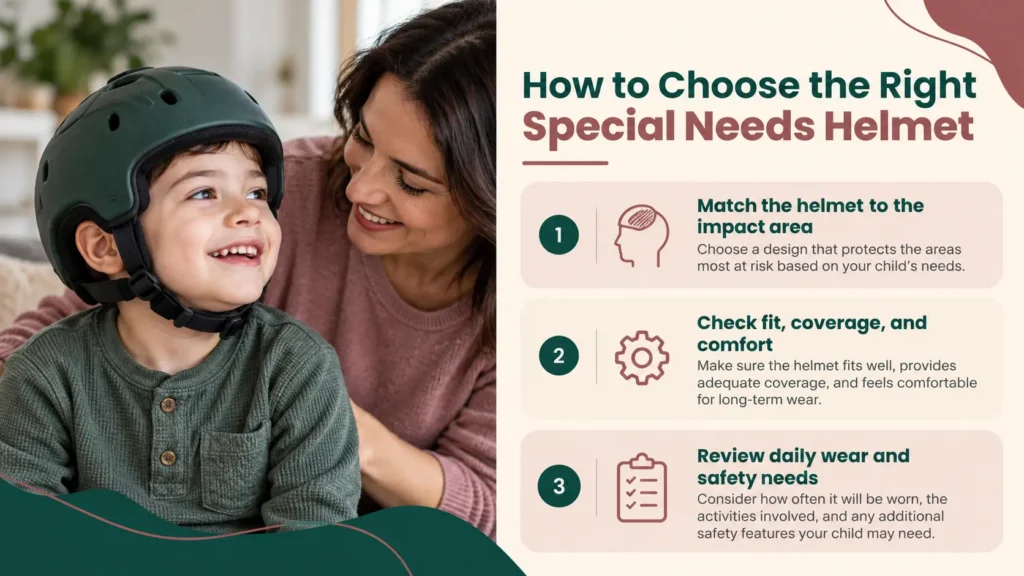
When selecting an autism safety helmet, you need to consider more than just the size or padding. Risk direction, coverage, daily activities, comfort, product instructions, and professional recommendations all affect suitability.
Match Protection to Impact Pattern
First, find where impacts are likely to take place. Autism children who fall forward may need a different type of protective headgear than those who repeatedly knock the back of the head against the wall.
Record patterns rather than guessing. The front, side, rear or multidirectional impacts may alter the coverage type that could be necessary.
Check Coverage
A special needs helmet should protect the areas identified as being at risk without unnecessarily restricting the child’s movement, vision, hearing, or communication.
Review coverage around the:
· Forehead
· Temples
· Back of the head
· Sides
· Ears
· Face when relevant
Review Safety Information
The protective helmet for autism should be checked based on the intended use, sizing directions, fitting instructions, materials, warnings, and limitations stated in the product.
Avoid assuming that a general sports helmet or another protective device provides equivalent protection. Each product is targeted for a specific activity and impact pattern.
Consider Daily Wear
Daily usability is important because an uncomfortable autism helmet can cause extra difficulties.
Consider:
· Overall weight
· Ventilation
· Heat buildup
· Strap positioning
· Cleaning requirements
· Glasses or hearing devices
· Skin contact
· Typical daily activities
Correct Helmet Sizing
A properly sized special needs helmet will ensure it protects the intended area without causing excessive pressure or discomfort when moving.
Measure Head Circumference
Use a flexible measuring tape according to the helmet manufacturer’s instructions. Sizes are not necessarily standard and factors such as a special need helmet for head banging should be taken into account when choosing the size of the helmet.
Take careful measurements and repeat the measurement if it is not certain. Growth should be considered when monitoring fit over time.
Perform a Fit Check
If done correctly, head banging should not cause any pain on the helmet and should not be painful during normal movement.
Check that the helmet:
· Sits in the intended position
· Does not rotate excessively
· Covers the required risk areas
· Uses the retention system correctly
· Does not create painful pressure points
· Allows appropriate vision and hearing
· Does not cause persistent skin irritation
Sensory Comfort During Helmet Use
Sensory experience can influence how comfortably a child uses an autism safety helmet. Texture, pressure, heat, weight, straps and change around the ears can all be of importance.
Introduce the Helmet Gradually
Slowly introducing protective headgear for autism can ease a child’s discomfort if medical or safety considerations do not dictate otherwise.
Families can start with short, consistent time, opportunities to look at the helmet, and positive experiences in wearing the helmet. The aim is to ensure the comfort and respect of participation and not to force and wear.
Watch for Discomfort
A child using a special needs helmet should be monitored for signs that the equipment is creating avoidable discomfort.
Look for:
· Redness or pressure marks
· Excessive heat
· Persistent attempts to escape the helmet
· Restricted vision
· Hearing interference
· Strap irritation
· Changes in participation
When the consumer doesn’t want to use it, it is not a problem of resistance, it is a problem of discomfort.
Safety Strategies Alongside Helmet Use
An autism helmet should be used as part of a comprehensive safety plan. Risk of injury persists and environmental changes, supervision, communication support and individual planning continue to be important.
Make the Environment Safer
A helmet for head banging does not remove hazards in the surrounding environment.
Families will explore the following common spaces for:
· Hard edges
· Repeated impact locations
· Unsafe furniture placement
· Fall hazards
· Situations where additional support may be needed
Adjustments to the environment can help to prevent additional injury.
Use Appropriate Supervision
Using a protective helmet for autism does not remove the child’s individual level of supervision.
The caregiver should be aware of when the child has more of a risk of such an episode and adhere to the child’s agreed upon safety or clinical plan. Protective equipment should not give a false sense of security against injury.
Build a Cross-Setting Safety Plan
A special needs helmet for head banging might be used in a different way at home, school, therapy, or in the community.
A practical plan can clarify:
1. When the helmet is used
2. Who checks positioning
3. What discomfort signs require attention
4. How the helmet is stored or cleaned
5. What staff or caregivers do when unsafe behavior begins
When children are receiving school support, coordination of family and practitioner planning can be beneficial. Alma’s school-based ABA therapy guide explains how behavioral support can connect skills and strategies across learning environments.
Understanding the Function of Head Banging
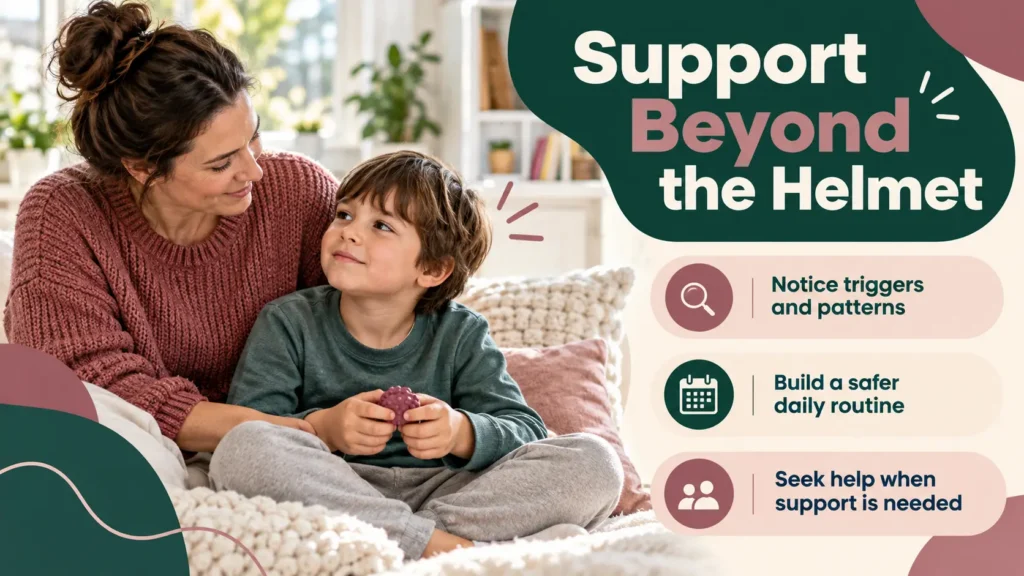
While safety equipment can minimize immediate harm, knowing the behavioral patterns may help families decide what kind of help might be beneficial beyond an autism safety helmet.
Observe What Happens Before
Events occurring before head banging can offer valuable clues. An autism helmet is used to make sure the head isn’t damaged, and observation can help to identify patterns that may warrant additional evaluation.
Possible antecedents may include:
· Difficult transitions
· Loud environments
· Tasks
· Communication difficulties
· Failure to have access to desired items
· Changes in routine
A pattern should be used to inform further evaluation, not to serve as an explanatory basis for the behavior. Learn more in Alma’s guide to antecedents in ABA therapy.
Observe What Happens After
Analysing the content that follows an incident may add context and a head banging helmet is a physical solution.
Ask whether the situation changed. Has the activity been discontinued, attention focused, something returned or the environment quieted down? Qualified professionals can use repeated patterns to generate and try out ideas for explanations.
Teach Safer Replacement Skills
A special needs helmet could prove to be a valuable protection for a child while better means of communication or response are being developed.
Replacement skills might include:
· Requesting a break
· Asking for help
· Communicating discomfort
· Requesting sensory support
· Using gestures or AAC
· Moving to an agreed safe space
When clinically appropriate, a structured behavior intervention plan can link assessment data to proactive responses, skill building, and consistent responses.
When Professional Support Is Needed
Families should get more information if handling an autism safety helmet or the underlying issue is challenging due to injury risk, uncertainty, sudden change or ongoing behavior.
Medical Evaluation
Medical evaluation is a consideration if the head banging starts suddenly or dramatically changes, results in injury, or is accompanied by pain or illness.
A protective helmet for autism must not be a barrier to assessment of a potential head injury, concussion, seizure, neurological change, or other medical condition.
Behavior-Analytic Support
Head banging can be supported with behavior-analytic strategies when it occurs often, poses a risk, is hard to interpret, or is linked to communication and activities.
A special needs helmet for head banging and a BCBA will evaluate patterns and create individualized teaching strategies. Families in Los Angeles can explore Alma’s direct ABA therapy services when behavioral support is clinically appropriate.
Occupational Therapy Input
When a child has a protective headgear response to autism that impacts their sensory comfort, the use of functional equipment, their movement or daily functioning, occupational therapy may be beneficial.
Families can work together to prevent taking one approach as the final solution. Medical, behavioral, occupational and school and family contributing inputs may be different.
FAQs About Special Needs Helmet for Autism
Can Helmets Cause Autism?
No. Wearing an autism helmet does not cause autism. Helmets are protective equipment that may be used as part of an existing safety problem, like repeated head impacts, frequent falls, or other individual risks for injury.
Why Do Some Children With Autism Wear a Helmet?
Some children wear a protective helmet for autism because head banging, falls, seizures, motor problems or other factors increase the risk of injury. Helmet use should be based on individual safety needs.
Should an Autism Helmet Be Worn All Day?
Not necessarily. Autism safety helmets are to be worn based on the child’s risk pattern, comfort, professional recommendations, and product instructions and care plan. It is not to be assumed that continuous use is suitable for all children.
Can a Regular Sports Helmet Be Used for Head Banging?
A sports helmet should not automatically replace a helmet for head banging. Helmets in different categories can vary greatly with regard to intended use, coverage, fit, pattern of impact, wear time, materials and limitations in the product.
How Often Should a Special Needs Helmet Be Replaced?
A special needs helmet should be replaced according to the manufacturer’s instructions, growth, damage, material deterioration, fit changes and the helmet’s state following big impacts. Inspect it regularly and follow product-specific instructions.
Get Personalized Support From Alma Behavioral Solutions
Wearing protective clothing is not the only aspect of the problem of unsafe behavior. Alma Behavioral Solutions supports families in exploring the patterns of behavior, developing functional communication, teaching replacement skills, and creating individual support around life as it unfolds.
Families in Burbank and across Southern California can discuss ABA support when head banging or another behavior is affecting safety, participation, or family routines. Alma’s approach focuses on understanding behavior rather than relying on a special needs helmet as the complete solution.
To discuss your child’s needs, Call (747) 250-8494 or email info@almabehavioralsolutions.com. The Alma team can help families understand available ABA services, assessment steps, and appropriate next options while medical helmet selection remains coordinated with qualified healthcare professionals.