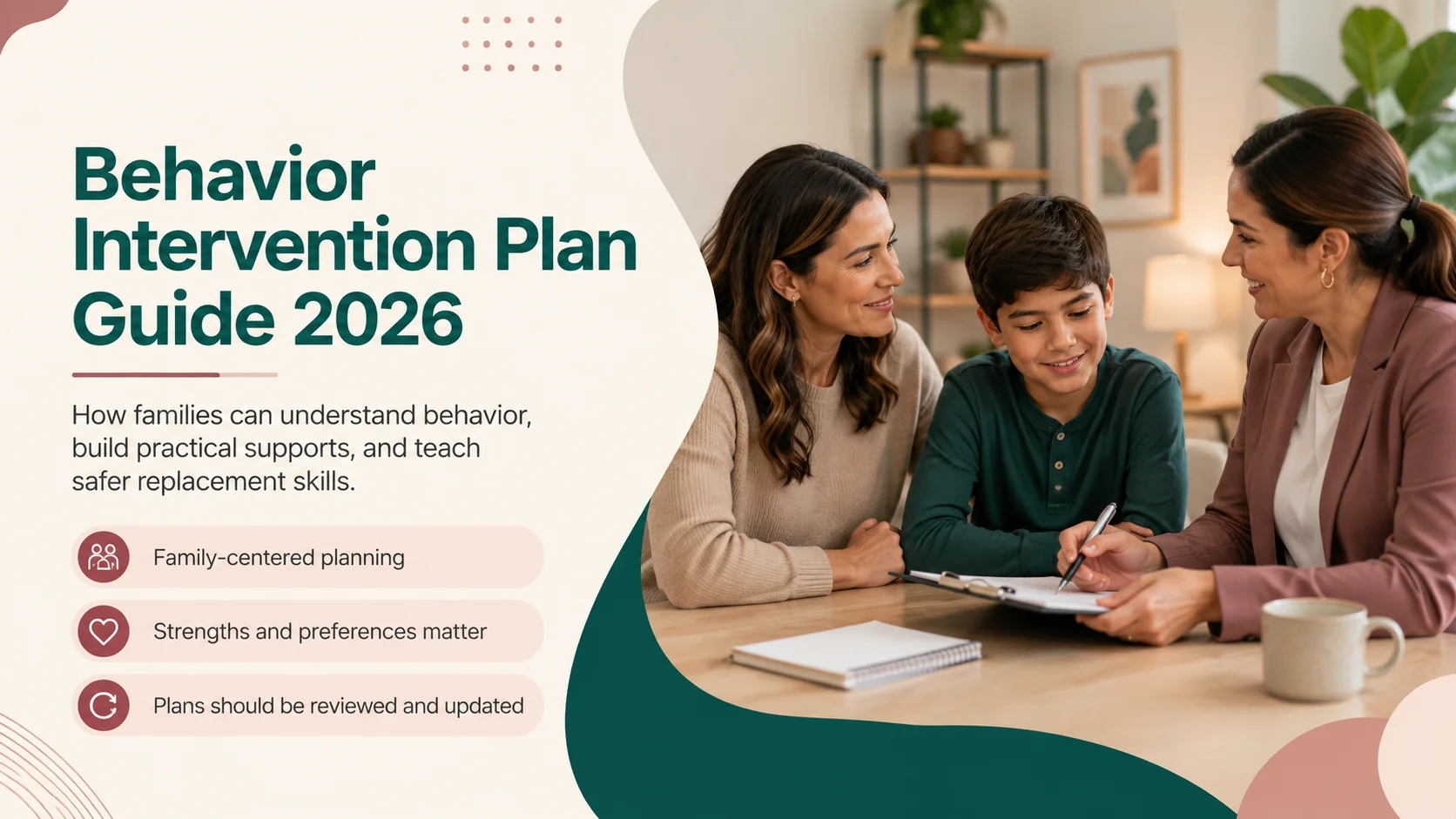

Could a child’s difficult behavior be communicating a need an adult has not identified? Behavior carries information. A behavior intervention plan, or BIP, turns assessment into support. It discusses what occurs before, during, and after behavior.
Proactive support has an impact on discipline data. Students with disabilities were 17% of K–12 enrollment in 2021–22. Yet they represented 29% of students receiving out-of-school suspensions. The U.S. Department of Education reported this.
A good behavioural intervention plan is more than just a list of consequences. It specifies behaviour and proposes potential functions. It provides a replacement skill and modifies the environment. It provides for caregivers and professionals a response plan.
What Is a Behavior Intervention Plan
A behavior intervention plan is a written individual plan to address behavior that significantly impacts learning, participation, daily functioning or safety. A good BIP makes an explicit description of the behavior, examines its function, and addresses what adults can change or teach. It is not just used to prevent behaviour. The plan should develop useful communication and coping, participation, self-advocacy, or independence skills.
Common parts include:
- prevention and environmental supports
- replacement-skill teaching
- reinforcement and adult responses
- data collection and review
How a BIP Relates to a Functional Behavior Assessment
A Functional Behavior Assessment (FBA) looks at the circumstances surrounding the occurrence of the behavior, what often happens before, after and why the behavior might be occurring. Those findings will inform a BIP to choose supports.
According to federal guidance, a BIP is a plan that is frequently created following an FBA to support the environmental, behavioral and instructional needs. Put simply, the FBA helps explain why; the BIP explains what the team will do next. Teams may use observations, interviews, records, and ABC data.
When a Child May Need a BIP
A BIP can be considered if behavior occurs more than once and it interferes with meaningful participation, poses a safety issue, or is not positively reduced by the use of simpler supports. This includes, but is not limited to, aggressive behavior, elopement, refusal to tasks, work avoidance, calling out, or off task behavior that has a significant impact on the child or others. Do not make a plan because a child differs from other children. The plan should be based on functions and be meaningful, not just about compliance.
IDEA does not mandate a BIP in every case where behavior is interfering with learning, but it does call for the IEP team to consider positive behavioral interventions and supports. Some disciplinary situations are accompanied by specific FBA/BIP requirements, such as some manifestation determinations involving a disciplinary change of placement.
The 2025 IDEA report will include approximately 6.9 million students ages 6–21 served under IDEA in 2023, which does not reflect BIP use.
Looking beyond 2026, NCES projects U.S. public-school enrollment at about 47.3 million in fall 2030. This projection does not count BIP use, but it does reveal that schools will continue to provide tens of millions of students who could require individualized support.
What Should a Behavior Intervention Plan Include
A helpful BIP template helps to link the assessment results to action. Staff and caregivers should be aware of what to do, when to do it and how progress will be measured. Federal guidance also includes focus on behavior definitions, environmental factors, function, prevention, teaching, reinforcement, staff responsibilities, fidelity and evaluation.
| BIP component | What it explains |
| Target behavior | What can be observed and measured |
| Baseline | How often, how long, or under which conditions the behavior occurs |
| Function | What the behavior may help the child access, avoid, communicate, or regulate |
| Prevention | Changes that may reduce predictable difficulty |
| Replacement skill | What the child will be taught to do instead |
| Reinforcement and response | What adults do after replacement or target behavior |
| Measurement | What data are collected and reviewed |
Clear Behavior Definition, Baseline, and Function
A good definition is detailed enough that trained observers can generally decide if the behaviour was present or not. The term ‘act aggressively’ is too ambiguous; there needs to be a plan that specifies observable actions and clear boundaries. Objective descriptions assist teams to gather more helpful information instead of making judgements.
Baseline data may include:
- frequency
- duration or latency
- relevant context
- conditions where behavior does and does not occur
The function is an assessment, not a judgement about the child.
Prevention Strategies and Replacement Skills
Prevention alters the circumstances that might make it easy to be difficult. Support can be visual options, breaking tasks up in smaller steps, preparation for transition, communication support, or environmental modifications. Action or strategy choice should be based on the assessment and not the behaviour itself.
Replacement skills should meet the same or a related need:
- escape from difficult work → request help or a break
- need for interaction → request attention
- transition difficulty → use a visual or communication routine
The skill needs to be taught, practiced and reinforced.
Reinforcement, Response, Data, and Responsibilities
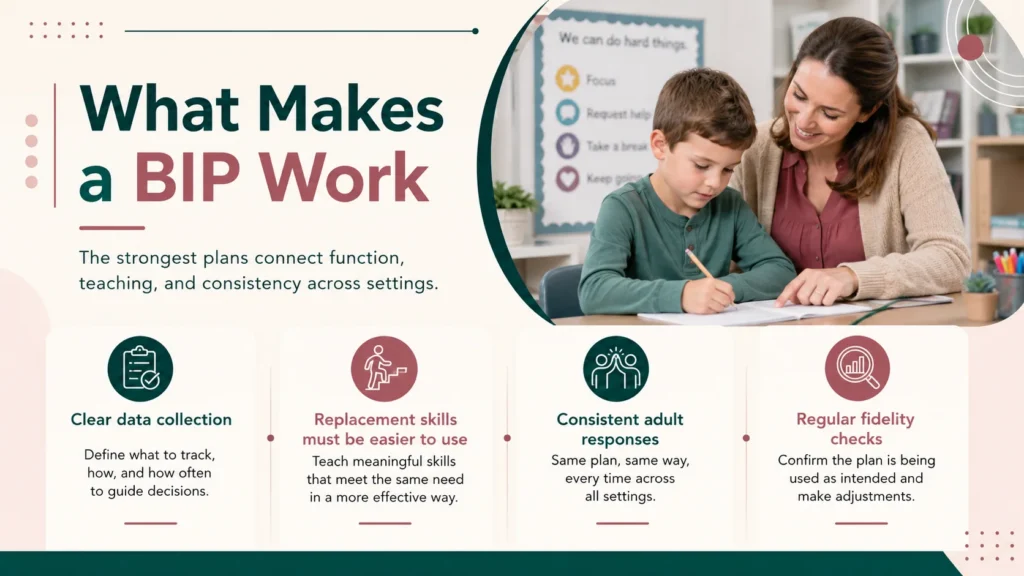
A full behavioral intervention plan outlines what will happen after a replacement skill has been successfully used and what will happen if the target behavior is used by the adults. Reinforcement should be meaningful, while response procedures should be safe, respectful, and function-informed. Data should capture progress in replacement skills as well as changes in the target behavior.
The plan should also identify:
- who implements and collects data
- how fidelity is checked
- when progress is assessed
- safety procedures only when necessary
How to Write a Behavior Intervention Plan
It’s easier to learn how to write a behavior intervention plan if the team follows this sequence: assess, define, plan, teach, reinforce, measure, adjust. Observable definitions, environmental factors, function, prevention, skill teaching, reinforcement, staff responsibility, fidelity, evaluation are also highlighted in federal guidance.
Review the FBA and Baseline Data
Don’t jump to conclusions, but begin with evidence. Revisit observations, interviews, records, communication needs and patterns in settings. Direct and indirect information can help the team identify conditions associated with both the occurrence and non-occurrence of behavior.
Ask:
- What exactly is happening?
- How often or how long does it happen?
- Under which conditions is it more or less likely?
- What function is best supported by the data?
Set Meaningful and Measurable Goals
Goals should involve meaningful change, rather than mere compliance. It is hard to measure the child’s behaviour to be appropriate. A stronger goal includes the skill, context, measurement and realistic criterion. Goals should also be meaningful to the child’s participation in, and quality of, life.
Track both:
- reductions in unsafe or interfering behavior when appropriate
- increases in communication, coping, participation, or independence
Progress should reflect skill growth, not only fewer target responses.
Choose Function-Based Prevention, Teaching, and Reinforcement Strategies
A function-based plan asks what the child needs and what response will work better with the child. A practical sequence is prevent → teach → reinforce → respond. Research reviews and federal guidance provide support for making intervention selections based on behavior function instead of just generic interventions.
Possible strategies include:
- visual supports, choices, and transition preparation
- task modification or chunking
- Functional Communication Training
- prompting and fading
- differential reinforcement when appropriate
- individualized reinforcement
- safe sensory or regulation supports when relevant
Communication preferences and sensory needs, dignity, autonomy and signs of distress should be respected in the development of strategies. Self-regulation should not be automatically a reduction target if it’s harmless. The BACB’s existing code of ethics focuses on respect, dignity, self-determination and restrictiveness to consider social acceptability.
Assign Roles and Decide How Progress Will Be Measured
Consistent implementation is needed to ensure that the results of a strong plan are clear. Identify the name of the person who will be teaching the replacement skill, reinforcing the skill, collecting data, and communicating updates. Families in Glendale or Burbank may also require a variety of school and home strategies that are practiced in different ways, and not necessarily in the same way.
Useful measures include:
- frequency, duration, or latency
- independent replacement responses
- participation
- A short test of fidelity
Behavior Intervention Plan Example
A behavior intervention plan example should make people aware of how assessment impacts intervention decision making. The following example of BIP is fictionalized for educational purposes and should not be used as a replacement for individual assessment.
BIP Example for Task Refusal and Work Avoidance
Jordan, age 9, often leaves the table during difficult independent writing. Observation suggests leaving is most likely during longer assignments and is followed by a pause in work, supporting an escape or avoidance hypothesis.
| BIP element | Example |
| Target behavior | Leaves the work area for more than 10 seconds after a writing direction |
| Baseline | About 4 times during a 30-minute writing period |
| Possible function | Escape from difficult or lengthy work |
| Prevention | Shorter sections, a clear finish point, and a choice of writing tool |
| Replacement skill | Request “help” or “break” using speech, AAC, or a card |
| Reinforcement | Honor appropriate requests as planned and reinforce manageable participation |
| Measurement | Track leaving, requests, prompting, and completed sections |
This BIP for task refusal also demonstrates an escape-maintained behavior intervention when assessment indicates that it is such.
Why This BIP Example Is Function-Based
The plan does not simply reward Jordan for staying seated. It alters tasks requirements, it helps teach a faster method of asking for assistance or break, and it assesses if communication becomes independent. Function-based interventions are based on assessment rather than one-size-fits-all.
difficult task → leaving produces escape → teach help or break request → reinforce communication → build successful participation
Schedule a BIP Consultation
How BIP Strategies Change for Common Behaviors
Aggression, elopement, calling out, inappropriate behavior may all have various functions. Behaviour that looks alike might then need different plans. Functional assessment is used to determine the relationship between behavior and the events in the environment prior to the selection of function-linked supports.
BIP for Aggression and Elopement
A BIP for aggression should define the behavior, assess its context and function, teach an effective alternative, and include individualized safety planning when needed. A BIP for elopement should consider, whether leaving facilitates escape, access to something desired, interaction, control over sensory input or a different need.
Possible supports include:
- functional communication
- transition or environmental changes
- Providing feedback for safer replacement behaviors
- individualized safety procedures
A general guide should not contain generic guidelines for restraint or seclusion.
BIP for Calling Out and Off-Task Behavior
A BIP for calling out may need an attention-maintained behavior intervention when calling out reliably produces interaction. A different plan might be necessary if another child calls out due to work being confusing.
A BIP for off-task behavior may involve easier task entry, help requests, shorter work segments, or planned breaks when assessment supports escape.
Ask what happens before the behavior, what reliably follows it, and which replacement response could meet the same need.
How Parents Can Help a BIP Work in Everyday Life
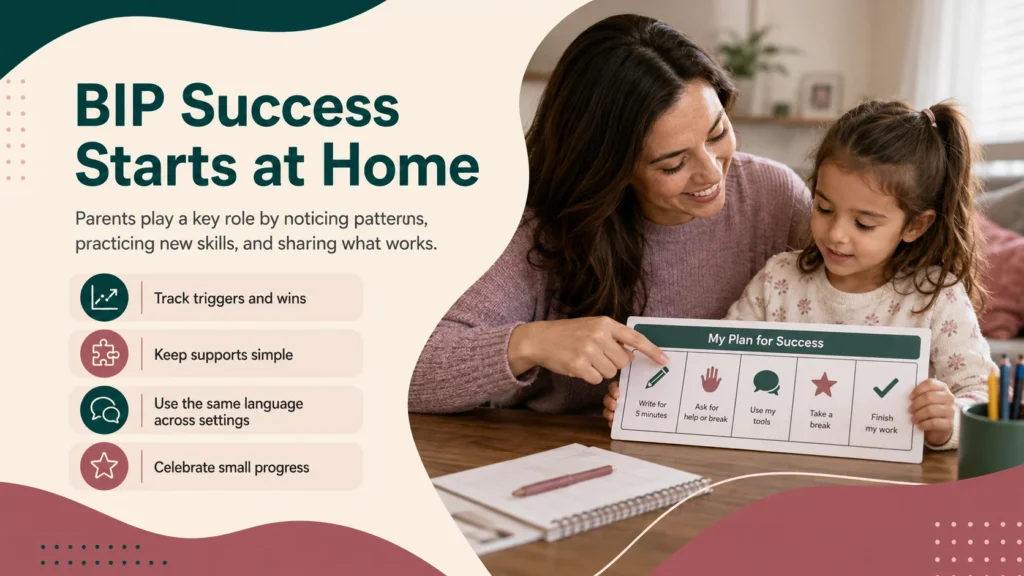
Parents provide input which is not shared at a clinic or during a classroom visit. There are various ways to enhance plan design, including routines, communication differences, preferences, sensory needs, and what works at home. Collaboration between educator, parent and student where appropriate is highlighted in federal guidance.
Questions Parents Can Ask the Care or School Team
Good questions make the logic of a plan visible. Families in Pasadena or Los Angeles can utilize them for home, school and ABA support coordination.
Ask:
- What function does the assessment suggest?
- What skill are we teaching instead?
- How does the strategy correspond to the function?
- How are strengths and preferences reflected?
- What will be the indicators of progress?
- What would make the team revise the plan?
How to Know Whether the Plan Is Working
Progress to be measured using data and day to day meaningful changes. Target behaviour, replacement skills, independence skills, participation, distress and generalization can be monitored. Fidelity is important because results will be assessed by implementation quality when teams consider results.
The review sequence can be the same for families in Beverly Hills or Granada Hills when support is provided in both the home and school setting, as well as in therapy.
Use this sequence:
- Check implementation.
- Review target and replacement-skill data.
- Reconsider context and setting events.
- If results do not fit repeat the function hypothesis.
- Adjust ineffective or unnecessarily intrusive strategies.
Behavior Intervention Plan Template
A practical behavior intervention plan template should make the plan usable, rather than just a piece of paper. Families can use this BIP template as a discussion checklist with a BCBA, school team, or other qualified professional. Federal and PBIS guidance is in place to help support function linked planning, clear responsibilities, fidelity and data-based review.
Include:
- strengths and preferences
- target behavior and operational definition
- baseline and likely function
- measurable goals
- prevention strategies
- replacement skill and teaching procedure
- reinforcement and adult response
- data method and responsibilities
- fidelity check and review rules
- individualized safety planning when needed
A downloadable working plan document may be of assistance, but responsible team members should be able to access, understand and amend the working plan.
Get Individualized Behavior Support for Your Child
A strong BIP should make support clearer, more respectful, and more useful for the child and the adults helping them.
ALMA Behavioral Solutions offers parent support, individual ABA therapy and school consultation in Studio City and Northridge, Southern California.
They have a team that specializes in designing functional, practical behavior plans, which will help to enhance every child’s daily routine, communication and skill development over time.
Contact (747) 250-8494 or info@almabehavioralsolutions.com to discuss Assessment, Behavior Planning, and Next Steps with families.
Frequently Asked Questions About Behavior Intervention Plans
Can a BIP Be Used at Home
Yes. A BIP can guide consistent support at home when strategies match the child’s assessed needs and family routines. Coaching for parents can provide a natural environment to practice prevention, communication, reinforcement and data collection.
Is a BIP the Same as an IEP
No. An IEP is a comprehensive special education document that includes services, goals, accommodations and supports that are considered eligible. A BIP specifically addresses behavior support and may be incorporated into or attached to an IEP.
Does a Child Need an Autism Diagnosis to Have a BIP
No. A behavior intervention plan can be used for any type of behavior. Function based planning may be used for children with various diagnoses, disabilities and/or support needs when individual behavioral intervention is warranted.
How Often Should a BIP Be Updated
No one review schedule works for all BIPs. Teams should check data at scheduled times and more frequently when behavior shifts, progress is not happening, safety issues arise, conditions change, or implementation issues.
Can Parents Ask for Changes to a BIP
Yes. Parents may contribute observations, concerns, priorities and data to the appropriate team and request review. School procedures and clinical processes vary, and families should adhere to the requirements of the applicable program, district and state.