
What happens when a child is able to use a skill in therapy but not in the classroom because of the noise, chaos, or social interaction?
Children are not in the school environment where they are expected to be in situations that are hard to replicate in a clinic: group instruction, transitions, independent work, peer interactions, lunch, recess, unexpected changes. Skills may need additional practice in the environments where they are actually used.
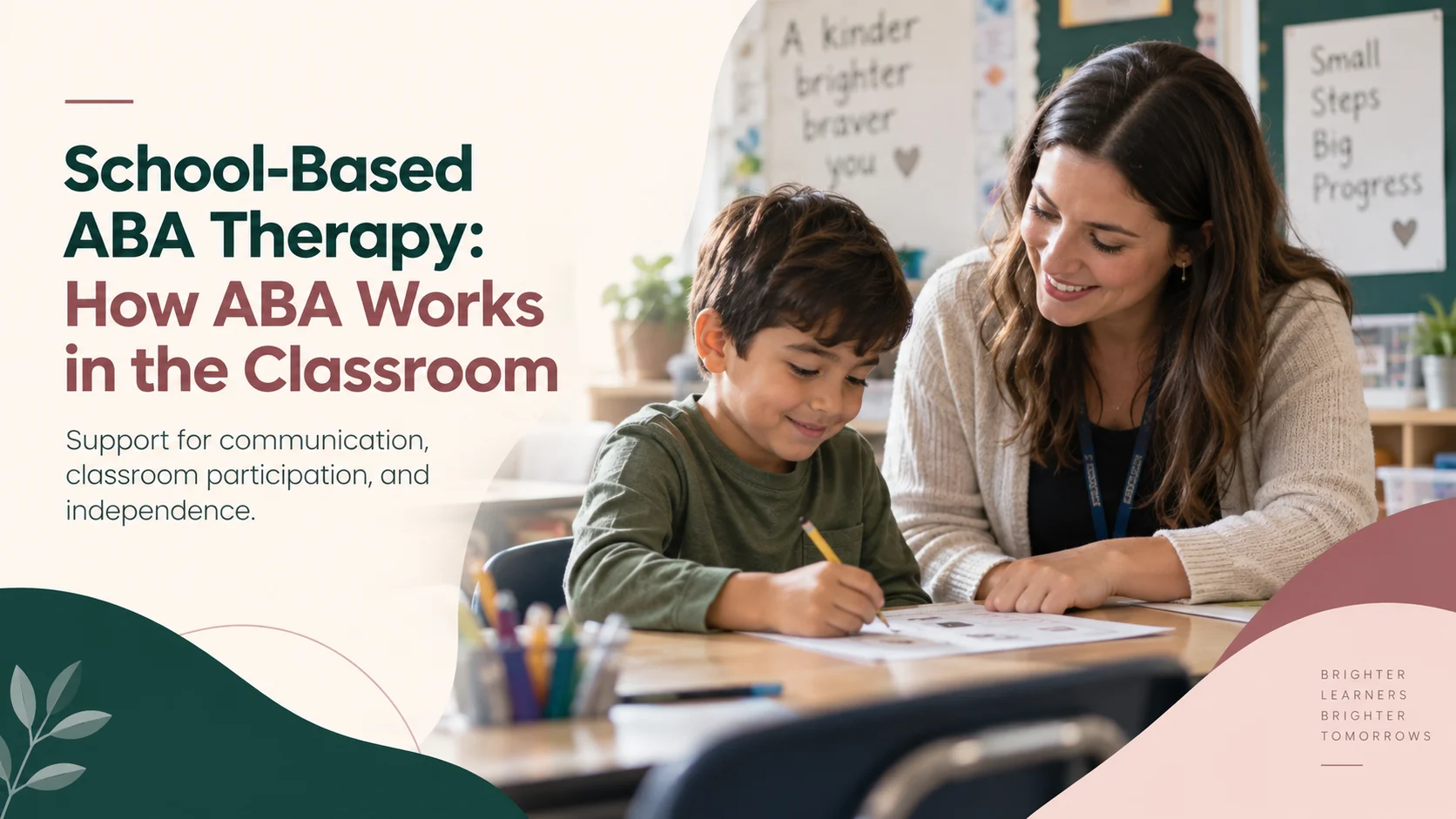
School-based ABA therapy integrates individualized behavioral supports into these normal learning experiences. The aim is not just to change behaviour, but to promote meaningful communication, participation, independence and access to learning.
This guide provides an overview of how ABA is used in school, some classroom strategies that can be employed, measurement, and how families, educators, and ABA professionals can collaborate.
Quick Answer: What Does School-Based ABA Therapy Look Like?
School-based ABA therapy utilizes behavior-analytic principles in authentic school-based routine. Support can include classroom observation, individualized goals, skill teaching, behavior support, data collection, collaboration with teachers, and fading of support. This will depend on the needs of the student and not be a uniform program in one classroom.
What Is School-Based ABA Therapy?
ABA therapy in schools involves the application of Applied Behavior Analysis in school settings to help the student develop functional skill. Support can be provided in the classroom, from one activity to another, as part of peer activities, as part of independent work or as part of other relevant activities.
Some school-based ABA therapy services can be direct intervention, consultation, staff coaching, classroom observation or coordination of an existing IEP or Behavior Intervention Plan, depending on the student’s plan.
The emphasis should be on being personalized and measurable. Applied behaviour analysis in schools should be used to foster meaningful participation and independence, not to achieve uniformity of performance among all pupils.
How Does ABA Therapy Work in the Classroom?
Effective ABA therapy in the classroom begins with understanding the student and the classroom first and then using techniques. A visual schedule or token system or reinforcement plan is not a universal fit for all situations because it is an ABA strategy.

Observe School Routines and Define Meaningful Goals
The process is often started by observing what occurs in the student’s school day. Considerations for the classroom setting, environmental demands, communication skills, current strengths, and situations where extra support is required.
Goals should be observable and useful skills. Instead of a vague objective such as “behave better during class,” a goal might focus on independently beginning a task, requesting assistance, moving between activities, or participating safely during group instruction.
For example: A student in Pasadena may be able to finish similar exercises successfully at home and need extra support starting written work in a run-down classroom. The setting must be considered in problem definition.
Understand What Is Influencing the Behavior
Behavior provides information. Effective support considers what happens before, after, and what the student is gaining, avoiding, communicating, and responding to.
Sometimes, a Functional Behavioral Assessment (FBA) can assist teams in understanding behavior that is interfering with learning. According to the U.S. Department of Education, an FBA is a procedure used to determine the factors that influence a student’s behavior, in order to create function-based interventions.
Not all students receiving ABA support will automatically have to receive an FBA. Assessment procedure and legal requirements vary depending on the situation.
Build a Support Plan Around the Student’s Needs
Assessment information informs the team of what to teach and how the environment can facilitate success.
A plan may identify:
- the skill or behavior being measured
- situations in which support is needed
- preventive or antecedent strategies
- useful replacement skills
- reinforcement procedures
- staff responsibilities
- methods for measuring progress
A Behavior Intervention Plan (BIP) may be created when appropriate. The U.S. Department of Education’s guidance highlights the importance of working together as educators, parents, specialists, and, as appropriate, the student in developing and implementing behavior-support plans.
Families who need help connecting behavioral recommendations with classroom realities can also explore Alma’s School Consultation services.
Practice Skills During Real School Activities
School provides opportunities to practice skills that are relevant.
A student may develop the ability to ask for assistance in challenging math assignments, stay in line for a class, take a communication response to an assignment, or follow a visual sequence for moving between classes.
Teaching in authentic routines is significant because if a student demonstrates a skill with one therapist, he or she may not perform the skill with teachers, peers, or in another setting.
Measure Progress, Adjust Strategies, and Fade Support
ABA relies on data to see if there is actual help. Frequency, duration, level of prompting, percentage of independent responses, or other measures that relate to the goal are acceptable measures for teams.
Progress reviews should result in decision-making. Strategies may need to change if data show little improvement or if the student’s needs change.
Support should also be reduced, where applicable. Immediate fading, gradual reinforcement thinning and exposure to multiple people and settings may eliminate the need for unnecessary adult assistance.
Alma’s guide to the Seven Dimensions of ABA Therapy explains why measurable outcomes and generalization are important parts of high-quality ABA.
What Skills and Outcomes Can School-Based ABA Support?
The appropriate targets depend on the individual student. Skills targeted in ABA therapy for students with autism may relate to communication, participation, independence, and successful access to common school activities.
Functional Communication and Self-Advocacy
A student can express ways to ask for assistance, communicate discomfort, ask for clarification, request an appropriate break, or express preference. Functional communication can reduce the need to rely on less effective ways of communicating a need.
Classroom Participation, Routines, and Independence
Goals can include: initiating assignments, classroom routines, organization, multi-step activities, and more prompts for transition. Progress should be made towards being more independent where appropriate for the learner.
Social Participation With Peers and Adults
School provides regular social events. ABA can assist in turn-taking, joining in an activity, conversation, cooperative play or group work. Social targets should be effective and respectful, not designed to make differences that pose no threat look inconspicuous.
Flexibility and Coping With School-Day Changes
Other demands can result from assemblies, substitute teachers, changes in the schedule, fire drills, and the end of preferred activities. Coping responses, communication, and preparation strategies may be taught to enable students to participate more successfully when routines change.
ABA Strategies in the Classroom: Practical Examples
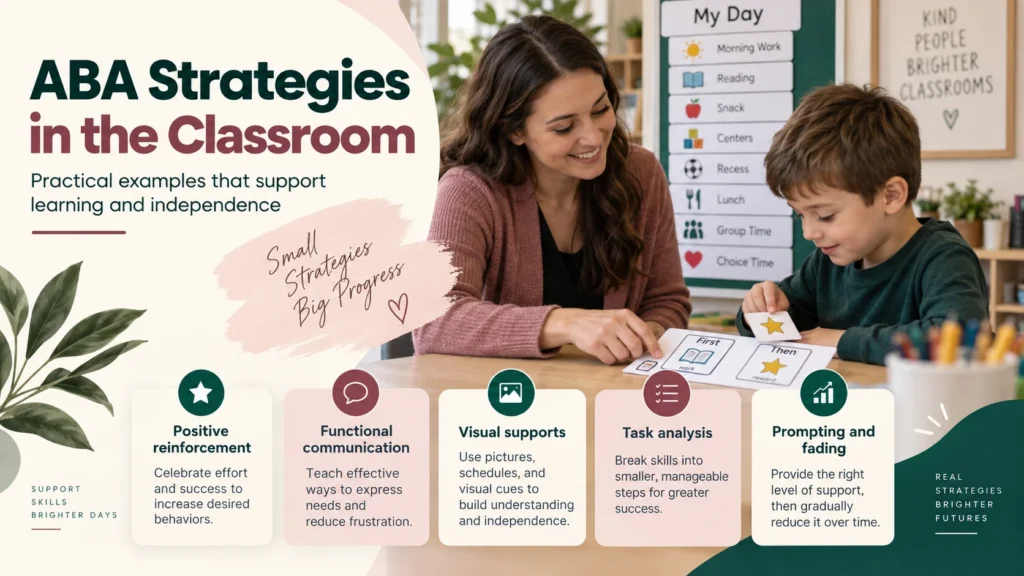
Effective ABA strategies in the classroom are chosen according to assessment information, goals, and the student’s response to intervention. A strategy appropriate for one learner may not be suitable for another learner.
Positive and Differential Reinforcement
Reinforcement makes a behavior likely by giving a meaningful consequence following the behavior.
Independent task initiation, functional requests, or successful use of a newly learned skill may be reinforced by a teacher or therapist. Differential reinforcement can provide reinforcement under specific behavioral conditions rather than rewarding behavior indiscriminately.
Readers who want a deeper explanation can review Alma’s guide to Differential Reinforcement in ABA.
Functional Communication and Replacement Skills
Extinction of an interfering response without the teaching of a useful response can leave the need unfilled.
Assume that when a student is doing hard work, they often get up from the desk. It may be appropriate to consider the issues of escaping or postponing challenging tasks. Teaching the student to request help, clarification, or an appropriate break provides a functional alternative.
Visual and Antecedent Supports
Support can sometimes be provided in anticipation of a difficulty.
Some helpful suggestions include:
- visual schedules
- first-then boards
- advance warning before transitions
- clear, concise instructions
- choice-making opportunities
- environmental adjustments
These supports can help make expectations more explicit without the need for a problem to arise.
Task Analysis, Prompting, and Fading
Task analysis is a procedure that divides a complex activity into more manageable steps to teach. Packing a backpack is one of the school routines that might involve collecting assignments and putting them in the right place, reviewing a visual list, and getting ready to leave.
Prompts can facilitate learning, but a planned fading procedure will allow the student to perform more steps without prompts.
Naturalistic Teaching, DTT, and Structured Reinforcement Systems
Natural Environment Teaching uses opportunities that occur during normal activities. Discrete Trial Training provides more structured teaching opportunities when appropriate.
Where there is a well-determined and meaningful reinforcement system, token systems can be helpful as well.
The use of methods should be based on the student’s goals and data, not to every classroom situation, using DTT, token boards, or procedures.
What Can School-Based ABA Look Like During a Typical School Day?
ABA in school settings becomes easier to understand when strategies are connected to actual school routines.
| School Moment | Possible Support Need | Example ABA Approach | Skill Being Developed |
| Morning arrival | Completing the arrival routine | Visual sequence with faded prompts | Independence |
| Group lesson | Asking for assistance | Functional communication | Self-advocacy |
| Independent work | Beginning difficult tasks | Task analysis and reinforcement | Classroom participation |
| Transition | Moving to another activity | Advance warning and visual cue | Flexible transitioning |
| Lunch or recess | Joining peers | Naturalistic skill practice | Social participation |
| Schedule change | Managing unexpected routines | Preparation and coping strategy | Flexibility |
It is not the objective to make the whole school day a therapy session. Support should be appropriate to the education and learning program without disrupting access to teaching, peer and normal school program activities.
Even with the same diagnosis, students with support in the community of Northridge, or any other community in Southern California, may have very different classroom needs.
Who Is Involved in School-Based ABA?
Effective school-based ABA services include collaboration as one of its key characteristics.
There is a significant need for coordinated school support. In 2024, more than 8 million children received services under IDEA, and 67.8% of children with disabilities ages 6–17 spent 80% or more of their school day in regular education classrooms in 2023 (According to the U.S. Department of Education).
BCBA and Behavior Support Staff
A Board-Certified Behavior Analyst can evaluate needs, develop behavior goals, analyze data, provide training or supervision for appropriate support personnel, and implement treatment changes based on progress.
As of the end of 2025, there were 81,566 BCBAs reported by the BACB, and between 2024 and 2025, the job-posting demand for BCBA/BCBA-D credentials grew by 28%. California represented 15% of 2025 demand.
Teachers and the School Team
Teachers are aware of the curriculum and classroom environment, peer dynamics, schedules, and any constraints that an outside provider might not have noticed.
But their job is not to be an ABA therapist. Collaboration helps ensure that recommendations can realistically work within the educational environment.
The BLS estimates that about 37,100 special education teacher jobs will open up every year between 2025 and 2035, driven by the need to replace many workers. The projection serves as a useful context to future workforce needs, not evidence of the effectiveness of ABA.
Parents, Caregivers, and Related Providers
Parents provide details of communication, routines, preferences and skills observed outside of school. Depending on the student’s needs, other providers such as speech-language pathologists, occupational therapists, psychologists, and others may also contribute.
For example, families in Granada Hills can utilize the school-home communication to find out if new skills are being transferred between the two settings.
School-Based ABA Vs. Home-Based and Clinic-Based ABA
No one-size-fits-all setting is best. The best setting will be based upon goals, clinical needs, family priorities and opportunities to practice relevant skills.
| Factor | School-Based ABA | Home-Based ABA | Clinic-Based ABA |
| Environment | Natural educational setting | Home and family routines | Structured clinical setting |
| Common opportunities | Classroom participation, transitions, peers | Daily living and family routines | Structured teaching and skill practice |
| Collaboration | Teachers and school team | Parents and caregivers | Clinical team and family |
| Generalization | School-specific skills | Home-specific skills | Skills require transfer to other settings |
| Environmental control | Dynamic and variable | Familiar and natural | Usually more controlled |
There is support for some pupils throughout settings. Coordination is important to prevent teaching conflicting responses and establishing different goals that fail to carry over into real-life.
When Might School-Based ABA Therapy Be a Good Fit?
Consider school-based support when critical skills are not being transferred to the classroom and when the meaning of participation is regularly impacted by the school environment.
Possible signs include:
- communication difficulties during classroom activities
- Recurring problems with transitioning between school activities
- problems beginning or completing school tasks
- limited independence despite having the necessary underlying skills
- challenges navigating peer activities
- a need for consistency in therapy, home and school environments
The decision should be individualized rather than based solely on an autism diagnosis. Glendale families have the opportunity to learn about the local ABA services available in the neighborhood and school-specific support when clinically appropriate.
Questions Parents Should Ask Before School-Based ABA Begins
Parents don’t have to be behavior analysts to ask some useful questions. Clear answers can help to determine if the plan is individualized, measurable, collaborative, and independent.
Consider asking:
- What is the specific school skill that we would like to develop?
- What will be used to gauge progress?
- How will support be implemented in the regular classroom activities?
- How will the ABA team communicate with school staff?
- How will prompts and intensive assistance be faded?
- What happens if the strategy is not working?
- How will my child’s preferences, dignity, and participation be protected?
Families in Glendale can explore Alma’s local ABA services alongside school-specific support when clinically appropriate.
School Consultation and ABA Support With Alma Behavioral Solutions
School success depends on more than using isolated behavior techniques. Meaningful support connects assessment, practical classroom strategies, family priorities, school collaboration, and measurable progress.
Alma Behavioral Solutions offers school consultation throughout Southern California and individualized ABA services to families in communities like Beverly Hills, Burbank, and others. Services can encompass classroom observation, IEP/BIP coaching, teacher and staff coaching, data and progress support, parent-school collaboration and transition planning.
For information about school-based ABA therapy services or what type of support services might be appropriate for their child, parents are encouraged to Call (747) 250-8494 or email info@almabehavioralsolutions.com. The team can help families understand possible next steps without assuming that the same school-support model is appropriate for every child.
Frequently Asked Questions About School-Based ABA Therapy
Does ABA Therapy Replace School or Special Education?
No. ABA is a behavioral health service, not a school service, and schools are covered by applicable laws and perform education and special education needs. ABA can assist with classroom participation but it is not an alternative to the teaching, the IEP, or educational services.
Can a Private ABA Provider Work With My Child at School?
Sometimes. Access available if school policies and permission given, clinical need, service arrangements, funding, etc. Families should discuss directly with the school and/or ABA provider prior to assuming that outside therapy is possible on campus.
Is School-Based ABA Automatically Included in an IEP?
No. An IEP is developed by the student’s IEP team based on educational needs and applicable requirements. Where appropriate, ABA related strategies or behavioral supports can be considered, but are not automatically included.
Who Pays for School-Based ABA Therapy Services?
Payment varies. Insurance authorization may be required in clinical ABA, and behavioral support may be funded in various ways in a school setting. It’s important for families to confirm with the ABA provider, school district and insurer what they will be responsible for before services start.
How Long Does School-Based ABA Therapy Continue?
There is no universal duration. Service intensity and duration will vary based on the students’ individual goals, progress, clinical recommendations, authorization, school context, and ability to sustain skills with increasingly less support.