
Who helps a Board-Certified Behavior Analyst review data, coach behavior technicians, support families, and keep a child’s ABA program moving forward?
In many treatment teams, that professional may be a Board-Certified Assistant Behavior Analyst, commonly called a BCaBA. The credential is a trained behavior analysis professional who can provide significant clinical support but must do so under the guidance of a qualified BCBA. Knowing this role enables parents to know who they can trust with their child’s care and who they can trust for the bigger decisions in their child’s treatment.
This guide explains the BCaBA meaning, duties, supervision limits, certification pathway, 2026 requirements, 2027 changes, and differences between a BCaBA, BCBA, RBT, and BCBA-D.
What is a BCaBA?
BCaBA Meaning in Simple Terms
Board Certified Assistant Behavior Analyst (BCaBA) is an undergraduate level professional certification from the Behavior Analyst Certification Board (BACB). A BCaBA works with a qualified Board-Certified Behavior Analyst and implements the principles of behavior analysis. The credential is not a BCBA credential and should not be labeled as an “entry level” BCBA credential. BCaBAs have their own education, fieldwork, examination, ethics, renewal, and ongoing supervision requirements.
BCaBA in ABA Therapy
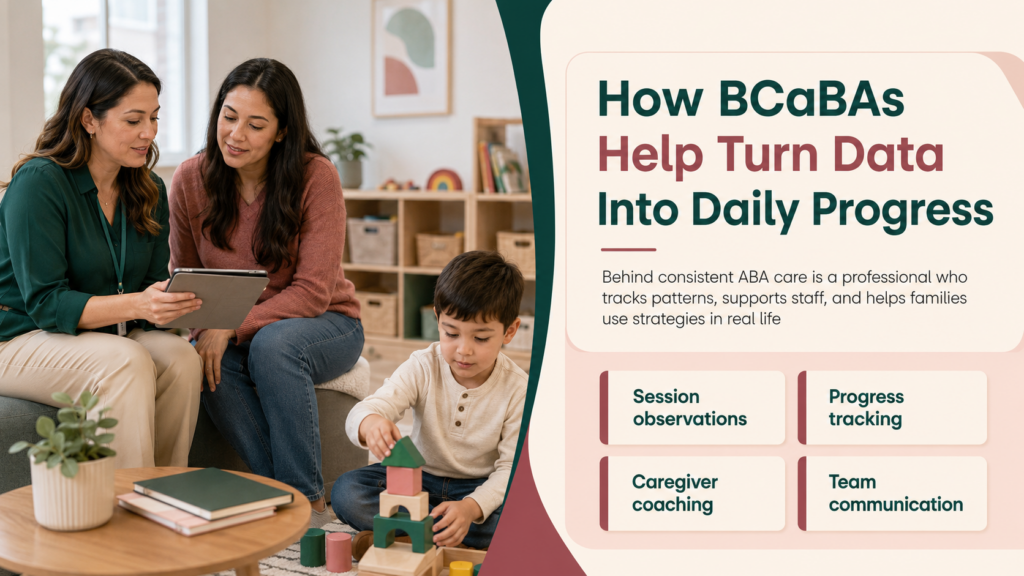
In ABA therapy, a BCaBA may help translate a treatment plan into consistent daily practice. The professional can observe sessions, view progress information, help with staff training, meet with caregivers, and help implement changes that have been approved by the supervising BCBA. No one can provide behavior-analytic services alone who is not a BCaBA. Supervising BCBA continues to provide clinical supervision.
BCaBA at a Glance
| Question | Answer |
| What does BCaBA stand for | Board Certified Assistant Behavior Analyst |
| Credential level | Undergraduate level |
| Certifying organization | Behavior Analyst Certification Board |
| Can a BCaBA practice independently | No |
| Can a BCaBA supervise RBTs | Yes, when qualified and authorized |
| Common settings | Homes, clinics, schools, and community programs |
| Required oversight | Ongoing supervision by a qualified BCBA |
| Certification maintenance | 20 CEUs during each two-year cycle |
What a BCaBA Does in ABA Therapy
Core BCaBA Responsibilities
BCaBA responsibilities vary according to the person’s training, demonstrated competence, work setting, clients, supervisor, state requirements, and payer policies. Typically involves providing direct clinical assistance, supervision of staff, data collection and dissemination. A BCaBA can only work within an approved supervisory arrangement. Common BCaBA duties may include:
- Observing a child during ABA sessions
- Collecting, graphing, and reviewing behavioral data
- Monitoring progress toward treatment goals
- Helping implement behavior intervention plans
- Supporting parts of an assessment under BCBA direction
- Training or coaching RBTs and other staff
- Checking whether procedures are implemented accurately
- Helping caregivers practice recommended strategies
- Preparing session notes, reports, or program materials
- Sharing concerns and treatment observations with the BCBA
These are duties that can’t be done on a checklist. The successful BCaBA needs to know when progress is not occurring, when data may not be reliable, and when a treatment procedure isn’t going as planned. The professional then shares that information with the supervising BCBA and does not make changes on their own.
A Family-Centered BCaBA Example
Think about a child who wants to take a time out, rather than get up from the table during a challenging activity. The BCBA will prepare and implement the behavior plan based on information gained from the assessment and family priorities. The BCaBA can observe sessions, review progress data, coach the RBT, model the procedure with a caregiver and return questions or recommended changes to the BCaBA. The RBT then implements a majority of the direct teaching as outlined in the approved plan. This holistic approach ensures co-ordinated support for the child whilst avoiding the ‘blurring of the boundaries’ between professionals.
How a BCaBA Fits Into the ABA Therapy Team
How the BCaBA Works With the BCBA
The BCBA meaning is important because the BCBA is the graduate-level professional responsible for supervising the BCaBA’s services. Supervision involves discussion, observation, feedback, ethical guidance, skill development and review of the client’s care. It is not an occasional signature or administrative formality. A strong partnership allows the BCaBA to detect patterns in the day while the BCBA will be responsible for assessment, treatment design and clinical decisions.
How the BCaBA Supports RBTs and Families
A qualified BCaBA can supervise RBTs and oversee their work while remaining under BCBA supervision. This can provide technicians with timely coaching and help families comprehend treatment procedures. Parents should also be aware of who is the BCBA that is supervising the intervention and how concerns might be made known to that clinician. Families in Glendale and the surrounding area may want to inquire about the team prior to treatment.
BCaBA Supervision Requirements and Scope of Practice
Can a BCaBA Practice Independently
No. A BCaBA cannot practice independently or provide behavior-analytic services without qualified BCBA supervision.
Professional experience does not remove this requirement. A BCaBA held inactive is one who does not have a qualified supervisor on record and may not practice or use the certification for behavior-analytic services. This restriction also affects the person’s ability to supervise RBTs, provide RBT training, or complete certain competency and certification attestations.
What Ongoing BCBA Supervision Means
BCaBA supervision requirements are in effect after certification AND while supervised fieldwork is being conducted. The current supervision system is 2026, which requires that supervision be provided for 5% of the total number of hours of behavior-analytic services rendered, in the first 1,000 hours after certification. The minimum later changes to 2%, and the BCaBA and supervisor must meet during any month in which behavior-analytic services are provided.
New maintenance rules will be in effect on January 1, 2027. The updated framework includes a minimum of 5% supervision of behavior-analytic service hours, a minimum of one supervisory contact per month, and a minimum of one observation of the BCaBA working with a client every quarter. The earlier distinction based on the first 1,000 post-certification hours will end.
How to Become a BCaBA
People interested in pursuing a career as a behavior analyst should begin by deciding what credential might be the best option for them. The BCaBA career path requires a bachelor’s degree, qualifying coursework, supervised fieldwork, an application, and the BCaBA exam. Applicants must meet the rules in effect at the time of application.
BCaBA Certification Requirements in 2026
Degree and Coursework
Current BCaBA certification requirements offer two pathways.
- Pathway 1 requires a bachelor’s degree or higher from an ABAI-accredited behavior analysis program and supervised work experience.
- Pathway 2 requires a bachelor’s degree in any subject, meeting coursework requirements for behavior analysis, and supervised experience.
Pathway 2 currently consists of 225 instructional hours, and coursework from 2026 must be generally from 2016+ or later.
Fieldwork and the BCaBA Exam
| 2026 fieldwork option | Required hours | Required supervision |
| Supervised Fieldwork | 1,300 | 5% |
| Concentrated Supervised Fieldwork | 1,000 | 10% |
Trainees may accrue 20 to 130 fieldwork hours per month under current rules. A minimum of 40% of the total must involve unrestricted activities such as data analysis, assessment support, program development, caregiver training, and staff training. The remaining restricted hours can be direct implementation of therapeutic and/or instructional procedures.
The current BCaBA exam uses the sixth edition Test Content Outline. It contains 150 scored questions and 25 unscored pilot questions in nine content areas. Candidates have four hours to complete the examination, and the 2027 eligibility transition does not currently include a separate examination-content change.
BCaBA Requirements Changing in 2027
The methods, organizational behavior management, ethics, assessment, and intervention content in the 2027 coursework are increased. Supervised Fieldwork will require 60 cumulative minutes of client observation per month, while Concentrated Supervised Fieldwork will require 90 minutes. Any applicant who might cross the 2027 transition should coordinate with the Program Coordinator and Supervisor to record hours of service as appropriate.
| Requirement | Applying in 2026 | Applying beginning in 2027 |
| Pathway 2 coursework | 225 hours | 270 hours |
| Supervised Fieldwork | 1,300 hours | 1,300 hours |
| Concentrated Supervised Fieldwork | 1,000 hours | 800 hours |
| Monthly fieldwork maximum | 130 hours | 160 hours |
Can BCaBA Certification Be Completed Online
Online searches for BCaBA certification may make it seem like the credential is only one online course. While online coursework can be part of an eligible academic pathway, a BCaBA certification can’t be obtained through a short online certificate. There are still degree, coursework, fieldwork, application, examination and jurisdiction requirements that must be met.
Prospective students should confirm that an online program meets the BACB pathway that will apply when they submit their application. The use of marketing terminology like “online BCaBA program” should not be a substitute for verification via the school and current BACB materials.
BCaBA Vs BCBA Vs RBT
ABA Credential Comparison
| Credential | General level | Main role | Independent behavior-analytic practice |
| RBT | Paraprofessional | Implements plans under close supervision | No |
| BCaBA | Undergraduate | Provides assistant-level services under a BCBA | No |
| BCBA | Graduate | Designs and oversees behavior-analytic services | Yes, subject to law and competence |
| BCBA-D | Doctoral designation for a BCBA | Same certification scope as a BCBA | Same as BCBA |
The BCBA meaning is Board Certified Behavior Analyst. A BCBA typically designs and implements treatment, whereas a BCaBA provides behavior-analytic services that are supervised. An RBT implements treatment under close supervision, consistent and continuous supervision, and is not independent in designing treatment.
BCBA-D Meaning
The BCBA-D meaning is Board Certified Behavior Analyst Doctoral. BCBA-D is a qualification for existing BCBA practitioners who hold a doctoral degree. It is not a new BACB certification that has a wider scope of practice. A BCBA does not need the doctoral designation to supervise a BCaBA.
Where BCaBAs Work and Their Career Path
Common BCaBA Work Settings
BCaBAs can work in an ABA clinic, family home, school, residential programs, community settings, hospitals, or interdisciplinary healthcare setting. The roles they might play in these settings may vary. The professional’s activities can be influenced by the State licensure requirements, insurance policies, employer policies, client needs and the BCBA’s supervisory plan.
The BCaBA career path can also involve work with children, adolescents, or adults. Behavior analysis is not limited to autism services, although many BCaBAs work in autism-focused programs.
BCaBA Salary and Career Growth
BCaBA salary rates can differ depending on location, experience, employer, work hours, funding source, and level of responsibility. Be cautious when using averages published, as boards for jobs may mix jobs that have different responsibilities and requirements. Candidates should consider a range of local job postings, benefit packages, supervision, workload and professional-development opportunities, and not just one national number.
Some BCBA’s eventually go on to graduate school and become certified as a BCBA. Some continue to work as assistant behavior analysts while gaining more specific experience in caregiver training, school consultation, staff development or program coordination.
What Families Should Know When a BCaBA Supports Their Child
While credentials are important, a professional title is not a key indicator of the quality of care. Parents should understand who supervises the BCaBA, how treatment decisions are made, and how concerns reach the BCBA. A strong team should explain roles clearly and welcome respectful questions.
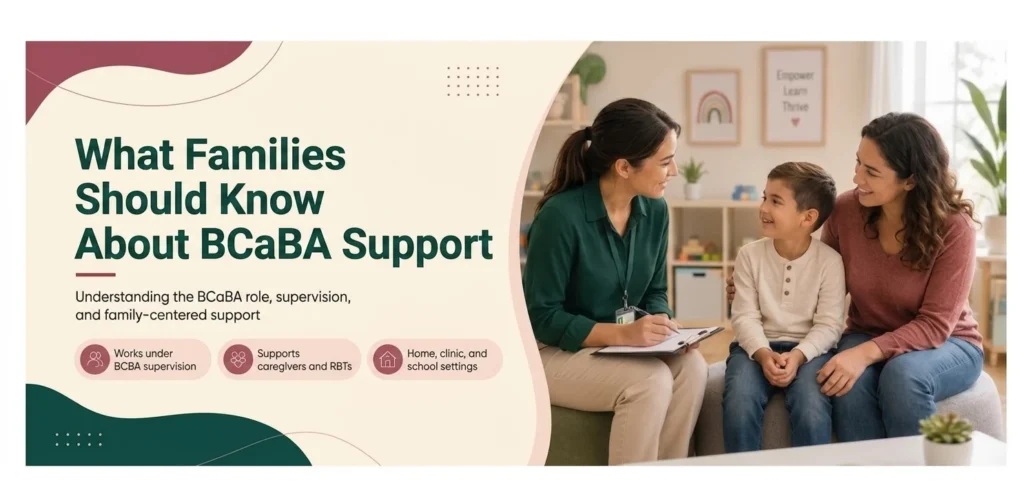
Families can ask:
- Who is the supervising BCBA?
- Who developed and approves the treatment plan?
- How does the BCaBA communicate progress to the BCBA?
- How often are sessions observed?
- Who should parents contact with clinical concerns?
- What is done when goals are not met as data suggest?
- How can caregivers participate in treatment planning?
Families can feel empowered with answers without needing to be experts on the rules for certification. Collaborative care should connect professional oversight with the child’s communication, independence, routines, safety, learning, and family priorities.
Talk With Alma Behavioral Solutions About Your Child’s ABA Team
Understanding the roles of each professional involved can make starting In Home ABA therapy feel less overwhelming for families. Alma Behavioral Solutions helps families understand who will work directly with their child, who will oversee treatment and monitor progress, and how progress will be measured. We also guide families on meaningful ways they can be involved and support their child’s success throughout the therapy process.
Families can find out what to anticipate from assessments, treatment planning, guidance for caregivers and continuous communication in Studio City and other communities in the south side of California.
To discuss ABA services, team structure, or the next steps for care, call Alma Behavioral Solutions at (747) 250-8494 or email info@almabehavioralsolutions.com. The team is available to answer questions and help families make informed care decisions.
FAQs About BCaBA
Is BCaBA Certification the Same as State Licensure
The BACB is responsible for awarding No. BCaBA certification and states or other jurisdictions award professional licensure. It may require both and more employer, payer, school/facility approval, depending on location.
Can a BCaBA Supervise RBTs
Yes. A qualified BCaBA can supervise RBTs and receive BCBA oversight and follow BACB, workplace and jurisdiction rules. Tasks can include coaching, providing feedback, assisting with training or participating in any approved competency tasks.
Does a BCaBA Only Work With Autistic Children
No. BCaBAs may support people with developmental, learning, behavioral, educational, or organizational needs. There are many people working in autism services and the population served is determined by the expertise, supervision, work duties and need of individual clients.
Is BCaBA Certification Available Abroad
Possibly. International eligibility is subject to existing BACB jurisdiction and other rules, and the applicant’s residency. Students who are interested in a course should check any official requirements prior to taking courses, starting a fieldwork experience, or paying fees for a course as older information regarding online courses may be incorrect.
How Can Parents Verify a BCaBA Credential
Parents can search the BACB Certificant Registry to confirm active certification. They should also enquire about services being provided for BCBA supervision, what the BCaBA does, and how treatment decisions and concerns of the family are shared.