
Discriminative Stimuli in Everyday Learning
A green traffic light signals that driving forward is currently appropriate and likely to allow continued travel. This is an example of a discriminative stimulus, or SD, and helps explain what an SD means in ABA. These environmental signals are all around us and we learn what signals are associated with when a response will work. Knowing this process can assist parents in seeing how ABA therapy can help with communication, routines and independence.
Key Takeaways About Discriminative Stimulus SD
- An SD specifies that reinforcement will be provided for that response.
- It does not have automatic power but is learned through past experience.
- An SD is not a prompt, reward, command or motivating operation.
- Effective teaching transfers control from temporary help to clear, natural cues.
- Progress should be individualized, measured, generalized and reviewed by a qualified professional.
What is a Discriminative Stimulus in ABA Therapy?
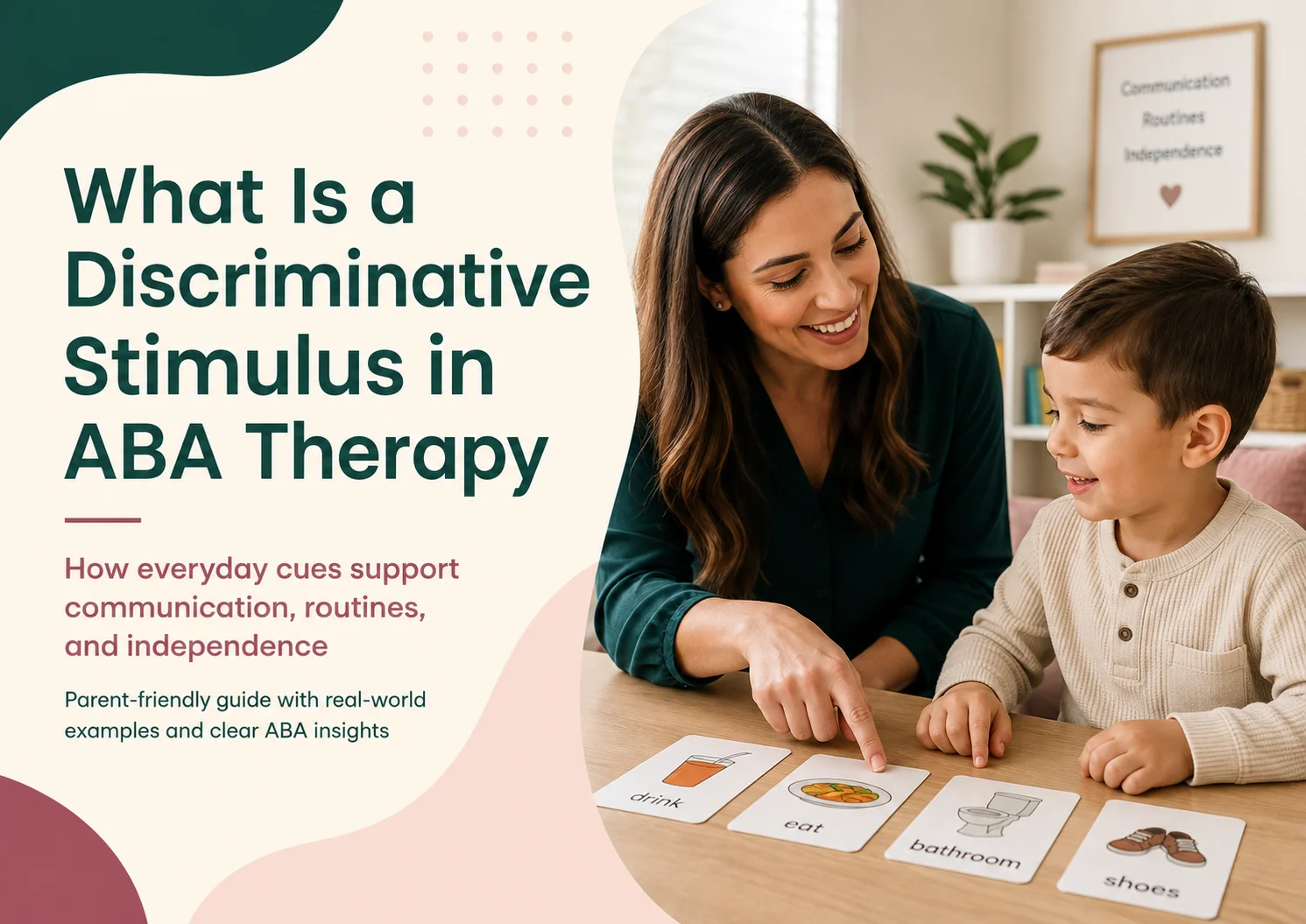
A discriminative stimulus is an event or condition that signals a behavior is likely to be reinforced. It’s basically saying to the learner, ‘This answer might be good here.’ The American Psychological Association defines an SD as a stimulus that is present during a time when a response was previously reinforced. It establishes a context for actions, but does not compel a response.
Discriminative stimulus example
A teacher asks, “Which one is red?” while showing colored cards. Choosing red brings praise after the question, so that is the response that is reinforced. The question and materials may function as the SD.
Reinforcement History Gives an SD Meaning
A sound, object, person, instruction or environmental cue is not automatically an SD. Its function is dependent on the learner’s reinforcement history or what has occurred in similar situations in the past. For instance, a closed snack container may be an SD for requesting assistance that has earlier been successful in this context.
The same cue may serve as different cues based on the behavior and past learning. A school bell could be used to dismiss an individual student but be used by a teacher as a transition cue, meaning that the meaning is tied to response and reinforcement history rather than the stimulus.
How a Discriminative Stimulus Works in ABA
The Antecedent Behavior Consequence Sequence
ABA usually teaches learning in a simple 3-step process:
- Antecedent (SD or cue) — A relevant cue appears in the environment.
- Behavior — The learner performs a response.
- Consequence — Reinforcement is given after the appropriate response.
For example, a therapist asks, “What do you need?” The child responds by saying or selecting “break,” and then receives a short break. This frequent response sequence can become a discriminative stimulus for a given request over time.
Not all of the antecedents are uniformly an SD. It relies on the reinforcement history of the learner and whether or not the cue reliably predicts a reinforcement.
Stimulus Control and Learned Responses
When a behavior is under stimulus control, it is performed more frequently in the presence of a discriminative stimulus and less frequently in its absence. That is, they start to make responses that are related to environmental stimuli instead of prompting or random guesses.
Stimulus discrimination is the response to change in stimulus conditions such as responding to one stimulus but not another. Stimulus control, stimulus discrimination, and stimulus generalization are three dominant concepts in behavior-analytic practice, as defined by the Behavior Analyst Certification Board (BACB). Independent responding is fostered by good stimulus control, when a child is not prompted and instead is responding to meaningful cues in the environment.
Discriminative Stimulus Examples in Daily Life and ABA Therapy
The table indicates possible appearances of SDs in settings.
| Possible SD | Response | Likely Outcome | Setting |
| Walk signal | Cross at the marked area | Safe, permitted movement | Community |
| Phone rings | Answer the phone | Connection with the caller | Daily life |
| “Touch the cup” with items present | Select the cup | Praise or continued instruction | Therapy |
| Visual schedule shows “shoes” | Put on shoes | Transition outside | Home |
| Peer says hello | Return the greeting | Social interaction continues | School |
Home and Daily Routine Examples
Visual schedules, timers, labeled drawers, naturally occurring objects can be used as SDs. A towel near the sink can indicate drying hands upon washing. A photo of shoes on a regular board might be a signal for the next step when leaving home.
A picture alone will not establish stimulus control. The learner must practice and receive a meaningful consequence for the cue to be useful. Alma clinicians can also support families in Glendale and Burbank to recognize cues in their home environment that will match the caregiver’s current home routines.
School and Therapy Examples
Teachers may indicate a call to answer by calling a student’s name. During discrete trial teaching, “Point to the dog” with a picture array may function as the SD for selecting the dog. A toy or familiar routine could be used as a means of communication in a natural environment teaching situation.
The SD should be well documented. “Gave a prompt” will be hidden if the therapist presented the instruction or assisted.
Social and Community Examples
An open sign might indicate the possibility of entering and purchasing. Depending on culture and preferences, an extended hand can mean a greeting. A bus display can be used to indicate boarding.
Social cues can be very complicated. Words, prior interaction, tone and facial expression may be used together, and should not be used in a one-for-one way.
Types of Discriminative Stimuli
SDs can appear in different forms depending on how the learner experiences the cue. These are not the clinical “types” of stimulus control but a way to conceptualize stimulus control under natural conditions.
- Questions, instructions, names and spoken choices are verbal SDs.
- Visual SDs include pictures, objects, signs, written words, gestures, and schedules.
- Timers, bells, alarms, and notification sounds are all examples of auditory SDs.
- Environmental SDs include time, people, materials, routines, and locations.
- Social SDs are greetings, facial expressions, conversational cues, and another person’s presence.
- Natural or contrived SDs refer to the frequency in which the cue is encountered in real life or collected for instructional purposes.
- ABA programs will ultimately focus on changing the control of behavior from artificial SDs to natural SDs that maintain independence over time.
How an SD Differs From Related ABA Concepts
| Concept | Main Function | Over Time |
| SD | Signals reinforcement availability | Natural SD remains |
| Prompt | Adds help | Prompt is faded |
| S-delta | Signals reinforcement is unavailable | Supports discrimination |
| Motivating operation | Changes a consequence’s value | Varies by condition |
| Conditioned stimulus | Elicits a learned respondent reaction | Part of classical conditioning |
Discriminative Stimulus and Prompt
An SD will signal if a response might be available. A prompt provides support by offering a hint, a model, some guidance, or the answer. Prompts are not to be the primary cue.
Prompt fading is the transfer of stimulus control from added assistance to the correct SD. If the natural SD is faded, the cue that the learner most needs will be removed.
Discriminative Stimulus and S Delta
An S-delta, written SΔ, signals that reinforcement is unavailable for a response under the current condition. An open store sign may be an SD for entering, while a closed sign may be an SΔ.
SΔ does not mean punishment. It’s a statement about the differential in reinforcement availability. Discrimination forms when a response is reinforced in the SD condition but not in the SΔ condition.
Discriminative Stimulus and Motivating Operation
The SD responds, “Can this answer go to the result at this location?” A motivating operation that is asking, “How valuable is that outcome right now?” Seeing a working water fountain may be an SD for pressing the button, while thirst increases the value of water.
A learner might not have a strong impetus to ask for something that they don’t want. Businesses can better design learning opportunities by taking into account the availability of reinforcement and current motivation.
Stimulus Discrimination in Psychology and ABA
Stimulus discrimination psychology is a general concept of responding differently to different stimuli. The APA defines stimulus discrimination as the ability to tell stimuli apart and respond differently to them. ABA uses the principle of observable behavior, reinforcement conditions and meaningful skills.
Differences can be noticed when the learner’s discriminating skills are used, and the various examples, people, and settings can be used when the learner’s skill is generalized.

Why Discriminative Stimuli Matter in ABA Therapy
In ABA-based instruction, clear discriminative stimuli (SDs) provide cues that let the learner know when a response is likely to be reinforced, thus providing a predictable cue and structure that enables many people to make sense of their learning. They can be used effectively as part of a:
- functional communication
- self-care and daily routines
- classroom participation
- play and social interaction
- safer community behavior
- smoother transitions
- independent responding
- generalisation into real situations
The outcomes are a result of individual planning, good teaching methods and reinforcement in the various settings. While SDs cannot guarantee any particular outcomes, they can make a difference in the opportunities for learning, communication, choice making, independence, and participation in the everyday environment.
How ABA Professionals Use Discriminative Stimuli
Qualified individuals determine the response, reinforcement, specify an SD, and gather data. Stimulus discrimination, prompting, fading, generalization, and maintenance are all expected to be professional skills, as are BACB standards. The RBT examination content beginning in 2026 assigns 25% of scored questions to behavior acquisition.
Practice Context in 2026
The BACB reported 85,587 BCBAs and 260,174 RBTs on July 1, 2026, up from 81,566 and 246,109 at the end of 2025. According to the Bureau of Labor Statistics, a larger category of behavioral-health counselors’ jobs is expected to increase by 17% by 2034. This is not a BCBA-specific forecast, but it signals continued demand for qualified care.
Choosing and Presenting Clear SDs
Clinician gives an observable description of the response. The SD should be understandable, age-appropriate, culturally responsive and relate to a meaningful skill. Natural cues are used whenever possible.
Good delivery usually includes:
- clear wording or materials
- an appropriate response interval
- consistent reinforcement
- limited accidental cues
- adjustments based on data
Using Prompts and Transferring Stimulus Control
Some pupils require support following the appearance of SD. A therapist may model, point, or use a visual aid according to the individualized program.
Prompt fading should be gradual. Research published indicates that time delay and other fading procedures can transfer the control of a behaviour to the intended instruction or natural materials, but the best method varies by learner and by task.
Generalization Maintenance and Data Review
A skill cannot be effective if it is only used with one therapist, or one set of materials. While maintaining the key cue, teams change out people, materials, wording and settings. Maintenance checks are used to determine if the answer persists over time.
Data can contain individual answers, prompted answers, mistakes, and response time if applicable. A supervising BCBA reviews these patterns and adjusts procedures based on data rather than assumptions.
Common Challenges and Mistakes
It is difficult for a learner to know what is expected when the intended SD is vague or ambiguous. Repeated exposure to or inadvertent cues from the environment may cause confusion in some cases.
Common examples include:
- Rehearsing a skill with repeated practice until it is cued.
- looking toward the correct item or giving unintentional gestures
- reinforcing the response in both SD and SΔ conditions
- using prompts for too long, leading to prompt dependence
- teaching only with one person, location, or material
- ignoring motivation, sensory needs, or response effort
- Teaching without explicit teaching of generalization
- focusing on only one small part of a complex cue
Restricted control by only part of a stimulus is sometimes called stimulus overselectivity. Research shows that it can limit learning, although it is not exclusive to autistic people. Families are never advised to alter a treatment program without first consulting with the supervising BCBA.
What Parents Should Know About SDs at Home
Parents can help to ensure consistency around home, but the plan should be followed at home. Discuss with the BCBA what will be used for cues, what is considered independence, when to help and how success will be reinforced.
Respect remains essential. The BACB Ethics Code calls upon the behavior analyst to benefit the client, protect the rights of the client, rely on scientific evidence, seek informed consent when appropriate, obtain assent when required, and treat clients with compassion, dignity and respect.
Home goals should foster purposeful communication, safety, choice, self advocacy, and independence in daily life. Distress, refusal, or withdrawal of assent should lead the team to pause, understand the context, and consider appropriate changes rather than simply increasing pressure. Parent support is also available to Alma families in Granada Hills and Pasadena.
Get Support From Alma Behavioral Solutions
The principles of learning are most useful when applied judiciously to a child’s strengths, communication, preferences and family goals. Alma Behavioral Solutions offers individualized ABA services throughout Beverly Hills, Los Angeles and other communities in Southern California.
To discuss your child’s needs, Call (747) 250-8494 or email info@almabehavioralsolutions.com. The Alma team can explain to the family the process of assessment, answer questions about services and guide the family to the next step of respect.
FAQs About Discriminative Stimulus in ABA Therapy
Can the Same Stimulus Be an SD for One Behavior but Not Another?
Yes. An SD is defined by its relationship with a particular response and consequence. When someone is going into the kitchen, it might mean they are there to help open a container, but it might not mean that they are there to help when screen time is needed. Context and reinforcement history determine the function.
Can a Person or Place Function as a Discriminative Stimulus?
Yes. An SD can be a teacher, parent, therapy room, a playground, or a store if a particular response has consistently resulted in reinforcement at that location. It is still important to look for more specific clues because it may be hard to generalize from one person or location.
Are Discriminative Stimuli Only Used With Autistic Children?
No. SDs are part of everyday learning for people of all ages. Traffic signs, a ringing telephone, a workplace indicator or an audible cue can all communicate when a response will result in an outcome. ABA therapists systematically use the same learning principle to specific goals.
How Do Professionals Know a Stimulus Has Become an SD?
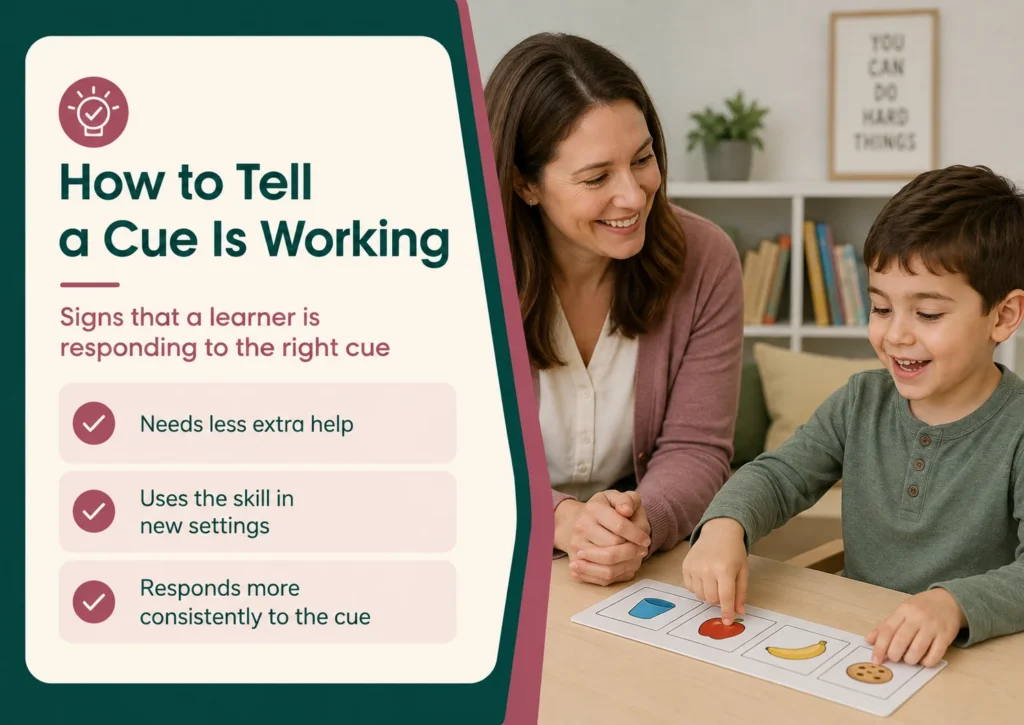
Experts make comparisons across situations. The target behavior should occur more reliably when the intended SD is present and less often when it is absent or when an SΔ is present. Information gathered over individuals, materials and settings serves to support the assurance that the right cue is controlling the response.
When Should Parents Ask a BCBA for Help With SDs?
Parents should notify the supervising BCBA if the child requires repeated assistance, does not repeat the skill with another person, gets upset when practicing, or does not make progress. A BCBA can analyze and discuss motivation, reinforcement, prompts, cue clarity, and social significance of a goal.