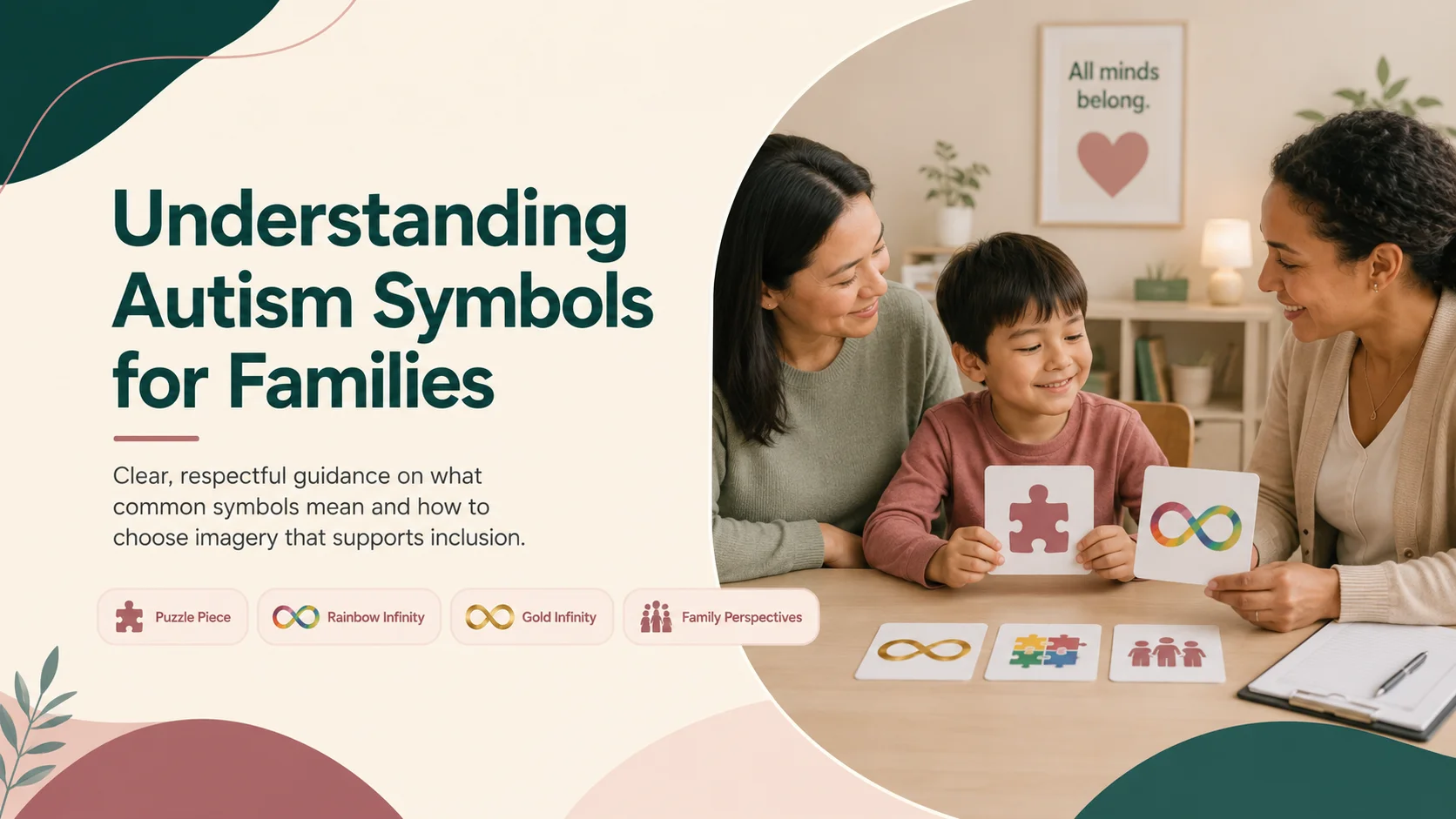

Which autism symbol should a parent, school, or care provider use when the puzzle piece now shares space with rainbow and gold infinity signs?
Symbols define the autism community, identity, support and belonging. A picture that is meant to convey caring can seem comfortable to one reader, and antiquated to another.
There are no right or wrong answers, and meaning may vary from individual experience and community point of view. The puzzle piece is well known and the infinity sign is typically associated with neurodiversity and acceptance.
Understanding the history behind each symbol helps avoid misinterpretation or harm. The most important thing is to honour autistic people and families’ feelings about representation.
This guide will detail the history, implications, discussion, and positive adoption of common Autism Symbols in 2026 and beyond.
What Is the Symbol for Autism Today
There is no one official autism symbol that is recognized by all autistic people, families, health and disability service providers, or autism organizations. The puzzle piece is still the most iconic autism awareness symbol, and many autistic advocates now use a rainbow or gold infinity sign. The infinity design is often associated with neurodiversity, acceptance of autism, identity, and a broad spectrum of autistic experiences. The decision should be made based on personal preference and context, not because one picture is for all.
Quick answer
- Puzzle piece for historical awareness and recognition
- Rainbow infinity for neurodiversity and infinite variation
- Gold infinity for autism-specific identity and worth
- Other designs including butterflies, ribbons, hearts, and spectrum wheels
Common Autism Symbols Compared
| Symbol | Common Meaning | Where It Appears | Important Consideration |
| Puzzle piece | History, complexity, and autism awareness | Older campaigns, ribbons, logos, and awareness materials | Some autistic people feel it suggests that something is missing or needs to be solved |
| Rainbow infinity | Neurodiversity, autistic pride, and infinite variation | Advocacy campaigns, community events, clothing, and social media | It may represent neurodivergence broadly, not autism alone |
| Gold infinity | Autistic identity, value, acceptance, and personal worth | Autistic-led campaigns, jewelry, clothing, and personal items | It is less widely recognized by the general public than the puzzle piece |
| Butterfly | Growth, change, transformation, and individuality | Family resources, educational graphics, and awareness materials | Its meaning can vary between individuals, organizations, and communities |
No table can identify the “correct” autism awareness symbol for a person. A good choice is one that is respectful towards the audience, makes sense and doesn’t portray autism as a tragedy or mystery. Parents can ask autistic family members how they want to be represented. That conversation often matters more than the design.
The Autism Awareness Puzzle Piece and Its History
Why the Puzzle Piece Became a Symbol for Autism
The puzzle piece autism meaning began in a different period of autism history. In 1963 a parent-led group, which later became the National Autistic Society adopted a logo designed by board member Gerald Gasson. The design featured a crying child, and the era’s perception of the autism was also puzzling and distressing. The Society later discontinued it, saying that missing-piece and miserable-child messages are inaccurate and offensive.
Autism Speaks did not create the original autism awareness puzzle piece because the organization was founded in February 2005. Following the introduction of Light It Up Blue in 2010, Blue became familiar. This timeline fixes articles that link the 1963 logo to organizations that were not around at that time.
What the Puzzle Piece Has Meant to Families
The recognizable symbol was used by many parents and professionals because it provided instant recognition. For some, it became a simple way to signal support in schools, clinics, and community events. Families tend to give a unique interpretation to the design.
- Some perceive connected pieces as individuality and community
- Others associate it with learning how to support a child
- Keepsakes or ribbons may hold personal memories
A parent might have been wearing a puzzle piece pin, as a result of many years of meeting at school and therapy appointments. It can be interpreted as persistence, love and access to services, not as a child being “missing” anything. That experience counts, and autistic adults’ awkwardness with the image should be given due respect and understanding.
Why Some Autistic People Reject the Puzzle Piece
The symbol has been criticized for implying that an autistic might be incomplete, confusing or a problem in need of a solution. Older photographs of missing parts and upset children may also send messages of deficits. Peer-reviewed study with 400 people showed that the puzzle pieces and autism puzzle-piece logos had more negative impressions than comparison images.
The study doesn’t establish that everyone reacts in the same way. It does indicate that framed images have an effect on attitudes, which is relevant if schools, clinics and organizations choose their images. Don’t use the term “bad” or “good” for the puzzle piece. History, intent, audience, impact are all key factors in meaning.
The Autism Infinity Symbol and What It Represents
The Rainbow Infinity Symbol
The autism infinity symbol is a sideways figure eight, often filled with rainbow colors. It is an infinite range of minds, communication, sensory experiences, strengths and support needs. The design is related to neurodiversity, where neurological diversity is considered variation in the range of human capabilities. Many appreciate it for the way it depicts autistic people as whole persons.
The rainbow infinity image was introduced with the first Autistic Pride Day in 2005 by Aspies For Freedom. It currently has more than 200 organisations using its reporting toolkit in 22 countries, including more than 30 councils and government departments. This reach does not make the symbol universally preferred.
The Gold Infinity Symbol and Au
Gold has more of an autism-specific infinity design. The chemical symbol for gold is Au, the first two letters of autism, with the combination of colour, value, identity and worth. Gold infinity images are used on pins, clothing, on the web, and for autistic resources. It’s not as well-known as the more familiar autism awareness symbol.
Key distinction
Rainbow infinity is often used to symbolize neurodiversity in relation to many neurological differences.
- The identity of the autistic is a more specific concern of gold infinity.
- Both focus on whole and different rather than on something lacking.
- These are not official symbols for all people who are autistic worldwide.
Other Autism Symbols and Colors Families May See
Autism Awareness Ribbons and Rainbow Spectrum Designs
Awareness ribbons are commonly used in public campaigns to show support and recognition for different causes, including autism awareness. Some designs include multicoloured puzzle piece ribbons, which are sometimes used in older awareness materials, but their meanings are different in each community.
Rainbow spectrum imagery also commonly applied and can be differences in communication, sensory experiences, strengths, and support needs, without being fixed traits.
Colors in autism colors and symbols do not have clinical definitions. An autism awareness ribbon or autism colour should be used with the intention of making the message understandable.
Blue and Light It Up Blue
Blue was adopted as a color for autism awareness campaigns, such as Light It Up Blue, which has contributed to public awareness and visibility.
- Some families use blue positively to show support and solidarity within communities today widely
- Its use ties to organisation branding and gendered colour association issues are criticised.
- It can involve awareness but not acceptance, and meaning will depend on the perspective used.
Butterflies Hearts and Spectrum Wheels
The autism butterfly symbol represents growth, change, and individuality. Hearts are a symbol of support, belonging and connection in autism communities. Spectrum wheels represent multiple dimensions of a trait instead of a single scale. These autism symbols vary in meaning depending on context and explanation.
- Butterfly: growth change individuality
- Hearts support belonging connection
- Spectrum wheels multidimensional traits not single scale
- Words have meaning based on context and explanation
Awareness Acceptance and Autistic Pride
How the Language Has Changed
Initially awareness was dedicated to raising public awareness of autism, through campaigns, symbols and basic education. The exchange shifted to acceptance and pride as a function of an evolving understanding of autistic identity and rights over time. These terms are now in harmony but with differing priorities.
- Awareness: recognition and visibility of autism in society
- Acceptance: removing barriers and respecting autistic people as they are
- Autistic pride: identity, self-advocacy, and belonging within neurodiversity
In 2007, the United Nations recognized 2nd April as World Autism Awareness Day and the celebration started in 2008. The theme for its 2026 celebration is “Autism and Humanity, Every Life Has Value” and builds upon a rights-based perspective of equal participation. A future community-driven and preference-based use of symbols is likely, as no credible authority has announced a replacement for existing symbols for use after 2026.
Why Representation Affects Real Support
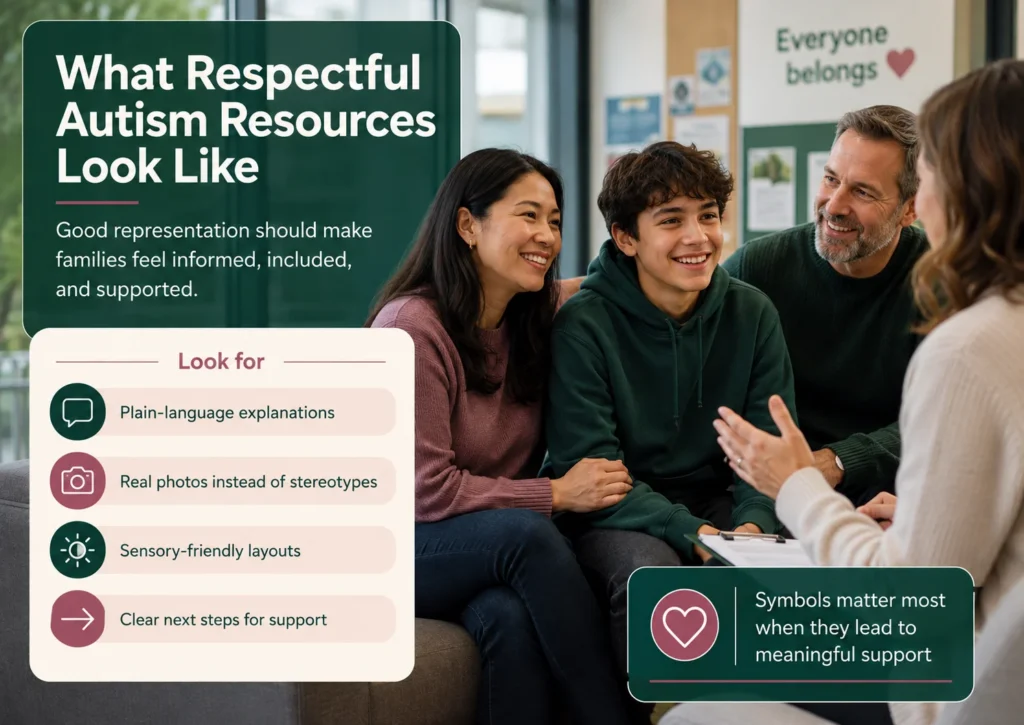
Symbols initiate conversations, but actual inclusion requires action, not images. Representation is important when it results in support in daily life.
- Communication supports and sensory-friendly environments
- Respectful language and staff training
- Collaboration with autistic individuals and families
- Disability support in school and provision within care settings.
Families in Glendale can see pictures on a provider’s website, but what is more important is how the team is listening. Alma Behavioral Solutions says that their care is tailored, evidence-based and family-centred.
How Autism Symbols Are Used Today
Schools Clinics and Community Programs
Autism symbols on posters, badges, guides, awareness materials are used in schools, clinics, and community programs to alert families of support services. These visuals enhance navigation and awareness, but are not an inclusion on their own. Real accessibility depends on communication support, sensory-friendly spaces, trained staff, and respectful interaction. Symbols are not to be used as a substitute for care.
Social Media Clothing and Fundraising
Autism symbols are seen on profile pictures, posts, shirts, pins, and autism fundraisers. These can be used to raise awareness but must be used with care to avoid the spreading of outdated ideas. There is a need for respect and accuracy.
Personal Identity and Family Meaning
- Autism symbols may mean different things to different people and families.
- Teens can wear a gold infinity symbol pin for identification and pride.
- Parents can hang puzzles together with family memories.
- There may be no wrong or right interpretation of preferences.
- Symbol use should always be voluntary, not required.
How to Choose and Use Autism Symbols Respectfully
A Respectful Symbol Selection Checklist
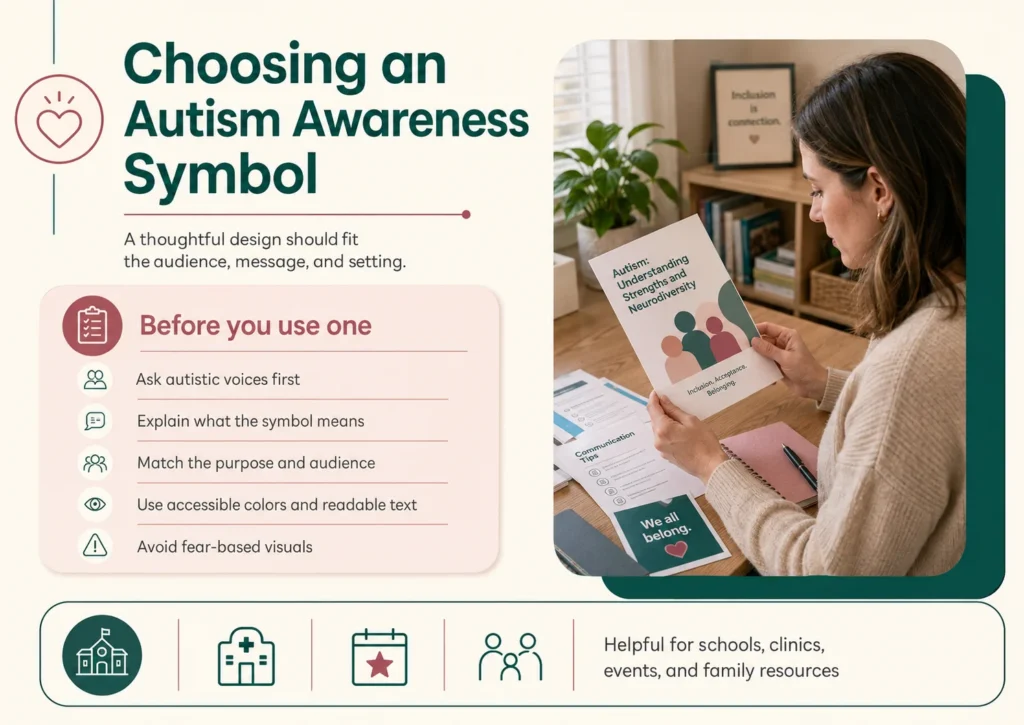
Purpose should come before design. There may be different images that are needed for a school poster, therapy resource, keepsake and autistic-led event. People represented should have a meaningful voice in the decision. Use this checklist:
- Identify target audience and intent.
- Ask autistic people what they prefer.
- Don’t send cure-themed, doom or “missing piece” messages.
- Define unusual symbols using common words.
- Demonstrate variations in age, culture, communication and needs.
- Relate the symbol to real-world situation of inclusion.
- Respect a person who prefers no symbol.
Beyond 2026, tastes and fashions will continue to change and not coalesce around one single symbol. No reliable forecast predicts which autism symbol will dominate after 2026. It’s more reliable to trust the regular feedback than claims of trends. Periodic review also prevents outdated imagery from being repeated without context.
Accessible and Inclusive Design Practices
Readable design enhances access for autistic and non-autistic viewers. Use simple fonts, good contrast, straight layout, captions, descriptive alt texts and scannable headings. Never convey crucial information just by using color. Don’t display autism as a boy or as a physical symptom.
Supporting Understanding Beyond the Symbol
An autism symbol can open a door but the real help is listening, individual care and respect for the person. Ongoing support that comes from collaboration between families and providers makes meaningful progress.
Alma Behavioral Solutions offers individualized autism and ABA Services in Burbank and throughout the greater Los Angeles area, targeting communication, behavior, and daily living skills with evidence-based and family-focused supports to meet each child’s individual needs.
Families are encouraged to Call (747) 250-8494 or email info@almabehavioralsolutions.com with any questions, goals and next steps. Our team is available to support families by responding in a non-judging manner and providing information on available supports.
Frequently Asked Questions About Autism Symbols
Can a Family Use More Than One Autism Symbol
Yes. Different symbols can be used for the family to represent identity, school activities, advocacy or community events. Preferences can change as people learn or an autistic child develops personal views. There are several designs which are not at odds when the family knows what they are and respects the represented person.
Is the Hidden Disabilities Sunflower an Autism Symbol
The sunflower is not autism-specific. It discreetly indicates a non-visible disability and possible need for support, patience, assistance, or extra time. Some autistic people wear it in airports, stores, workplaces, or public settings, while others do not.
Do Autism Symbols Mean the Same Thing in Every Country
No. Recognition, language, advocacy history and campaign branding is different from country to country. The puzzle piece might be known in one group, infinity imagery in another group lead by an autistic. Explanations are helpful for multicultural families or for international audiences.
Should a Child Be Required to Wear an Autism Symbol
No child should wear a diagnosis on their clothes, badges or accessories. Parents and schools should consider privacy, safety and comfort, consent and communication preferences. In some cases it might be appropriate to use a discreet identifier but it should be used for the benefit of a child rather than for the comfort of an adult.
How Can Parents Ask About Symbol Preferences
Ask neutrally, “Do any of these symbols feel right to you?” Display options, define them and provide the option to not select any. Communication can be verbal, written, pictorial or via an augmentative system. Revisit the question instead of treating one answer as permanent.