
No. Not all autistic children are nonverbal.
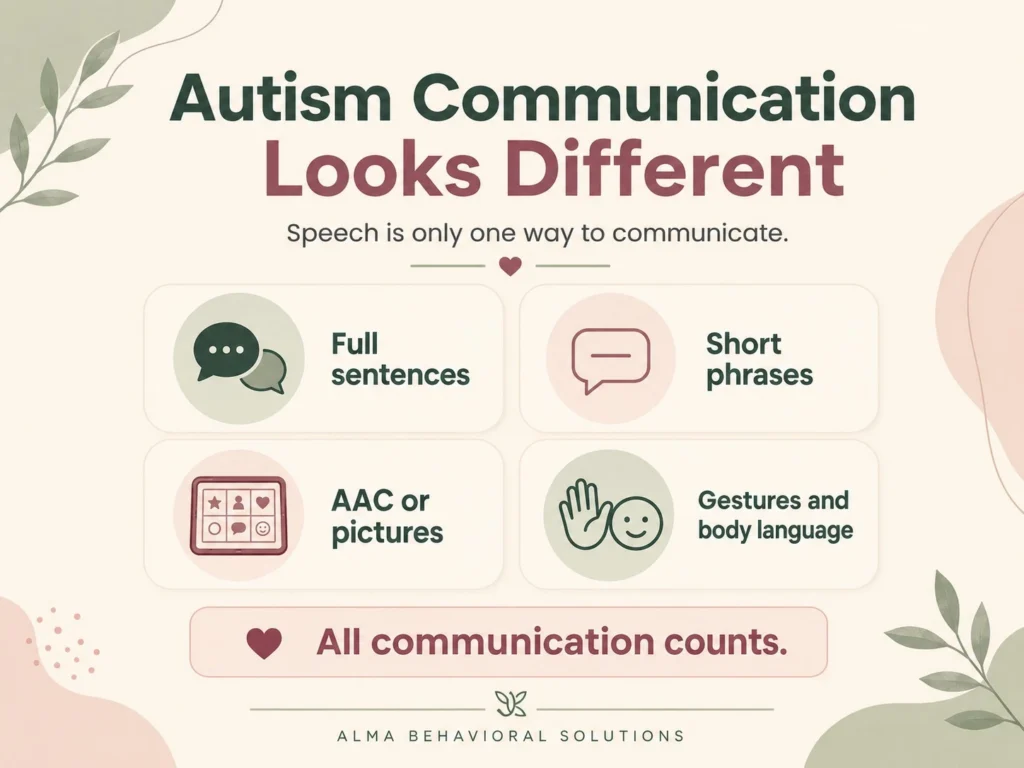
Some autistic children speak in full sentences. Some use short phrases. Some repeat words or scripts. Some use gestures, pictures, signs or communication devices. Some do not use words to express themselves, but communicate nonetheless.
Speech is just one part of communication and autism is a spectrum. One kid might be very verbal, but not be able to tell you how he feels, answer a question, or get into a conversation. Another child might be able to speak little but comprehend routines, feelings, others, and the world around him.
At Alma Behavioral Solutions, our mission is to help kids feel understood, supported and able to communicate in a way that serves them.
The Word “Nonverbal” Can Be Misleading
When many families hear “nonverbal,” they think about a child who cannot communicate in any way. That is not accurate.
A child who is not able to speak may communicate with others using body language, facial expression, movement, sounds, pictures, gestures, eye gaze or technology. Some children also use speech in specific contexts when they are safe, calm and regulated.
A better question is not, “Can my child talk?”
A better question is:
“How is my child already trying to communicate?”
Speech is important, but a child’s needs, choices, comfort, stress and joy are not limited to speech.
Different Speaking Styles You May See in Autistic Children
Autistic communication can look very different from child to child. Some children have a frequency of spoken language that is greater than others; however, it may be in a manner different from what adults expect.
A child may:
- Recite lines, from a show, song or person
- Use one word to mean a full idea
- Talk a lot about favorite topics
- Answer slowly after a question
- Clearly use words at home, less in public
- Use speech with gestures or visuals.
- Lose words during stress, fatigue, or sensory overload
Minimal verbal children are some children. May use a few words but not enough to express their daily needs well.
Some children do not speak. May not speak as their primary method of communication.
The labels don’t tell the whole story. With support, comfort, routine, health, sensory needs and emotional regulation, a child’s communication can change.
Why a Child May Not Answer Right Away
Silence after a question can be confusing for parents. It might be considered as ignoring, refusing or not listening. It is often, however, something else that is going on.
Autistic children may need extra time to process spoken language. According to the National Institute on Deafness and Other Communication Disorders, an autism diagnosis may impact children’s language understanding and use.
Imagine that a child hears:
“Go get your backpack, put your shoes on, grab your jacket, and hurry because we need to leave.”
There’s a lot to take in. The child must listen and comprehend the instruction, make the transition and then perform an action. The task is more difficult if the room is noisy or if the child is already over-stimulated.
A calmer version may sound like:
“Shoes on.”
Pause.
“Shoes on.”
Then show the shoes.
Very little language, wait time, and visual support can be of enormous help.
Communication is Bigger Than Spoken Words
It’s a good thing to have spoken words, but it’s communication that’s the goal.
A child has to find a means to express:
“I want that.”
“I do not want that.”
“I need help.”
“I am hurt.”
“I am scared.”
“I want more.”
“I need a break.”
“I like this.”
As adults are only paying attention to speech, they might miss what the child is trying to communicate. Adults who respect gestures, pictures, sounds, signs and devices: the communication works.
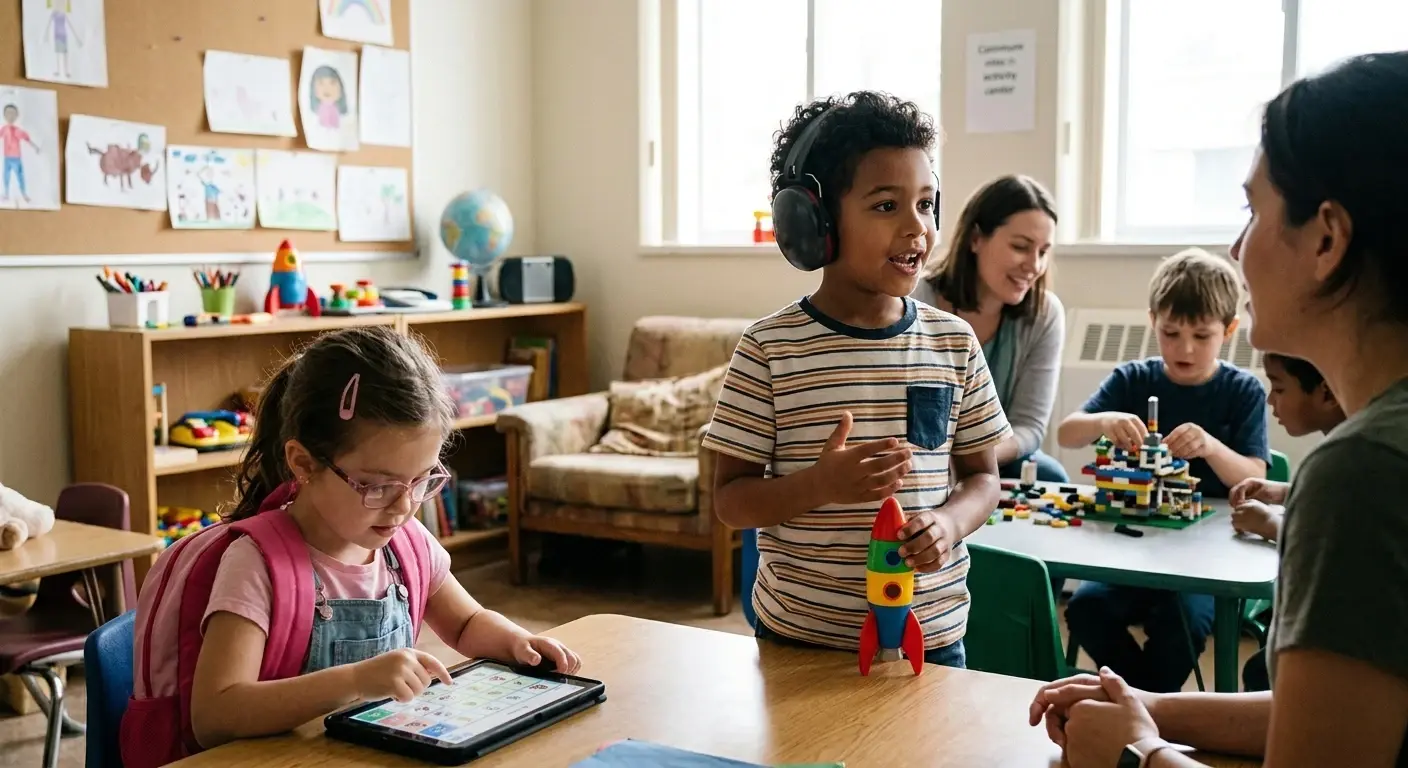
AAC can contribute to this support. AAC Stands for augmentative and alternative communication. Can be in the form of picture cards, communication boards, sign language, typing, tablets or speech generating devices.
AAC does not mean giving up on speech. Many times, it provides a means of communication for the child before or when he or she can talk.
Support That Feels Calm, Not Pressuring
It should not be a test all day long to provide communication support.
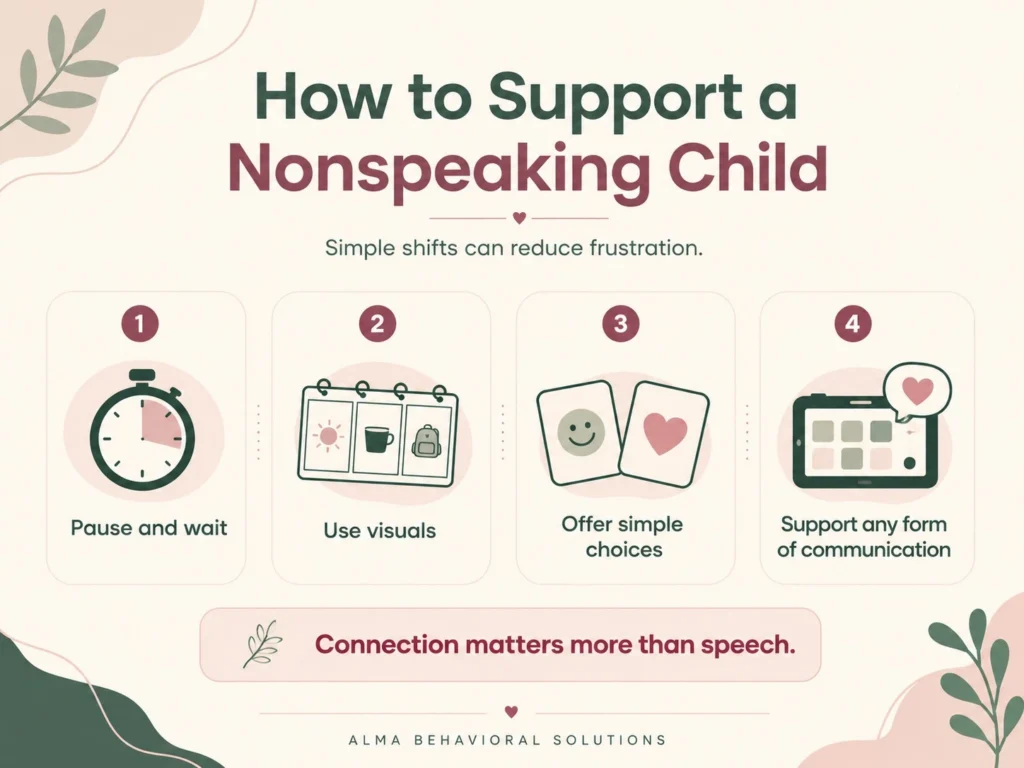
When a child is required to use speaking to communicate, their needs should not go unmet. If the child is pointing to water, hands you a picture, taps a button, or signs ‘drink’, then the ‘drink’ is a response that is warranted.
Helpful support may include:
- Giving one direction at a time
- Waiting quietly before repeating
- Repeating the same words without rephrasing, too quickly
- Using pictures, objects, or gestures
- Offering two simple choices
- Modeling words without demanding them
- Celebrating communication in any form
Here, the 6 Second Rule can be of great help. After asking a question or giving an instruction, wait about six seconds before repeating. The pause allows the child to “think” without the additional language pressure.
It is better to do a quiet pause, than to add more sentences.
What ABA Can Do for Communication Growth
ABA therapy can be used to help with communication by making small steps towards communication skills. The most effective approach is to be individual, respectful and based on the communication the child is currently using.
Goals for children who have limited speech can be to request assistance, to make a choice, to select a picture card, to point, to follow a one-step direction, to tolerate a transition or to use a device to request.
For a verbal child, goals may look different. These can be things like answering questions, social interaction, asking for a break, knowing how to use language, etc. when stressed.
Alma Behavioral Solutions’ team supports families to make communication support a part of their daily routine. Skill building can occur naturally during mealtimes, play times, getting dressed, bath time and when going out.
A Hopeful Takeaway for Families
Not all autistic children are nonverbal. Some talk a lot, some talk some, some communicate without talking.
Most important is not to impose communication on one “right” way. The most crucial element is to help the child connect, communicate needs, be safe and understood.
Families act on communication in all forms, telling children a strong message:
“Your voice matters, even if it does not always come out as speech.”
Alma Behavioral Solutions is here to help families build practical, compassionate communication strategies that fit daily life. If your child speaks little, doesn’t speak or has trouble communicating clearly, call us at (747) 250-8494 or email us at info@almabehavioralsolutions.com to connect with us.
FAQs About Nonverbal Autism
1. Are all autistic children nonverbal?
No. A large number of autistic children speak, some speak less, some speak later, some speak by gestures and pictures and signs and some by communication devices. Communication may be different for each child, as there is a spectrum to autism.
2. What percentage of autistic children are nonverbal?
Based on research, 25-30% of children with autism are minimally verbal or nonverbal. Other children may speak but require help with conversation, processing time or need to express needs clearly.
3. Can nonverbal autistic children learn to talk?
Absolutely, children who don’t use language can learn to speak, particularly if they are supported from an early age and their efforts are consistently reinforced. It is possible that others will communicate best via AAC, gestures, signs or pictures. The primary objective is to facilitate the child’s communication.
4. What is the difference between nonverbal and nonspeaking?
A child’s “nonverbal” use of the word often means that the child does not talk much or at all. Many people prefer the term “nonspeaking” as a kinder way of saying a child understands, thinks, feels and communicates without speech.
5. How can I support my nonverbal child at home?
Speak succinctly, be clear, allow for extra processing time, provide options, and provide a way to communicate using pictures, gestures, signs or AAC devices. Respond to all communication attempts, not just spoken words.
6. Are AAC devices effective for autistic children?
Yes. AAC devices can be used to enable autistic children to express their needs, make choices, decrease frustration and be more independent. AAC is NOT about not speaking. Provides another means of communication for the child as language is developing.