

When Silence Does Not Mean Ignoring
Did you ask your child to put on shoes, clean up toys, or answer a simple question, only to get silence back?
That’s when many parents start to feel anxious. Some wonder, “Did my child hear me?” Others may think their child is ignoring them. Actually, in many instances, the actual problem is much simpler – the child may need more processing time.
Many families are not aware of the prevalence of autism. The CDC estimates that approximately 1 out of every 31 children ages 8 is diagnosed with an autism spectrum disorder. Communication, behavior, sensory needs and social interaction can all be impacted.
Alma Behavioral Solutions works with families to not only help them understand this, but also provide practical, small tools to help make communication easier each day. One of those tools is the 6 second rule, a simple wait-time strategy often used in therapeutic treatment for autism.
What is the 6 Second Rule for Autism?
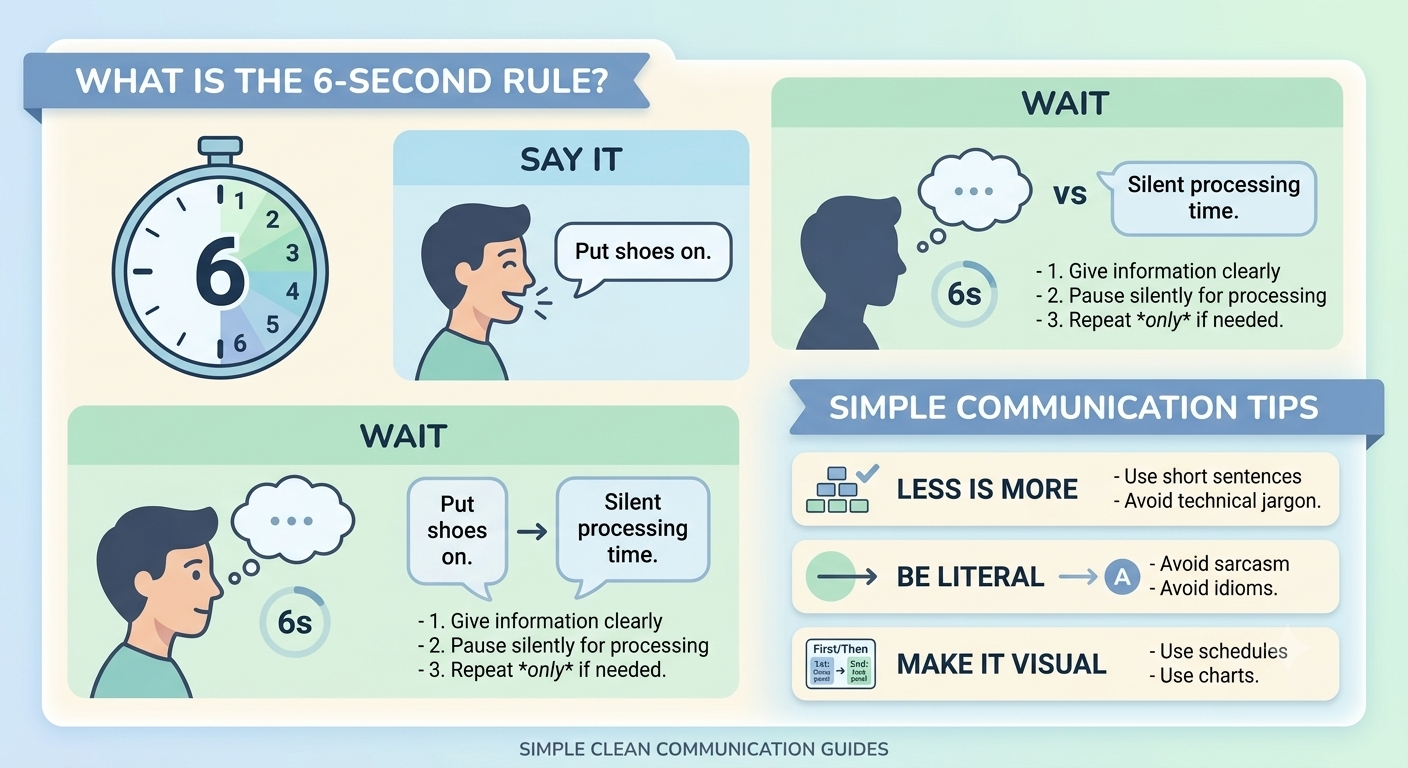
The 6 second rule for autism is a communication strategy that allows a child to “process” what has been said and gives them time for the adult to repeat or prompt again.
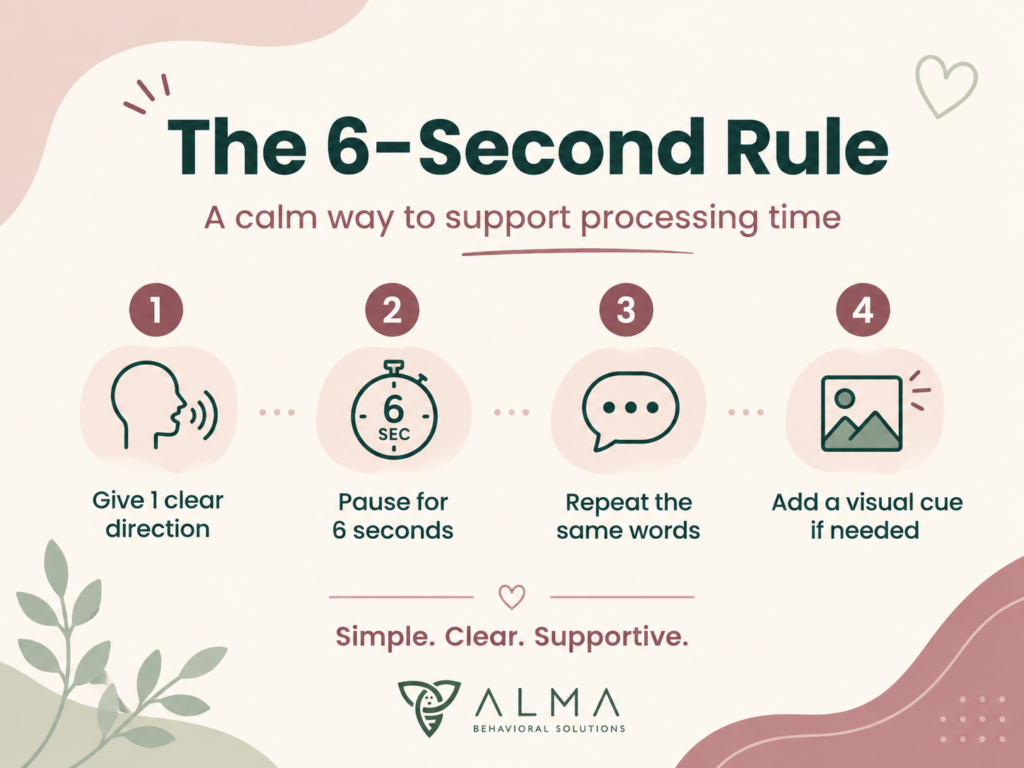
The idea is simple:
- Give one clear instruction or question.
- Wait quietly for about six seconds.
- Repeat the same words if needed.
- If the child continues to require assistance, provide a visual cue, gesture, model or choice.
For instance, if you say “Put on your shoes. Come on, we are late. Why aren’t you listening?,” you can pause and wait for a response to that.
A six-second delay is too long for an adult, but for many autistic children it allows their brain to process the words, make sense of what they mean, and then act. It is not about forcing compliance. It’s the idea of making communication smoother, easier and clearer.
Some children may need less than six seconds. Others may need 10 seconds or more, especially during transitions, noise, stress, or new routines.
Why Autistic Children May Need Extra Processing Time
Autistic children may respond to language, sounds, movement, feelings and social cues differently. Your words may be heard but may still require additional time for a child to understand.
According to the National Institute on Deafness and Other Communication Disorders, autism may impact children’s language and understanding of language. This can manifest in real life as: Late or incomplete answers, no response after a question, difficulty following lengthy instructions.
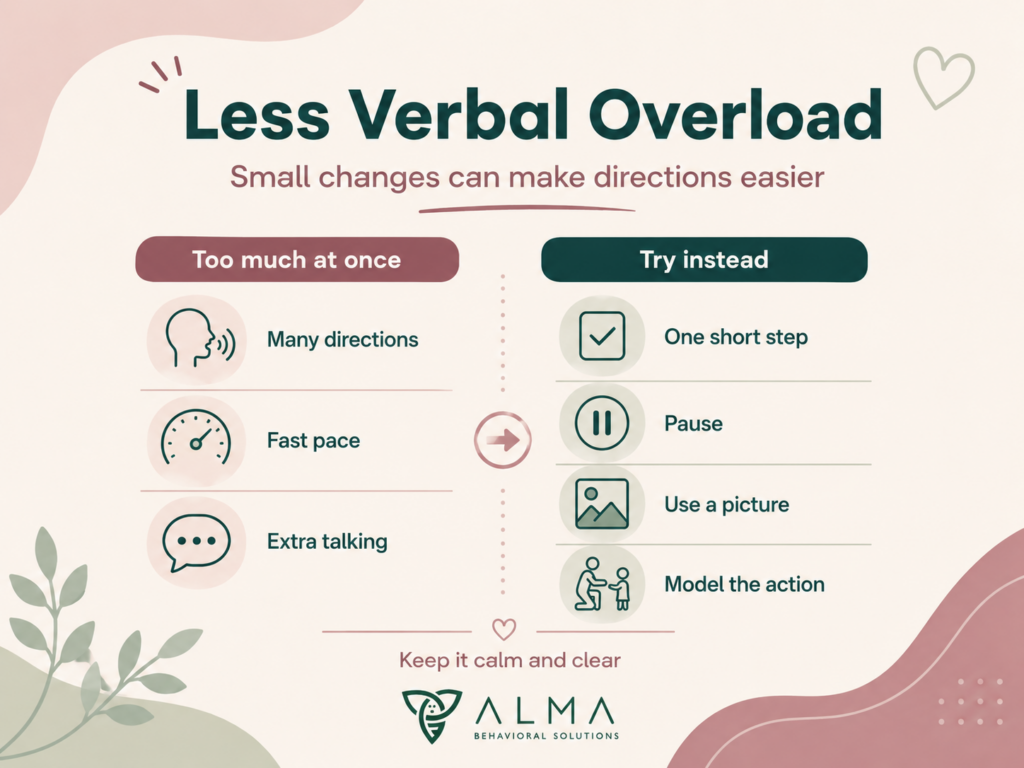
Verbally overload with long directions. Children may require a bit more time to process, such as the instruction “Get your bag, get your book, find a friend, and line up.”
Support needs also vary across the levels of autism. For some children, just a brief stop and simple words will be enough. Some may require visual schedules, gestures, modeling or repetition. The intent is not to make a comparison of the children. The aim is to help the child in front of you.
Understanding Levels of Autism and Support Needs
The levels of autism will relate to the amount of support that a person may require for day to day living. They have no value of worth, intelligence or potential.
Level 1 is “requiring support.” A child can be able to speak well but have problems with social communication, flexible thinking or transitions.
Level 2 means “requiring substantial support.” Child may require additional support in communication, routines, social interaction and transitions.
Level 3 means “requiring very substantial support.” A child might require robust, sustained communication and regulatory support, as well as safety and daily living support.
The 6 second rule can be adapted for different support needs. A child with Level 1 support needs may use the pause to answer a question. For children requiring Level 2 or Level 3 support needs, the pause plus visuals, gestures or choices may be helpful.
How the 6 Second Rule Works Step by Step
Give One Clear Instruction
Short words are more easily understood. Use simple words and phrases such as “shoes on”, “come to table”, “clean up” or “show me red”.
The explanation may be lengthy and cause the child to feel overwhelmed. A clear instruction provides the child with more opportunity to comprehend and respond.
Pause Silently for About Six Seconds
After giving the instruction, wait quietly. Don’t repeat immediately. Avoid changing the words. Avoid adding more questions.
Sometimes it’s uncomfortable to be silent, but it is also where processing occurs. Taking a moment of calm can help the child not feel rushed.
Repeat the Same Words if Needed
If after the pause the child is unable to respond, repeat the same words again.
For example, say, “Put on socks.” Wait. If needed, repeat, “Put on socks.”
Changing the words too quickly can create a new language task. Now the child will have to understand two different versions of the same instruction.
Add Visual or Physical Support
If the child still requires assistance, then reduce verbal communication and increase assistance. Point to the socks. Present two options. Show a picture. Model the action.
The message can be made clearer with visuals, gestures, and modelling but without increasing the verbal pressure.
Real Life Examples of the 6 Second Rule
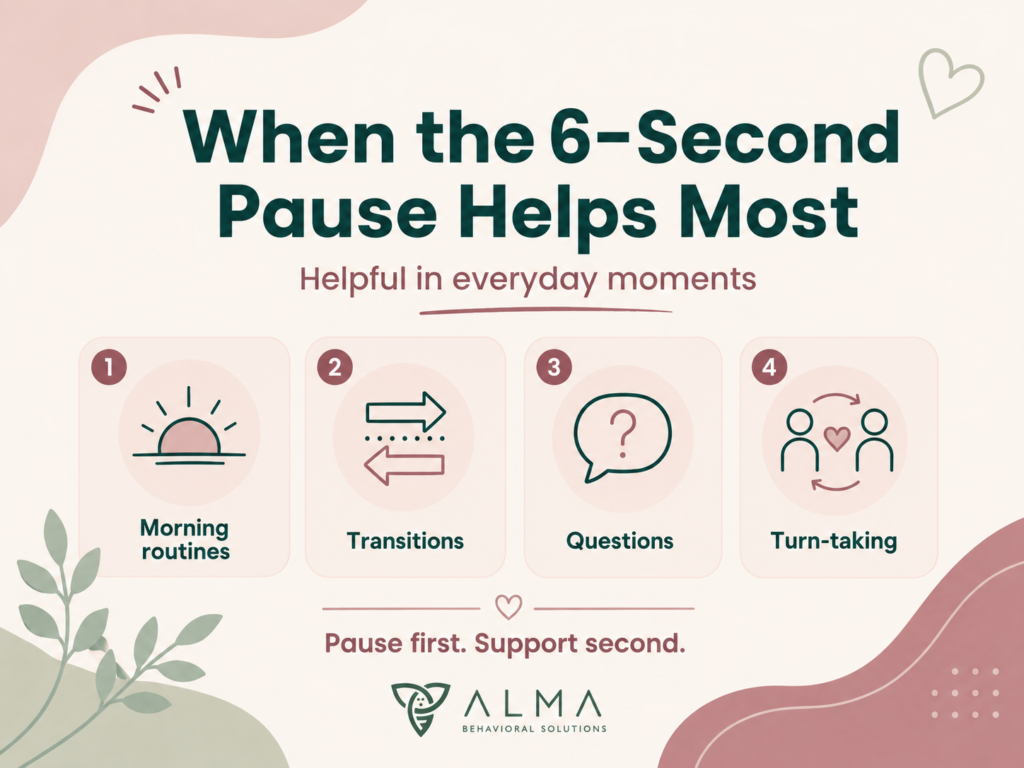
This is a strategy that is often used during the morning routine.
- Try to say “Put on socks.” rather than “Put on your socks. No, not those socks. Hurry up. We are late.” Wait for 6 seconds. Repeat, if necessary: “Put on socks.” Then point to the sock drawer.
- School and therapy transitions are another good time to use wait-time. Say, “Clean up.” Pause. If needed, repeat, “Clean up.” Then gesture toward the bin or show the visual schedule.
- Playtime can also benefit. If you are teaching turn-taking, say, “My turn.” Pause. If needed, repeat, “My turn.” Then hold out your hand gently.
- Questions may need the same support. Ask, “What do you want?” Pause. After two attempts, if the question is still too difficult, make choices: “Crackers or apples?”
Common Mistakes That Can Make Communication Harder
Parents often repeat themselves because they want to help. The issue is that there may be an excess of words to make communication more difficult for some autistic children.
Common errors include the repetition of words, rephrases, delivering multiple directions at a time, a frustrated tone of voice, or a stare down during a pause.
For example, “Get your shoes” may quickly become, “Find your sneakers, we have to leave, why are you still sitting there?” The child now has to process more words, and to cope with more pressure.
Don’t be abrupt, with explanations that are unclear and unpredictable. The 6 second rule is for the adults to slow down before putting more words in.
Is the 6 Second Rule Only for Autism?
The 6 second rule and the general concept of wait time can be beneficial to many children, and is a topic that is mentioned a lot in autism communication supports. Slower communication can also be helpful for children with language delays, anxiety or sensory issues, as well as those with ADHD.
However, this strategy is still relevant to autism as many autistic children suffer from processing times, verbal overload, sensory input and social communication differences.
A child might be quick to respond during familiar activities but slower to respond during transitions, group activities, new activities or emotional experiences. Good support should adjust to the situation.
How the 6 Second Rule Fits Into Therapeutic Treatment for Autism
The 6 second rule can be one small part of a larger therapeutic treatment & types of autism. Wait-time can be used in therapy to enhance communication, follow directions, transitions, independence, emotional regulation, social interaction and skill development.
At Alma Behavioral Solutions, we work with families on effective strategies they can use in their daily lives. A strategy should work in a session! It should support in the mornings, meals, play, school preparation and outings in the community.
Parent training can also enable parents to be aware of when to wait, when to repeat, when to use visual support and when to change the task. When it works, communication is not as stressful for the child or family. Join
When Should Parents Seek More Support?
Professional support can be useful for parents when day-to-day life can be frustrating, ‘shut down’, ‘meltdown’ or ‘confused’.
Help may also be required with answering questions, one-step instructions, transitions, and when adults speak quietly.
Adult autism signs symptoms are also sought by some families, when they see the same lifelong pattern in themselves or another family member. They can be related to additional processing time, being overloaded with social cues, lack of eye contact or being stressed out by verbal instructions.
Using information on the internet can support families in learning, but cannot take the place of a professional evaluation or an individualized support plan.
Can an Online Autism Test Help?
A free autistic spectrum test can be used to consider some of the traits of autism but it can’t diagnose autism.
Screening tests are not an evaluation. The developmental history, input from the caregivers, observation, review of communication, and clinical judgment are all components of a professional assessment.
Families don’t need to wait until everything is in place, before they can use supportive communication. Many children feel understood with simple devices such as one-step directions, visual cues, options and wait-time.
Autism Announcement Today: What Parents Should Know Before Changing Strategies
Many parents look for an autism announcement today when new research or updates to therapy is released or when prevalence figures are made public online. It’s useful to be aware of the situation, but it’s not a substitute for clinical advice.
The support for the child should be tailored to need, strengths, communication and challenges. If a new study or news item should come along it may be helpful; but before altering a care plan, it is important to discuss it with a qualified professional.
The 6 second rule is an easy-to-implement rule that families can discuss in therapy or parent training.
Quick Parent Checklist: Using the 6 Second Rule at Home
Apply this straight forward checklist in normal day-to-day activities:
- Get your child’s attention gently.
- Use one short instruction.
- Wait about six seconds.
- Keep quiet while the break.
- Say the same words again, if necessary.
- Utilize a visual, gesture, model or choice.
- Don’t add any additional language.
- Adjust the wait-time based on your child’s needs.
Often the adult’s change in communication is significant enough to the child that it significantly impacts how they respond.
15. Conclusion: A Small Pause Can Make Communication Easier
The 6 second rule is simple: Remain silent, wait and repeat the words. A brief pause can help the communication of many autistic children to become calmer, clearer and easier to understand.
The aim is NOT to coerce the child to react. The aim is to allow the child sufficient time to process information, allow verbal overload to be reduced and provide for successful communication.
Alma Behavioral Solutions is an excellent resource for families needing to develop positive, practical strategies that can be implemented in daily life when: your child doesn’t understand instructions, transitions, or communication.
For more information about treatment and individual options for helping with autism, give us a call at (747) 250-8494 or send us an email at info@almabehavioralsolutions.com and we’ll put you in touch with our team.
FAQs About the 6 Second Rule for Autism
How long should I wait after giving an instruction?
Use approximately 6 seconds. Some children may need less time, while others may need 10 seconds or more. The appropriate pause will be determined by the child, setting and task.
Why does repeating the same words matter?
Repeating the same words helps keep the message clear. Fast speaking rephrases allows the child to take in new language. Repeated words help to clarify and aid comprehension.
Can wait-time help with meltdowns?
Wait-time may be able to reduce the frustration of rush or verbal overload. Other triggers for meltdowns are sensory overload, fatigue, transitions and stress. The 6 second rule can be useful, but isn’t on its own complete.
Should I make eye contact during the pause?
Gentle attention is good but some autistic children may be uncomfortable with the intensity of eye contact. It’s better to have a calm face, a soft voice and relaxed body language than staring.
Can teachers use the 6 second rule?
Yes, teachers can use wait-time in classrooms, small groups, and transitions. Allowing for a brief pause, repeating directions and using visual materials can make directions more manageable for students with autism.