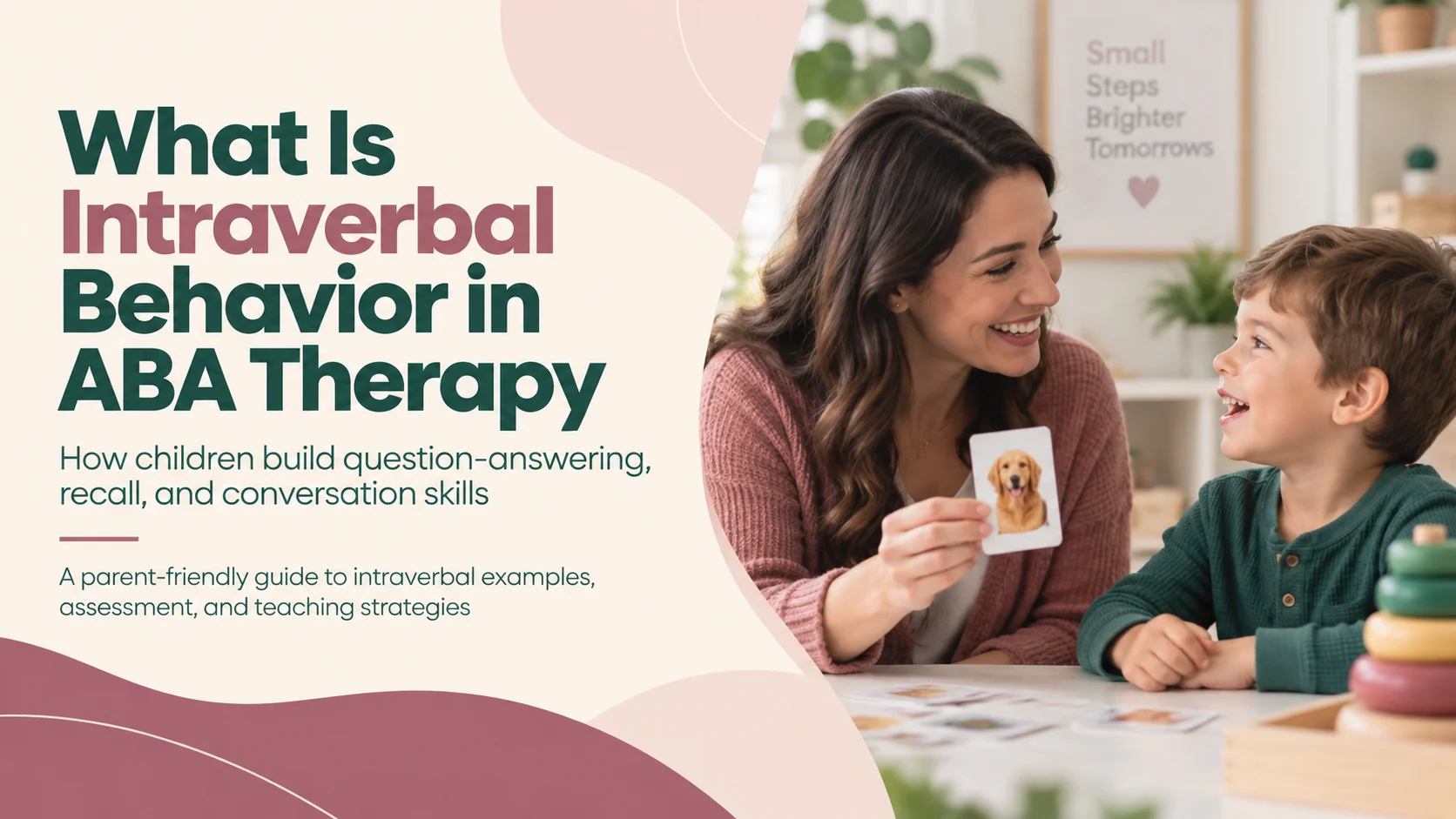

How does a child progress from knowing words to answering questions, share their ideas and sustain a conversation? Intraverbal behavior is one type of verbal skill that is discussed in Applied Behavior Analysis in the context of meaningful communication.
Intraverbal behavior means responding to the words of another person other than by repeating the words back to them. A child may respond “pancakes” to a question like “What did you eat for breakfast?” when it was not actually part of the question.
These skills can be used to facilitate conversation, class participation, socialization, safety, and day-to-day independence. Individual abilities are different in the intraverbal aspects of autistic children, and teaching should always aim to teach what the child can communicate and what he or she needs.
This guide will discuss intraverbal behavior in ABA therapy, examples, common forms, assessment procedures, evidence-based teaching strategies, training errors, intraverbal generalization, and how families can naturally encourage intraverbal responding.
What Is Intraverbal Behavior in ABA Therapy?
Intraverbal Definition in ABA
An intraverbal is verbal behavior that is controlled by the words of another person, but not repeated verbatim. In ABA, there is no one to one correspondence between the verbal stimulus and the response.
For example: if a person asks, ‘What animal makes a meow sound?’ and a learner responds, ‘Cat’, the question prompts another but similar answer. This behavior can be maintained by social interaction, acknowledgment or by generalized reinforcement.
Skinner’s verbal behavior framework describes intraverbals on the basis of their relationship to environmental events and not just by their sound. Intraverbal behavior may include answering inquiries, filling in phrases, naming categories, recalling information, and engaging in conversation.
What Is Intraverbal in Autism?
Intraverbal behavior in autism includes responding to someone’s words but not just repeating them. A child might respond “octopus” to the question, “Which animal has 8 arms and lives in the ocean? Some autistic learners may respond to familiar questions but require assistance with open-ended questions, responses or conversation.
Errors in more complex verbal conditional discriminations were found with 71 autistic children, favoring individualized teaching according to demonstrated communication skills rather than age alone.
Why Intraverbal Skills Matter for Communication and Autism
Conversation and Social Connection
Talking doesn’t involve repeating someone verbatim. Individuals respond to questions, respond to comments, describe experiences, ask further questions, switch topics, suggest alternative answers.
Intraverbal skills can therefore support:
- answering and asking questions
- discussing preferred interests
- responding to peers
- sharing opinions and experiences
- continuing a conversational topic
- recalling information without a visible object
- Being able to correct communication when it is uncertain.
Good conversational ability in ABA does not imply rote learning of a script for each occasion. Useful communication is flexible, contextually appropriate and responsive to the learner’s interests and style of communication.
Learning Safety and Everyday Independence
Intraverbal behavior is not just a part of social talk. Children can apply them to answering questions in class, recalling their daily routines, sharing key personal details, talking about past events and when asked to answer any safety-related questions.
This is demonstrated in the recent research. Using simultaneous prompting, in a small group format, a 2026 study taught safety-related responses for intraverbal behavior for three autistic preschoolers for dangerous materials. All three received the intended responses and showed maintenance and generalization across persons and settings, though because of the small sample, the results cannot be assumed to be general outcomes.
How Intraverbal Behavior Differs From Other Verbal Operants in ABA
Verbal Behavior ABA Programs may address several verbal operants, including mands, tacts, echoics, and intraverbals. It is controlled primarily by its differences in the nature of the response and the consequences of maintaining the response.
| Verbal Operant | What Usually Controls the Response | Simple Example |
| Mand | A need, preference, or motivating condition | Child says “water” when thirsty |
| Tact | Something nonverbal that is seen, heard, felt, smelled, or otherwise contacted | Child sees a dog and says “dog” |
| Echoic | Another person’s verbal response with point-to-point similarity | Adult says “apple” and child says “apple” |
| Intraverbal | Another verbal stimulus without direct point-to-point correspondence | Adult asks “What fruit is red?” and child says “apple” |
Mand Vs Intraverbal Behavior
The main difference between mand and intraverbal behavior is what controls the response. A mand is strongly related to what the person wants or needs, while an intraverbal is primarily evoked by preceding verbal information.
A child who is thirsty and calls out “juice” to get juice is manding. The child who responds to the question, “What did you eat for lunch?” with “juice” could be responding intraverbally.
Tact Vs Intraverbal Behavior
The intraverbal vs tact distinction depends largely on the antecedent. Seeing a bicycle and saying “bike” is a tact because the visible bicycle controls the response.
Hearing “What has two wheels, and pedals?” and saying “bike” may be intraverbal due to the verbal nature of the relevant information. However, there can be several sources of control in real communication, and not all responses can be classified in one of these categories.
Echoic Vs Intraverbal Behavior
An echoic is very similar to the verbal model. Someone says, “Say dinosaur,” and the learner says, “dinosaur.”
An intraverbal response is related, but doesn’t repeat that model. The learner says, “dinosaur”, when asked, “What animal lived millions of years ago?” When prompts are being faded this intraverbal vs echoic distinction becomes especially important.
Common Types and Examples of Intraverbal Behavior
The word types are helpful for organizing intraverbal examples, but these word types are not formal verbal operants. They are practical forms of intraverbal responding that may range from simple associations to complex conversation.
Fill-Ins and Familiar Phrases
Early intraverbal examples in ABA may involve predictable verbal sequences:
“Ready, set…” → “Go”
“Twinkle, twinkle, little…” → “Star”
“One, two…” → “Three”
“Shoes and…” → “Socks”
A verbal context will strongly dictate limited responses in familiar fill-ins, making them a simpler starting point.
Questions and Personal Information
Questions may refer to names, preference, place, routine or familiar experience.
Examples include:
“What is your favorite game?” → “Soccer”
“Where do you sleep?” → “In my bedroom”
“Who is your teacher?” → an appropriate name
“What did you eat for breakfast?” → “Eggs”
Special targets on personal information should be carefully chosen. Important issues of privacy, safety, context, and the right to refrain from answering some questions remain.
Categories, Associations and Feature Function Class
Intraverbal questions can require learners to connect multiple pieces of verbal information.
Examples include:
“Name three fruits” → “Apple, banana, orange”
“What do you write with?” → “A pencil”
“What animal has stripes?” → “A zebra”
“Tell me something that flies” → “An airplane”
Complex questions might call for convergent control, that is, several words working together to produce the correct answer, or divergent control, one verbal cue may be appropriate for multiple answers.
Academic and Everyday Recall
Academic intraverbals may include answering math, science, reading, or general-knowledge questions without seeing the answer.
Daily examples can be equally meaningful:
“What did you do at recess?”
“What do we do after brushing our teeth?”
“Where did you go yesterday?”
“What do plants need to grow?”
Goals should be for information which is functional and/or educationally relevant to the individual learner and not endless trivia drills.
Reciprocal Conversation and Follow Up Questions
Advanced intraverbal behavior is less about giving a memorized response and more about responding flexibly in an exchange.
Consider this interaction:
Person A “I went swimming yesterday.”
Person B “Was the water cold?”
Person A “A little, but it was fun.”
Person B “I like swimming too.”
Several verbal relations can take place in such a talk. Intraverbals, manding, listener behaviour, nonverbal cues and multiple sources of stimulus control can be part of the natural dialogue.
How Are Intraverbal Skills Assessed in ABA?
Baseline Skills and Individual Readiness
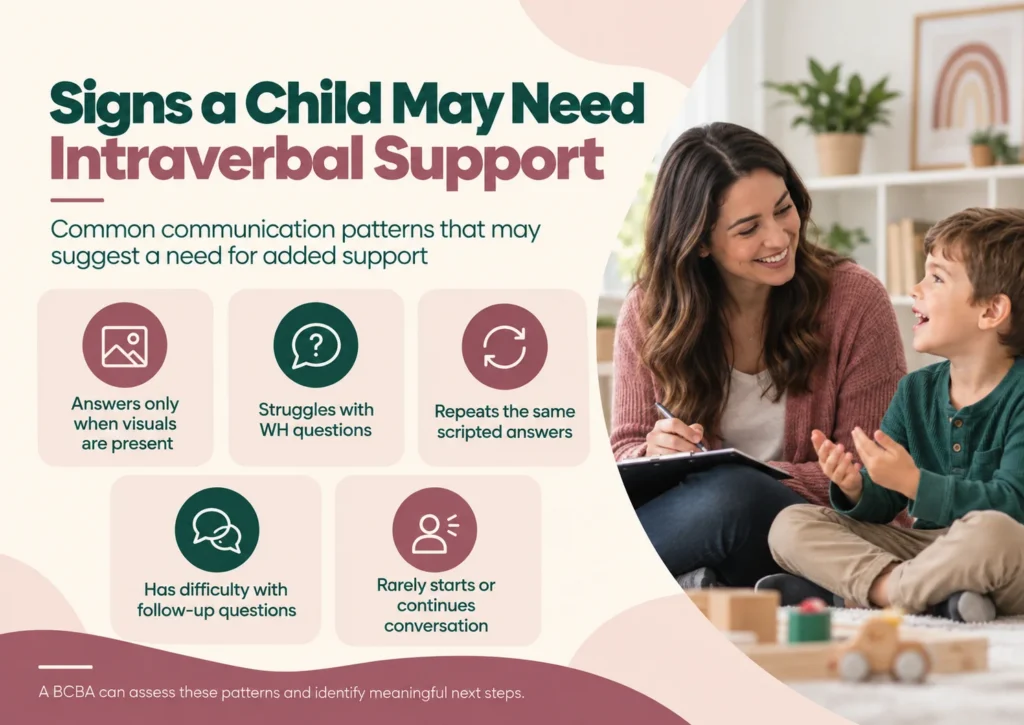
Assessment starts at the level at which the learner can work on his own. Listener responding, tacts, alternative communication, question answering, conversational responses, interests and situations where communication is useful may be observed by a clinician.
No single age determines readiness for intraverbal training for autism. Assessment determines a starting point and avoids a goal being too easy or too difficult.
VB-MAPP and Individualized Language Assessment
One set of frameworks behavior analysts can use to assess verbal repertoires is known as the Verbal Behavior Milestones Assessment and Placement Program (VB-MAPP). It evaluates more complex skills, such as fill-in, answering questions, and reacting to verbal cues, using its intraverbal milestones.
VB-MAPP results must be interpreted in the context of direct observation, caregiver input, functional needs, communication modality, and real world communication. There may also be other assessment tools that are suitable.
Accuracy, Prompting, and Generalization
Assessment should be based on more than right answers. Clinicians may examine:
- independent versus prompted responses
- response latency
- prompt type and level
- different question wording
- flexible versus memorized answers
- communication partners and settings
- maintenance over time
- communication repair
- responses using speech, AAC, signs, or writing
The aim is to identify if the question asked is a verbal cue to give the response, or if it is an unintended prompt. Skills should also be evaluated away from the teaching situation to determine generalization and maintenance.
How to Teach Intraverbal Behavior in ABA
Choose Functional and Meaningful Targets
Useful communication is the starting point of effective intraverbal goals in ABA. Targets can be related to family habits, friendships, school involvement, safety, hobbies, topics of interest or independence in everyday situations.
Teaching “What is the capital of a distant country?” may offer little value to one learner. It is well possible to boost participation with peers by being taught how to reply to the question, “What do you desire to play?”
Start From Skills the Learner Already Has
A learner who can already label animals might be able to respond to some basic animal questions. An individual who has a familiarity with familiar routines can start by saying the missing words associated with these routines.
Good programming is based on the demonstrated repertoire, and does not assume that all learners will proceed in a certain order.
Prompt the Target Response When Needed
Prompts can help establish a correct response during early teaching. A clinician may choose to use an echoic model, written word, picture, tact prompt, partial verbal prompt or any other individualized cue depending on the target and learner.
Transfer Control and Fade Prompts
Prompt fading for intraverbals is designed to move the control of the verb away from the prompt and towards the naturally relevant verbal stimulus.
A simple progression might look like this:
- Therapist asks the target question.
- A prompt is provided when needed.
- The learner responds.
- Appropriate responding is reinforced.
- The prompt becomes less intrusive.
- Independent responding is tested.
The effectiveness of echoic, textual and tact prompting has been compared to other prompting procedures and found to vary among learners.
Build From Simple to Flexible Responding
Training should be extended beyond the memorization of a single answer to questions.
A learner might progress from:
“A dog says…” → “Woof”
to:
“Name an animal” → “Dog”
then:
“Tell me three animals” → “Dog, horse, elephant”
and eventually:
“What animal would you like as a pet, and why?”
This sequence helps to develop more flexible and complex verbal responses.
Plan for Generalization and Maintenance
Intraverbal generalization is when the learner can apply the skill outside of the specific trial.
Practice may therefore vary:
- the person asking the question
- wording of the question
- physical setting
- time of day
- response examples
- conversational context
Generalization should be programmed and measured rather than assumed. In prior studies, learners acquired categorical intraverbals during structured teaching and generalization and maintenance were inconsistent for some of the targets.
Effective Intraverbal Teaching Strategies
Tact to Intraverbal Transfer
Tact-to-intraverbal transfer uses an established response to develop responding under verbal control. A learner can initially identify a Firefighter in a picture and then respond to the question, “Who puts out fires?” when the picture is taken away.
Echoic and Textual Prompting
Echoic prompts offer an oral model, and textual prompts offer written information. Both can engage in intraverbal teaching. The best prompt will vary based on the learner’s existing skill, the desired skill response, and the ease of fading the prompt.
Delayed Prompting and Prompt Fading
A clinician may briefly delay a prompt to allow the learner to respond independently. Delays should be systematically adjusted to reflect prompt delays.
Multiple Exemplar Training
Multiple exemplar training varies examples and question formats associated with a concept. Instead of teaching only “What do you eat?” → “Pizza,” instruction might include:
- “Tell me something you eat.”
- “What foods do you like?”
- “Name a breakfast food.”
- “What could you eat when you are hungry?”
This variation decreases reliance on a specific stimulus and promotes stimulus generalization.
Common Intraverbal Training Mistakes
Teaching Memorized Answers
Drilled answers to one question may be effective but in the long run they can inhibit flexible communication. Use a variety of sentences, appropriate answers, spontaneous remarks and authentic contexts.
Delaying Prompt Fading
Learners can be given verbal cues, visual cues, and gestures before they speak. A fade is systematically and independent responses are checked so that verbal cues are naturally relevant.
Confusing Tacts or Echoics
Practicing an “apple” when looking at a photo is a tact, and repeating an adult’s answer is echoic. Evaluate stimulus control before the response before naming it intraverbal.
Using Limited Practice Conditions
Attempting a single question style or therapist may lead to limited learning. Vary wording, communication partners, settings, and examples to promote flexible responding and generalization.
Ignoring Choice and Generalization
Communication should be respectful to interests, privacy, culture, language and modality. Help students understand that it is legitimate to not know, ask for clarification or say no when appropriate.
How Parents Can Support Intraverbal Skills at Home
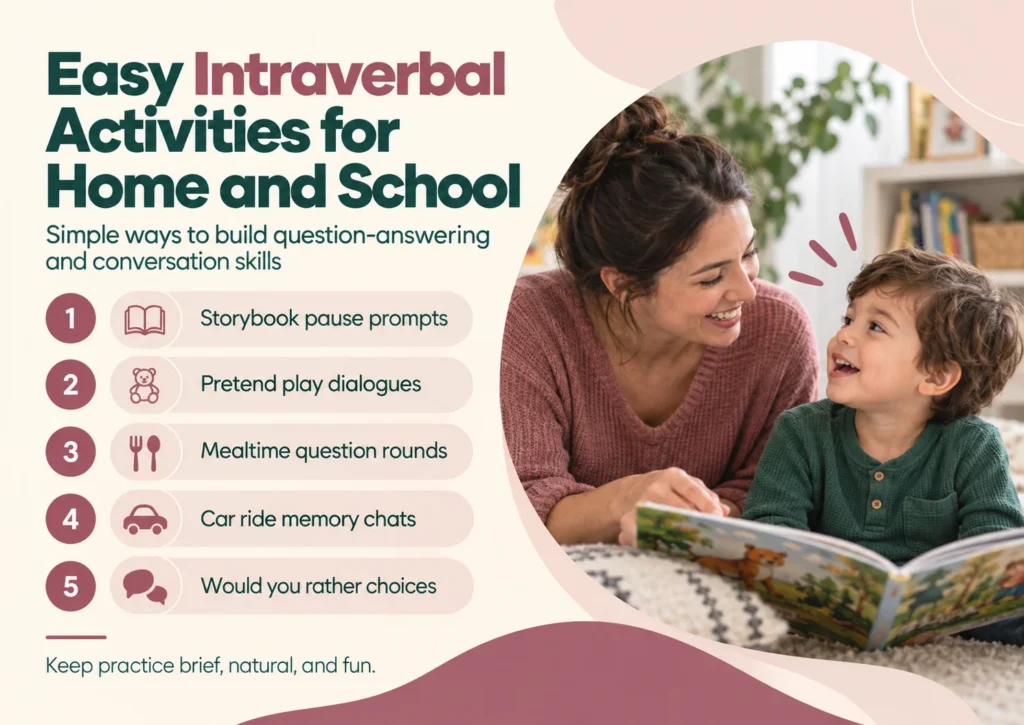
Use Everyday Routines and Preferred Activities
Parents don’t need piles of flashcards to provide communication opportunities.
Natural questions and comments can arise during cooking, reading books, driving, playing games, walking, and favorite activities. The family can consult with their clinician in Burbank, or any other location, to determine which current therapy goals they can work on during their normal family activities.
Give Time to Respond Without Turning Conversation Into a Quiz
Communication can feel like a test when it’s done quickly with a lot of questions.
Parents can comment, pause, model conversational responses, and give the child enough processing time. Genuine back-and-forth interaction often creates richer opportunities than repeatedly asking questions whose answers the adult already knows.
Encourage Flexible Answers and Communication Repair
A valuable communication is knowing what to do when you don’t know the answer.
Responses such as:
- “I don’t know.”
- “Can you say that again?”
- “What do you mean?”
- “I forgot.”
- “Can I show you?”
Guessing is not so functional as may be. Allowing a few reasonable answers may help support response variability.
Follow the Child’s Individual Communication Plan
If applicable, parents should schedule practice in conjunction with the child’s BCBA and other communication professionals. Spoken language is not the only available response modality; other modalities such as AAC, signs, writing, etc. can be involved in verbal behavior based on the learner.
Communication services will continue to be an important care area for children. The U.S. Bureau of Labor Statistics estimates that speech-language pathologist jobs will increase by 17% by 2035 and create 12,500 annual openings specifically referencing employment related to the communication needs of children with autism.
Key Takeaways About Intraverbals in ABA Therapy
- Intraverbal behavior is responding to verbal information, but not just repeating it.
- Intraverbals have different functions from mands, tacts and echoics.
- These include fill-ins, WH questions, categories, academic recall, and reciprocal conversation.
- Intraverbal training must be individualized, thoughtfully prompted, prompted faded, reinforced, and flexibly practiced.
- Correct responses are not the only items that matter during teaching, there are generalization, maintenance, communication repair, learner preference and natural conversation.
How Alma Behavioral Solutions Supports Communication Growth
Intraverbal skills are not the only part of a child’s communication repertoire. Alma Behavioral Solutions provides individual, evidence-based ABA services that can pinpoint meaningful goals, track progress, work with families, and facilitate children in practicing meaningful skills in their daily environment.
Families in Beverly Hills and other communities in Southern California can talk to Alma about their child’s needs regarding communication, socialization, behavior, and daily functioning and about the availability of ABA support. Connect with us by Calling (747) 250-8494 or emailing info@almabehavioralsolutions.com to discuss what you think your child needs and what the assessment and care process may look like for your child.
FAQs about Intraverbal Behavior
Can Intraverbal Responses Use AAC Signs or Writing?
Yes. Verbal behavior is defined functionally, not only by speech. Intraverbal response can be AAC, Signing, writing or other means of communication when the response is appropriately guided by preceding verbal information.
When Is a Child Ready to Work on Intraverbal Skills?
There is no universal age. Readiness is a function of the learner’s communication repertoire, listening abilities, current verbal operants, interests, and functional needs. A BCBA can identify targets based on individualized assessment.
How Long Does Intraverbal Training Take?
There is no standard timeline. Progress is related to starting skills, skill complexity, teaching procedures, practice opportunities, modality of communication, and generalization. Programming should be based on data and not assume a specific number of sessions for mastery.
Can a Child Have Strong Vocabulary but Weak Intraverbal Skills?
Yes. While a child can identify numerous objects and say many words, they have a hard time answering questions or having an open discussion. Verbal operants can form somewhat independently because some responses are under the control of environmental variables, while others are not.
What Should an Intraverbal ABA Goal Measure?
A good goal should reflect meaningful observable responding. Independent work, correctness, generalizability, flexible responses, timeliness responses, diverse question wording, communication partner, maintenance, and generalizability, not just memorization.