

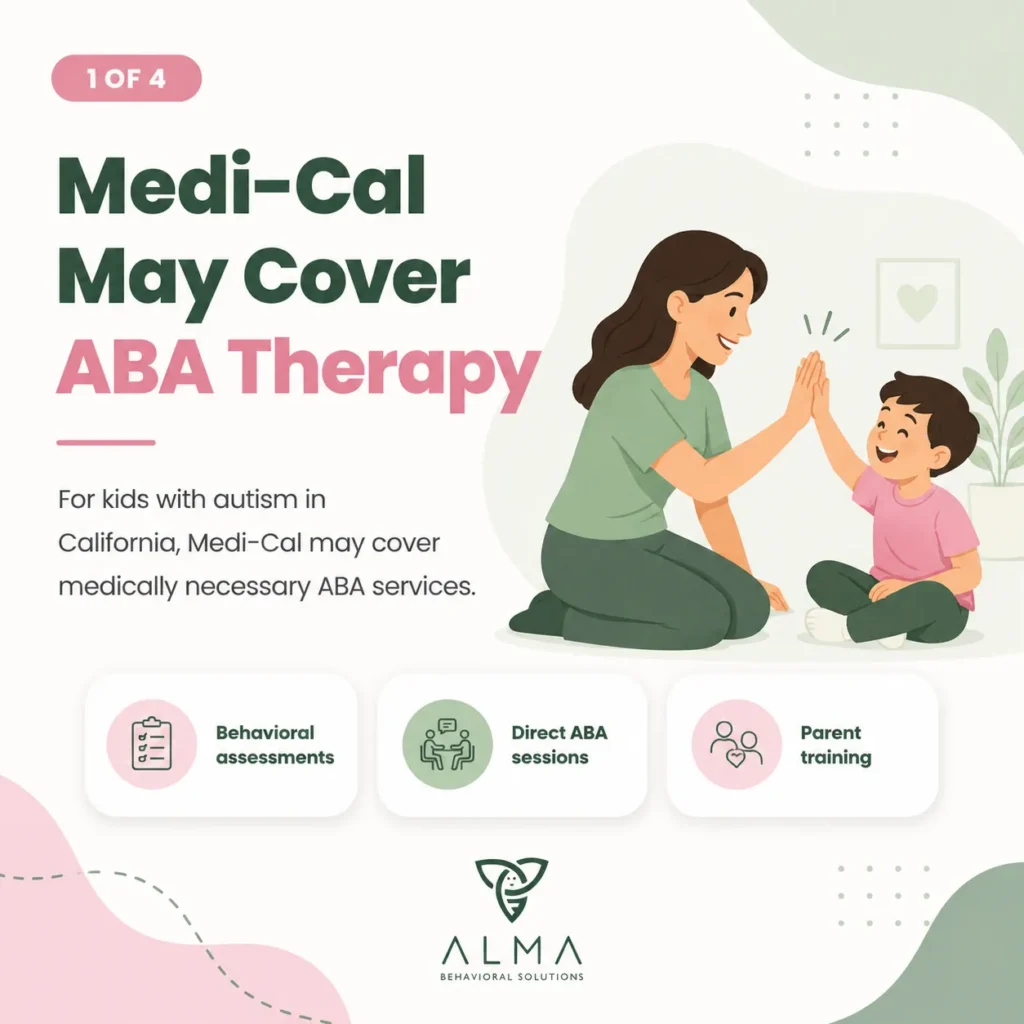
Most parents trying to cover ABA therapy for their autistic child already know the frustration: therapy is important, but the cost can feel overwhelming. Parent training, speech therapy, occupational therapy, evaluations and ABA therapy can be expensive.
Medi-Cal for kids with autism in California can make care easier to access.
Medi-Cal is California’s Medicaid program. It provides free or low-cost health coverage to eligible children and families. Medi-Cal can pay for autism-related care for children that is necessary for their medical care, such as Behavioral Health Treatment (BHT). If the medical care is needed, Applied Behavior Analysis (ABA) therapy may be included in BHT.
Medi-Cal can help lower out-of-pocket expenses for many California families, and provide a more direct route to therapy, evaluations and other services and supports.
Parents who are not sure about eligibility, diagnosis or coverage for ABA can begin with an autism evaluation and benefits check.
What is Medi-Cal?
Medi-Cal is the state’s public health insurance for qualified children, families, pregnant people, seniors, and people with disabilities. This can be for preventative, medical, behavioral health, developmental and medically necessary services for children.
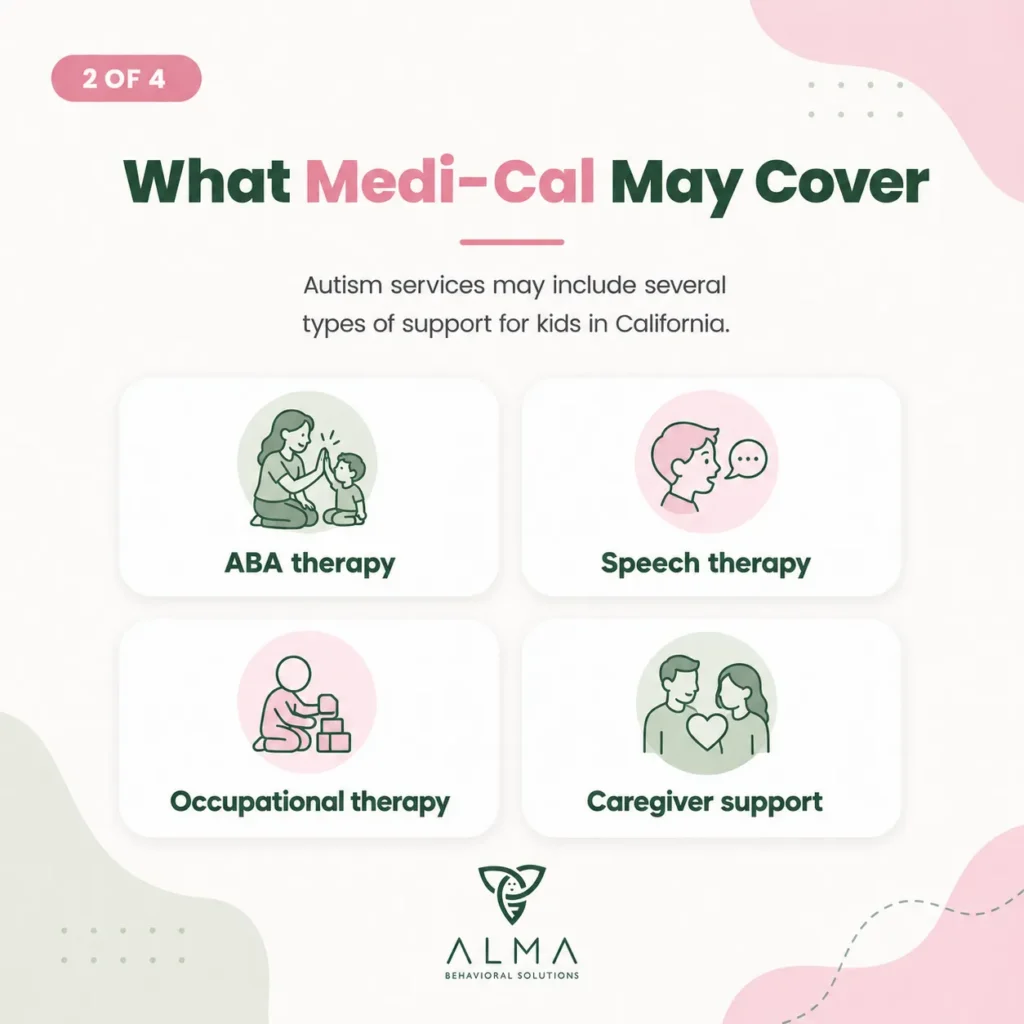
Medi-Cal might cover services for autistic children that assist with communication, behavior, daily living skills, safety, emotional regulation, social skills and family training.
California coverage options usually include:
- Medi-Cal: Public health coverage for eligible children and families.
- Medi-Cal for Kids & Teens: California’s EPSDT benefit for full-scope Medi-Cal members under age 21. It helps children access medically necessary services.
- Covered California: Marketplace health plans for families who do not qualify for Medi-Cal but may qualify for financial help.
- Private or employer-sponsored insurance: Coverage through work or private plans. Many California-regulated plans must cover autism treatment, including behavioral health treatment.
Parents looking to obtain autism benefits under Medi-Cal should be aware that autism treatment may be covered by Medi-Cal if the treatment is medically necessary, and the child qualifies for Medi-Cal eligibility.
Does Medi-Cal Cover ABA Therapy for Kids with Autism?
Yes, Medi-Cal will cover medically necessary ABA therapy for eligible children.
In California, ABA therapy is usually covered under Behavioral Health Treatment. BHT uses evidence-based behavioral strategies to help improve or maintain a child’s functioning. BHT can help children with autism to communicate, learn new skills, get along with regular school activities, improve parent training skills and decrease behaviors that impact safety, learning or daily functioning.
Many parents believe that ABA only could be provided through private insurance. However, coverage for ABA therapy on Medi-Cal California may be available when the child is eligible and the steps for authorizing coverage are taken.
Medi-Cal May Cover:
- Behavioral assessments: Evaluations which identify needs, strengths, behaviors and treatment goals.
- Direct ABA therapy sessions: One-on-one therapy delivered by qualified staff under supervision.
- BCBA treatment planning: A Board Certified Behavior Analyst creates and oversees the treatment plan.
- Parent and caregiver training: Sessions that help families use ABA strategies at home.
- Care coordination: Help connecting families to needed services, depending on the plan.
- Related therapies: Other supports, such as speech and occupational therapy, medically necessary mental health services and more, may also be provided.
Coverage may differ among Medi-Cal managed care plans, county, provider network, and Medi-Cal documentation of medical necessity.
Medi-Cal Eligibility: Who Qualifies in California?
To qualify for Medi-Cal, children must meet certain eligibility requirements. This can include age, income, residence in California, program-specific immigration status requirements and more.
Children often qualify for Medi-Cal at higher income levels than adults. The limits are based on Federal Poverty Level guidelines, and may vary from year to year in California.
Children may qualify based on:
- Age: Child Medi-Cal eligibility usually applies to children under 19. Medi-Cal for Kids & Teens benefits apply to full-scope Medi-Cal members under 21.
- Income: Must comply with program income limits for households.
- Residency: The child must live in California.
- Coverage category: Medi-Cal, disability eligibility, foster care, adoption eligibility and other eligibility groups are the ways a child can qualify.
- Immigration status: In California, many children with or without immigration status have been granted full-scope of Medi-Cal coverage. Families should confirm current rules through the county, BenefitsCal, Covered California, or an enrollment assister.
It’s important for families to make sure they are eligible even if they feel they have too much income. The final decision may be influenced by the number of people living in a household, how income is used, whether or not someone files taxes, and program rules.
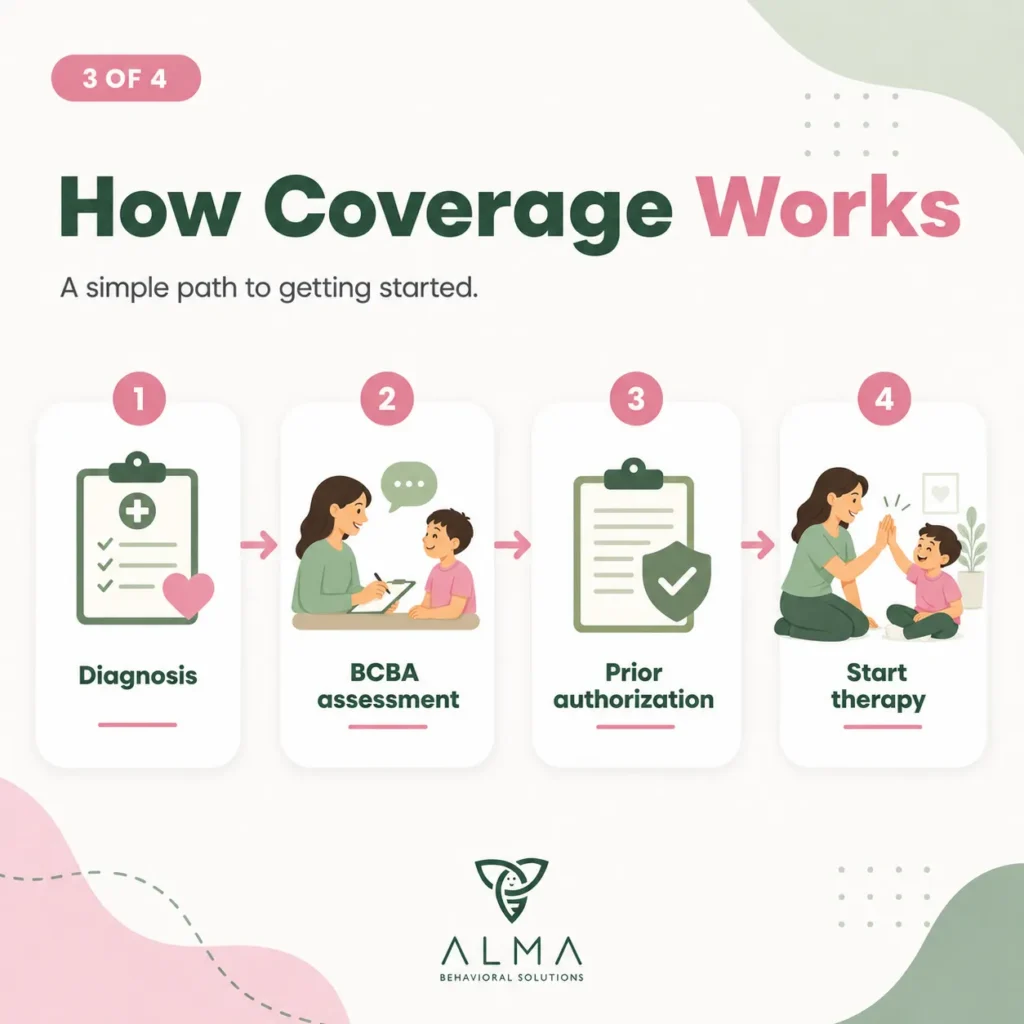
How the ABA Coverage Actually Works
ABA therapy may not start immediately with Medi-Cal coverage. For most children, clinical documentation, review, authorization of services still does not begin until after services begin. The intent is to demonstrate the medical necessity of ABA therapy and to match treatment to the child’s needs.
Step 1: Confirm Your Child’s Medi-Cal Plan
Families should verify that the child is on Medi-Cal, and that the child has a managed care plan. Most children in California receive services from plans like LA Care, Health Net, Anthem Blue Cross, Blue Shield Promise, Molina, CalOptima, Kaiser, Partnership HealthPlan or from a county plan.
A child’s plan determines:
• Which ABA providers are in-network
• Where authorization requests are submitted
• What documents are required
• How long approvals last
• Where therapy can take place
Families should verify that the Medi-Cal plan is the same as the child’s with the ABA provider prior to the start of services.
Step 2: Get Diagnosis or Medical Necessity Documentation
Many children begin to realize that they have a formal autism diagnosis. The evaluation can be performed by a licensed psychologist, developmental pediatrician, neurologist, psychiatrist or other qualified clinician.
Useful documents may include:
• Autism diagnostic report
• Medical necessity letter or referral
• Developmental evaluations
• Speech or occupational therapy reports
• School reports or IEP documents
• Behavior notes or safety concerns
• Prior treatment records
These records contribute to understand why ABA therapy is necessary and aid in the authorization request.
Step 3: Complete the BCBA Assessment
After the family has found a provider of ABA services, a Board Certified Behavior Analyst (BCBA) typically does an intensive evaluation.
The BCBA can observe the child and interview the caregivers, examine records, and implement assessment tools to gain insight into:
- Communication skills
- Social engagement
- Daily routines
- Self-care skills
- Safety concerns
- Emotional regulation
- Transitions
- Challenging behaviors
- Parent priorities
A solid evaluation should indicate clearly what behaviors are problematic and how ABA therapy can contribute to significant change.
Step 4: Create the Treatment Plan
After the assessment, the BCBA creates an individualized treatment plan. This plan is important when seeking authorization as it will outline what therapy will cover and why services are medically necessary.
The plan may include:
• Diagnosis or medical necessity basis
• Assessment results
• Recommended therapy hours
• Treatment goals
• Parent training goals
• Behavior support strategies
• Data collection methods
• Supervision plan
• Progress review timeline
Medical necessity is the key in Medi-Cal California autism services. A treatment plan should relate the child’s needs to specific therapy objectives.
Step 5: Submit Prior Authorization
Most Medi-Cal managed care plans will require prior approval before ABA therapy is started. The health plan receives the assessment, treatment plan, diagnosis or medical necessity documentation and requested therapy hours from the ABA provider.
The plan may:
• Approve the request
• Approve fewer hours
• Ask for more information
• Deny the request
• Approve services for a limited period
If the request is denied or partially approved, families can appeal. Supporting documents may assist in making the request.
Step 6: Start Therapy
Once authorization is approved, ABA therapy can begin. Services may occur at home, clinic, community or school as appropriate.
The therapy may be directed towards communication, safety, daily routines, emotional regulation, social engagement, toileting, feeding routines, or decrease behavior that interferes with learning.
Parent training also supports the caregivers to apply hands-on strategies in real-life situations, such as during meals, bedtime, transitioning, errands, and drop off at school.
What Medi-Cal Costs for Autism Families
Medi-Cal can significantly reduce the cost of autism services for eligible children.
Medi-Cal for Kids & Teens is designed to provide medically necessary services for full-scope Medi-Cal members under age 21, often at no cost to the family. Families might not need to pay high monthly premiums, deductibles, or high costs per therapy session for covered autism services.
Nevertheless, families need to verify details of the plan in advance. Check whether ABA therapy is included, if there is a prior authorization requirement, if there are in network ABA providers, if parent training is covered, the frequency of reauthorization and whether speech or OT services are covered.
Clear answers early can prevent delays later.
A California Example: How Medi-Cal Works in Practice
A family in Los Angeles has a 5-year-old son recently diagnosed with autism. Has difficulty expressing himself, has trouble changing routines, is easily overstimulated in noisy places, and requires assistance with activities.
His parents are concerned because they cannot afford private ABA therapy. They apply for coverage and learn their child qualifies for Medi-Cal.
The family contacts Alma Behavioral Solution for support. The intake staff ensures that the child’s Medi-Cal managed care plan is verified, coverage is reviewed and documents are explained.
The parents provide the autism diagnostic report and pediatrician referral. A BCBA completes a behavioral assessment, identifies goals, and creates a treatment plan. The provider will make the authorization request to the health plan.
After approval, therapy begins. Child receives ABA (communication, transitions, safety, and daily living routines). The parents also receive caregiver training.
For this family, Medi-Cal makes autism therapy financially possible.
How to Apply for Medi-Cal
Families may apply for Medi-Cal online at BenefitsCal or Covered California, by phone at Covered California or the county social services office, in person at the county human services office or by using a certified enrollment counselor, community clinic, family resource center or school support team.
Medi-Cal applications can be submitted throughout the year. Unlike some private marketplace plans, there’s no timeframe for open enrollment.
Helpful documents may include
- Proof of income
- Proof of California residency
- Child identity documents
- Tax household information
- Current insurance information
- Medical or disability-related records.
Families should keep their coverage active and complete renewals, notify the county of necessary changes, and update contact information.
Medi-Cal vs. Other California Coverage Options
Not every child will qualify for Medi-Cal. Families who do not qualify may still have other options.
- Medi-Cal: For eligible children and eligible families who meet the income, disability, foster care or other eligibility criteria.
- Medi-Cal for Kids & Teens: Provides broad medically necessary services for full-scope Medi-Cal members under age 21.
- Covered California: Marketplace health insurance for families who do not qualify for Medi-Cal but may qualify for financial assistance.
- Private insurance: Employer or individual plans may cover autism treatment, depending on the plan and California law.
- Regional Center: California Regional Centers provide services for eligible persons with developmental disabilities and can assist with service coordination.
- School district services: Services can be part of an IEP or school-based plan if a child requires assistance to receive education.
More than one system may be required for families. ABA can be provided using Medi-Cal, school supports, and service coordination can be provided through a Regional Center.
What If Medi-Cal Denies ABA Therapy?
The denial may be discouraging but, it does not always stop the process.
If ABA therapy is denied, families should ask why the request was denied, if documentation was missing, if medical necessity was questioned, if requested hours were reduced, if the provider was out of network, and if an appeal can be filed.
Many denials are related to documentation. Additional Treatment Plan, a new assessment, physician letter, school report, behavior data, or statement from caregiver can assist with the appeal.
Copies of letters, call notes, authorization requests, denial notices and appeals should be retained by the family.
Why Provider Experience Matters
It’s hard enough for parents to keep track of appointments, school meetings, work schedules and daily care, but the Medi-Cal process can make it even more confusing.
An experienced ABA provider can assist families with the steps, documentation, benefits verification, plan authorization requests, and plan communication.
The provider will discuss the paperwork that is required, the process and time for BCBA assessment, the process for denials, parent training, and progress measurement.
Families should feel informed before therapy begins, not surprised by paperwork halfway through the process.
Conclusion: Medi-Cal Can Help California Families Access Autism Support
Medi-Cal can be a powerful support for children with autism in California. Medically necessary Behavioral Health Treatment such as ABA therapy for eligible children up to age 21. It could also provide opportunities for children to access speech therapy, occupational therapy, mental health assistance, care coordination and other medically necessary supports.
When parents are looking for Medi-Cal for children who have autism, autism services covered by Medi-Cal California, Medi-Cal autism benefits, or Medi-Cal coverage for ABA therapy, it is important to confirm the exact coverage and obtain appropriate documentation.
Alma Behavioral Solution supports families to understand coverage, prepare for ABA intake, and take steps towards support the child deserves. The aim is easy to understand: Making it easier for children to access care without confusion, and with confidence.
Frequently Asked Questions
Does Medi-Cal cover ABA therapy for children with autism in California?
Yes. Medi-Cal may cover ABA therapy for eligible children when it is medically necessary. ABA therapy is typically included under the Behavioral Health Treatment, which can provide assistance with communication, daily living skills, safety, behavior, emotional management and parent training.
What autism services are covered by Medi-Cal California?
The services received under Medi-Cal California can encompass a behavioral evaluation, ABA therapy, BCBA treatment planning, parent and caregiver training, and speech, occupational, mental health, and other medically required services. Coverage will be based on the needs and clinical plan of the child.
Does my child need an autism diagnosis to get ABA therapy through Medi-Cal?
Many kids begin the process with a formal diagnosis of autism from a qualified clinician. Medical necessity documentation from a physician or psychologist can also support access to Behavioral Health Treatment, in some cases. Families should check with their child’s Medi-Cal managed care plan to confirm requirements.
How long does Medi-Cal ABA authorization take?
The time frame may differ based on the documentation, plan and provider. Rarely, delays are more likely to occur if the records are missing or when the treatment plan is not clear and does not demonstrate that the treatment is medically necessary. Providing a full diagnostic report, BCBA assessment, and treatment plan will aid in the review process.
Can Medi-Cal cover speech therapy and occupational therapy for autistic children?
Yes, if speech and occupational therapy is medically necessary, it may be covered by Medi-Cal. Speech therapy can assist in communication and language; occupational therapy can assist in sensory processing, self-regulation, feeding, motor skills and day to day skills.
What should parents do if Medi-Cal denies ABA therapy?
Parents should read the denial and understand the reasons for the denial, then contact the doctor or ABA provider and provide more documentation. A change in treatment plan, new assessment, physician letter, school report or behavior data can be beneficial to an appeal.