

Have you seen a child notice an airplane and say, sign, or select “airplane” without asking for it?
This may be a tact. A tact is a verbal operant that is made when someone describes or names something they see or hear, feels or tastes or smells or experiences internally. The response is usually followed by social acknowledgment, such as “Yes, that airplane is flying high.”
The technical terms like tacting, manding, echoic, and intraverbal refer to familiar communication. Knowing what these are can help families grasp the importance of these skills being taught in therapy. This guide describes what tacts are, how they differ from other verbal operants, and how families can facilitate the use of tacts.
What Does Tact Mean in ABA?
Tacting is the term for recognizing or describing something that exists or occurs or is directly experienced. Behavior analysts look beyond the word to what led up to the response and what followed. It may be a tact to say “cookie” after seeing one, it may be a must to say it to get one.
How a Tact Works
There are usually three parts of a tact.
| What happens first | Communication response | What usually follows |
| A child sees a dog | The child communicates, “Dog.” | A listener says, “Yes, that is a dog.” |
| Rain begins | The child communicates, “It is raining.” | A parent acknowledges the observation. |
| A siren sounds | The child communicates, “Loud siren.” | Another person agrees or comments. |
The object, action, event, or sensation is the nonverbal stimulus. The tact is the response and generalized reinforcement is given by the act of acknowledging. These functional features are used in research to define a tact.
What Verbal Means in ABA
In behavior analysis, verbal means “spoken” – not just “spoken only.” Tacts may use speech, sign language, an augmentative and alternative communication device, pictures, or typing. ASHA explains that AAC supplements or compensates for speech-language difficulties. A nonspeaking child who selects the word “bird” after observing one can do as meaningfully as a speaking child.
Types and Examples of Tacts
Tact goals start with familiar objects, but it is also useful to have instruction for actions, events, properties, functions, categories, sensory experiences, and feelings.
Object Action Event and Property Tacts
Typical examples of tacting are:
- Object tact — seeing a cup and communicating “cup”
- Action tact — watching someone jump and communicating “jumping”
- Event tact — noticing rain and communicating “It is raining”
- Property tact — seeing a red car and communicating “red”
- Feature tact — describing a bicycle with “two wheels”
- Function tact — seeing a spoon and communicating “eat with it”
- Class tact — identifying an apple as “fruit”
Language may expand from “car” to “red car” and “The red car is moving.” Measure progress by usefulness, independence and application in context as well as length.
Sensory Emotion and Private Event Tacts
Tacts can refer to things that are not visible to another person, such as: “The blanket is soft,” “My stomach hurts,” and “I feel worried.” Feelings and body sensations belong to the private sphere because they can’t be observed by other people. Don’t make assumptions about feelings or equate one behavior with one emotion. Examples of support are modelling language, use of choice, noticing context, and respecting the child’s report.
Expanded Tacts and Natural Comments
Labels are not always as helpful as a natural comment. A child may draw attention by saying “Airplane!” when they notice a plane. Expanded tacts refer to changes or relations, e.g., “The door is open.” During instruction, prompts may be used which can lead to a prompted or multiply controlled response, which is then slowly faded.
How Tacts Differ From Other Verbal Operants
Verbal operants are categories of communication based on their function. A word can have more than one use depending on its cause and the outcome it is hoped for.
Mands and Tacts
Mands and tacts can appear the same but have different functions.
| Skill | Main purpose | Main controlling condition | Typical result |
| Mand | Request something wanted or needed | Motivation | Receives the requested outcome |
| Tact | Label or describe something noticed | Nonverbal stimulus | Social acknowledgment |
Consider “juice.” A child points to a juice in a grocery bag and says “juice” and the parent agrees. That is an answer that creates a tact. If a child asks for a drink and says the word “juice” the drink is given, and this “juice” is considered a mand.
This distinction may become confused to the child when the named item is given following each tact trial. Therapists can use neutral materials or natural social responses. Some studies suggest that the mind and tact skills do not necessarily transfer automatically and planned generalization is essential.
Echoics Intraverbals and Listener Responding
An echoic repeat of a verbal model. An intraverbal is a response to other words, but not a copy, like when someone asks “What animal says meow?” and you reply “cat”. Listener responding involves acting on words; touching a picture after “Show me the dog” is not tacting. Visualization of the picture and saying “dog” is a tact, but some factors might affect one response.

Why Tacting Skills Matter
Tacting encourages people to communicate their observations, experiences and emotions. These skills can be used to enhance expressive vocabulary, shared attention, classroom involvement, conversation and self-advocacy.
For example, communication such as “It’s too loud” or “My head hurts” provides others with clear, actionable information. Tact instruction is not a guarantee of outcomes or a cure, but instead, goals are meaningful, age appropriate, and delivered in the person’s current communication system.
How Tacting Is Taught in ABA Therapy
Goals can be determined by a qualified BCBA based on the assessment of communication, interests, strengths, and family priorities. The RBT oversees and carries out the behavior-analytic program, which is designed and supervised by the BCBA. BACB standards emphasize verbal operants, multiple control, generalization, and maintenance.
As of July 1, 2026, the BACB listed 85,587 BCBAs and 260,174 RBTs. These are national numbers of credentialed workers and not the number of clinicians who provide instruction in tactics or treat a specific community. Families should still ask who develops communication goals, who supervises implementation, how progress is reviewed, and how collaboration occurs with speech-language pathologists or AAC specialists when appropriate.
Choosing Meaningful Tact Goals
Effective tact goals focus on language that is useful in everyday life, such as familiar people, activities, foods, school materials, actions, and sensations. Content should be appropriate, diverse, and meaningful to the student. Goals should not be based on a single, standard list of vocabulary but should be based on the language, routine and cultural references used by families in Glendale and Burbank. The child’s communication system, including AAC if used, should always remain available.
Prompting, Reinforcement, and Prompt Fading
A practical teaching sequence may include:
- Present or capture a clear object, action, event, or sensation.
- Pause to allow an independent response.
- Provide the least intrusive effective prompt if needed.
- Reinforce or acknowledge correct responses.
- Use a planned correction procedure for errors.
- Gradually reduce cues as time passes.
- Practise until the response occurs when the natural stimulus is present.
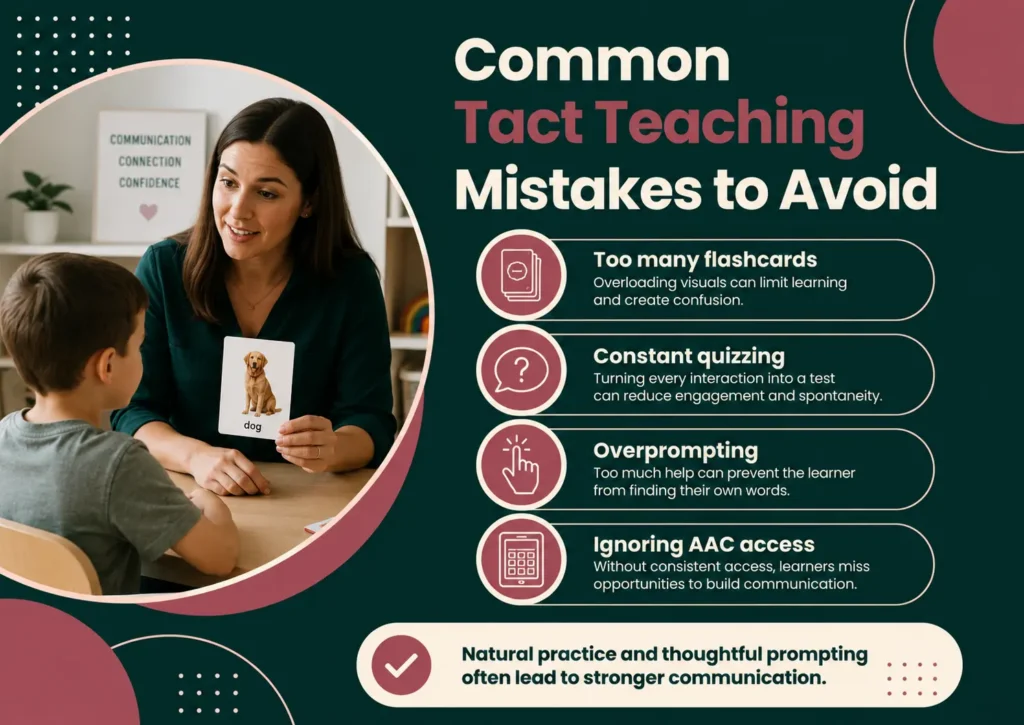
Visual prompts, time delay, gestures, sign or AAC support or verbal models. Questions such as “What is it?” can be used to facilitate learning, but too many questions can result in prompt dependence. The goal is for the natural environment—not the question—to control communication. Shared attention, comment, and short social responses are used to reinforce tacting in many instances, and clinicians observe changes in responses from comments to requests.
Generalization, Maintenance, and Progress Tracking
Tacts are best when they are generalized over settings, people and materials. Therapist may systematically change objects, environment, and routine and re-evaluate performance over time. Independent, prompted, incorrect, generalized and maintained responses are usually distinguished from a data collection.
A review of 51 tact-intervention studies from 2000 through 2019 found that 87.18% of interventions eligible for effect-size calculations showed high or excellent effects. This is not an individual success rate figure and generalization and maintenance still needs to be planned for.
A four-participant study conducted in 2024 showed that fewer teaching trials were needed to evaluate individual tacts than to replace sets of tacts. A credible outcome forecast for any particular tactic can only be made through 2026. Federal projections anticipate that community and social service occupations will have a 6.6% increase from 2016 to 2034, and research continues to focus on AAC systems, mobile technologies and artificial intelligence. Technology is not an end in itself, but must facilitate clinical decision making.
How Families Can Encourage Tacting at Home
Home practice is best not as a test, but a connecting experience. Books, cooking, walks, play, dressing and shopping are natural ways to model language, and to respond to comments and questions.
Natural Tacting Opportunities in Daily Routines
Families can:
- Model “The truck is loud” while watching traffic.
- Notice an interesting picture during a shared book.
- Describe actions during play, such as “The bear is sleeping.”
- Describe textures during food preparation or when folding clothes.
- Expand “dog” into “brown dog” without demanding repetition.
- Enlist the child’s observation and respond positively.
Northridge and Studio City offer neighborhood sights, family foods, home languages, and preferred activities for parents. Specific examples are likely to be more effective than general ones. A clinician will be able to choose targets that are appropriate to the plan.
Supporting Communication Without Constant Quizzing
Repeatedly asking “What is this?” may make the learner wait for a question. Follow interests, give time for processing, accept the agreed communication style, and do model comments. AAC should never be removed to encourage speech. When the meaning is understood, minor pronunciation inaccuracies may not require extensive correction and family coaching can help with accuracy without disrupting communication.

What Tacting Progress May Look Like
Making progress is not always a one-off event, but can happen in a number of ways. These changes may be slow, and they can be different for each learner.
Signs of Progress
Progress may include:
- Smaller number of reminders to answer
- Ability to label or describe new examples
- Communication with a wider range of people
- Use of tacting skills outside of therapy sessions
- Retention of skills over time
Variability in Skill Development
Development doesn’t necessarily run in straight lines. For instance, a child might be able to identify objects easily, but not be able to identify actions, properties or feelings. In ABA programming, this is a typical and normal growing curve.
Adjusting Goals Over Time
Granada Hills should expect the goals to grow depending on the data to see what is effective for families. There is no universal timetable for the delivery of targets and they are continually reviewed in line with learner progress and needs.
When to Seek Additional Guidance
When it may help to have professional support:
- Labels are still used only for flashcards or formal drills.
- AAC systems are not consistently available or used
- Frustration or diminished engagement due to practice
Learn How Alma Supports Functional Communication
While effective goals are those that are appropriate, Tacting can be used to help a child identify, describe, and share meaningful aspects of daily life. Alma Behavioral Solutions produces tailored ABA plans that consider communication mode, family priorities, natural routines, generalization and measurable progress. Families may call (747) 250-8494 or email info@almabehavioralsolutions.com with any questions regarding enrollment, services, or to get started on the ABA journey with guidance from a clinician.
Services are offered in several communities in Los Angeles, and BCBAs, RBTs and caregivers collaborate to ensure services are consistent, data continue to be reviewed, and strategies are implemented and practical in the home, school and community setting, enabling the development of lasting independence and confidence in communication skills.
Frequently Asked Questions About Tacting in ABA
Is Answering What Is This Always a Tact?
Not always. The visible object can be part of the answer, and also provides a verbal prompt for the question. Clinicians may call this prompted or multiply controlled responding. When the aim is to independent the stimulus, the teaching should gradually move to a natural stimulus.
Can the Same Word Be Both a Mand and a Tact?
Yes. A child may say “ball” to label it or request access. The word is the same but the meaning is different. Motivation, present stimulus, listener response, and desired outcome are all factors to be considered by behavior analysts.
Can Nonspeaking Children Learn Tacts?
Yes. A learner can sign, use an AAC device, select pictures, type or communicate in another way they can access. Assessment should determine a feasible system, and adults should have a continuous system at home, school, therapy and community.
How Many Tact Goals Should a Child Have?
There is no one correct number for all children. A BCBA takes into consideration current skills, rate of learning, communication, family priorities, generalization and teaching time. A more limited number of significant, independent objectives can be more important than a large number of goals drilled.
Should Parents Teach Tacting Without a Therapist?
Language can be modelled by parents and responded to with natural comments; formal targets and prompting plans should be based on professional guidance. Coaching can minimise the tendency to be prompted, frustration and goals that are not relevant for the learner.