
How does a child learn a new skill when the full task feels confusing or overwhelming?
Discrete trial training provides an answer to that question by dividing up learning into small, clear opportunities that can be practiced and measured. During an ABA session, parents may hear terms like prompt, reinforcement, mastery, and generalization, but not see the connection between the terms.
Parents who ask “What is DTT in ABA” will find out why instructions are repeated, how progress is tracked, and when a different method of teaching might be more appropriate. Individualized and responsibly used discrete trial teaching can be used to help meet communication, school readiness, self-care, play and other functional goals.
This guide will describe what DTT is, how DTT works in one trial, skills that may be taught using DTT, benefits and limitations of DTT, and what parents can ask their ABA provider.
Understanding Discrete Trial Training
What Is Discrete Trial Teaching DTT in ABA
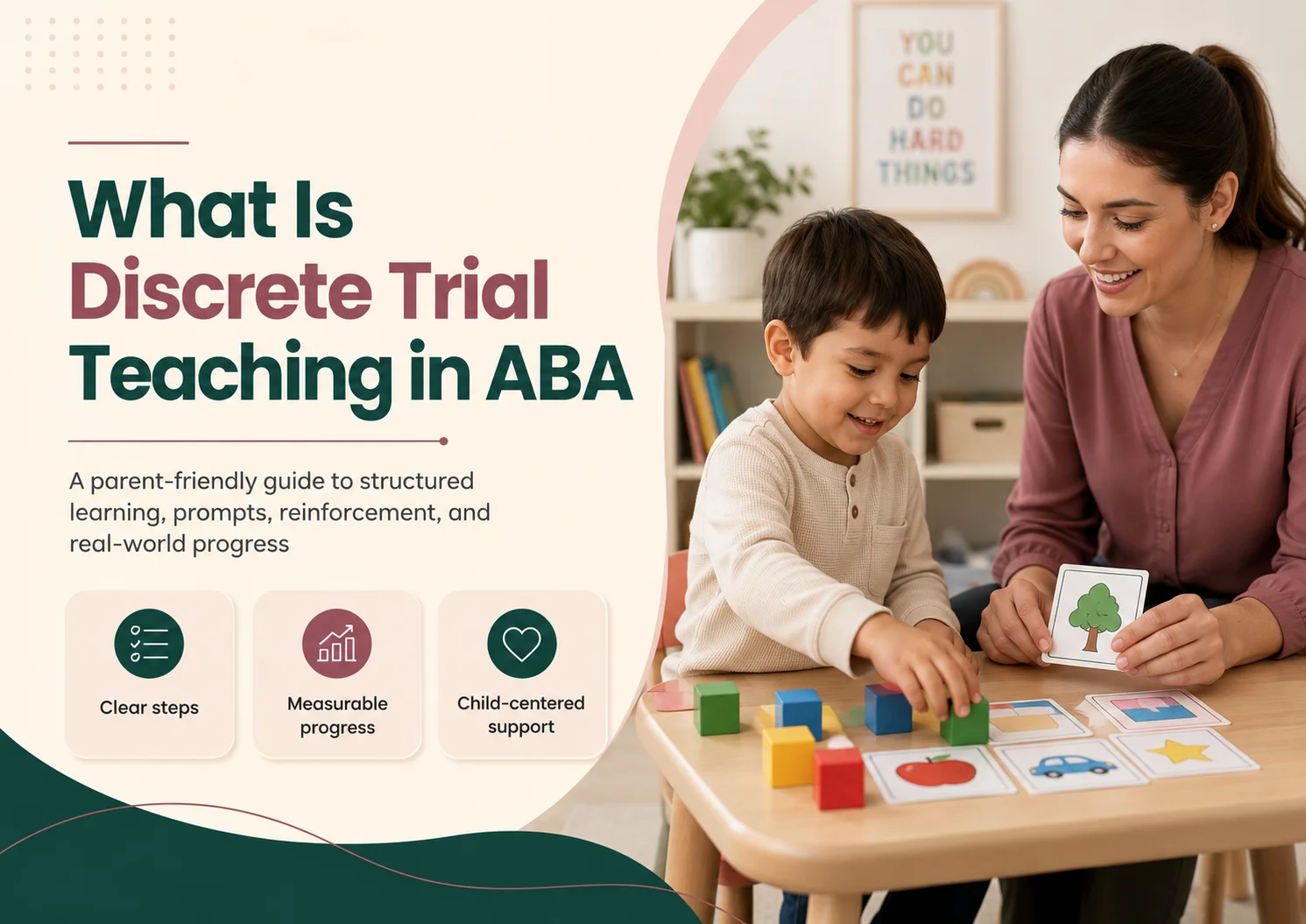
Discrete trial training, also called discrete trial teaching, is a structured method based on applied behavior analysis. A provider breaks a skill down into small trials, an instruction, a response and a consequence, and a pause. Correct answers are reinforced and errors are calmly corrected.
Why the Method Is Called Discrete
“Discrete” means separate and clearly defined. A trial has a distinct start and finish point and one response can be taught and measured. Several trials may occur, with suitable pacing and breaks.
How DTT Fits Within Applied Behavior Analysis
ABA is a larger science of learning and behaviour. DTT is not a different term for the entire field of ABA, but rather one procedure. This relationship is referred to as discrete trial training applied behavior analysis, and programs may also employ naturalistic teaching and coach the caregiver. Selection should depend on the learner and goal.
How Discrete Trial Training Works
A trial is sometimes referred to as antecedent-behavior-consequence. A fuller model also names prompting and the pause between trials.

The Instruction or Antecedent
The provider displays a short instruction, question, object or picture. Behavior analysts might refer to this as a cue that is a discriminative stimulus that indicates that a response has the opportunity to earn reinforcement. For example, placing down two blocks and saying “touch red”.
A Prompt When Support Is Needed
A prompt to assist the learner in answering successfully. It can be verbal, visual, gestural, model based, positional or physical. Later the provider reduces support and the learner responds to the natural instruction.
The Learner Response
The answer can be right, right with prompting, wrong, or missing. A prompted answer is not independent mastery. Clear categories help everyone measure progress consistently.
The Consequence and Positive Reinforcement
Immediate reinforcement is provided for a correct response, in the form of praise, attention, tokens, or a preferred activity. While it is important to recognize and correct errors, these should be handled in a neutral manner rather than being shamed or punished. Reinforcement needs to be personalized and target response referenced.
The Inter-Trial Interval and Data Collection
A brief pause marks the trial’s end. The provider can then mark if this response was an independent reply, prompted, incorrect or not given. Data can be used to assess accuracy, prompt use, learning rate, and barriers by a BCBA. According to AFIRM, DTT consists of repeated trials, which include an instruction, a response, a planned consequence, and a pause.
Five practical parts of DTT
- Present the instruction
- Prompt when needed
- Observe the response
- Reinforce or correct
- Pause and record data
A Complete Discrete Trial Training Example
A Color Identification Trial
Suppose the goal is identifying red. The therapist drops a red and a blue block and asks, ‘touch red’ and waits. An optional pointing prompt can be included. The therapist then provides the reinforcement and records if this answer was independent or prompted after the child touches red. The blocks can be moved around prior to the next trial to discourage position guessing.
| Trial element | What happens |
| Instruction | “Touch red” |
| Prompt | Point if needed |
| Response | Child touches a block |
| Consequence | Reinforcement or correction |
| Data | Independent, prompted, incorrect, or absent |
A Daily Living Skill Example
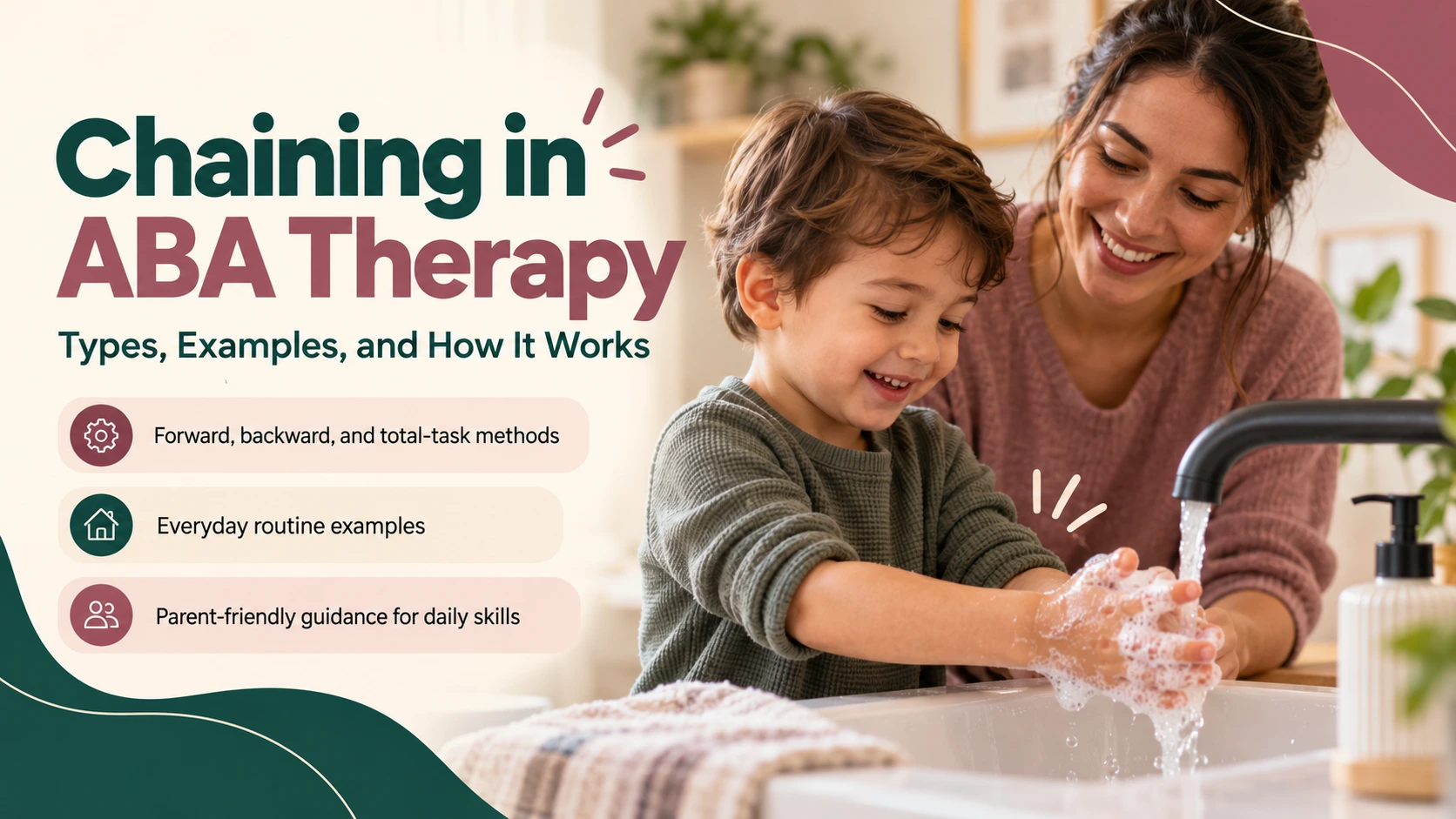
Handwashing is a series. Task analysis can break it down into using water, soap, scrubbing, rinsing and drying. DTT can thicken one challenging step, and steps can be chained together. Practice at a real sink supports transfer.
Skills DTT Can Help Teach
AFIRM evidence of DTT is provided for communication, adaptive skills, play, social skills, school readiness, academics, cognition, joint attention, and vocational learning from birth to age 22.
Communication and Language Skills
Targets can include instructions, labels, asking for assistance, answering questions, speech and/or alternative communication systems. Goals should be to assist with the needs, choices, interests and boundaries.
Learning and School Readiness Skills
Matching, sorting, imitation, letters, numbers, classroom directions can be practiced. Materials and settings should later vary to prevent memorizing one presentation.
Daily Living and Independence Skills
Dressing and grooming, toothbrushing, meal times, and safety skills may be supported by DTT. The emphasis is to be on being independent in practice.
Social and Play Skills
Turn taking, imitation, play actions and responding to invitations may be introduced in trials. Flexibility and initiation with natural play is still vital.
How DTT Is Planned and Personalized
Choosing a Meaningful Target Skill
Assessment and baseline data, family priorities and leaner preferences are used in planning. The team defines success and why the skill matters. Effective goals work in the support of communication, safety, participation, learning and independence. Harmless autistic traits should not be targeted merely to make someone appear less different.
Using Prompts and Fading Support
A prompt hierarchy is a sequence of levels of assistance. Clinicians can initiate support based on skill and learner’s level. Prompt fading decreases the level of assistance as closer and closer responses are made. Prompt dependence can be caused by an inconsistent plan.
Reinforcement and Error Correction
Preference checks identify what is motivating now. Reinforcement should occur immediately after target behaviour. Error correction may re-present the instruction, model the answer, prompt success, and offer another opportunity. Calm correction protects learning and trust.
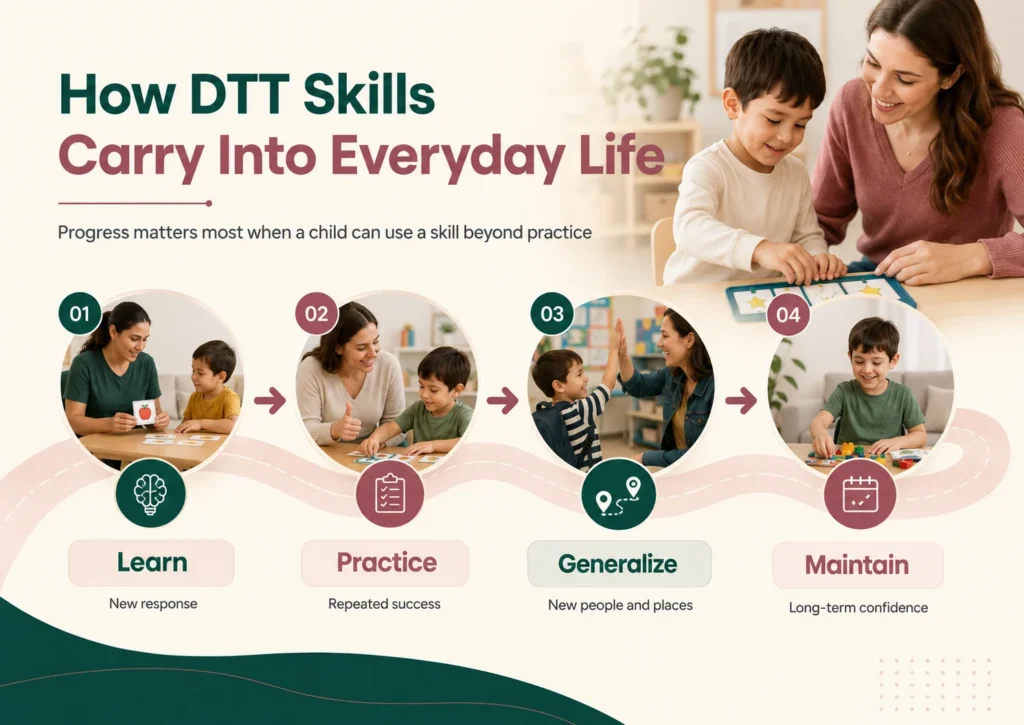
Measuring Mastery Maintenance and Generalization
Mastery is defined by achievement of the learning criteria. Maintenance refers to retaining the skill after teaching levels off. Generalization involves using it with new people, materials, wording and settings. Early planning of all three helps with good functioning at the level of daily living. Always be flexible, open and responsive to the child’s progress, preferences, communication, comfort, environment and needs.
Benefits of Discrete Trial Teaching
Clarity and measurability are the benefits of discrete trial training. DTT can:
- Break learning into manageable parts
- Plan for predictable response opportunities.
- Provide immediate feedback
- Separate independent and prompted progress
- Display when teaching requires adjustment
- Build foundations for functional skills
- Prepare skills for natural settings
Results are not guaranteed with research support. Advancement is contingent on the objective, the teacher, the students, and the practice.
Limitations and Ethical Considerations
Preventing Rote Learning and Prompt Dependence
A learner may memorize an answer without understanding the concept. Examples may be rotated, instructions may be changed, some targets may be new and some may be old, and skills may even be tested in new environments. Data should be divided between independent and prompted data. Prompt fading and natural practice is key.
Supporting Choice Comfort and Engagement
Modern DTT should take into consideration communication, assent, sensory needs, and stress signals. Sessions can contain movement, breaks, activities of choice and choices. The team gets important information if they are withdrawn, protested or distressed repeatedly. Ethical teaching protects dignity and avoids targeting harmless differences. The BACB’s ethics framework focuses on compassion, dignity, respect, competence, and protecting the interests of their clients.
Knowing When Another Teaching Method Fits Better
Structured trials do not fit every objective. Naturalistic teaching is frequently required in spontaneous requests, flexible play, conversation and daily routines. A good program pivots around when data or learner feedback indicates that there is a poor fit.
Discrete Trial Training and Natural Environment Teaching
Key Differences Between DTT and NET
| Comparison area | Discrete Trial Training (DTT) | Natural Environment Teaching (NET) |
| Structure | Uses planned, clearly defined teaching trials | Embeds learning within natural activities |
| Learning opportunities | Arranged by the therapist or instructor | Created through the learner’s interests and daily routines |
| Setting | Often taught in a structured or controlled environment | Practiced in everyday environments |
| Reinforcement | Selected and delivered as part of the teaching plan | Naturally connected to the activity or response |
| Primary purpose | Builds and practices specific skills step by step | Encourages spontaneous and practical skill use |
Neither method is automatically better. Alma explains that both may be used within ABA according to the learner and goal.
How Both Methods Can Work Together
A child may first label “ball” during structured trials. Later the therapist provides opportunities to make requests and comments in play. Parents can practise at outdoor play or clean up. The response is functional moving from practice to meaningful use.
What Parents May See During DTT
Who Designs and Delivers the Teaching Plan
A BCBA can train staff, design procedures, review data and select goals. An RBT can deliver direct services in a supervised manner. According to the BACB, BCBAs are independent practitioners who work at the graduate level while RBTs are paraprofessionals who are supervised. End-of-2025 data reported 81,566 BCBAs and 246,109 RBTs.
Projected growth in the category of broader behavioral disorder and mental health counselors is 17% over the next 10 years, up from 2024 to 2034. This is not a forecast for ABA, but indicates ongoing requirements for trained individuals and supervision.
Questions Parents Can Ask the ABA Provider
- How was this target chosen?
- What is considered independent progress?
- How will prompts be faded?
- What will be the skill transfer outside of trials?
- What do I do when my child is disengaged?
- How will parents receive coaching?
Answers should relate decisions to assessment, data, family priorities and quality of life.
Learn About Individualized ABA Support With Alma Behavioral Solutions
No single teaching method fits every child. Alma Behavioral Solutions develops individualized, family-centered ABA plans with goals in communication, independence, daily routines, and meaningful participation in real-life. Families in Glendale or Burbank can call (747) 250-8494 or email info@almabehavioralsolutions.com to discuss their child’s needs. A consultation can help determine whether discrete trial teaching is an appropriate part of a personalized ABA program.
Frequently Asked Questions
Can Parents Use DTT at Home
Parents can use selected DTT strategies after coaching from their child’s team. Short practice, clear instructions, natural reinforcement, and consistent responses may help. Home activities must not be a rigid drill or a substitute for assessment. Ask the supervising BCBA which targets and prompts are appropriate.
Is DTT Used Only for Autistic Children
DTT is linked to autism services, but is not a requirement for diagnosis. Professionals may use its learning principles with other populations when appropriate. Assessment, meaningful goals and evidence of the suitability of structured trials should guide decisions.
Is DTT the Same as Task Analysis or Chaining
No. Task analysis divides a complex skill into steps, while chaining teaches those steps in order. Instruction, response, and consequence all occur in one learning opportunity for DTT. Clinicians may combine these procedures for skills such as handwashing.
How Long Does a DTT Trial or Session Last
There is no established trial time or number of trials in general. Duration varies according to goals, attention, involvement, environment and individual plan. Goodness is more important than a pre-determined level of output. The team should change their pace when they feel fatigued.
How Do I Know if DTT Is Right for My Child
Do the target is well defined, have some kind of practice, and the provider has a plan for independence and generalization. A responsible team offers alternatives, checks comfort and data to assess fit. DTT may be one part of care.