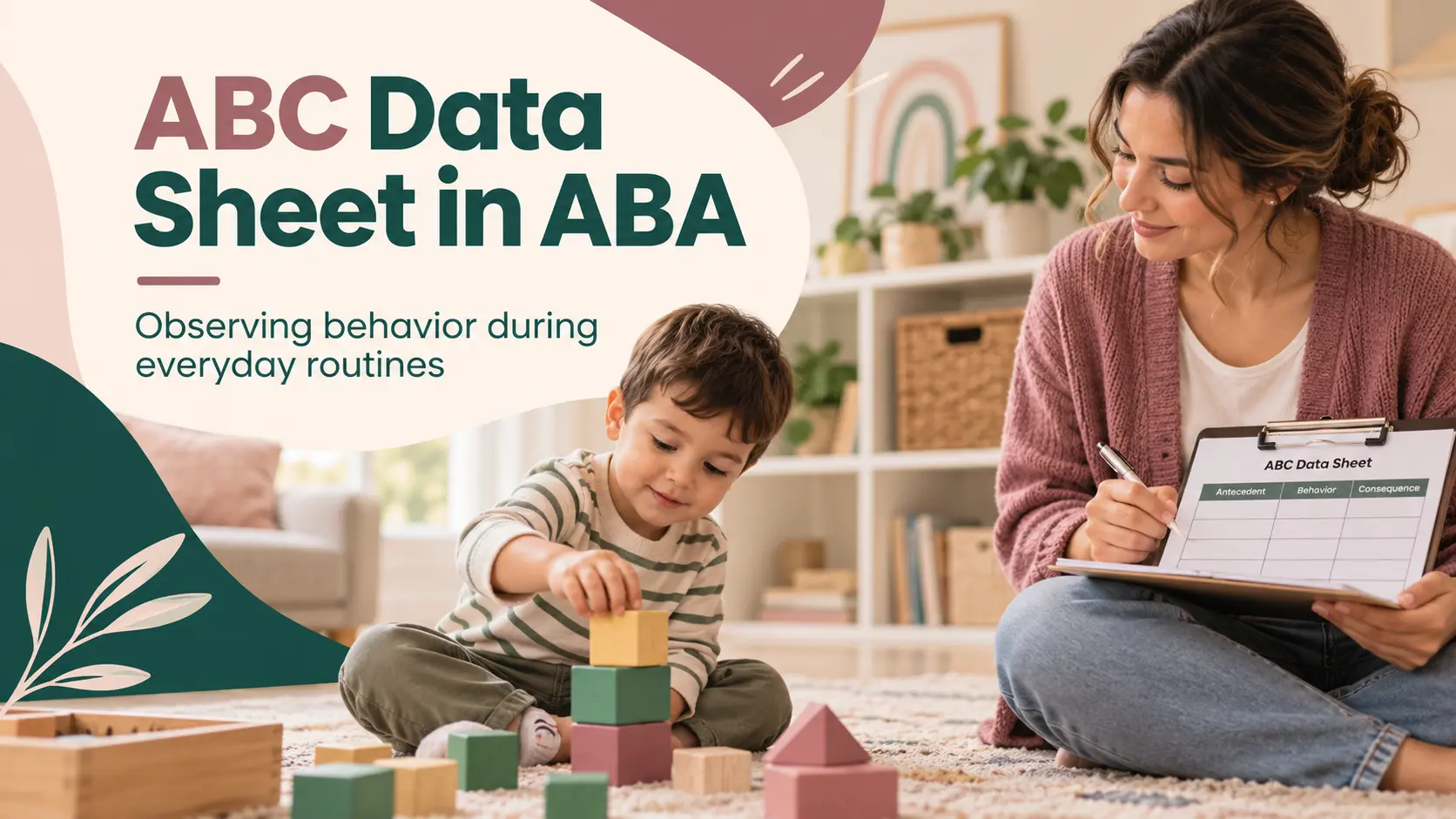

Has your child ever cried when playtime ended, or fussed with an activity that was once easily done but is now more difficult? It can be difficult to understand why there has been a change and how to help them without making assumptions.
Using an ABC data sheet in ABA lets you record what occurred before, during, and after a behavior. These observations will provide a clearer picture of what is happening around your child, not a judgment about your child.
This guide provides an explanation of the recording process, realistic examples, and a description of how a BCBA could use this information in conjunction with other assessment tools.
Key Takeaways
• ABC stands for antecedent, behavior, and consequence: the events before, during, and immediately after a behavior.
• Record what you can see or hear, rather than guessing what your child feels or intends.
• Patterns of behavior may be seen over and over again, but they can’t prove that a behavior is occurring for a reason.
• Caregivers can assist in gathering data with guidance that considers the child’s communication, comfort and safety.
What Is an ABC Data Sheet in ABA?
An ABC antecedent behavior consequence data sheet is an observation form used in applied behavior analysis (ABA) to record what happens before a behavior (antecedent), the observable behavior itself, and what happens immediately afterward (consequence). Repeated entries allow the caregiver and clinician to see patterns and to continue to assess.
It is used by parents, teachers, behavior technicians, and board-certified behavior analysts (BCBAs) in the home, school, and therapy environments to better understand an agreed-upon target behavior without faulting the child.
ABC data collection in ABA is a descriptive method. It can be used to test a hypothesis about the function of behavior, but a recording sheet doesn’t prove what is maintaining a behavior.
What Does ABC Stand For in ABA Therapy?
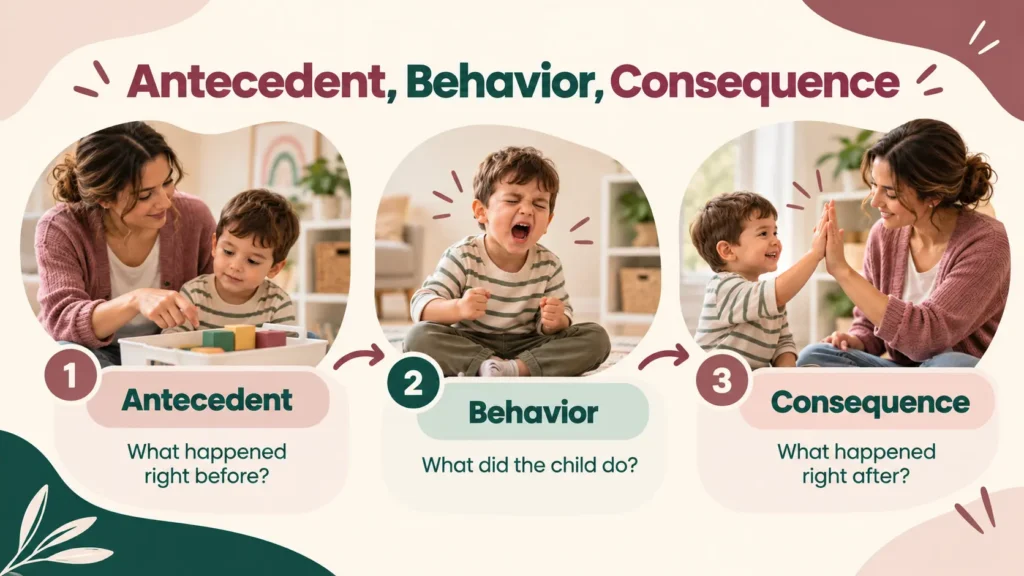
An antecedent behavior consequence chart records the events that led to an action, the action the child took, and what that action resulted in.
| ABC component | What to record | Everyday example |
| A — Antecedent | An event or change directly before the behavior | A parent says, “It’s time to put the blocks away.” |
| B — Behavior | The child’s observable words or actions | The child drops two blocks and says, “No.” |
| C — Consequence | What people or the environment do immediately afterward | The parent pauses and offers to put the blocks away together. |
Consequences are not punishments, but rather a result that followed, like a verbal response, a change of activity, or no noticeable response.
One row records an event, not the child’s feelings, intentions or definite reasons for action. These questions require more information.
What Information Should an ABC Data Sheet Include?
A practical ABC recording form includes:
• Date and time: When the observation occurred.
• Setting and activity: Where the child was and what was happening.
• Observer: The person recording, identified according to privacy procedures.
• Target behavior: Observable and measurable action, called an operational definition.
• Antecedent, behavior, and consequence: Three separate spaces for the event sequence.
• Optional measures: Duration, frequency, or other details requested by the BCBA.
• Contextual notes: Relevant setting events or information not captured in the main columns.
Events can influence behavior if they don’t happen right before the behavior. They are such as routine changes, reported poor sleep or noise, and none of these alone accounts for an episode.
A two-page ABC data sheet template can pair an original completed example with a blank printable form, without identifying details.
What Are the Types of ABC Data Recording?
There are two versions of the same events.
Narrative ABC Recording
Narrative recording involves students describing in writing: “The teacher gave the students a one-minute warning because the student was continuing to read.”
It records unexpected information, but takes longer and may be subjective if it is written from memory.
Checklist or Coded ABC Recording
Checklist recording offers predefined options, such as activity changed or adult provided help. Easier to fill out and to compare.
Use notes for fixed choices in case they miss the important communication or context. Frequency and duration are separate measures, not ABC recording formats.
How to Fill Out an ABC Data Sheet Step by Step
Learning how to collect ABC data begins with agreeing on a meaningful target and schedule with your child’s BCBA.
1. Identify and define the target behavior: Agree on an action relevant to your child’s well-being or participation. Find an operational definition for the event that another person could identify: “pushes a worksheet off his or her desk.” Harmless stimming does not automatically need intervention.
2. Prepare the form: Input the date, time, activity, setting and observer. Ensure that the agreed form is kept available and discuss the definition of the target.
3. Record the antecedent: Record the triggering event: a request, noise, transition or interaction. Mark events that you do not know as “not observed.” Write general context events on their own.
4. Objectively describe behaviour: Record what you heard or observed, including counts or time if applicable. Don’t “read” minds or infer intent or emotions.
| Avoid a subjective description | Record an observable description |
| “She was angry and trying to get out of work.” | “She pushed the worksheet to the floor and said, ‘No work.’” |
5. Document the consequence: Record the first reaction: a speech, assistance, transport or movement of materials, or change in activity. Assume nothing about its response to the behavior.
6. Record promptly and consistently: Follow the agreed observation schedule; mark missing details as unknown. When distress or injury may occur, it is more important to provide support and the plan for safety than it is to complete paperwork.
7. Review with a BCBA: Share records privately and discuss patterns, missing context, and additional assessment. Do not change an intervention plan based on a few entries.
Watch during agreed times, rather than all the time; remain sensitive to the needs of your child.
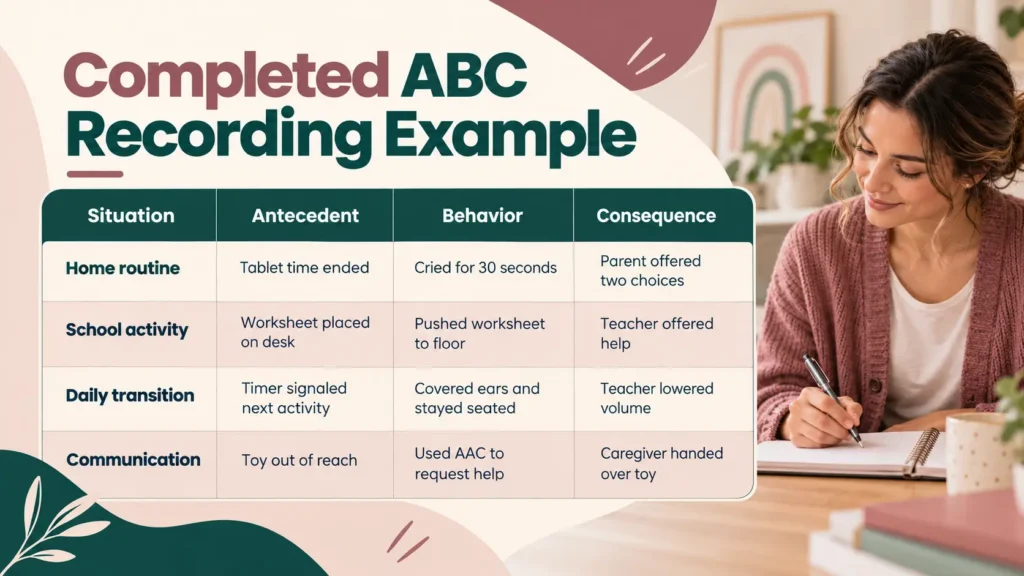
ABC Data Collection Examples in Everyday Situations
These fictional ABC data collection examples illustrate factual observations across settings.
| Situation | Antecedent (before) | Behavior (observed) | Consequence (after) |
| Home routine | Parent says tablet time is finished and holds out a storage basket. | Child places tablet on sofa and cries for approximately 30 seconds. | Parent sits nearby, acknowledges the change, and offers two next-activity choices. |
| School activity | Teacher places a five-question worksheet on the student’s desk. | Student slides the sheet onto the floor and looks toward the doorway. | Teacher picks up the sheet and offers help with question one. |
| Daily transition | Classroom timer sounds and teacher announces outdoor time. | Student remains seated, covers ears, and says, “Too loud.” | Teacher lowers the timer volume and offers a quiet route to the door. |
| Functional communication | A preferred toy is on a shelf beyond the child’s reach. | Child selects “help” on their AAC device and points to the toy. | Caregiver asks which toy and brings it within reach. |
An ABC behavior chart can capture communication as well as disruptions. Children may express needs through speech, gestures, signs, or augmentative and alternative communication (AAC).
Placing a cover on the ears after hearing a timer indicates a detail that should be investigated, not a sign of sensory functioning. Repeated records and child, family and professional input provide context.
How Do BCBAs Review ABC Data to Identify Behavior Patterns?
A BCBA reviews observations for repeated events, setting differences, and areas in need of further observation.
Looking for Repeated Antecedents, Consequences, and Setting Events
There may be discrepancies in records between unannounced and predictable transitions or when communication aids are provided.
The team asks what recurs, what follows, which setting events matter, and when the behavior is absent. The child, family, and educators add perspectives missing from a form.
Patterns can indicate functions of accessing, avoiding, social interaction or sensory consequences, but not confirm them. No universal observation count establishes function.
ABC Data vs. Functional Behavior Assessment and Other Measurement Methods
A functional behavior assessment (FBA) combines information such as interviews, records, observations, and other procedures to understand behavior. ABC observations can be used to provide information to support a comprehensive FBA if necessary. Functional analysis is a unique method of systematically testing conditions.
| Method | Main question answered |
| ABC recording | What happened immediately before, during, and after an episode? |
| Frequency | How many times did it occur? |
| Duration | How long did it last? |
| Latency | How much time passed between a specified event and the response? |
| Interval recording | Did the behavior occur during specified observation intervals? |
These measures can be complementary. Texas SPED Support and Vanderbilt IRIS describe how assessment findings can inform individualized supports and a Behavior Intervention Plan (BIP).
What Are the Benefits of ABC Data Sheets in ABA Therapy?
Clear observations can make conversations about your child’s needs more specific.
• Better context: Records show what was happening around an action, not just the action itself.
• Shared understanding: Consistent descriptions can be used to facilitate communication between caregivers, teachers, and clinicians.
• Individualized assessment: A BCBA can consider the data alongside communication needs, preferences, and other evidence.
• Caregiver collaboration: Parents bring in their observations of routines that may not be seen by professionals.
• Informed planning: Patterns can indicate areas of possible accommodation, communication supports or further testing.
Best Practices and Common Mistakes When Recording ABC Data
Records should be kept to aid understanding, and that the child’s dignity and privacy are respected.
Best Practices for Accurate, Respectful ABC Recording
Agree on observation periods and definitions with your BCBA. Record your child’s speech, gestures, and AAC; listen for discomfort, help requests, and preferences, without taking on a role.
Respect for dignity, communication preferences, comfort and consent and refusal. Do not withhold basic needs or ignore distress. Keep records private and follow safety procedures. The BACB Ethics Code for Behavior Analysts is focused on rights, welfare and confidentiality.
Common ABC Data Recording Mistakes to Avoid
| Avoid writing | Record instead |
| “He was manipulative.” | “He said ‘no’ and moved the book away.” |
| “She was upset because she wanted attention.” | “She called the teacher’s name three times; the teacher walked over.” |
| “Nothing happened before.” | “Immediate antecedent not observed.” |
| “He always does this at school.” | “Observed twice during the recorded math period.” |
Get Personalized ABA Guidance With ALMA Behavioral Solutions
Understanding your child’s behavior takes patience, careful observation, and support that respects their individual needs. Using an ABC data sheet in ABA can help you observe what is happening around a behavior, and with professional guidance, you can better understand what is happening. ALMA Behavioral Solutions works with families to understand communication, routines, preferences, and meaningful goals.
Our Parent Support services help caregivers feel more confident using ABC data collection in ABA and discussing patterns with their child’s BCBA. We don’t offer a generic approach to everything, we do practical, respectful approaches to your family. Contact ALMA Behavioral Solutions to explore how we can support your steps.
Frequently Asked Questions About ABC Data Sheets
How Often Should Parents Collect ABC Data?
Follow the observation schedule recommended by your child’s BCBA. The frequency will vary based on the target behavior, the safety concerns, and the purpose of the assessment. Observations over multiple episodes may be informative, but there is no absolute minimum that will establish the functionality of a behavior.
What If I Don’t Know What Happened Before My Child’s Behavior?
Do not guess, write “not observed” or “unknown”. Record the setting, behavior, and immediate response you witnessed. An incomplete, but accurate entry is better than an invented detail. Ask your BCBA how to handle recurring gaps in observation.
What If ABC Data Shows Different Patterns at Home and School?
These differences may be related to routines, sensory environments, demands, communication opportunities or supports. Report observations in both settings, not saying one observer is necessarily incorrect. ALMA’s School Consultation services help families and educators coordinate individualized support.
Can Parents Complete an ABC Data Sheet Without Being an ABA Therapist?
Yes. Parents are guided on the target behaviour and the agreed procedure, then they can document what they observe. Request information on how to document missing information, privacy concerns, and how to address safety issues from the supervising BCBA. Clinical interpretation should remain professionally guided.
When Should Parents Share ABC Observations With a BCBA?
Share records according to your team’s agreed schedule. Report urgent safety concerns promptly, following the child’s safety plan. Bring up unclear entries, new patterns, or changes in routines during reviews. Use approved private methods for sharing any identifying information.
Can an ABC Data Sheet Confirm Why a Behavior Happens or Replace an FBA?
No. ABC observations can provide hints of relationships between events and behavior but cannot prove what is maintaining the behavior. A BCBA considers other information and may recommend a comprehensive FBA before developing or revising individualized supports and interventions.