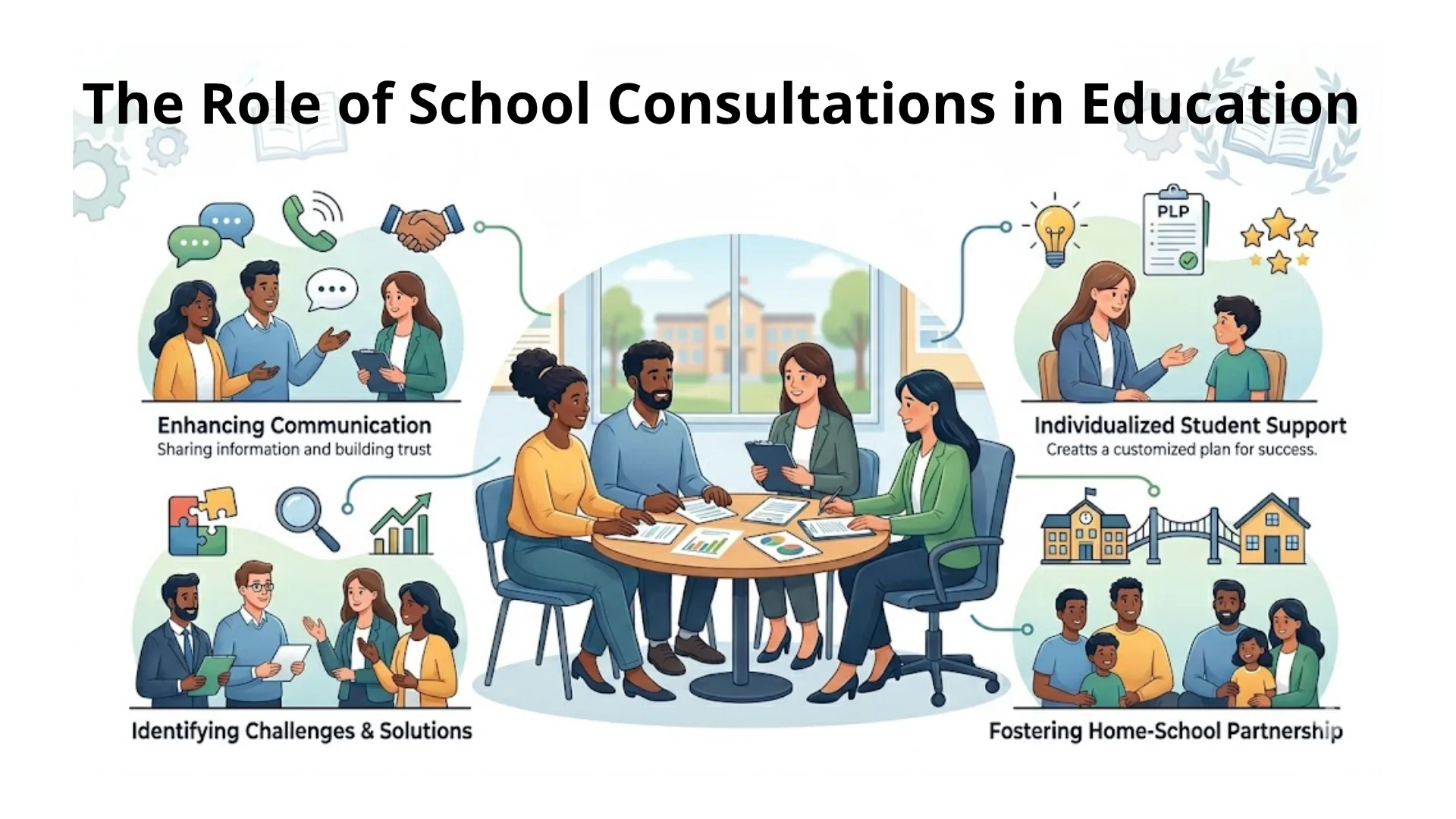

Introduction: Why School Consultations Matter in Modern Education
Schools are being asked to do more than ever in 2026. They are supposed to promote academic development, behavior, mental health, inclusion, family communication and use of technology simultaneously. At the same time, families often need help navigating a growing number of school options.
School Consultations are the difference there. School consultation in education assists schools, teachers, families and experts to collaborate in addressing issues in a practical and understandable manner. Consultation adds order, experience, and a strategy, as opposed to making inferences about what might be helpful.
For students, that can mean better support in the classroom. To teachers, it may involve more powerful strategies, coaching, and assistance in problem-solving. To families, it may result in more understanding and direction with less overwhelming feelings.
This is the reason why school consultation services are important. They assist schools in addressing real challenges through effective, evidence-based support that enhances learning, behavior, and overall school outcomes.
What Are School Consultations?
School Consultations refer to collaborative processes to solve academic, behavioral, emotional, developmental, and system-level challenges in education. A school consultant can collaborate with teachers, school leaders, support staff, specialists, and families to learn more about a problem and construct a plan to work. The goal is not just to give advice. The goal is to improve outcomes for students and enhance the support schools provide them every day.
The Purpose of School Consultation in Education
- Improves instruction so schools can better support student learning.
- Supports diverse learners with strategies matched to student needs.
- Creates welcoming classrooms that enhance access, activity and inclusion.
- Meet behavioral needs with practical, collaborative school problem-solving.
- Improves family communication for more consistent student support plans.
The Core Role of School Consultations in Schools
Supporting Student Learning, Behavior, and Well-Being
Students do best when their academic, emotional, and behavioral needs are seen together. School support services help schools to develop plans that promote learning, as well as regulate behavior, confidence, and relationships. This is particularly vital among students who require closer attention or have difficulties with school routines and expectations.
Helping Educators Address Complex Classroom Challenges
Teachers often face situations that do not have simple answers. A student might be lagging, exhibiting difficult behavior, or be unable to socialize. School consultation services give educators a structured way to assess the issue, test better strategies, and adjust support over time. Such educator consultation has the potential to ease stress and make teachers more confident in their actions.
Strengthening School-Wide Systems and Practices
School Consultations are not only about individual students. They are also useful in enhancing the bigger system. A consultant can help a school to perfect routines, enhance processes of intervention, reinforce inclusion practices, or align services with school objectives. With time, that builds a better and well-structured support system for all.
Key Areas School Consultations Support
Curriculum Development and Instructional Planning
One major part of school consultation in education is helping schools improve teaching and learning. Consultants can also help in curriculum planning, classroom teaching, and lesson development to ensure that students get clearer and meaningful learning experiences. Strong curriculum support also helps schools promote critical thinking, problem-solving, and deeper engagement rather than only focusing on memorization.
Personalized Learning and Support for Diverse Learners
Not all students learn the same way, and that is exactly why personalized support matters. School Consultations tend to help teachers in applying differentiated instruction, flexible approaches and student planning. This facilitates addressing various learning styles, development, and support needs. This is one of the most useful sections of the process to schools specializing in inclusive education support.
Technology Integration in Teaching and Learning
Technology can be helpful, but only when it is used with purpose. Schools can be advised on the use of tools to enhance engagement, collaboration, and access to learning by educational consultation services. It does not imply more technology in the attempt to stay abreast of the trends. It is about using the right tools in the right way so students and educators benefit.
Social-Emotional Learning and Student Mental Wellness
Emotional well-being is closely connected with academic success. School consultations frequently enhance social-emotional learning, contributing to building self-awareness, self-management, social awareness, relationship skills and responsible decision-making into the school day. These abilities enable students to cope with frustration, find a way to relate with others and feel secure in school. This constitutes a significant portion of school behavior and academic support in many schools.
Equity, Inclusion, and Culturally Responsive Practice
Strong school consultation services also look at whether all students have fair access to support and opportunity. It involves exploring obstacles, enhancing inclusivity, and promoting culturally responsive instruction. When schools accomplish this, students will feel more visible, honored and capable of engaging in the learning process.
Family and Community Engagement
Families are a key part of student success. School-based consultation can help improve communication between home and school, support shared goal-setting, and connect families with useful resources. This shows the impact of practical support in helping families to make informed choices on education.
School Consultations in Special Education
School Consultations in special education are designed to assist teachers, parents and experts in supporting students with disabilities and complex learning needs.
Collaborative Problem-Solving and Targeted Support:
Using school consultation services, the teams determine barriers, survey student needs and develop practical interventions based on academic, behavioral, and developmental objectives.
Inclusive Practices and Classroom Access:
Special education consultation is also useful in the inclusive classrooms in terms of how to guide accommodations, differentiation instructions, and participation strategies that enhance learning accessibility.
Legal and Ethical Guidance:
Effective School Consultations help schools stay aligned with IDEA, Section 504, and student rights while making informed, ethical decisions.
Why This Support Matters:
Properly executed, school consultation in education enhances collaboration, enhances intervention planning, and assists various learners as well as enabling schools to provide more equitable and responsive learning environments to all students.
Types of School Consultations and Service Models
School Consultations address a variety of service models, which are designed to address various academic, behavioral, developmental, and family needs in education.
Instructional and Academic School Consultations:
Teaching techniques, curriculum support, instructional planning, academic interventions, are the areas of interest of Instructional and academic School Consultations. Through these services, educators can enhance lesson delivery, engagement, and better respond to learning gaps and classroom performance concerns.
Behavioral and Mental Health School Consultations:
Behavioral and mental health School Consultations support behavior management, emotional regulation, mental health-informed school support, and a healthier school climate. Such services help staff to manage the problematic behaviors and assist in forming safer and more supportive settings to students and educators.
Special Education Consultation Services:
Special education School Consultations helps students with disabilities by providing accommodations, custom strategies, and coordination of families, educators, and specialists. The services enhance access to learning, enhance inclusion, and assist schools in delivering more consistent and responsive learning support.
Early Childhood Consultation Services:
Early childhood School Consultations may include Infant Toddler Specialists, Mental Health Consultants, and Quality Specialists. These services support environmental design, routines, transitions, behavior management, and quality improvement. In other models of partnership, early childhood consultation services can be provided free of charge.
School Search and Parent Guidance Consultations:
School search and parent guidance School Consultations help families to comprehend school models, schedules, localities, transportation, strengths of children, support requirements, shortlisting alternatives, and enrollment resources. This support helps families make clearer, more informed school decisions with less confusion and stress.
ASD and Emotional Behavioral School Consultation:
ASD and emotional behavioral School Consultations provide collaborative assessment, evidence-based strategies, staff training, individualized support plans, and progress monitoring. These services contribute to better student achievement, a more positive school climate, and enhanced teacher performance in the context of supporting students with complex behavioral or developmental needs.
How the School Consultation Process Works
Effective school consultation processes have a well-defined direction to ensure that the support is practical, organized, and result-oriented. Rather than offering one-time advice, School Consultations move through structured steps that help schools understand concerns, build solutions, and improve outcomes over time.
Initial Assessment and Discovery
The process begins with assessment. This could involve classroom observations, interviewing of staff, analysis of existing practices and discussion of student and school needs. The purpose is to build a clear picture of what is happening before making recommendations.
Collaborative Goal Setting
Next, the team identifies clear priorities and realistic goals. These goals should align with the needs of the student, educators, and the school setting so everyone is working toward the same outcome.
Strategy Development and Planning
Once goals are set, school consultation services focus on evidence-based recommendations and customized intervention planning. The most appropriate strategies are aligned to the school environment, the resources at hand and areas of need.
Training, Coaching, and Implementation Support
Support then moves into action through professional development, coaching, mentoring, and technical assistance. This assists the staff in using strategies more confidently and consistently.
Ongoing Monitoring and Continuous Improvement
Follow-up, review of the outcomes, refinement of strategies, and adjustments also make good School Consultations, which can promote long-term improvement.
How School Consultations Support Educators and School Teams
Professional Development and Practical Skill Building
School Consultations help educators build stronger day-to-day skills through focused, practical support. Teachers are not only provided with broad theory, but they are also provided with strategies that they can apply in real classroom situations.
Key areas of support include:
• specific advice to teachers.
• evidence-based strategies
• practical classroom implementation
Reflective Practice and Growth Mindset
School consultation services provide room as well to enable educators to contemplate their practice and to make improvement deliberately. This assists schools in developing the culture that growth, flexibility and learning are an everyday aspect of work.
This often includes:
• self-assessment
• professional reflection
• a continuous improvement culture
Peer Learning, Collaboration, and Access to Expertise
Strong School Consultations encourage school teams to learn together instead of solving problems alone. This commonality of approach provides the educators with more access to support, resources, and professional wisdom in times of need.
This may involve:
• peer learning networks
• shared problem-solving
• availability of experts, equipment and materials.
Benefits of School Consultations for Educators and School Teams
- Prepares teachers more efficiently by providing them with evidence-based practice-based strategies that they can implement in classrooms instantly to enhance teaching, behavior management, and day-to-day confidence.
- Promotes reflective practice in such a way that school teams are able to assess what is working, modify approaches that are not effective and develop a more deliberate, improvement oriented professional culture across schools.
- Makes collaboration stronger by solving problems jointly, enables educators to learn with each other, coordinate their actions, and collaborate more efficiently to meet student needs daily.
- Increases access to experts, tools, and resources that enhance improved decision-making, isolations minimization, and provide employees with more direction when obstacles occur in school environments.
- Enhances long-term school sustainability by assisting teachers in implementing the same strategies, developing confidence in the long run, and becoming more responsive to the needs of complex students on a day-to-day basis.
Partner With Alma Behavioral Solutions for School Consultation Support
If your school, educational program, or student support team is looking for practical and collaborative School Consultations, Alma Behavioral Solutions is ready to help. We collaborate with schools and families to promote student achievement, educator confidence, and enhance systems that influence learning, behavior and inclusion.
Our services are planned to appeal to actual needs in schools, which are carefully planned and supported by evidence. Be it behavioral consultation in schools, special education consultation, staff support or more comprehensive school support services, our group has that clear and responsive practice to every step of the process.
When schools have the right guidance, they are better prepared to support both students and staff in lasting ways. To learn more about our school consultation services or schedule a consultation, call (747) 250-8494 or email info@almabehavioralsolutions.com
Conclusion
School Consultations play an important role in helping schools respond to real challenges with more clarity and consistency. They facilitate more robust teaching and planning of behavior, enhanced inclusion, and healthier communication among teachers, families, and experts. Schools can develop systems that will assist students better instead of responding to problems individually.
This can mean better access and stronger support to students, as well as meaningful progress. To teachers, it provides a more direct way to make choices and plan interventions and practice in classrooms every day. To the families, it establishes trust, communication, and a closer feeling of partnership with the school.
In 2026, schools are expected to support a wide range of academic, behavioral, emotional, and developmental needs. This is why school consultation services are very important. They assist schools to build more responsive spaces in which students can develop, teachers can feel enhanced, and communities in schools can progress with a stronger sense of assurance.
FAQs about School Consultations
1. What is the main purpose of school consultations?
School consultations are primarily aimed at assisting schools in addressing academic, behavioral, emotional and systems-related problems in an organized manner. They unite teachers, parents and experts to develop enhanced support strategies. The aim is to always achieve more in students and in school practices.
2. Who benefits from school consultation services?
It can benefit students, teachers, school leaders, specialists, as well as families. Learners receive increased specificity in support and teachers receive coaching and practical strategies. The families also gain as there is a more effective communication and interaction with the school team.
3. Are school consultations only for special education?
No. Special education consultation plays a vital role but school consultations also aid in general education, early childhood settings, behavior support, instructional planning, family guidance, and school-wide improvement. They may be applied in any place where a school requires an organized problem-solving and professional assistance.
4. How do school consultations support inclusive education?
School consultations contribute to inclusion by facilitating the schools to minimize the obstacles to learning and participation. They can preside over accommodations, differentiated instruction, culturally responsive teaching and classroom support strategies. This assists more students to gain access to learning in significant aspects.
5. What happens during a school consultation process?
An average process involves evaluation, target setting, plan formulation, support of implementation and follow-up. The consultant collaborates with the school team to get familiar with the problem and develop effective follow-up measures. The progress is then analyzed in order to be able to make future improvements to the plan.
6. Can school consultations help with behavior and mental health concerns?
Yes. One of the most significant areas of services is the behavioral consultation in schools. Consultants can assist in the behavior planning, emotional regulation plans, classroom plans, and staff training. This will help to increase student well-being and enhance the school climate in general.