
Introduction
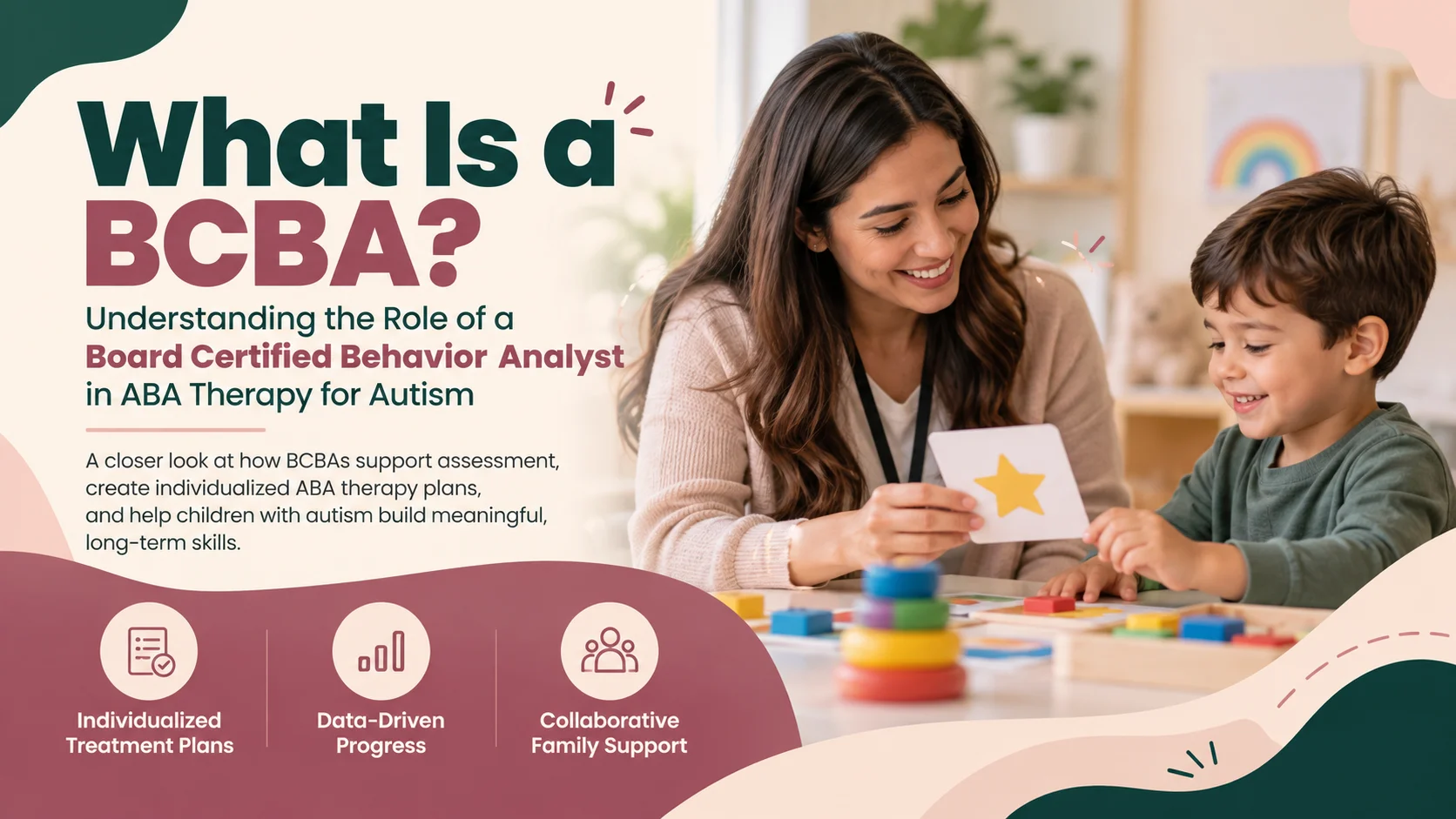
Who guides an ABA program when your child’s needs change? A Board Certified Behavior Analyst (BCBA) connects assessment results to meaningful goals, teaches strategies, monitors progress, and makes clinical decisions.
Understanding what a BCBA is can make ABA therapy easier to navigate. You have the right to know who helps develop your child’s program, supports the therapy team and reviews if the treatment is moving toward meaning therapy goals.
This guide explains the BCBA’s role in ABA therapy for autism, including assessment, treatment planning, supervision, skill development, and family collaboration.
You’ll also learn how BCBAs differ from RBTs and BCaBAs, where they work, what qualifications they need, and when their involvement may be helpful.
Key Takeaways
• A BCBA is a graduate-level behavior analysis professional who can independently provide behavior-analytic services.
• BCBAs assist in the evaluation of needs, development of individual goals, planning interventions, and monitoring progress.
• RBTs are often directly providing services under appropriate supervision, and BCBAs are responsible for clinical oversight.
• Data review and assessment are used to decide if an ABA program should be continued, changed, or expanded.
• Family priorities and normal routines should continue to be a part of good treatment planning.
Family Note: A well-designed ABA program should not only tell you what your child is learning, it should make it clear why the objective is important to your child’s daily life.
What Is a BCBA?
A BCBA is a Board Certified Behavior Analyst with graduate-level certification in behavior analysis who can independently provide behavior-analytic services and supervise qualified team members.
The board certified behavior analyst autism role is broader than simply observing behavior. A BCBA can evaluate skills and behaviors, negotiate individualized training objectives, oversee intervention, analyze data, and oversee professionals in program implementation.
For families, the credential is important because decisions about clinical care should be made for your child, not a program. A BCBA can support the implementation of assessment data to inform communication, independence, learning, social participation, routine, or behavior support related objectives.
ALMA’s BCBA autism services are personalized, family-oriented, measurable, and skills that last beyond the therapy session. You can learn more about our approach through our ABA and autism care therapy services.

What Does a BCBA Do in ABA Therapy?
A BCBA’s primary role is to direct the clinical direction of treatment, working with assessment, individualized goals, intervention, data, supervision and family input to ensure meaningful progress.
Sets Meaningful and Measurable Goals
A BCBA will determine the skills that are important to your child and family, and develop measurable goals that can be monitored. Goals can be in the areas of communication, independence, learning, routines, safety, or social participation.
Selects ABA Strategies and Interventions
Treatment decisions should be based on assessment results, your child’s ability and preferences, environment, and treatment priorities. Effective BCBA ABA therapy is individualized rather than copied from another child’s program.
Reviews Data and Monitors Progress
Data give the BCBA information about how your child is responding to treatment. It is not just the question of “Did therapy occur?” but whether or not the therapy is working toward the desired skill or behavior.
Supervises and Trains RBTs
RBTs can deliver direct behavior analytic services in a mandated supervision configuration. The BCBA can give direction, training, feedback and review to ensure implementation remains consistent with the treatment plan.
Works With Parents and Caregivers
Parents are aware of the child’s habits, likes and dislikes, communication and problems. We appreciate it because, based on your observations, we can develop practical goals and supporting strategies that would work in real family life.
Collaborates With Other Professionals
Behavioral goals can overlap with school, communication, developmental or other support goals. Consistent expectations are maintained across the people and environments involved in your child’s care through appropriate collaboration.
How Does a BCBA Develop an Individualized ABA Therapy Plan?
The treatment plan should start with the knowledge of your child’s strengths, needs, environment, family priorities, and existing skills, and not by following a checklist.
Initial Assessment and Information Gathering
The BCBA collects data through observation, caregiver input, records, and through appropriate assessment. This allows for a more solid foundation to begin building skill and behavior support.
Identifying Priorities and Setting Goals
The BCBA role in ABA therapy includes turning assessment findings into specific, meaningful goals. At ALMA, we seek to identify goals that will make communication, participation, independence, learning, or daily routines easier.
Selecting Individualized ABA Strategies
Teaching procedures are selected according to the goal and the child. A strategy successful for one learner may need to be adapted for another student as needs, motivation and environment vary.
Monitoring Progress and Updating the Plan
Treatment planning does not end when the document is written. Information, observation, caregiver input and needs can help determine when a goal should be maintained, adjusted, extended, or terminated.

How Does a BCBA Help Children With Autism?
A BCBA can support practical skills that enhance participation and independence while valuing your child’s individual communication style, strengths, preferences and needs.
Supporting Communication Skills
Communication targets can include requesting, making decisions, seeking assistance, responding, or speaking, gesturing, signing, or using AAC. The goal is to communicate in a way that will enable your child to participate more effectively.
Building Transition Skills
Sometimes, transitions are challenging because of changes in activity, person, expectation or environment. A behavior analyst can determine obstacles and implement routine, communication, coping responses or other supports that are predictable.
Developing Daily Living Skills
Goals for daily living may involve dressing, hygiene, eating, clean-up and other age appropriate skills of independence. BCBA autism support should connect these goals to the routines your family actually uses.
Supporting Social Interaction
Social goals can be to take turns, participate in activities, play flexibly, talk, say hello, or respond to other children. Goals should be based on what your child can do and relevant experiences for interaction.
Replacing Challenging Behaviors With Functional Skills
Behavior can serve a purpose or communicate a need. A BCBA can review what occurs before and after the behavior, determine the function of the behavior, and teach a more appropriate alternative behavior that allows your child to communicate or participate in a more effective way.
ALMA’s whole-child autism care approach keeps communication, behavior, daily routines, learning, and family priorities connected.
BCBA Vs RBT: What’s the Difference?
The difference between a BCBA and an RBT is the degree of clinical responsibility. A BCBA can independently provide behavior-analytic services and supervise RBTs, while an RBT implements behavior-analytic services under ongoing supervision.
This BCBA Vs RBT distinction can help families understand why both professionals may participate in the same ABA program while carrying different responsibilities.
| Role | Main Focus | Clinical Responsibility |
| BCBA | Assessment, goals, treatment planning, supervision, data review | Provides clinical direction |
| RBT | Direct implementation, teaching, data collection | Works within the supervised treatment structure |
What is the difference between a BCBA and a BCaBA?
A key difference in BCBA vs BCaBA is certification level and supervision. A BCBA is a graduate-level certified individual and a BCaBA is an undergraduate-level certified individual who provides behavior-analytic services supervised by a BCBA.
| Role | Certification Level | Supervision |
| BCBA | Graduate level | May independently provide behavior-analytic services |
| BCaBA | Undergraduate level | Provides services under BCBA supervision |
The term BCBA assistant is sometimes used informally when families are describing an assistant-level behavior analyst, but the formal BACB credential is BCaBA, or Board Certified Assistant Behavior Analyst.
What Assessments Does a BCBA Conduct?
Assessment enables the BCBA to better understand skills, behavior patterns, strengths, needs, and environmental factors, which will then inform the selection of treatment priorities and strategies.
Indirect Assessments
Caregiver interviews, questionnaires, records, and other information obtained from individuals who know your child well may be used for indirect assessment.
Direct Descriptive Assessments
In direct observations, the professional gets to see what happens before and after the behavior in the setting where it is happening.
Functional Analysis
When clinically appropriate, functional analysis systematically evaluates conditions related to a behavior to help identify its function and guide intervention decisions.
Preference and Reinforcer Assessments
These procedures can be used to try to determine what activities, items, interactions, or experiences might be conducive to engagement and effective teaching.
Milestone and Skill Assessments
Skill assessments can provide information about strengths and areas of need for communication, learning, social development, adaptive behaviors and daily living.
Ecological and Social Skills Assessments
Environmental factors in which skills must be applied, including home, school, community routines, and social settings, may also be taken into account.
Families can explore ALMA’s ABA assessment guide to understand common assessment types and how findings can inform treatment goals.
Where Do BCBAs Work?
Depending on the child’s needs and services being provided, BCBAs can work across home, clinic, school, community, and other behavioral health settings.
Home-Based ABA
Home-based services provide opportunities for teaching and behavior support within routines of communication, self-care, play, transition and independence.
ABA Clinics and Centers
Clinics can offer a structured environment for communication and learning, social interaction, behavior control, and daily living skills practice.
Schools and Community Settings
Children can learn skills to use where they need them, with the help of school and community support. ALMA offers school consultation services to facilitate collaboration between classroom and family settings.
Other Behavioral Health and Clinical Settings
Other settings can include behavioral health, developmental, educational and clinical settings where behavior analytic services are warranted.
What Qualifications Does a BCBA Need?
BCBA certification requires specific education, behavior-analytic coursework, supervised fieldwork, examination, and ongoing requirements. The BACB is also transitioning to revised BCBA requirements beginning January 1, 2027.
Master’s Degree or Higher
Current and upcoming BCBA eligibility pathways require a qualifying master’s degree or higher, with pathway-specific requirements that should be checked against the applicable BACB rules.
Qualifying Field of Study
Eligibility depends on the certification pathway and applicable coursework requirements. A degree title alone does not determine whether an applicant meets all current certification criteria.
Verified Course Sequence (VCS)
The older VCS terminology is not to be used as a sole pathway description. Coursework requirements and verification procedures are changing as the BACB moves toward its 2027 framework.
Supervised Fieldwork Experience
Applicants are required to complete required supervised applied behavior analysis supervised fieldwork as outlined in their certification pathway.
BCBA Certification Exam
To earn the credential, eligible applicants must have finished the BACBA application process and pass the BCBA certification exam.
State Licensure and Regulations
Certification is different from state licensure. When assessing a provider’s professional qualifications and scope of practice, families should take into account their state’s rules.
A BCBA salary is a career consideration influenced by experience, setting, location, and employer; it is not part of determining whether someone is qualified to provide care.
When Should a Family Work With a BCBA?
BCBA involvement could be helpful when your child requires individualized assessment, structured skill development, behaviour support, progress review or caregiver guidance in an ABA service.
Severe or Challenging Behaviors
When behaviours have a significant impact on safety, learning, participation, communication or important family routines, then professional assessment might be useful.
Communication Difficulties
A BCBA can assist you in developing goals if your child struggles with requesting, responding, communicating options, asking for assistance, or engaging in typical social interaction.
Struggles of Daily Life
When routines routinely hinder daily participation, dressing, hygiene, eating, going to bed, tidying up, or transitions can be a focus of treatment.
Difficulty Developing New Skills
Structured behavioral teaching can support children who need additional help developing communication, adaptive, social, learning, or independence skills.
Need for Caregiver Training
Parent coaching can help you understand treatment goals and use practical strategies during everyday routines. Your participation can make it easier for important skills to carry over outside therapy.
Conclusion
Understanding what does a BCBA do can help you make sense of your child’s ABA program and ask better questions about care. The BCBA does not isolate these components of assessment, individualized goals, intervention, data review, supervision and family collaboration.
We know that meaningful ABA support should be tailored to your child’s strengths, needs, family routines, and priorities at ALMA Behavioral Solutions. Burbank and neighboring families have the opportunity to learn about customized ABA therapy services that focus on real-world skills and quantifiable improvements.
Call ALMA Behavioral Solutions to speak with us at (747) 250-8494 or send us an email at info\@almabehavioralsolutions.com if you are interested in ABA therapy or wish to understand more about your child’s current program.
Frequently Asked Questions About BCBAs
What Happens During a First Meeting With a BCBA?
In the first meeting, the BCBA will talk to you about the strengths, needs, routines, history and family priorities of your child, and will talk through assessment, treatment plan, services, and next steps.
Does a BCBA Work Directly With the Child?
A BCBA may work directly with your child depending on the treatment model. Their responsibilities can also include assessment, supervision, data review, and clinical decision-making.
Can a BCBA Diagnose Autism?
A BCBA does not diagnose autism solely through their behavior-analytic credentials. Appropriately qualified individuals operating within their scope and responsibility are required for autism diagnosis.
Does Every Child Receiving ABA Therapy Have a BCBA?
Not necessarily. ABA service structures vary, but a BCBA commonly provides clinical oversight, assessment, treatment planning, supervision, and ongoing review within a child’s ABA program.
Can Parents Participate in Their Child’s ABA Therapy Program?
Yes. Parents can participate through caregiver training, feedback, goal setting, and practicing strategies during daily routines, helping your child use important skills outside therapy sessions.
How Often Does a BCBA Review a Child’s ABA Therapy Program?
Review rates are based on your child’s needs, treatment model, treatment goals, and provider structure. A BCBA must conduct regular review of progress and implement changes in treatment as data suggest.
What Should Parents Look for When Choosing a BCBA?
Check for BCBA certification, experience, good communication, individual planning, ethics and a desire to engage your family in meaningful treatment decisions.
How Long Does a BCBA Stay Involved in a Child’s ABA Therapy?
A BCBA can continue to be involved during ABA therapy when clinical supervision is warranted. Their level of involvement can change as your child’s needs, goals, and progress evolve.