
Introduction: Why Toy Messes Can Mean More Than “Messy Play”
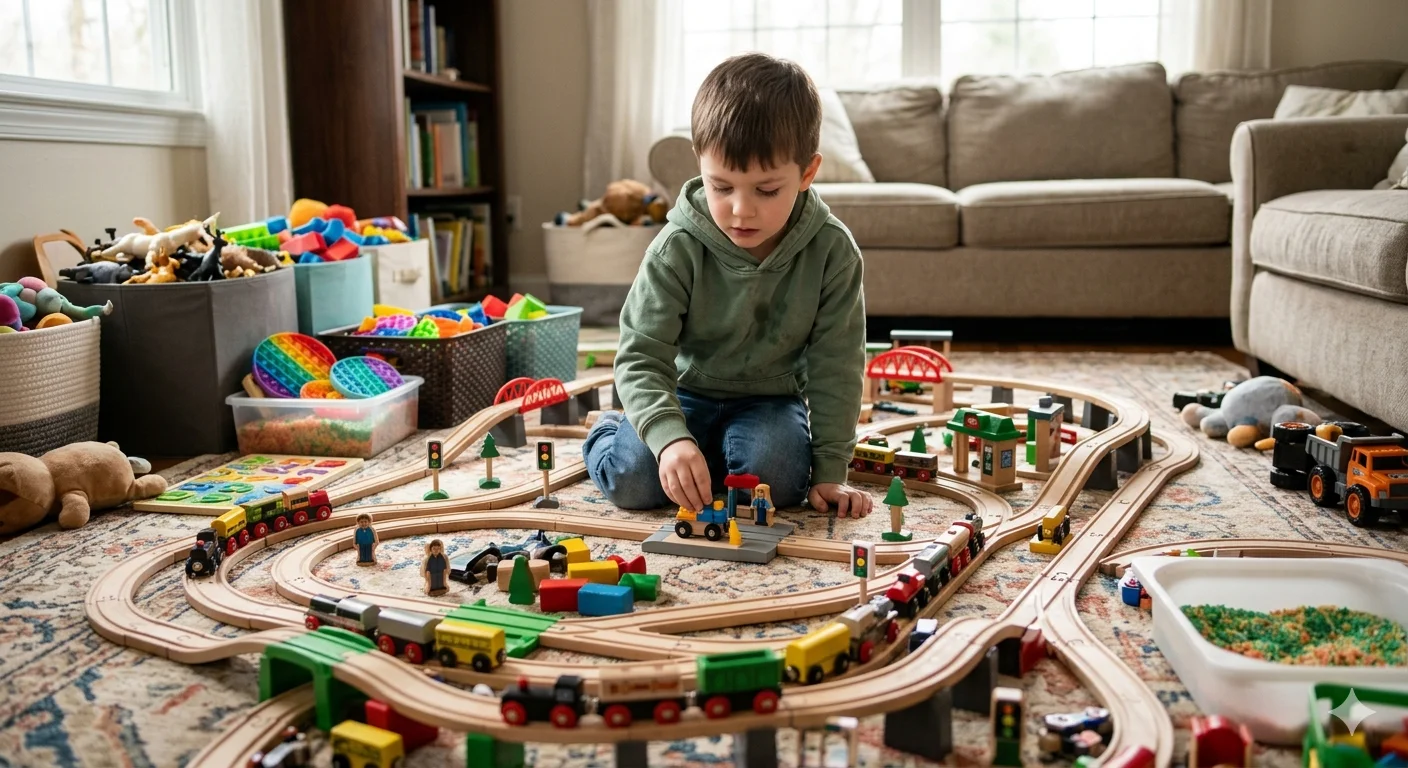
Does your child dump toys, spread them across the floor, line them up, or move quickly from one toy to the next?
There is increased interest from many families for more information about play, behavior, communication and daily routines.
There are many reasons that toy messes occur. A child might be trying out, exploring for sensory input or practising cause and effect or demonstrating that they require assistance.
Alma Behavioral Solutions can assist families to interpret what behavior is communicating. We help children with play skills, communication, transition, clean up skills, and daily independence through compassionate ABA therapy.
Key Takeaways
- Toy messes can happen with autistic and non-autistic children, so mess alone does not mean autism.
- Autistic children might dump, sort, line up, scatter or repeat toy actions due to sensory needs, communication needs, repetitive play or lack of transition.
- Children can learn functional play, communication, clean up and daily living skills through ABA therapy.
- You can have a calmer, more predictable, and easier-to-manage playtime at home with parent coaching.
Do Autistic Kids Make Messes with Toys?
Yes, some autistic kids make messes with toys, but many children make messes during play. Is my child making a mess? is the important question. A better question is, “What pattern do I see during play?”
Some children dump toys as a way of enjoying the sound. Some enjoy watching toys falling, rolling, spinning and bouncing on the floor. Some children may line up cars, sort blocks according to colour, stack items or be disturbed when someone moves the toys.
Toy play is meaningful when it is frequent, repetitive, causes distress, impacts upon safety issues or makes daily routines more difficult when it is messy. Another difficulty a child may have is changing from play to clean up, sharing toys, pretend play, or asking for help.
Toy messes alone should not be used to identify autism. The social communication differences, limitations in or repetitive behaviors, sensory differences, and history of development are part of the broader pattern in autism.
Why Toy Messes May Happen in Autistic Children
Toy messes often have a reason. Play provides clues when it is observed by an adult that will help them understand a child’s needs, interests and learning style.
Sensory Exploration
Some kids like how toys feel, sound, move or look. Dumping blocks may make a loud sound. It is possible to form a pattern with spinning wheels. Throwing toys may be an exciting experience as the kid might watch what occurs.
Not all sensory play is bad. Some support may be required when play becomes unsafe, difficult to halt or when the child is unable to learn alternative play.
Repetitive or Pattern-Based Play
Repeat actions may be calming and predictable to Autistic children. A child can arrange toys, put things in order, open and close boxes or do the same activity numerous times.
Repetitive play can be meaningful. The aim is not to make a child lose his or her interest. The aim is to gradually increase play opportunities so that the child is able to develop new skills without feeling unsafe.
Communication or Frustration
When children get their toys all in a jumble, it could be a message. The child may be at a loss for what to do, tired, overstimulated, excited, or bored.
A child who cannot say “help me,” “play with me,” “I need a break,” or “I am done” may use behavior instead. Communication instruction can facilitate playtime and minimize frustration.
Difficulty With Transitions or Cleanup
Cleanup can be challenging due to the number of skills needed. Child must stop playing, listen to instructions, put things in order, obey instructions, change activities.
The mess is not a problem for some kids. The hard part is ending play and changing activities.
When Is Messy Toy Play a Concern?
Dirty toy behaviour might be a problem if it compromises safety, learning, social interaction or family life. If a child is throwing toys dangerously, becomes very upset if toys are moved around, or refuses to clean up daily, he or she may require additional support.
Signs Parents May Notice
Parents might observe repeated dumping without play, intense distress in response to changes in toy patterns, decreased pretend play, unsafe throwing, problems sharing, and meltdowns in clean-up situations.
A child can also jump rapidly from one toy to another without focussing on any. A different child can only use one part of a toy, for example they could use the wheel of a toy car, but not the whole car.
When to Seek Support
When toy chaos causes frequent stress, safety issues, communication problems, and/or large-scale disruptions to the routine, parents might need some assistance.
A trained person can help with determining the function of the behavior and provide instruction in skills that can be used for play, communication and activities.
How ABA Therapy Can Help With Toy Play and Cleanup Skills
ABA therapy doesn’t just aim to prevent behaviors. Useful replacement skills taught through strong support, e.g. asking for support, selecting a toy, cleaning one thing at a time, taking turns or “all done.”
Teaching Functional Play Skills
Functional play is about helping children to learn and use toys to develop everyday skills. Throughout the ABA therapy, the kid might learn to use toys for their designed function, adhere to simple play routines, mimic actions, and come to grips with a broader range of activities.
Working on functional play skills can help to enhance a child’s attention, problem solving, flexibility and participation in social relationships with peers and family members.
Building Communication During Play
Play creates natural opportunities to teach communication skills that children can use throughout the day. A child can be taught to request their preferred toys, ask for help, choose, receive attention correctly and talk when they are done with an activity.
Children can communicate their needs clearly and effectively, minimising frustration and improving interaction during play and routine activities.
Supporting Cleanup and Transitions
Children do benefit from being directly taught how to walk between activities and do clean up. ABA therapy can help to stop the behavior, break it into small steps and teach it slowly.
Using visual schedules, countdowns, timers and having expectations helps children to know what comes next. Practice can enhance cooperation, independence, and flexibility in transitions.
Parent Coaching for Home Routines
Parent coaching assists families to use effective strategies in their daily life at home. Support and guidance can involve establishing routines, planning play areas, setting clear expectations, fostering independence and consistent responses to behaviour.
Children can learn skills quicker, when parents use the same method in different situations of the day.
Simple Toy Cleanup Strategies Parents Can Try at Home
Toys can be made easier for parents to cope with, by establishing structure before the mess gets to be too large. It’s usually better to have a simple set-up than a long list of rules.
Helpful strategies include:
- Limit the number of toys available at one time.
- Label the bins with words or pictures.
- Give one-step directions, such as “put blocks in.”
- Model clean up before child can do it by themselves.
- Start clean-ups after the timer sounds.
- Praise small cleanup efforts right away.
- Offer a clear next step, such as “clean up, then snack.”
Make Cleanup Visual and Predictable
Use Simple Labels
Using picture labels can make it easier for children to understand where toys go. A block picture on a bin can be easier to understand than a spoken direction.
Keep the Routine Short
Short clean up routines are more easily followed. Do one bin, one type of toy or one small room before requesting the child to clean the entire room.
How Alma Behavioral Solutions Supports Children and Families
Alma Behavioral Solutions provides individualized ABA therapy for children who need support with communication, play skills, social development, behavior, routines, transitions, and independence.
We may provide you with services such as direct ABA therapy, In Home ABA therapy, parent training, school consultation, behavioral assessments, social skills support, communication skills development, and more.
We collaborate with families to understand the ‘how’ and ‘why’ of behavior and to provide families with applicable skill instruction. This can involve developing play skills, teaching tidy up, helping with transitions, and helping parents to be more confident at home for their toy mess.
When Toy Messes Are Really Communication
Actions may be considered a means of communication. Instead of only asking, “How do I stop the mess?” parents can also ask, “What is my child trying to tell me?”
A toy mess may mean:
- I need help.
- I like how this feels or sounds.
- I want attention.
- I do not know how to play with this toy yet.
- I need a break.
- I do not want playtime to end.
Once the message has been understood by the families they can teach the child another way to impart the message.
Conclusion: Support Your Child’s Play, Learning, and Daily Routines
Some kids with autism make messes with toys, but it isn’t all of them. Signs of sensory needs, communication needs, repetitive patterns or challenges with transitions may be evident during toy play.
Our team helps families look beyond the mess and understand what a child may need. With compassionate ABA therapy and parent support, children can build play skills, communication, cleanup routines, and daily living skills.
If toy messes, cleanup struggles, transitions, or play routines are becoming stressful at home, Alma Behavioral Solutions can help your family take the next step with care and clarity.
Frequently Asked Questions
Is making messes with toys always a sign of autism?
No, making messes with toys is not always a sign of autism. During play, many young children dump, scatter and explore toys. To consider the entire pattern, communication, social interaction, repetitive behaviors, sensory needs, and daily routine issues.
Why does my child dump toys over and over?
Dumping may occur repeatedly due to the sound, movement, or visual effect of the dumping. It can also be an attention getter, to avoid something, or excitement. Observing what occurs prior to and following the behaviour may be helpful in understanding why the behaviour occurs.
Should I stop my autistic child from lining up toys?
Lining up toys does not always need to be stopped. It can be comforting or pleasurable to some kids. Additional support is useful if the child is very distressed if the pattern changes or if the play interferes with learning, sharing or daily routines.
How can I teach my child to clean up toys?
Start small and make cleanup simple. Follow one-step directions, picture labels, model, timers and praise. A child may first learn to put one toy in a bin before cleaning up a full play area.
Can ABA therapy help with toy messes?
Yes, ABA therapy can help, as it can pinpoint the cause of toy messes and help teach skills that can be useful. Therapy can be on functional play, communication, transitions, cleaning up strategies, and parent strategies that are effective at home.
When should parents ask for professional support?
Parents can ask for help if toys present a safety risk, if they have frequent meltdowns, if they have big clean up challenges or if they are having issues communicating and playing with toys. Families may benefit from a professional evaluation to gain insight into the behavior and develop a practice oriented plan.