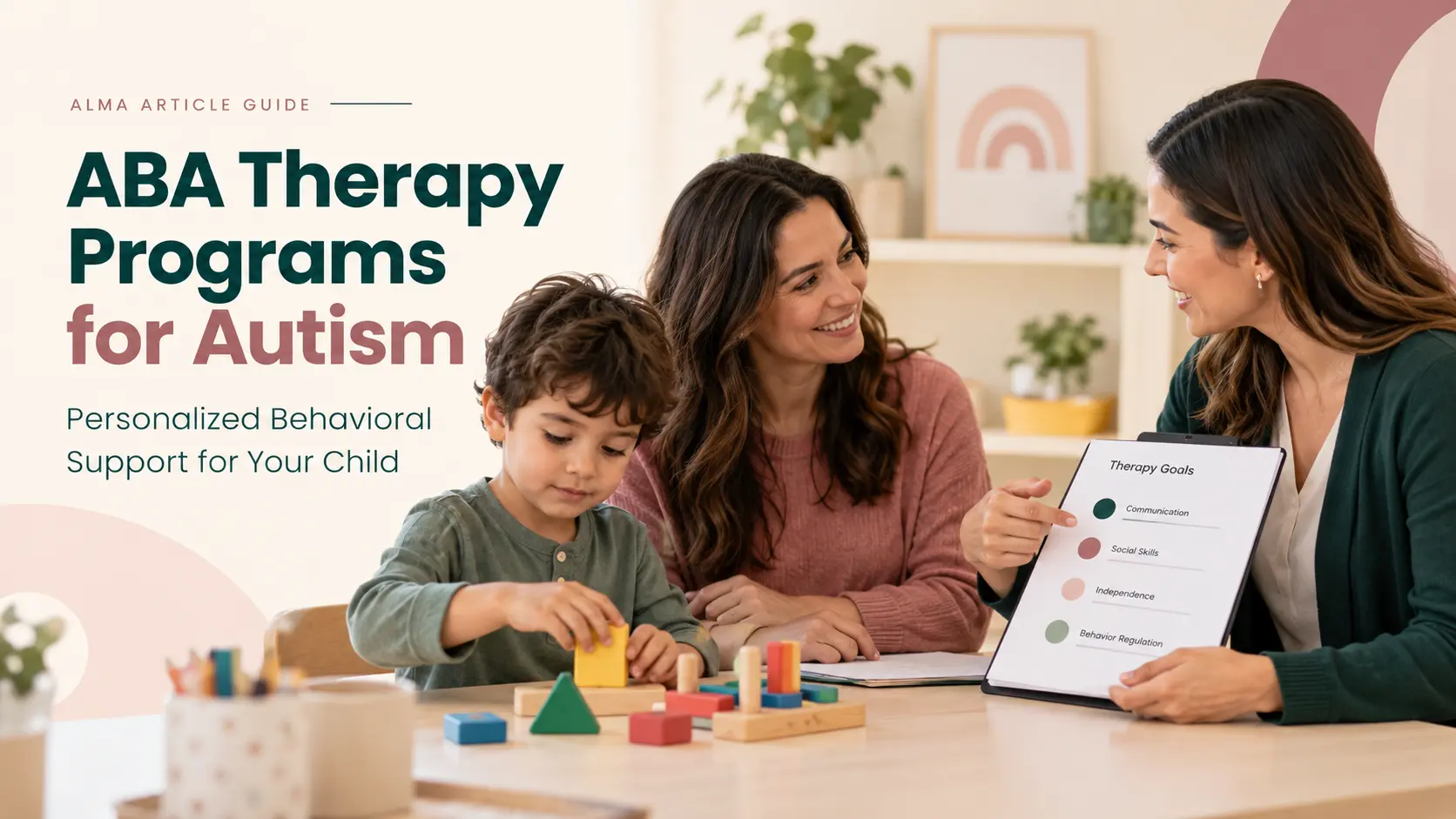

How can parents tell whether an ABA program truly fits their child instead of simply following a standard template? The answer begins with personalization.
The impact of autism on communication, routines and learning, play, safety and independence can be very different. A good program should take into account those differences and not impose uniformity.
Successful ABA therapy for autism includes assessment, measurable goals, evidence-based teaching, family involvement and review. Progress should be linked to skills which would make life easier and more fulfilling.
This guide provides information about how a customized ABA therapy program for autism is developed, some of the strategies that can be employed, how progress is tracked, and what parents should look for when comparing services.
Key Takeaways
· ABA programs should begin with the child’s individual strengths, needs, communication, preferences, and daily routines.
· Treatment’s goals should be functional, measurable, meaningful, and relevant in the real world outside of therapy.
· Different ABA therapy techniques can be selected based on the skill being taught and the child’s response.
· Progress data is used to determine when to make changes to strategies, goals, prompts, or teaching conditions.
· Communication, safety, independence, participation, choice, and quality of life should be supported within the framework of respectful ABA.
What Is an ABA Therapy Program for Autism?
An ABA program for autism is a personalized approach to assessment, teaching, behavioral support, progress monitoring, and caregiver collaboration, based on meaningful, real-world skills.
Applied Behavior Analysis studies how learning and behavior interact with a person’s environment. An ABA program applies those principles to understanding current skills, identifying skills that are limiting their success, teaching them skills they can use, and measuring whether intervention is actually making a difference.
Sometimes the term ABA Autism will appear in its short form in families, but that does not mean that it is one autism program. Programming should vary from person to person receiving support.
Parents wanting a closer look at ALMA’s approach can explore its ABA & Autism Care Therapy services.
What an ABA Program Is Designed to Do
Effective ABA therapy for autism programs relate clinical goals more to real life than teach individual responses for the sake of measurement.
Programming may focus on:
· Expressing desires, needs, discomfort, and options
· Participating in useful home or school routines
· Developing greater independence
· Learning safer alternatives to harmful behavior
· Building play or social participation when meaningful
· Generalizing skills across people and settings
If a child becomes distressed when struggling with a challenging task, instead of relying on behaviour that expresses the same need, the child may learn to ask for support or a break.
Who Guides the Program?
Individualized ABA therapy is grounded in qualified clinical judgment, which is essential for determining goals, teaching strategies, progress and changes to the program.
A care team may include:
· BCBA: assesses needs, develops programming, reviews data, supervises implementation, and updates goals.
· Behavior technician or RBT: provides direct teaching under appropriate supervision.
· Parents and caregivers: share priorities and help skills carry into everyday routines.
· Other professionals: to coordinate care where speech, occupational, educational and medical services overlap.
Roles should be clear to families in order to understand who takes clinical decision making and who provides direct support.
Why Personalized ABA Therapy Matters
Good autism behavioral support should be responsive to the reasons for a skill or behavior being important for one particular child, and not the same reasons for other children.
No Two Children Begin in the Same Place
The first step to useful individualized ABA therapy is to identify the child’s current skills and determine what they should learn or modify.
Clinical planning may consider:
· Communication style
· Current independence
· Interests and preferences
· Learning strengths
· Daily routines
· Sensory or environmental factors
· Safety concerns
· Family priorities
Two children can be reacting in the same way to drastically different circumstances. One may be trying to withdraw from an activity to avoid something he or she finds challenging, whereas the other may be expressing discomfort and require different support.
Goals Should Connect to Real Life
Goals that have a tangible impact at home, school, in the community, or in the ability to communicate and participate are important considerations in a good ABA treatment plan.
Some objectives may include asking for help when doing homework, accepting a change as needed with support, carrying out a portion of a self-care activity, or saying “no” well.
A clinical goal should not be just put on a standard checklist. It’s important that it is relevant to the child’s life.
What an Individualized ABA Program Includes
A personalized ABA therapy program for autism connects assessment, clear goals, teaching strategies, supervision, data collection, caregiver input, and regular clinical review within one coordinated plan.

Individual Assessment
Assessment provides a place to start using ABA therapy for autism, as it will capture current skills, support needs, environmental variables, communication techniques, preferences, and areas affecting daily participation.
Caregiver input and observation can help look at how the child communicates, reacts to change, does routines, interacts with others, and carries out tasks. Baseline data is then used to track subsequent gains.
Measurable Therapy Goals
An effective ABA program for autism translates general goals like “improve communication” into objectives that can be quantified, taught, and objectively checked and assessed.
Strong goals are:
· Specific
· Functional
· Measurable
· Developmentally relevant
· Linked to relevant routines
· Reviewed as circumstances change
“Request help during difficult activities,” for example, gives the team a clearer teaching target than a vague goal such as “communicate better.”
The ABA Treatment Plan
The ABA treatment plan correlates the results of the assessment to the actual treatment techniques used during therapy. It should include information about what is being taught, why it is important, and how it will be assessed.
Target skills, teaching procedures, reinforcement, prompting, behavior support procedures, caregiver involvement, generalization, and data collection procedures may all be identified in a treatment plan.
Families who need a broader overview of starting services can review ALMA’s step-by-step guide to getting started with ABA therapy.
Clinical Supervision and Progress Measurement
Continuous review ensures individualized ABA therapy remains responsive whenever a strategy is successful in a rapid fashion, when progress is slow, when new priorities emerge, or when a prior goal is no longer relevant.
A simple program cycle looks like this:
| Program Element | Purpose | Example |
| Assessment | Establish current abilities | Observe functional requesting |
| Goal | Define meaningful progress | Request help independently |
| Teaching | Build the skill | Practice during real activities |
| Data | Measure change | Track independent requests |
| Review | Guide decisions | Fade prompts or revise strategy |
Data should be used to inform clinical decisions, not supplant clinical judgment.
Skills ABA Therapy Programs May Support
The benefits of ABA therapy are dependent on the goals chosen for each individual child, and programs can target a wide range of combinations of communication, independence, safety, and participation.
Functional Communication
Communication is a common focus of ABA therapy for autism because being able to express needs can affect many areas of daily life.
Possible goals include:
· Requesting help
· Asking for a break
· Making choices
· Rejecting something appropriately
· Requesting preferred activities
· Using speech, gestures, signs, or AAC when appropriate
Communication objectives should facilitate functional expression, not speech being the only alternative mode of communication.
Daily Living Skills
An ABA program for autism can help him be independent in a routine that he experiences on a regular basis rather than in a tabletop activity.
Examples include dressing, handwashing, toileting routines, mealtime participation, packing belongings, cleanup, and following portions of a morning or bedtime routine.
Instruction may start at the child’s existing level of support and may work toward the development of independence.
Social, Play, Safety, and Learning Skills
Personalized autism behavioral support can work with social participation and do not presume that all children must act in the same ways.
Goals might include:
· Joining a preferred activity with peers
· Taking turns during play
· Safe movement in the community.
· Requesting assistance
· Managing classroom transitions
· Following useful safety instructions
· Completing meaningful learning activities
Focusing on functional participation, and not eradicating harmless individual differences.
Common ABA Strategies Used in Personalized Programs
Different ABA therapy techniques serve different purposes. Structured teaching and natural practice can be used together rather than each technique being used for each goal.

Positive Reinforcement
Positive reinforcement is widely used within ABA therapy for autism to increase useful skills by following a response with something meaningful to the learner.
Be sure to tailor reinforcement toward the individual. Children will appreciate praise for one thing and another child will value another preferred activity, toy, movement break, conversation topic, etc.
Functional Communication Training
Functional Communication Training may further enhance the autism behavioral support by providing a functional communication response that has a similar effect to the challenging or unsafe behavior.
If the child becomes angry when tasks are too challenging, they will learn how to ask for support, a break or time to complete the task.
Natural Environment Teaching
Natural Environment Teaching can make individualized ABA therapy more meaningful to everyday life through routines, play, interests, and naturally occurring opportunities.
A therapist may ask for items to play with, ask for steps when making a snack or take turns when doing an activity that is wanted. Skills can be transferred outside of formal practice settings with natural practice.
Discrete Trial Training
Discrete Trial Training is one of several structured methods of ABA therapy that can be helpful when a skill can be taught by providing explicit instructions, planned practice, immediate feedback, and repeated practice opportunities.
DTT should be selected because it fits the target skill and learner, not because every ABA program requires the same teaching format.
Task Analysis, Prompting, and Prompt Fading
An ABA treatment plan may break complex routines into manageable steps through task analysis while using prompts to provide the amount of help needed for successful learning.
For instance, a dressing routine can be broken down into smaller actions. Many of the prompts will be modeled, gestured or provided visually, and will be reduced as independence increases.
Function-Based Behavioral Support
Strong autism behavioral support goes beyond what a behavior is and considers variables that could be influencing it.
Clinicians may examine:
· What happens before the behavior
· What happens afterward
· What the person may be communicating
· Environmental or task-related factors
· Skills that could provide a safer alternative
Knowing what a function is can help teams select proactive solutions rather than just problem solving when issues arise.
Where ABA Therapy Can Take Place
When choosing an environment for an autism therapy program, the child’s goals, family needs, provider model, clinical recommendations and opportunities for real-life practice can be considered.
Home-Based ABA
Home-based individualized ABA therapy can support routines where they naturally occur, including meals, dressing, communication with family members, play, hygiene, transitions, and household responsibilities.
For families in Glendale, strategies that are integrated into the same routines in which support is provided are beneficial. ALMA’s Glendale ABA therapy information provides local service context.
Center-Based ABA
A center-based ABA program for autism can provide a structured environment for planned teaching, therapist supervision, social opportunities, play, and targeted skill development.
For some children, a familiar therapy setting and materials and activities organized around present goals are helpful. Families may wish to discuss setting, schedule, clinical fit and learning needs with each other at Northridge.
School and Daycare Support
The school-based autism behavioural support can be directed towards routines, communication, transitions, peer participation, independence or consistency at school and home.
Using collaborative strategies to respond more consistently rather than using strategies that are disconnected. ALMA’s School Consultation service includes classroom observation, behavior guidance, school collaboration, and parent-school alignment.
This type of coordination can be very useful for studio city families if a child has goals that are to be carried over between learning environments.
ABA Support in California
Families considering an ABA program for autism in California should compare clinical recommendations, service settings, insurance requirements, availability, family schedules, and how well a provider’s model matches the child’s needs.
Care can be provided in the home, clinic, school, daycare, community or in a telehealth supported environment when clinically appropriate. Burbank and Granada Hills families need to consider the quality of the programs as well as their personal best fit and match.
How ABA Programs Change as a Child Progresses
A responsive ABA treatment program should adapt to data, observation, and feedback from caregivers, as well as a child’s developing skill sets, when goals or strategies are no longer appropriate.
The Program Review Cycle
Useful ABA therapy for autism involves an ongoing cycle of clinical targets rather than the same targets over and over again:
Assess → Set Goals → Teach → Measure → Review → Generalize → Adjust
Prompts or less direct teaching may be required for a mastered skill. A strategy producing limited progress may need revision rather than simply more repetition.
As the child’s communication, independence, school requirements, likes/dislikes, or family habits change, new priorities can arise. When families are deciding about ongoing support, they can get a first look at ALMA’s local ABA therapy services.
When Goals Should Be Updated
Good individualized ABA therapy is based on program revision as an aspect of responsible care, not a sign that something has gone wrong.
Goals may change when:
· A skill is mastered
· Independence increases
· Progress remains limited
· Family priorities change
· School demands shift
· Each skill is given greater significance
· The child’s needs and interests change
Treatment decisions should be individualized throughout the treatment.
Potential Benefits of Personalized ABA Therapy
Changes that help with daily functioning, communication, participation in activities, safety, independence, and access to meaningful activities are best understood as meaningful benefits of ABA therapy.
What Meaningful Progress Can Look Like
Personalized ABA therapy for autism should focus on outcomes that matter beyond a therapy session.
Progress may seem like a child:
· Asking for assistance from fewer people
· Completing additional steps of a routine independently
· Making it easier to talk about pain
· Using a learned skill with different people
· Applying skills in a new setting
· Navigating transitions with more effective support
· Participating safely in family or school routines
These examples describe possible goals rather than guaranteed outcomes. Progress is dependent on the person, their chosen objectives, surroundings, clinical requirements, and the quality of the implementation.
What Contemporary Child-Centered ABA Should Look Like
Modern individualized ABA therapy should be a blend of behavioral science, with dignity, meaningful goals, family collaboration, choice, appropriate assent practices, and respect for the child’s communication and individuality.
Meaningful Goals and Choice
A contemporary ABA program for autism should prioritize skills that improve quality of life rather than teaching conformity for its own sake.
They might focus on functional communication, safety, independence, advocacy, access to desired activities and relationships.
Harmless preferences, interests, communication differences and autistic characteristics should not automatically be set as treatment goals due to being different from the norm.
Respecting Communication and Distress
Automatic responses to refusal, discomfort, or distress are not the appropriate way to respond to the information offered.
Consider what has changed, what the child might be saying, if demands are appropriate and if changes might be necessary.
Communication may be verbal, AAC, gestures, signs, or other functional means. The goal is effective communication, not one prescribed form.
Assent and Family Collaboration
Child-centered ABA therapy for autism should provide clear information to families and take into account the learner’s involvement, preferences, comfort, and reactions during treatment.
Caregivers can provide context that session data alone may miss, including changes in sleep, routines, school demands, interests, or behavior at home.
This collective view is helpful for families in Beverly Hills and surrounding areas when they are evaluating and comparing treatment and providers.
How Parents Can Evaluate an ABA Therapy Program
When selecting an ABA program for autism, distance and availability are not the only factors to consider. Familiarize families with the process of making clinical decisions before agreeing to continuing treatment.
Verify Clinical Oversight
Effective autism therapies with ABA should be clearly supervised.
Ask:
· Who assesses my child?
· Who develops the program?
· What is the direct session provider?
· How frequently does a qualified supervisor review progress?
· How are program changes communicated?
Parents need to understand the individual responsible for decisions made during treatment.
Ask How Goals Are Selected
A personalized ABA treatment plan should be explainable in plain language. Families should know what a goal is and how achieving it will positively affect the child’s life.
Useful questions include:
· How was this goal selected?
· What information is required to back it up?
· What will be the indicators of progress?
· How does this goal relate to routines?
· What do you do after you have achieved the goal?
Review Parent Involvement and Progress Communication
A good individualized ABA therapy will provide the caregiver with valuable information instead of just telling them that a session went well.
Families should be provided with clear information regarding progress, obstacles, current priorities, and program changes. Parent coaching does not require parents to be therapists; it can help achieve consistency.
Parents needing individualized guidance can explore ALMA’s Private Consultations for Autism and ABA Guidance.
Evaluate Play-Based Social Skills Support
When choosing between different ABA therapy techniques for social development, parents should not be led by promises of a “play-based” program.
Quality support should consider:
· The child’s interests
· Natural opportunities for interaction
· Functional social goals
· Choice and engagement
· Peer opportunities when appropriate
· Generalization beyond structured practice
· Clear clinical oversight
There is no universal definition of the ‘best’ provider or method for every child. Fit is dependent on personal objectives and requirements.
Watch for Program Red Flags
This is where the clinical reasoning of a trustworthy ABA program for autism should shine through.
Possible concerns include:
· Identical goals for many children
· Guaranteed outcomes
· Treatment without individual justification
· Limited clinical supervision
· Little family communication
· No clear progress data
· Failure to review ineffective strategies and practices
· Goals emphasized adherence predominantly to compliance.
· Persistent distress being ignored
Parents should feel at ease in asking how decisions are made.
Frequently Asked Questions About ABA Therapy Programs
How Many Hours of ABA Therapy Does a Child Need?
There is no single schedule appropriate for all children. Recommended hours should be based on the assessment, functional outcomes, clinical need, tolerance, family situation, etc., and not a formulaic package.
How Long Does an ABA Therapy Program Last?
Program duration varies according to individual goals, progress, clinical needs, and changing priorities. Services, goals, strategies, and treatment intensity should be reviewed regularly to determine if they should be maintained, modified, or reduced.
Can ABA Therapy Support a Child Who Uses AAC?
Yes. ABA may be used to facilitate functional AAC use, communication practice and generalization, as needed. Speech-language pathologists continue to be relevant in their scope of practice for specialized speech-language evaluation and AAC assessment.
Can ABA Therapy Be Used With Speech or Occupational Therapy?
Yes, children may receive ABA alongside speech or occupational therapy when appropriate. Clear coordination allows providers to know their roles, minimizes conflicting strategies, provides support to useful skills in various settings.
Does California Have ABA Programs for Adults?
Yes, adults may access behavioral or developmental support in California depending on needs, eligibility, funding, provider availability, and clinical recommendations. Adult services can differ significantly from pediatric ABA program models.
Personalized ABA Support from ALMA Behavioral Solutions
Finding the right ABA program for autism in California begins with understanding your child’s strengths, communication, routines, challenges, and the skills that could make everyday life more manageable.
ALMA Behavioral Solutions offers individualized ABA support for families throughout Southern California and care that centers on goals of significance, family involvement, measurable progress and skill development. Families can learn more through ALMA’s ABA & Autism Care Therapy services or discuss their situation through a private consultation.
Any questions related to services, availability, and what to do next can be directly addressed to the ALMA team. Contact (747) 250-8494 or info@almabehavioralsolutions.com to discuss your child’s needs and determine if there is a strategy that is right for your family.