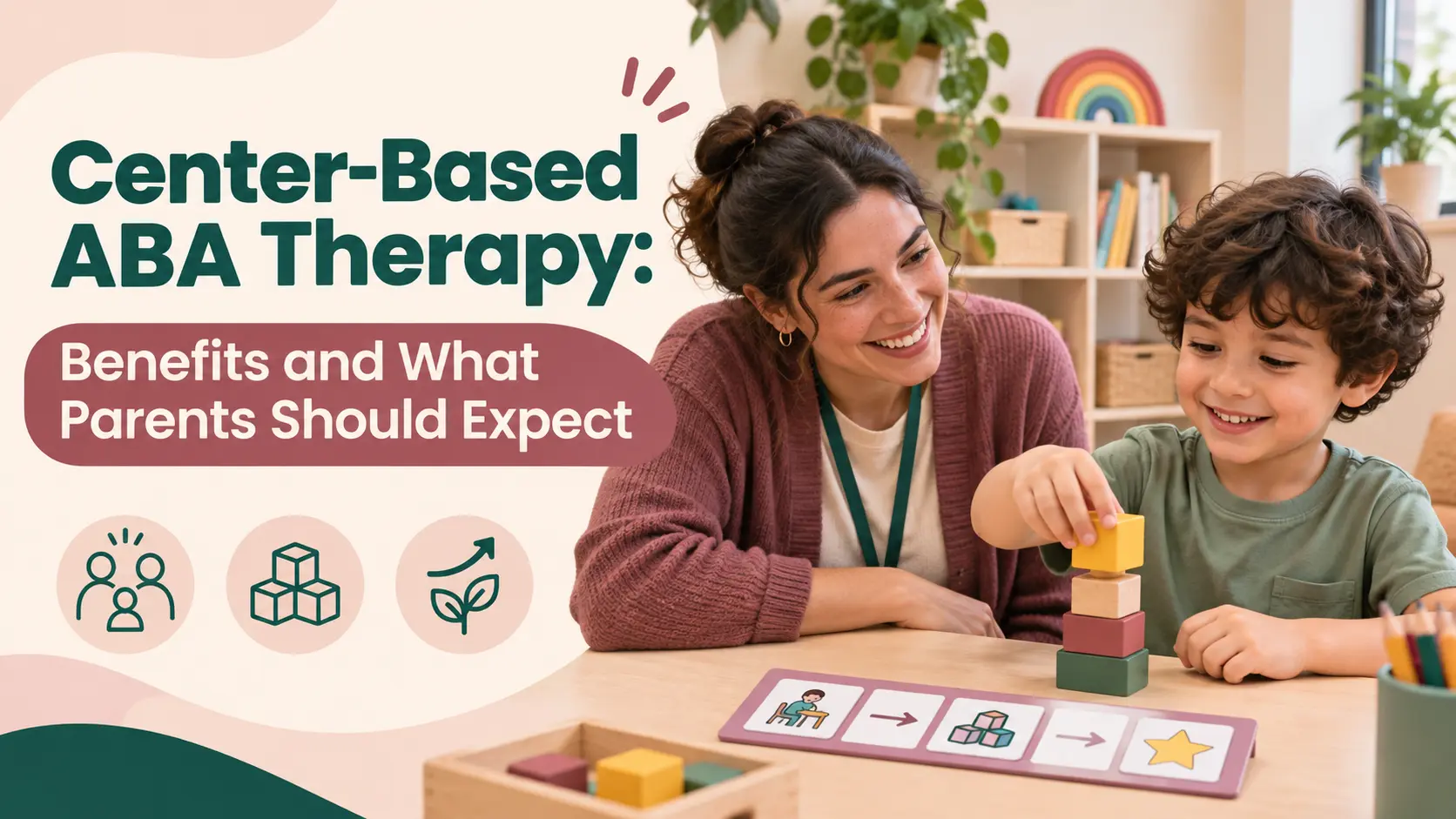

Center-based ABA therapy benefits include individualized behavioral support and opportunities to practice communication and social skills in a dedicated treatment environment. Sessions can include structured activities, play, and peer interaction tailored to each child’s needs.
For families looking into center-based ABA treatment for kids, it’s equally crucial to understand the daily treatment plan as it is to be aware of the potential benefits and treatment goals.
At ALMA Behavioral Solutions, we see that families need information when they are considering their choices. This guide outlines the content of sessions, how progress is tracked and how the various settings differ.
What Is Center-Based ABA Therapy?
Center-based ABA therapy is a form of applied behavior analysis delivered in a dedicated treatment setting. It concentrates on individual teaching to give the children meaningful skills.
An ABA therapy center is different from a regular school in that it does not teach a curriculum, but rather teaches individualized goals. Activities are adapted to each child’s needs and preferences.
Center-based autism therapy may include:
• Individual Learning Areas: Spaces for practicing communication, self-care, and other personalized goals.
• Play-Based Activities: Opportunities to learn through toys, games, and preferred interests.
• Professional Support: Board Certified Behavior Analysts (BCBAs) design and implement treatment plans, and qualified staff, such as Registered Behavior Technicians (RBTs), can provide direct services.
• Supported Peer Activities: Opportunities for shared play and communication when appropriate for the child.
The environment should accommodate each child’s sensory needs, communication style and preference, as well as comfort level, throughout treatment.
How Does Center-Based ABA Therapy Work?
Initial ABA Assessment and Family Consultation
The first step of the ABA assessment process is to learn about your child’s strengths, communication style, interests and support needs. Family involvement in ABA therapy is essential for identifying meaningful family priorities.
During assessment, a clinician may:
• Observe communication and daily living skills.
• Discuss sensory preferences and challenging situations.
• Discuss developmental past and concerns of caregivers.
• Define goals which will facilitate independence and participation.
Individualized ABA Treatment Planning
After assessment, the BCBA develops an individualized ABA therapy treatment plan. Goals are based on your child’s abilities, preferences, learning needs, and family priorities.
Example: Learning to Request Help
If a child is having difficulties asking for support, the plan may include teaching them to ask for help with words, gestures, pictures or an AAC device.
Progress measures enable teachers to identify if the methods used are inappropriate.
Starting Center-Based ABA Therapy Sessions
1. Meeting the Therapy Team: The initial therapy sessions give your child the opportunity to meet familiar faces, explore the available activities and the ABA therapy setting.
2. Building Rapport: Therapists discuss toys of choice and interests as they set up a relationship of trust and participation.
3. Beginning Learning Activities: Individual objectives introduced through appropriate activities with choices, breaks and communication supports.
4. Reviewing Participation: Clinicians monitor responses, talk to caregivers and modify activity based on child’s comfort and learning needs.
What Happens During a Center-Based ABA Therapy Session?
ABA therapy in a center typically combines individualized instruction with natural learning opportunities. Activities are planned to address the child’s treatment goals, interests and support needs.
Some children are helped with a predictable visual schedule, others require more flexibility. Movement breaks, preferred activities, quiet areas or individual sensory accommodations may be incorporated into sessions.
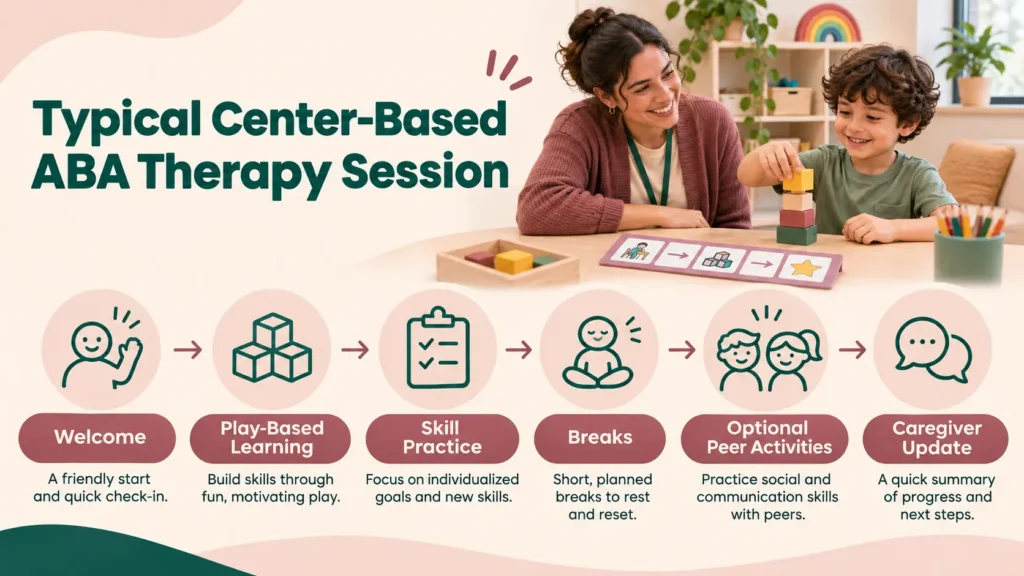
A Typical Center-Based ABA Therapy Session
Illustrative routine — not a fixed schedule
Welcome and Settling In → Play-Based Learning → Individual Skill Practice → Breaks and Regulation → Optional Peer Activities → Caregiver Update
During play-based learning, a therapist might help a child request building blocks using speech, gestures, or an augmentative and alternative communication (AAC) device.
Individual learning activities can focus on functional communication, self-regulation or other meaningful targets. Breaks should be available as needed and as communicated by the child.
Where appropriate, peer activities could include collaborative play or collaborative resources. They should allow for the child’s wishes, not force any unwanted social involvement.
Therapists might end with some observations to caregivers about activities practiced during the session, communication needs, and modifications that occurred during the session.
It’s also important to know what to expect from center-based ABA therapy as length, activities and teaching style are different for each child and program.
What Are the Benefits of Center-Based ABA Therapy for Children?
The benefits of center-based ABA therapy depend on each child’s goals, communication needs, preferences and support environment.
Structured Learning and Predictable Routines
Predictable activities, instructions, and visual supports can be helpful for children to understand what comes next in structured ABA therapy. These routines can help minimize transitions of uncertainty.
But, structure should not be rigid. Children should be given opportunities to express their preferences, to take breaks and to take part at a comfortable pace.
Example: Moving From Playtime to Snack Time
A visual schedule is presented to a therapist and advance warning is provided before snack time. The child can request additional time or support during the transition.
Social Interaction and Peer Learning Opportunities
Center-based programs can offer opportunities for social interaction through cooperative tasks, group activities and shared play. Social communication skills can be practiced within meaningful situations.
These experiences can include giving your own preferences, swapping materials, or responding to your child’s communication. Participation should be in accordance with personal interests and comfort.
Example: Building a Tower Together
Two children build a tower using colorful blocks. They learn to select materials, ask for objects and take turns without forcing interaction with them, with support.
Communication and Everyday Living Skills
One potential benefit of center-based ABA therapy is practicing functional communication and daily living skills through activities connected to the child’s everyday needs.
Communication can be verbal, gestural, pictorial, using AAC devices or other means that are accessible. Other goals that can be meaningful could include helping with grooming, getting dressed, or scheduling tasks or asking for support.
Professional Supervision and Individualized Support
• BCBA Supervision: A qualified behavior analyst develops treatment goals, monitors learning, supervises assigned staff, and adjusts strategies according to individual progress and needs.
• Qualified Direct-Care Support: Teaching strategies are implemented by trained staff (including RBTs where applicable) with appropriate supervision and under an individualized treatment plan.
• Adapted Learning Activities: Individualized ABA therapy involves instruction, materials, breaks, and environmental supports to match the skills, interests, and sensory preferences of the individual child.
• Family Communication: These can be used by caregivers to talk about treatment priorities, review progress and discuss information about skills that are important outside of therapy.
School Readiness and Skill Generalization
Center-based ABA therapy can offer the opportunity for a child to have practice with learning school readiness skills, such as communicating needs, transitioning, and engaging in shared activities with support.
An important treatment goal is skill generalization: using a learned skill across different people, activities, and environments rather than only during therapy sessions.
Example: Requesting a Break Across Settings
Child engages in a break request during an activity. They can be supported by a caregiver or educator at home and school using the same communication skill.
Our School Consultation Services help families and educational teams coordinate practical strategies across learning environments.
What Strategies Are Used in Clinic-Based ABA Therapy?
Clinic-based ABA therapy uses different teaching strategies based on individual treatment goals. The following approaches are examples of how learning can facilitate communication, independence and everyday participation.
1. Positive Reinforcement: A meaningful, preferred response follows a useful skill, increasing the likelihood it happens again. For instance, upon asking for a requested activity, a child is granted access to it.
2. Natural Environment Teaching (NET): Learning happens during ordinary activities and preferred play. A therapist might provide assistance in requesting, choosing or naming objects as a child constructs with blocks.
3. Discrete Trial Training (DTT): This is a structured approach to teaching specific skills in short learning trials and feedback sessions. Selected goals may be used as an adjunct to naturalistic child-centered learning, if appropriate.
4. Functional Communication Training (FCT): Children develop accessible means to communicate needs such as asking for assistance, breaks, attention, or desired items. Teaching considers the purpose of communication and individual abilities.
5. Prompting and Prompt Fading: Therapists offer the necessary support in the development of a skill and then fade it gradually. The aim is greater independence without unnecessary pressure.
6. Task analysis: breaking down tasks into small steps to be managed. Handwashing might involve turning on water, using soap, rinsing and drying hands with appropriate support to each step.
7. Skill Generalization: A skill learned during therapy is practiced with different people, materials, or environments. This enables children to apply their purposeful skills in more than one activity.
8. Child-Led Learning and Assent: Therapists incorporate preferred interests, meaningful choices, and opportunities to decline activities. If a child is uncomfortable or refuses, then attention, communication and adjustments should be made.
Not every strategy is needed for every child. Treatment options should be chosen depending on individual goals, Clinical Judgment and the well being of the child.
Center-Based vs In-Home ABA Therapy: What’s the Difference?
When comparing center-based vs in-home ABA therapy, parents should consider where their child feels comfortable, which skills need support, and how treatment fits family routines.
In both settings, opportunities for learning can be meaningful, and instruction can be individualized, with professional oversight. Their practical differences relate mainly to the environment and available activities.
| Comparison Area | Center-Based ABA Therapy | In-Home ABA Therapy |
| Environment | Designated therapy spaces with planned activities | Familiar household environment |
| Peer Interaction | May include supported peer activities | Usually focuses on individual and family interactions |
| Parent Involvement | Often includes scheduled updates and coaching | May allow more direct participation in household routines |
| Daily Living Skills | Practice through planned activities and available materials | Practice within actual home routines |
| Flexibility | Depends on center schedules and resources | Depends on provider availability and household routines |
| Accessibility | Usually requires travel to the center | Reduces travel for the child, subject to service availability |
| Skill Generalization | Requires intentional practice beyond the center | Requires intentional practice beyond familiar home settings |
Center-based treatment might be appropriate for children who do better when treated in a dedicated learning environment or in a setting that provides the right kind of peer opportunities. In-home treatment may suit children whose goals involve everyday household activities.
For some children, neither method is more effective. Treatment goals, sensory needs, preferences, caregiver circumstances, and clinical recommendations should guide the decision.
At ALMA Behavioral Solutions, in-home ABA Therapy is personalized to suit each child’s learning needs and helps build in-home routines to provide individualized learning opportunities, while involving family members in the process to build meaningful daily skills.
What Should Parents Expect During the First Week of Center-Based ABA Therapy?
The ABA therapy first day and initial adjustment period often focus on familiarity, communication, and trust rather than expecting immediate measurable changes.
1. Meeting the Therapy Team: Your child becomes familiar with therapists, treatment spaces, and available activities. Introductions can take place over time according to level of comfort and communication.
2. Exploring Preferred Activities: Therapists identify toys, games, and interests your child enjoys. These activities help establish positive interactions and a comfortable learning relationship.
3. Knowing your child’s communication needs: Staff watch how your child expresses their likes, dislikes and needs for help. They should offer ease of communication and sensory accommodations.
4. Introducing Learning Activities Gradually: Individualized activities begin at a suitable pace. Therapists can modify instructions, transitions, and learning goals, based on the child’s responses.
5. Observing Comfort and Engagement: The clinical team monitors participation, stress signals, and preferred activities. Breaks and environmental adjustments may support a more comfortable experience.
6. Sharing Parent Feedback: Caregivers can discuss observations, ask questions, and identify concerns. Regular communication allows for the therapist to get a sense of what their child requires during this transitioning phase.
Families can make the most of this time by having realistic expectations of what to expect from ABA therapy. Trust building and child understanding is a critical first priority.
How Can Parents Prepare for ABA Therapy in a Center?
Preparing for ABA therapy in a center involves understanding your child’s preferences and sharing helpful information with the treatment team before the first session.
First-Day Preparation Checklist
• Become Familiar With the Center: Ask whether photos, a tour, or an introductory visit are available.
• Introduce a Visual Schedule: Explain upcoming activities using a communication format your child understands.
• Share Communication Preferences: Describe speech, gestures, AAC devices, or other ways your child expresses needs.
• Talk about Sensory Accommodations: Talk about noise sensitivities, movement needs, quiet spaces or quiet activities to break.
• Prepare Familiar Items: Let your child know if it’s OK to have familiar items such as comfort objects, snacks, or supplies with them.
• Discuss Parent Updates: Inquire about how therapists share participation and concerns after sessions and what the next steps are.
Be flexible in the preparation. Other children prefer to have information about what is coming before they arrive, whereas others need to be eased into new places and people.
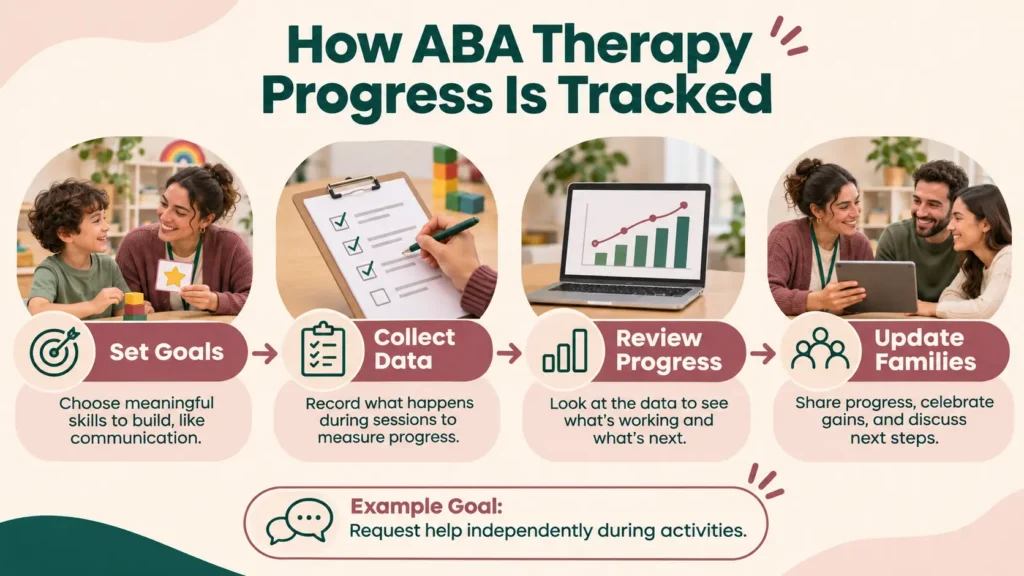
How Is Progress Tracked in Center-Based ABA Therapy?
ABA therapy progress reports enable parents to grasp what their child is learning, how progress is being recorded, and whether there are any changes to the treatment plan.
A BCBA typically identifies observable treatment goals and reviews information collected during sessions. Communication, independence, participation and generalization across settings can be part of progress monitoring.
How ABA Therapy Progress Is Monitored
Set Individualized Goals → Collect Session Data → Review Progress → Update Families
Example: Measuring Independent Requests for Help
A therapist documents the opportunities when a child requires help, and whether the child needs to ask for help, access a communication support or be prompted.
As time passes, the BCBA looks at patterns, assesses the effectiveness of the teaching method, and takes caregiver feedback into account regarding the same skill at home.
Progress is not the same as success at activities. It also covers the usefulness, meaning and increasing availability of the skills in everyday situations.
At ALMA Behavioral Solutions, we value family collaboration. Parent Support Services assist parents to know and practice goals and strategies in daily routines.
How Do Parents Choose an ABA Therapy Center for Autism?
Choosing an ABA therapy center for autism involves evaluating more than the location or schedule. Families can be asking about the quality of treatment, individual support, and children’s well-being.
1. Who Supervises Treatment? Inquire about the qualifications of the BCBA, training of direct care staff, supervision, and clinical decision making throughout the child’s treatment.
2. How Are Goals Individualized? Determine if treatment priorities are consistent with child’s strengths, communication preferences, developmental needs and goals agreed upon with caregivers.
3. How Is Child Autonomy Respected? Discuss how therapists know when to accept, when to respond in the event of refusal or distress, how to offer meaningful choices and how to avoid unnecessary demands focused on compliance.
4. What Sensory Accommodations Are Available? Talk about quiet rooms, time for activity, support for communication, room changes and what staff do when a child is overwhelmed.
5. How Parents are Involved? Discuss the caregiver coaching, progress meetings, communication, and ways to support skills at home, in the classroom, and community.
6. What are the indicators of progress? Ask for clarification of personal objectives, ways of observing, progress reporting and when treatment changes are indicated.
A good program will invite questions and communicate the services offered and how they relate to your child’s needs.
Frequently Asked Questions About Center-Based ABA Therapy
What Age Can a Child Start Center-Based ABA Therapy?
Center-based ABA therapy for children may begin during early childhood, although eligibility differs between providers. Considering developmental needs, individual goals, assessment results and available services, rather than just a single starting age, is important in making early intervention decisions.
How Many Hours of Center-Based ABA Therapy Does a Child Need?
Center-based ABA therapy hours vary by child’s treatment goals, clinical needs, comfort level, and family situation. An appropriate schedule and whether the intensity is appropriate should be recommended by a qualified clinician and reassessed as treatment proceeds.
Can Parents Participate in Center-Based ABA Therapy?
Yes. Parent involvement in ABA therapy may include treatment planning, caregiver coaching, progress meetings, and practicing useful skills at home. Opportunities to observe or join sessions depend on the center’s policies, treatment goals, and individual circumstances.
Does Insurance Cover Center-Based ABA Therapy?
Center-based ABA therapy insurance coverage varies by health plan, provider network, medical-necessity requirements, and authorization rules. Benefits and expenses vary, some plans cover eligible services. Families should check coverage, provider participation and any approvals with their insurance provider.
Can a Child Receive Both In-Home and Center-Based ABA Therapy?
Yes some children may be provided for coordinated support across settings when clinically appropriate and available. When implementing in-home and center-based ABA therapy, it’s important to have a clear treatment plan, communication among providers, an appropriate schedule and the appropriate insurance authorization to prevent overlapping or conflicting therapy.
What If My Child Has Difficulty Adjusting to an ABA Therapy Center?
Tell the treatment team if your child experiences distress or difficulty adjusting. Therapists should take communication needs, sensory accommodations, preferred activities and gradual introductions into account. If it causes significant amounts of discomfort, re-think the approach and do not push a child to participate without suitable support.
Finding ABA Therapy Support That Fits Your Child
Your child’s strengths, way of communicating, comfort and daily needs should all be taken into account in the right setting for ABA therapy. Individual support is more important than one setting versus another.
We provide families with personalized in-home ABA services, parent support, and school consultation in Glendale and neighboring communities in Southern California at ALMA Behavioral Solutions.
Our focus is on meaningful communication, daily living skills, and family collaboration. If you’re exploring suitable options, Connect with our team to discuss your child’s needs.
Call: (747) 250-8494