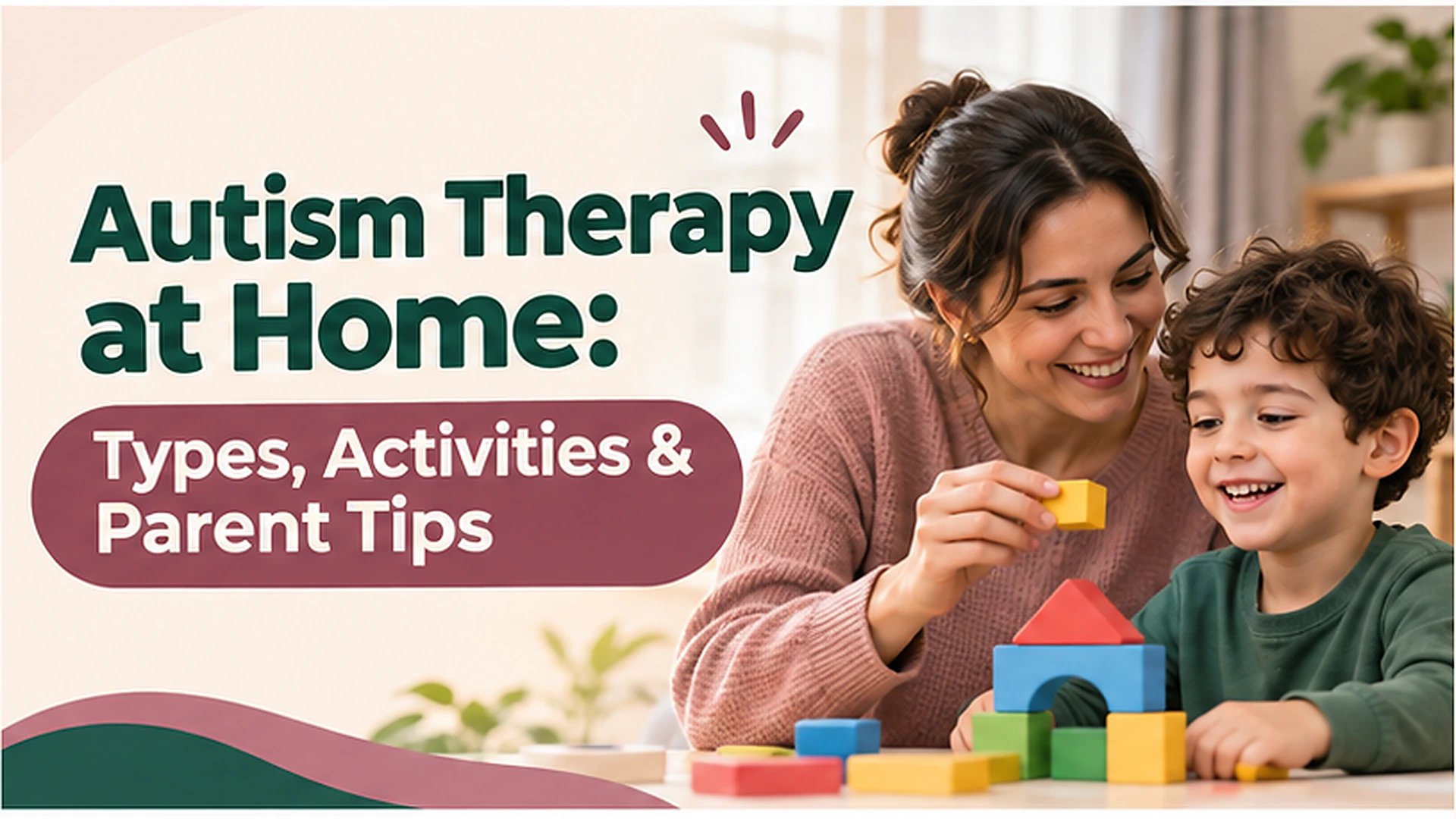

Autism therapy at home involves individualized support that helps autistic children develop meaningful skills during everyday family routines. This can include professional therapy sessions at home, caregiver-led activities, or virtual therapy with trained therapists. It’s about communication, independence, participation, well-being and not about changing who a child is.
Depending on your child’s needs, families can learn about Applied Behavior Analysis (ABA), speech-language, occupational and developmental approaches. This guide outlines these options and provides some tips on supporting learning at home.
Key Takeaways
· Parent-led activities and professional therapy are different activities.
· Useful skills are developed naturally during daily routine.
· Child preferences, individualized goals and professional guidance are important.
· Small, flexible activities fit in family life without being overwhelming.
What Is Autism Therapy at Home?
Home-based autism therapy refers to therapeutic services or guided skill practice within a child’s everyday environment. Home is a treatment setting, not a specific therapy method. The right approach will vary for each child depending on their strengths, support needs and family priorities. Families considering at home therapy for autism can discuss suitable options with their care team.
The CDC identifies home, school, health and community as potential settings for autism interventions.
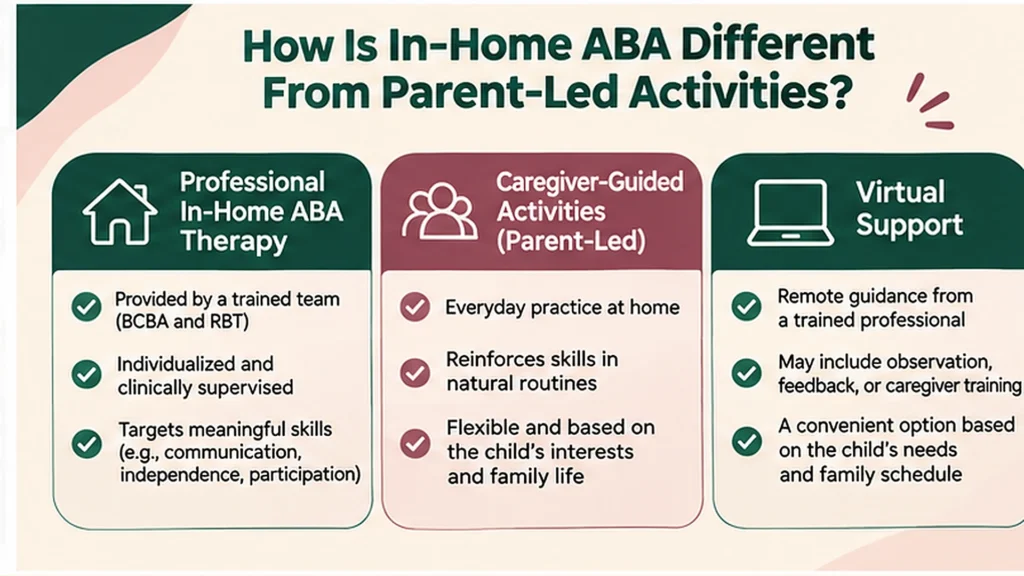
How Is In-Home ABA Different From Parent-Led Activities?
In-home ABA therapy provides professionally evaluated and supervised therapy, while parent-led services reinforce appropriate skills in a natural environment.
| Support model | Professional involvement | Main purpose |
| In-home ABA | BCBA supervision and trained providers | Individualized treatment and progress monitoring |
| Parent-led activities | Guidance from the child’s care team | Everyday skill practice |
| Virtual support | Remote professional guidance | Coaching, feedback, or appropriate remote services |
Parent-led practice is not intended to supplant clinically indicated professional care, but rather to augment it.
What Are the Benefits of Autism Therapy at Home?
Autism support at home may offer several advantages when matched to a child’s individual needs.
· Familiar surroundings: Children may feel more at ease if they can use known areas, people and objects to participate.
· Real-life learning: Families can help children to communicate, dress and other skills during real life routines.
· Caregiver involvement: Parents can gain insight into therapeutic objectives, provide observations and work cooperatively with professionals.
· Flexible opportunities: Activities may be geared to a child’s interests, energy level and family schedule.
· Skill generalization: Practicing a skill in different situations may help children use it beyond formal therapy sessions.
But in the home environment, there are distractions, scheduling problems or limited resources. Some children benefit more from clinic-based, school-based, or combined services.
Types of Autism Therapy Families Can Explore at Home
There are various types of therapy that address varying developmental and functional needs. Families can choose to use one or a combination of services after professional assessment.
ABA Therapy for Autism at Home
ABA therapy for autism at home uses individualized learning strategies to support meaningful communication, independence, and daily participation.
A Board Certified Behavior Analyst (BCBA) develops and supervises treatment plans. A Registered Behavior Technician (RBT) may provide services under appropriate supervision.
Natural Environment Teaching (NET) is blended with learning every day and functional Communication Training (FCT) is used to help with communication of needs. Positive reinforcement and other strategies should respect the child’s preferences and willingness to participate.
Learn about ALMA’s ABA Therapy for Families.
How to Do Speech Therapy at Home for Autism?
A speech-language pathologist (SLP) can recommend speech therapy activities for autism at home based on individual communication needs.
Parents can demonstrate language, provide options and encourage the use of augmentative and alternative communication (AAC) such as using gestures, using pictures, or using communication devices.
According to ASHA, communication support should recognize different communication methods and involve family collaboration.
How to Do Occupational Therapy at Home for Autism?
Occupational therapy helps with participation in daily activities such as self-care, fine motor tasks, toothbrushing and dressing.
An occupational therapist might suggest modifications to routine to help make it easier and more comfortable. Occupational therapy activities for autism should follow the child’s individual needs.
Activities should be based on personal sensory preferences and professional advice. Specialized feeding interventions or sensory techniques should not be attempted without appropriate clinical assessment.
Play-Based and Developmental Approaches
Play-based developmental interventions use children’s interests and natural interactions to support learning.
Naturalistic Developmental Behavioral Interventions (NDBIs), including the Early Start Denver Model (ESDM), combine developmental principles with learning opportunities during play.
Other relationship focused strategies focus on responsive interaction. They have different approaches and evidence, so families need to talk to professionals about what works and what is being offered.
Parent Coaching and Virtual Therapy
Caregiver coaching supports families to learn and implement therapeutic recommendations in their everyday lives. ABA parent training may be one part of that support.
Virtual services may involve remote observation, professional feedback, caregiver training, or suitable therapy sessions.
ALMA’s Parent Support and Virtual ABA Therapy provide additional information about available support options.
The suitability of remote care is determined by clinical and technological requirements and family factors.
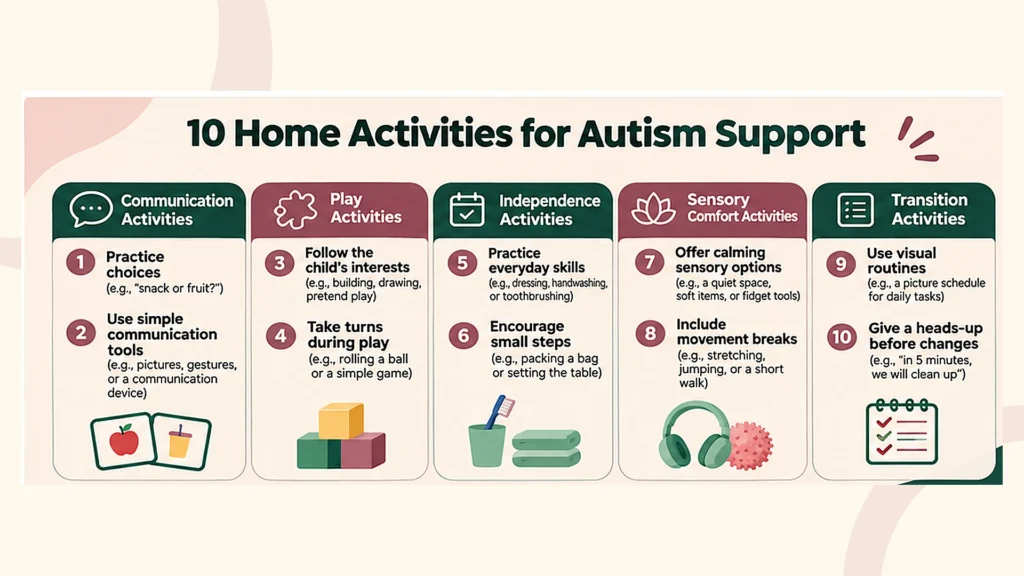
10 Easy Autism Therapy Activities to Practice at Home
These autism activities at home provide opportunities to support communication, play, independence, and comfort. Do activities that you and your child are interested in, have the ability to do, and are recommended by professionals.
| Activity | Skill addressed | How to practice | Adaptation or safety |
| Communication: Snack-time choices | Expressing preferences | Offer two suitable choices, pause, and respond to the child’s selection. | Accept speech, gestures, pictures, or AAC. |
| Communication: Picture books | Communication and shared attention | Follow the child’s interest, comment on pictures, and invite interaction. | Avoid demanding spoken answers. |
| Play: Rolling a ball | Shared play | Offer a gentle roll, pause, and follow the child’s response. | Use a soft ball and respect preferences. |
| Play: Building blocks | Cooperation and creativity | Let the child choose pieces and invite shared building. | Do not force turn-taking. |
| Daily living: Dressing | Independence | Offer clothing choices and break dressing into manageable steps. | Consider comfortable fabrics and accessible fasteners. |
| Daily living: Toothbrushing | Self-care | Preview the routine, offer a preferred toothbrush, and practice comfortable steps. | Seek professional advice for persistent distress. |
| Regulation: Quiet corner | Sensory comfort | Create an accessible, calm space with preferred comforting items. | Never use it as punishment. |
| Regulation: Movement breaks | Body awareness and comfort | Offer a preferred, safe movement activity. | Consider mobility needs and supervision. |
| Transitions: First-then board | Understanding routines | Show the current activity and what comes next. | Use meaningful pictures, objects, or words. |
| Transitions: Visual schedule | Predictability | Review upcoming activities and update changes together. | Keep schedules flexible. |
Prevent access to weighted sensory equipment or choking toys, and don’t provide any specific sensory intervention without instruction. Home activities are not a substitute for professional indications of treatment.
How to Start Autism Therapy Activities at Home: 6 Steps
It doesn’t take a lot of resources or a structured program each day to start parent-led autism activities. Get going with one impactful goal.
1. Identify strengths and priorities: Consider your child’s interests, preferred communication methods, sensory needs, and existing abilities.
2. Choose one meaningful goal: Work with your child’s care team on a realistic goal for participation that you can both accomplish.
3. Select an existing daily routine: Use meals, playtime, dressing, or bedtime as an opportunity, rather than an additional session.
4. Prepare helpful materials: Provide access to preferred toys, visual supports, or AAC as appropriate.
5. Practice without pressure: Model skills, allow processing time, and respect requests for help, breaks, or stopping.
6. Monitor and check progress: Record changes in communication, participation, comfort or independence and consult with professionals.
Example: During snack time, a parent offers two choices and accepts the child’s preferred communication method. A brief progress note is made to note if the child expressed a choice comfortably and what helpful supports they used.
Progress should reflect meaningful participation, not merely task completion.
ABA Strategies Parents Can Use During Daily Routines
Several autism therapy strategies for parents draw on ABA principles. These facilitative methods are not the same as an individual clinical behavior intervention.
· Positive reinforcement: Respond positively to useful communication or participation, such as acknowledging a request for help or honoring a request for a break.
· Modeling and supportive prompting: Demonstrate an action or offer a helpful cue. Professionals should guide formal prompting and fading procedures.
· Visual schedules: Make use of pictures, objects and first then statements to clarify routines and changes.
· Task analysis: Divide complex skills, such as getting dressed, into smaller, manageable steps.
· Functional communication: Facilitate meaningful requests, choices, refusals, and self-advocacy in accessible modes of communication.
· Generalization: Help children use relevant skills with different people and in appropriate everyday settings.
A BCBA should supervise individualized ABA treatment plans. Professional assessment is required for complex interventions, intensive behaviour procedures and important safety concerns.
A Simple Daily Home-Practice Schedule
Home practice does not need to become a series of formal therapy sessions. Existing routines can provide flexible learning opportunities.
| Routine | Skill focus | Flexible practice opportunity |
| Morning | Dressing and independence | Offer clothing choices or support one manageable dressing step. |
| Playtime | Communication and interaction | Follow a preferred activity and respond to communication. |
| Meals | Choice-making | Support requests and preferences using accessible communication. |
| Bedtime | Predictability | Review familiar routines using appropriate visual supports. |
Common Mistakes to Avoid With Autism Therapy at Home
Practicing autism therapy at home should support communication, independence, and meaningful participation without overwhelming your child. When introducing activities at home, avoid these common mistakes:
· Setting too many goals: Focus on one meaningful skill at a time and make gradual changes.
· Prioritizing compliance: Encourage communication, personal choice, and autonomy rather than blind obedience.
· Forcing eye contact or stopping harmless stimming: Respect your child’s natural communication and self-regulation.
· Ignoring sensory needs: Modify activities to suit your child’s comfort, communication style and desire for participation.
· Using complex interventions without guidance: Do not use intensive behavioral procedures without consultation of qualified professionals.
How to Choose an In-Home ABA Therapy Provider
Choosing the right in-home ABA therapy provider involves evaluating professional qualifications, individualized treatment plans, and family involvement. These five factors should be taken into account when families begin investigating home-based autism therapy in Southern California:
1. Professional qualifications: Check credentials of BCBA, therapist qualifications and supervision arrangements.
2. Individualized treatment plans: Look for providers that evaluate your child’s strengths, needs, and important developmental goals.
3. Parent involvement: Ask about caregiver training, progress updates, and collaboration with other professionals.
4. Child-centered care: Seek strategies that take account of communication differences, sensory preferences and learner autonomy.
5. Insurance and availability: Verify service areas, coverage, authorization, and if home-based sessions are suitable and available.
Autism Treatment: When to Seek Professional or Medical Help
Autism treatment and supportive interventions should address individual needs rather than attempt to change an autistic person’s identity. Some concerns need extra healthcare advice; however, behavioral and developmental therapies can help with communication and daily living skills.
For children who have ongoing sleep problems, feeding issues, severe distress, dramatic changes in behavior and safety risks, parents should seek professional advice.
Medications can be used to control some of the associated conditions but cannot cure the core symptoms of autism. Medical and therapeutic supports must be tailored to the individual, according to the CDC.
Professional evaluation is used to help families identify interventions, accommodations and medical services that may be needed.
Frequently Asked Questions About Autism Therapy at Home
Can Parents Practice Speech and Occupational Therapy Activities at Home?
Yes. Parents can support communication and daily living skills in the home with activities suggested by the speech-language pathologist and occupational therapist. Professional assessment determines appropriate goals, adaptations and safe limits. Home practice supports care but does not replace specialized therapy when clinically needed.
Does Insurance Cover In-Home ABA Therapy?
Sometimes. Medical need, plan guidelines, provider network, authorization and approved settings dictate coverage. California Medi-Cal covers medically necessary behavioral health treatment, including ABA, for eligible members under 21. Confirm specific in-home benefits and requirements before arranging services with providers.
Is There a Cure for Autism?
No. Autism is a lifelong neurodevelopmental difference, not a disease requiring a cure. Individual supports can support communication, access, independence, safety and well-being, without removing autistic identity. Goals should indicate the preferences, priorities, and quality of life over time for the person.
Can Autism Medications Replace Therapy?
No. Medications do not cure autism; they do not replace beneficial developmental and behavioral supports. An authorized prescriber can manage co-occurring conditions or certain symptoms, evaluate benefits and side effects, and coordinate choices with family and providers involved.
How Can Parents Support an Autistic Child During Difficult Moments?
First, prioritize safety and consider possible distress, pain, sensory overload, or communication barriers. Reduce demands, provide an alternative, and respect requests for space and help. Seek professional guidance when distress repeatedly interferes with daily life or safety is a concern.
Explore Personalized ABA Support with ALMA Behavioral Solutions
Every child deserves individualized support that respects their strengths, communication preferences, and unique needs. At ALMA Behavioral Solutions, we focus on meaningful skill development, caregiver collaboration, and personalized ABA support that fits each family’s goals.
Looking for In-home aba therapy near me? Our team can help families across Southern California explore available ABA therapy options, understand appropriate service settings, and determine whether home-based support may be suitable for their child’s needs.
We believe families should feel informed and involved throughout their child’s care journey, with professional guidance that supports communication, independence, and everyday participation.
Explore Personalized ABA Support and connect with our team to discuss your child’s needs.