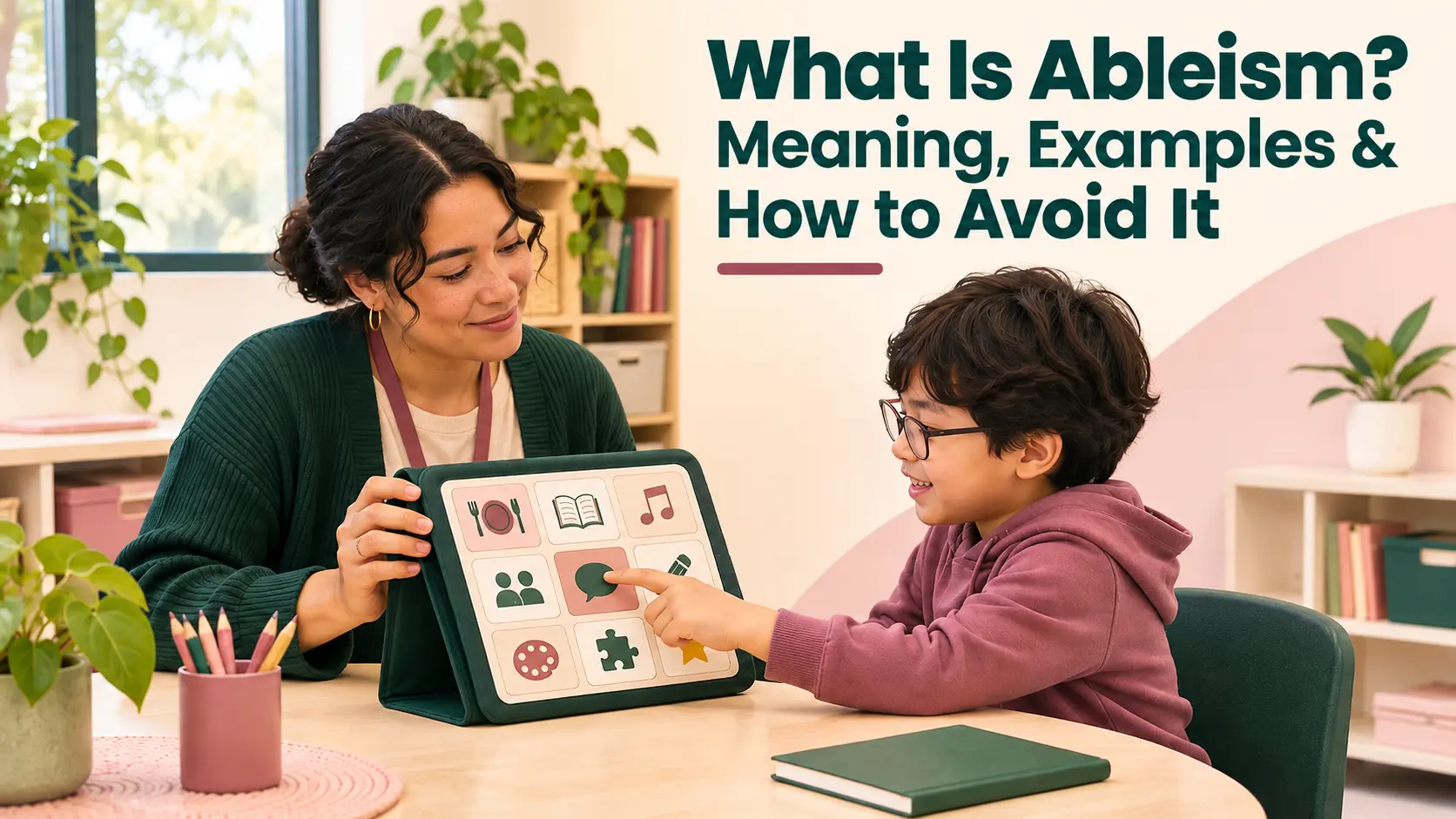

Have you ever witnessed someone being prevented from taking part in an activity due to the belief of others that it would be beyond them? Exclusion is sometimes disguised as help or concern. These assumptions may restrict the opportunities, independence and belonging of disabled people. Families, educators and communities can be better informed to respond to these patterns when they are recognized.
What Is Ableism?
Ableism is a prejudice or discrimination against a person with a disability due to the assumption of the superiority of some bodies, minds, or abilities over others. As access living, a disability-led group, says, ableism can impact individual attitudes and social structures. It may be intentional or occur through everyday practices that overlook accessibility needs.
These barriers may manifest in schools, workplaces, healthcare or public places, whether they are inaccessible communication, exclusionary policies or decisions taken without involving disabled people. Addressing ableism involves identifying unfair practices, removing unnecessary barriers, and creating opportunities for equitable participation.
What Does Ableism Mean?
The meaning of ableism becomes clearer in everyday interactions. An ableist assumption sees disability as proof of lack of understanding, contribution or decision making. Such judgments fail to take into account personal skills, preferences, and support needs.
Example: Teacher sees autistic student not looking at him/her during instructions and assumes that he or she is not paying attention. The teacher leaves a group activity without verifying their understanding. Rather, the teacher could easily give directions, assess understanding, and encourage engagement without eye contact.
What Are the Main Types of Ableism?
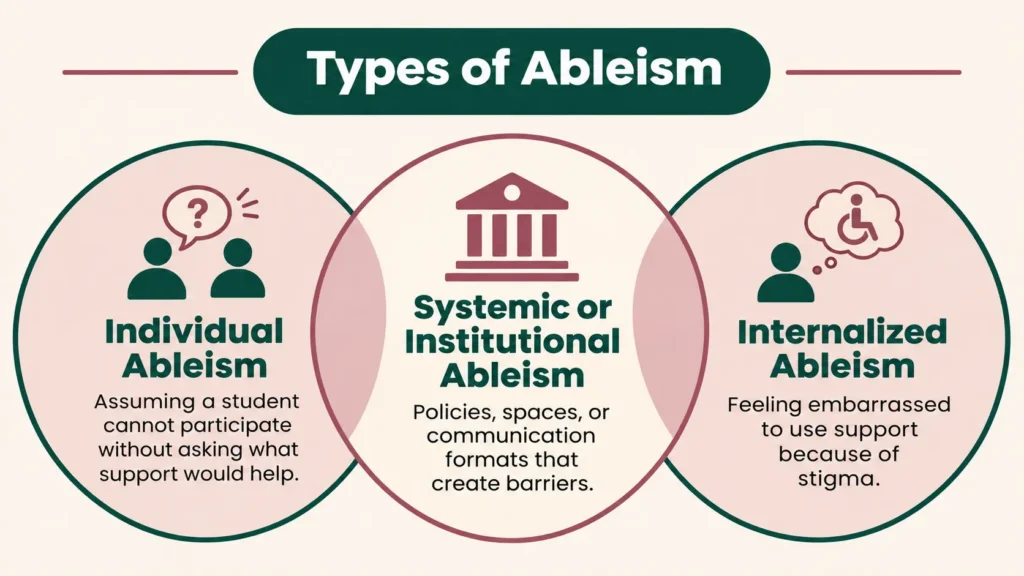
The main types of ableism are commonly described as individual, systemic or institutional, and internalized. These are overlapping categories that impact an individual at once. Ableism can affect people with physical, cognitive, developmental, psychiatric, or other disabilities.
Individual Ableism
Individual ableism involves one person’s assumptions, stereotypes, or actions toward somebody with a disability. It could be obviously aggressive or somewhat condescending without intending to say no.
Example: A coach assumes a wheelchair user cannot take part in a team activity. Questions about modifications honor the student’s strengths and choices instead of making choices for him/her.
Systemic or Institutional Ableism
Systemic ableism is when rules, services, or the environment systematically exclude disabled people. There need not be a single individual who expresses prejudice. Barriers may include:
1. Buildings or event spaces without appropriate access.
2. Strict classroom protocols that do not allow for disability needs.
3. Key data not available in accessible communication formats.
These barriers call for changes to policies and design, not only more positive attitudes. Relevant disability-rights requirements depend on the setting and circumstances.
What Is Internalized Ableism?
Internalized ableism occurs when an individual internalizes negative messages about disability and then applies them to themselves. They may feel that they have to conceal their needs, look nondisabled or fail to request for helpful support. This experience is not universal.
Example: A student discontinues a helpful classroom accommodation because peers deem it too much of a cheat. Adults can reiterate that equity in support is not something to be embarrassed about, it is a means of helping people participate.
Common Ableism Examples in Everyday Life
Ableism examples include dismissive assumptions, unequal treatment, inaccessible information, and language that reduces people to diagnoses. People can respond to the barrier and not give a generic reminder.
Everyday Assumptions and Accessibility Barriers
- Personal interactions: Someone directs every question to a disabled adult’s companion. Rather, talk to the person and find out what they want to communicate.
- Healthcare: Professionals believe patients cannot describe pain due to their method of communication. Provide easy-to-access symptom and preference sharing options.
- Education: A student is excluded from group work without considering accommodations. Discuss what modifications would enable it to be possible to participate.
- Public spaces: Organizers select an inaccessible space that creates barriers. Before inviting, please check the accessibility.
- Digital access: Important instructions appear only in an image without useful text. Offer alternatives that are readable, accessible.
Although these are each unique barriers, they can all limit access when the physical needs of individuals are not being met in the real world and work environments.
Ableist Language Examples: What to Say Instead
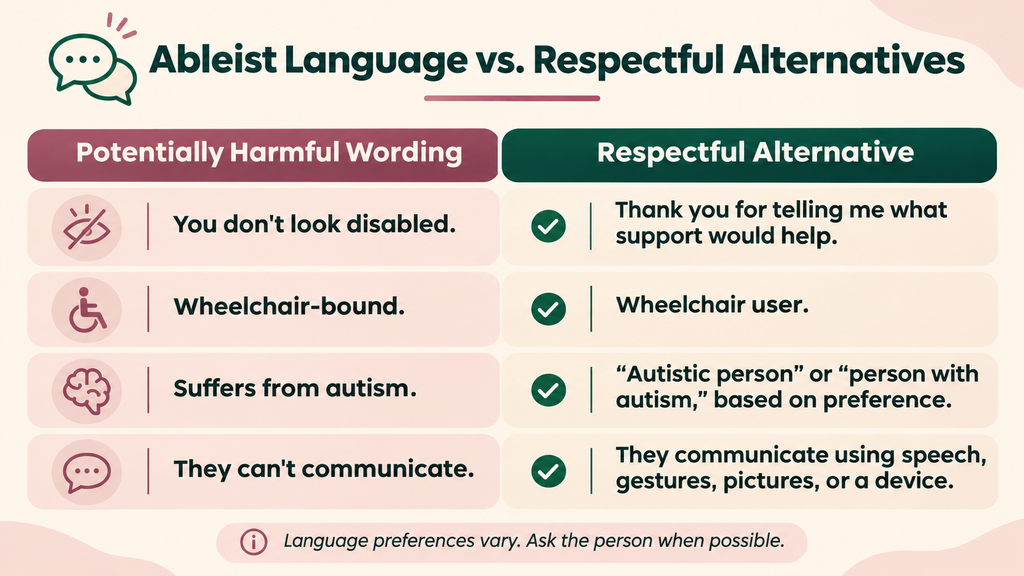
Some ableist language examples arise from assumptions rather than openly insulting words. Respectful phrasing is specific, not pitiable, and respects a person’s preferences. It should also not presume a diagnosis as an explanation of all things a person does.
| Ableist or Potentially Harmful Wording | Respectful Alternative |
| “You don’t look disabled.” | “Thank you for sharing what support would help.” |
| “Wheelchair-bound.” | “Wheelchair user” or “person who uses a wheelchair.” |
| “Suffers from autism.” | “Autistic person” or “person with autism,” according to preference. |
| “They can’t communicate.” | Describe the person’s actual communication methods and needs. |
Example: Calling a child “noncommunicative” may overlook meaningful gestures or use of augmentative and alternative communication (AAC). Explain the child’s behaviour and what supports it.
Some individuals use Identity-First terms, such as “autistic person,” while others use person-first terms, like “person with autism.”
Ableism in Autism and ABA Therapy
Ableism in autism happens when it’s more important for a child to look neurotypical than communicate or participate. Support should focus on the needs.
Ableism in Autism: Eye Contact, Stimming, and Communication
- Eye contact: Some children listen without looking into the eye. Teachers require eye-to-eye contact which causes distress. Rather, assess understanding by asking a question or using a preferred communication.
- Stimming: Repetitive movements may support regulation. A parent ends the harmless hand movements since they seem strange. Think of the function and safety before intervening.
- Communication: Speech is not the only option. A playground leader ignores a picture-based request. Recognizing AAC and gestures supports participation.
- Sensory needs: Bright lights, crowded rooms and unexpected noise can cause distress. When a child asks for a quiet space, rather than assume it is a form of being disobedient, make a reasonable adjustment if possible.
- Social participation: Inclusion does not require identical participation. A child enjoys parallel play; encourages children to participate but not in the same way as other children.
How Does Ableism Affect Autism Therapy?
Ableism in ABA therapy can happen when treatment priorities are rooted in making an autistic child seem more neurotypical, rather than in helping him to communicate, be independent, and to be well. Effective therapy will focus on meaningful skills and take into consideration each learner’s ability, preference and needs.
The research on neurodiversity affirming ABA emphasizes personalized goals and learner’s dignity. Key considerations include:
- Autonomy: Involve learners in decisions and offer meaningful choices.
- Assent: Recognize and respond to signs of discomfort or refusal.
- Communication: Support different communication methods, including AAC.
- Safety: Balance therapeutic goals with the learner’s well-being.
- Collaboration: Develop and review goals with learners and families.
For more information, see ALMA ABA Therapy for Families.
How Ableism Affects Children and Families
Ableism can shape opportunities as well as individual interactions. The results vary from person to person and situation to situation. Possible consequences include:
- Emotional wellbeing: Being dismissed or having negative assumptions can lead to frustration, embarrassment or loss of confidence.
- Friendships: Being left out of games or events can limit chances to form relationships and experience belonging.
- Education: When a child knows what to learn, but is denied the opportunity to learn due to lack of accommodations or inaccessible teaching methods.
- Family advocacy: Spending additional time explaining needs, arranging supports or resolving misunderstandings.
- Self-advocacy: When adults ignore a child’s preferences, opportunities to practice expressing boundaries and asking for help can shrink.
How to Avoid Ableism: 8 Practical Strategies
Learning how to avoid ableism begins with making different choices on a daily basis — not memorizing a vocabulary list. Families, educators, and professionals can look out for assumptions and act in a more considered way with these eight actions.
- Listen to Disabled People’s Experiences: Inquire about support and be attentive to the answer. Listen to the voices of those with a disability and not see one person’s story as another person’s story.
- Question Assumptions About Ability: Do not assume that a person is unable to participate, unless you ask what the activity entails and if an adjustment would be helpful. Focus on the individual skills, not diagnostic labels.
- Use Respectful, Individualized Language: When applicable, inquire about identity first or person first. Describe specific skills and needs, and supports, rather than using labels of ‘normal’ and ‘low functioning’.
- Make Communication More Accessible: Provide printed, pictorial, verbal or AAC representations as helpful. Allow sufficient processing time and test understanding but not presume that it will be given in speech.
- Respect Sensory Needs and Boundaries: Ask before touching or physically guiding someone. Plan activities with light, noise, seating, breaks and transition for consideration, not all to be acceptable to all.
- Include Children in Meaningful Decisions: Offer age-appropriate options and observes child’s response to the choices being made as to what they agree, care, or refuse. Every decision, even as simple as what activity or seating, offers a chance for participation.
- Address Ableist Comments Constructively: Correct misconception without embarrassing the person involved. For example, tell privately that using a communication device is not an indicator of a lack of ideas or understanding.
- Keep Learning and Reviewing Practices: Inquire about the effectiveness of accommodations. Seek input from disabled individuals, families and relevant professionals and modify routines – do not justify an approach because it is familiar.
Inclusive Practices at Home, in Schools, and in ABA Therapy
The process of inclusion takes time and requires action in settings over time.
Creating an Inclusive Home Environment
- Offer appropriate choices about routines and play.
- Use communication support the child prefers.
- Provide appropriate sensory breaks.
- Avoid comparing siblings or developmental timelines.
- Encourage preferences, help requests, and boundaries.
- Talk about disability with respect in the family.
Consider inviting children to choose between two activities, then honoring the choice when practical. Support should accompany the child and not be another rule to adhere to.
For family guidance, explore ALMA Parent Support.
How to Prevent Ableism in Schools and Classrooms
How to prevent ableism in schools starts with classroom access:
- Discuss barriers to participation.
- Use suitable communication supports.
- Modify environments as appropriate.
- Respond to teasing and unjustified separation.
- Collaboration includes the student, caregivers, and specialists.
- Evaluate participation and make necessary changes.
Teachers can also investigate if accessible materials are provided during the school day, such as recess, lunch or extracurricular activities.
For eligible students, Section 504 plans and IEPs may provide formalized school support.
Questions Parents Can Ask an ABA Therapy Provider
Ask prospective providers:
- How do goals reflect my child’s needs and interests?
- How will you support preferred communication methods?
- What happens when someone refuses or refuses to consent?
- How do you assess safety and quality of life?
- How can our family request changes?
Answers should describe who is reviewing goals, how a learner is expressing preferences, what occurs when activities are distressing, and how families are being informed. Plans must be flexible enough to change in the light of evidence and feedback.
Frequently Asked Questions About Ableism
Can Ableism Be Unintentional?
Yes. Unintentional ableism occurs when assumptions or routine practices exclude disabled people, even without any harmful intent. Delay intervening, inquire about help and listen to the feedback. It is important to identify barriers and then behavior change.
Is Ableism Always the Same as Disability Discrimination?
No. Ableism includes stereotypes, attitudes, and assumptions about disability. Disability discrimination involves unfair treatment or exclusion, sometimes violating the law. Though the concepts are similar, they are not the same. In some cases, a person’s actions are legally discriminatory while in others they are not.
How Can Parents Recognize Subtle Ableism?
Notice patterns such as low expectations, overlooked communication, inaccessible activities, or adults making decisions without your child’s input. Inquire about support for participation, ask your child’s opinion in a relevant manner, and discuss particular issues with teachers or care providers.
What Should Parents Do if Their Child Experiences Ableism at School?
Listen carefully to your child, note what has occurred, and reach out to the appropriate teacher or school official. Review current accommodations or educational plan, make specific requests for change, and make agreements for follow-up. If issues persist, proceed with a school’s formal complaint or escalation procedure.
How Can Families Discuss Disability Respectfully With Children?
Describe how individuals move, learn, communicate, and seek support in various ways. Speak in respectful terms, encourage questions, and dismiss stereotypes, never associating disability with shame. Remind children that they should ask before they help and not presume what people can do.
What Is the Difference Between Ableism and Accessibility?
Ableism refers to disability-related prejudice and exclusion. Accessibility means designing spaces, information, and services so people with different needs can participate. While access may be enhanced through removal of physical and communication barriers, it does not necessarily remove the underlying unequal treatment or biased attitudes.
Building a More Inclusive Future
Recognizing ableism means paying attention to language, expectations, and barriers that limit participation. Real inclusion requires accessible environments, sustained effort, and fair practices.
For children and families, dignity includes being heard, having meaningful choices, receiving appropriate support, and participating in ways that reflect individual strengths and needs. Caregivers and professionals can collaborate without expecting identical development.
At ALMA Behavioral Solutions, families can explore our approach and parent support services to learn about individualized, family-centered ABA support and start a conversation about their child’s needs.
Patients Choice Clinic:
Phone: (747) 250-8494
Email: info@almabehavioralsolutions.com