
How does a behavior analyst know which skills to teach first or what may be influencing a challenging behavior? With thoughtful ABA Assessment, these questions become measurable data that can be used to inform care.
Parents can hear terms like VB-MAPP, ABLLS-R, AFLS, Vineland-3 or FBA, and ask themselves what is different about these. The various types of ABA assessments do not all measure the same thing or serve the same purpose.
Choosing the right ABA Therapy Assessment can uncover strengths, priority skill areas, functional needs, or behavior patterns. This information can then be used to develop individual goals rather than having to use a one-size-fits-all program.
This guide covers the most common assessment tools that parents and caregivers might face, the process of information collection, and how the results of the assessment can inform meaningful ABA Therapy goals.
What Is an ABA Assessment?
An ABA Assessment is a systematic process to gather information about a learner’s current abilities, support needs, behavior patterns or adaptive functioning. A Board Certified Behavior Analyst (BCBA) can use standardized, curriculum-based, interviews, records, or direct observation measures.
The purpose of an ABA Therapy Assessment is not to generate a score. These assessments serve three main purposes:
- Assessment results provide a starting point to create a baseline
- Identify meaningful priorities
- Develop measurable treatment goals.
Recent ABA guidance also acknowledges that different types of useful information can be obtained from standardized measures and detailed assessments based on the curriculum.
Parent takeaway: There are no definitive tests for all clinical questions. The tool needs to be appropriate for the learner, the concern that is being assessed, and the information required for treatment planning.
Why ABA Assessments Matter in Therapy
The type of ABA assessment utilized in treatment can inform clinicians of what a child is already doing independently, where support might be appropriate, and which goals are feasible in daily life.
- Assessment can help a clinical team:
- establish measurable baseline skills;
- identify meaningful treatment priorities;
- select individualized teaching targets;
- Monitor performance against previous.
The updated Council of Autism Service Providers’ 2024 ABA Practice Guidelines, Version 3.0, now outline assessment as a core element of planning and evaluating ABA treatment. Parents who want a broader overview of care can also review Alma’s ABA therapy services for families.
Types of ABA Assessments Used in Therapy
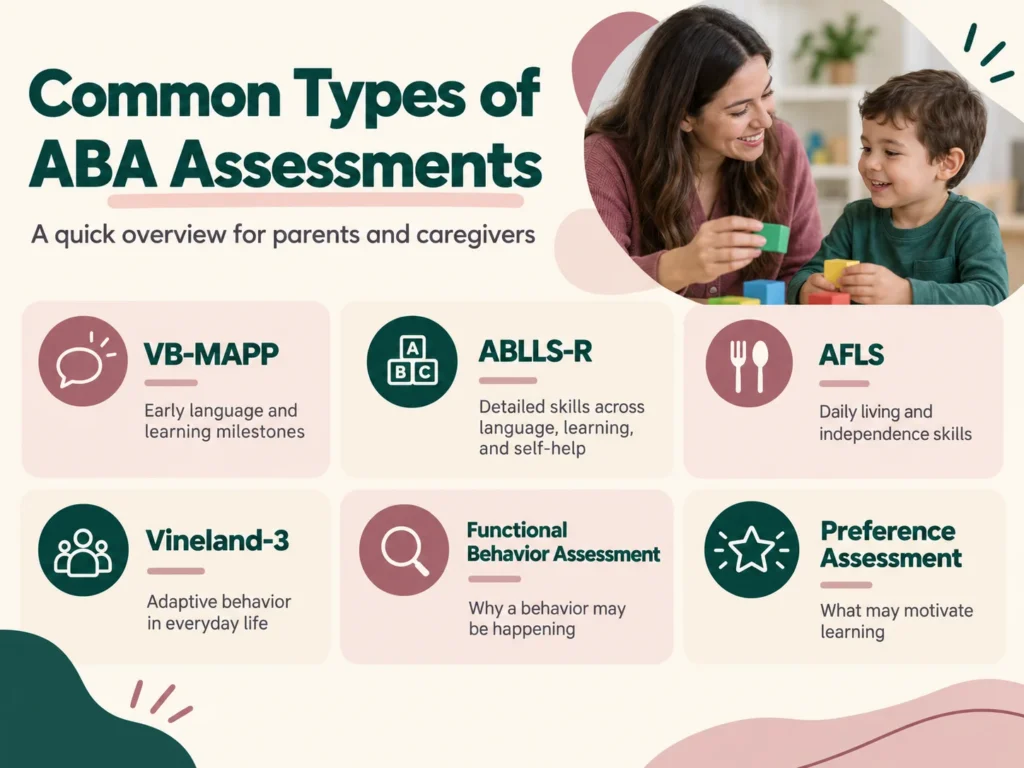
Choosing among the types of ABA assessments depends on what the clinician needs to understand. For example, an ABA skills assessment asks a different question than does a behavior-function assessment.
| Assessment | Primary Focus | Common Purpose |
| VB-MAPP | Language, learning, social skills | Early skill planning |
| ABLLS-R | Language, learning, self-help skills | Detailed skill programming |
| AFLS | Functional living skills | Building independence |
| Vineland-3 | Adaptive functioning | Broader everyday functioning |
| Essential for Living | Priority functional skills | Communication, safety, participation |
| FBA | Function of behavior | Behavior-support planning |
| Preference Assessment | Current preferences | Identifying potential motivators |
| ESDM Curriculum Checklist | Early developmental skills | Early intervention goals |
VB-MAPP: Language Milestones
The Verbal Behavior Milestones Assessment and Placement Program is language, learning and social development intensive. It is officially designed with the presence of 170 milestones, 24 language and learning barriers, 18 transition measures and over 700 supporting skills.
The clinician may use it when a child can be able to name familiar objects, but has difficulty asking for assistance, responding to questions or using communication in various situations. Parents can review the official VB-MAPP information from AVB Press.
ABLLS-R: Detailed Learning Profile
The Assessment of Basic Language and Learning Skills-Revised is both an assessment tool and curriculum guide. It examines 544 skills in 25 categories, such as language, social interaction, self-help, academic, and motor skill abilities.
This depth of detail can be used to identify particular skills that are developing, already developed, or still suitable to be taught. An ABA skills assessment (e.g., ABLLS-R) can then be used to inform highly specific teaching goals.
AFLS: Functional Independence
The Assessment of Functional Living Skills emphasizes functional skills that will promote increased independence. AFLS includes six protocols covering Basic Living Skills, Home Skills, Community Participation, School Skills, Vocational Skills, and Independent Living Skills.
Appropriate objectives may include clothing, cooking, doing chores, accessing community services or skills in the workplace. The assessment is not necessarily for every learner, but can be tailored.
Vineland-3: Adaptive Functioning
Vineland-3 is a standardized adaptive behaviour assessment to look at how a person behaves in the real world. It has a wide range of adaptive areas, consisting of Communication, Daily Living Skills, and Socialization, and information is gathered by interview or ratings, depending on the version.
Vineland-3 data is not a detailed curriculum assessment, but instead offers a more general standardized data that may be useful in treatment planning, progress reporting, or other treatment decisions. See Pearson’s official Vineland-3 overview for instrument details.
Essential for Living: Priority Life Skills
Essential for Living (EFL) is a criterion-referenced, curriculum-based assessment based on functional skills that promote safety and meaningful involvement in family, school and community life.
It is particularly useful if high priority life skills such as functional communication, daily participation, safety, or other life skills are used to direct programming.
Functional Behavior Assessment
A functional behavior assessment (FBA) investigates environmental events associated with challenging behavior. Interviews, records, direct observation, ABC data, or other behavior analytic procedures can be used to provide information.
To formulate a supported hypothesis regarding variables that affect behavior, in order to treat the function of the behavior instead of the behavior itself. There is devoted attention to the use of FBA as an assessment to uncover environmental events that affect challenging behavior in current clinical guidance.
Alma’s Behavior Intervention Plan guide explains how assessment findings may later inform function-based behavior support.
Preference Assessment: Identifying Current Preferences
A preference assessment systematically evaluates items, activities, or interactions a learner currently prefers. There are several types of common procedures, such as paired-stimulus, free operant, and multiple-stimulus-without-replacement (MSWO). Research is ongoing to see whether preference assessments can predict reinforcing effects accurately.
In preference assessment ABA practice, an important distinction is that a highly preferred item is a potential reinforcer; its reinforcing effect ultimately depends on whether it actually increases the relevant behavior.
ESDM Curriculum Checklist
The Early Start Denver Model is a broader intervention model, so it is more accurate to refer specifically to its ESDM Curriculum Checklist when discussing assessment.
The checklist examines developmental skills such as receptive and expressive communication, imitation, play, joint attention, social skills, cognition, motor abilities, and personal independence to help identify individualized learning objectives.
How ABA Assessments Gather Information
An ABA Therapy Assessment rarely depends on one source of information. Clinicians can use direct methods and consider information supplied by those who know the child well.
Direct Assessment
Direct assessment is the observation or interaction with the learner. The clinician can observe routines or skill tasks, record behaviour or observe antecedents and consequents for a behaviour.
Indirect Assessment
Indirect methods collect information from the caregiver or teacher’s interview, a questionnaire, rating scales, developmental history and record review. Multiple sources may give a more complete clinical picture than a single source.

How Assessment Results Shape Treatment
The results of the assessment should be taken to action that has outside consequences to the assessment. An effective ABA Assessment can help to clarify baseline performance, priorities, and select measurable objectives for the BCBA.
For example, a child who can label many objects but cannot reliably request a break may have functional communication prioritized before less urgent learning targets. Progress data can also be used to determine, later on, if targets should be maintained, modified, or altered.
Families in Studio City who want support beyond formal assessment can also explore Alma’s parent support services.
How Parents Can Prepare for an Assessment
Context provided by caregiver input that may not be seen during a clinic observation. Useful preparation may be:
- sharing current concerns plus meaningful strengths;
- bringing school or therapy reports when requested;
- describing routines where difficulties commonly occur;
- identifying skills that would make daily family life easier;
- Inquiries regarding the choice of a specific tool.
Parents do not need to “prepare” the child to perform well. Accurate information is more useful than trying to produce a particular score.
FAQs About ABA Assessments
Does an ABA assessment diagnose autism?
No. An ABA assessment used for treatment planning measures skills, behavior, or adaptive functioning. An autism diagnosis must be obtained, and this must be done by an appropriately qualified professional, with the use of known diagnostic tools and criteria.
How long does an ABA assessment take?
There is no universal duration. Timing will vary based on the assessment tool, number of domains being assessed, need for direct observation, records available, caregiver interviews, child participation and the clinical questions to be answered.
Which ABA assessment is best for my child?
The optimal tool will vary with the question being asked. The age of the child, communication level, daily living skills, challenging behavior, prior records, family priorities, and the goals therapy should address are factors a BCBA should take into consideration.
Does insurance require an ABA Therapy Assessment?
Requirements vary by insurer and plan. Some payers need an assessment or treatment authorization document to approve services. Families should check with their provider and insurance plan to ensure that the process is correct before they assume that it’s the same for everyone.
How often are ABA assessments repeated?
Timing varies. Reassessment can take place if treatment objectives are altered, if treatment progress indicates new priorities, or if funding needs call for new information. Families should discuss with their provider what the schedule is for their child.
Talk With Alma About Your Child’s Assessment
A thoughtful evaluation can provide clarity for families about a child’s existing abilities, need for support and goals for skillful, purposeful learning. Alma Behavioral Solutions uses individualized assessment findings to help shape practical, family-centered ABA care based on each child’s unique needs.
Contact us at (747) 250-8494 or send an email to info@almabehavioralsolutions.com to discuss assessment, enrollment or ABA Therapy services with our team with families in Northridge and surrounding communities in Southern California.