
Often parents will wonder why their Child’s ABA therapy session isn’t just table work and not toys, snack, playground, or routines. This method is known as Natural Environment Teaching or NET.
Natural Environment Teaching is an ABA method that builds skills during real-life moments. Communication skills could include asking for bubbles, turn taking on a swing or dressing themselves. The objective is for children to apply purposeful skills in their natural environment.
This guide will clarify what NET is, how it applies to the use of ABA therapy, what it might look like in practice, and how families can help support learning during daily activities.
Understanding Natural Environment Teaching in ABA Therapy
ABA therapy includes different teaching methods. Some are structured and adult-led. Others are more flexible, play-based and motivated by a child’s natural motivation.
Natural environment teaching ABA is in the second group. It provides learning opportunities through familiar contexts, materials and routines. Instead of removing the child from daily life to teach a skill, NET brings teaching into the child’s daily life.
A therapist can engage in requesting at snack time, following directions as they clean up or social communications as they play with a sibling. Child is still learning and teaching is more natural and in the moment.
This is important because many children, particularly children with autism, can learn a skill in one context and not be able to apply the skill in another. NET helps fill in that gap by practicing skills in routines at home, school, play and in the community.
The National Clearinghouse on Autism Evidence and Practice identified naturalistic intervention as one of the evidence-based practices for children, youth, and young adults with autism in its 2020 review of research published from 1990 to 2017.
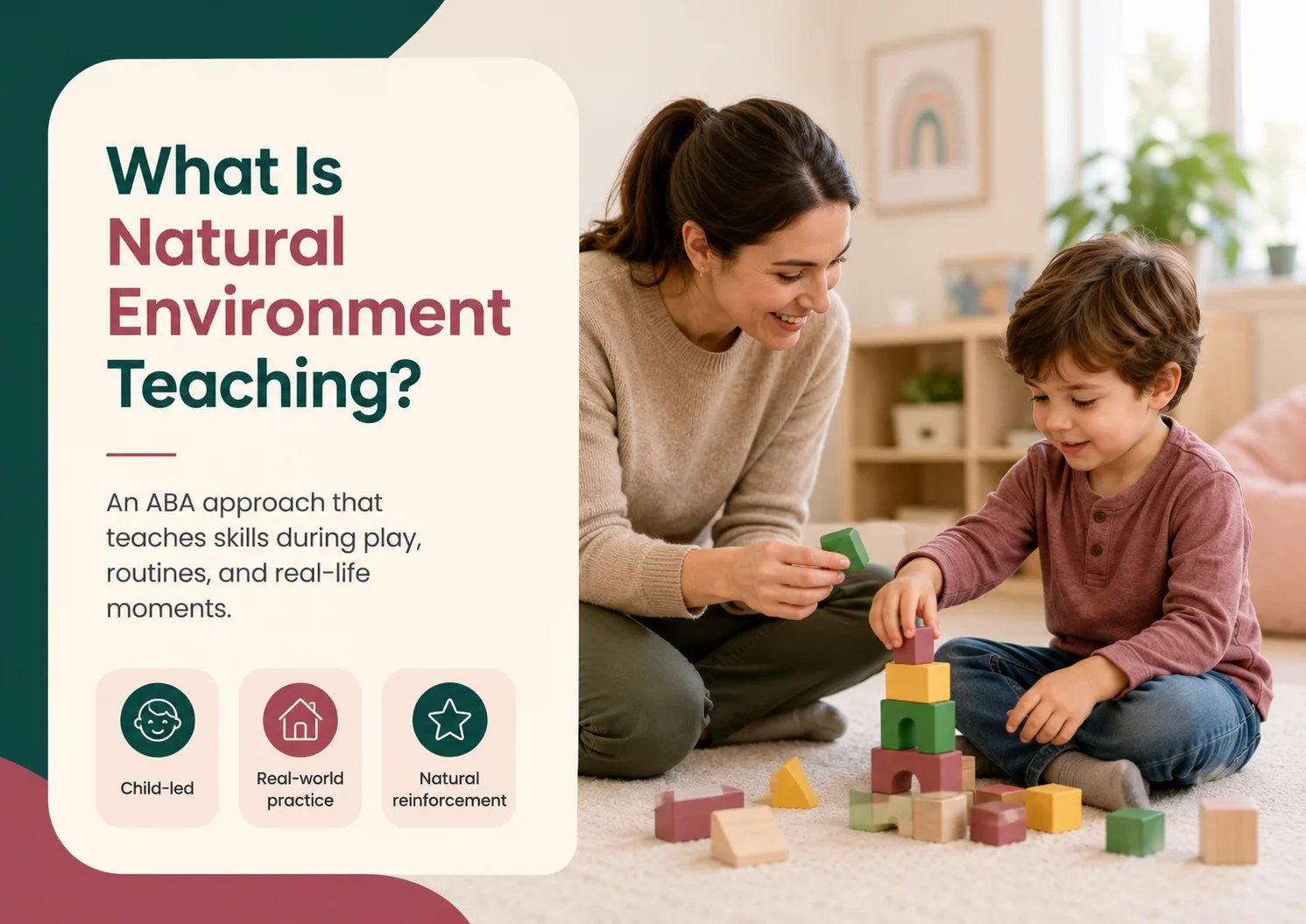
What Is Natural Environment Teaching?
Natural Environment Teaching (NET) is an ABA approach that teaches skills within a child’s everyday routines, interests, and surroundings. NET uses moments from life to develop meaningful skills, not just structured drills. A child’s motivation is the impetus to learning, and new skills are easier to relate to real situations.
Learning Through Everyday Activities
The emphasis for NET is on helping children learn during an activity that is meaningful to them. Communication, social interaction and independence is practiced in play, routines and daily activities. If these skills are practiced in the same environments in which they will be needed, children will be more likely to use them outside of therapy.
Why NET Is Used in ABA Therapy
NET is used as children tend to learn best when teaching is relevant and engaging. If a child practises asking for a snack during snack time they are likely to do this spontaneously outside of therapy. This allows for communication, social interaction, independence, and less repetition in teaching.
What NET Is Not
NET is not unstructured play or passive supervision. It is a planned and goal-oriented method guided by ABA principles. Prompts, reinforcement, and tracking of data are used to ensure progress. Seance sessions can be flexible but they are well planned and overseen by staff with appropriate qualifications to achieve measurable outcomes.
Key Principles of NET
Natural Environment Teaching is based on the basic principles of ABA and maintains learning meaningful, structured and child-centered.
Child-Led Learning
NET begins with the child’s interests. Therapists note child’s interests and apply them to provide learning opportunities. This enhances engagement and participation is more natural.
Functional Skill Building
Child skills are developed in a hands-on way to help them apply in their daily experiences, e.g., asking for assistance, listening to instructions, communicating with others. It’s not about repetition; it’s about real world application.
Natural Reinforcement
Reinforcement is directly tied to child’s action. Child receives what child wants when child communicates or completes chore. This further enhances understanding and motivation.
Generalization Across Settings
Skills are practiced in different environments and with different people. This facilitates the transfer of what children learn during therapy into their daily activities and increases independence.
Flexible but Goal-Focused Teaching
While NET adapts to the child’s interests, it remains guided by clear goals. Therapists provide prompts, monitor progress and modify strategies to promote consistent development.
How Does NET Work?
Natural Environment Teaching provides opportunities for learning without formal setups. Skills are not taught in therapy, but during play, routines, and interactions that a child is already enjoying.
Step 1: Identify Motivation
The therapist sets out to see what a child’s personal interests are: toys, snacks, movement, favorite activities, etc. Motivation is key because children are more likely to engage and communicate when the activity is meaningful to them.
Step 2: Embed a Skill Goal
The therapist then adds a targeted skill into the activity once the child is engaged. For instance, block play can help to practice counting, turn taking, snack time can help to practice requesting or labeling. Activity is natural, but has a clear learning objective.
Step 3: Provide Support Through Prompts
Then therapist uses nonverbal cues, modelling or gestures to prompt the child to respond. Graduation of supports to promote independence.
Step 4: Deliver Natural Reinforcement
When child responds, it is directly and meaningfully rewarded. For example, if I ask you for a toy, you will give that toy to me. This link makes the child aware of the importance of the skill.
Step 5: Monitor Progress
Although NET is an informal setting, there is careful monitoring of progress. Information about responses, independence, and skill usage contributes to the ongoing treatment decisions.
Why Is NET Effective in ABA Therapy?
NET is effective because it connects learning to real life. Children are doing more than practicing a skill, they are practicing a skill for a purpose. They are learning how a skill supports their ability to communicate, participate, play and be more independent.

NET Connects Learning to Real Life
A child may memorize the word “cup” during structured teaching, but NET helps the child use “cup” when asking for water. The skill is more meaningful because it is a real life connection.
NET Uses Motivation to Increase Engagement
When children care about what they are doing they are more likely to participate. If a child enjoys trains, they can learn to make requests, practice colors, counting, sharing, or pretend play using trains with a therapist. Motivation helps in lowering resistance and enhancing participation.
NET Helps Skills Carry Over Outside Therapy
The main objectives of Start ABA therapy include skill carry over. A child can learn to ask for assistance from a therapist, but parents want the same skills to be demonstrated at home, school and in the community. NET does this by beginning to teach skills from the outset in the natural environment.
NET Supports Independence Over Time
NET can help children take small steps toward independence. A child might learn to ask for assistance, to take turns, set up toys, tidy up toys or join in with family activities. Progress is based on the child’s needs and goals, and their consistency across environments.
Benefits of Natural Environment Teaching
Natural Environment Teaching supports multiple areas of development by embedding learning into everyday routines. The main benefit is to move children from the practice of skills to moving them into a meaningful real-life context.
Builds Functional Communication
Through NET, children learn to use practical communication skills such as requesting, labeling, commenting, and asking for help. These skills are taught during naturally motivating times, and children are more likely to know why they are learning and then use them on their own.
Promotes Skill Generalization
By practicing skills in real settings, the chances are greater that children will transfer and apply them to various settings and with various people. For instance, if a child learns turn taking in a play activity, he or she will be more likely to use turn taking when playing with peers or family members.
Enhances Motivation and Engagement
By incorporating preferred activities, NET keeps children engaged and willing to participate. Learning is more relaxed and informal, which may help to minimise resistance, and encourage more active participation.
Supports Independence in Daily Routines
NET integrates learning into everyday tasks such as dressing, eating, and cleaning up. These routines offer repeated experiences to develop independence and confidence and are meaningful.
Encourages Family Involvement
Caregivers can easily apply NET strategies at home, allowing learning to continue beyond therapy sessions. This uniformity aids in solidifying skills and promotes consistent progress over time.
How NET Supports Social Skills in Autism
Natural Environment Teaching allows children to practice social skills in a natural, not isolated, environment. By embedding learning into everyday routines and play, NET encourages meaningful communication, cooperation, and participation in social settings.
Turn-Taking in Play
Children practice taking turns in games, pretend play or shared activities. Therapists demonstrate phrases such as “my turn” and “your turn”, teach children to wait and respond to suit.
Greetings and Social Initiation
NET supports practicing greetings with familiar and unfamiliar people. Children can be taught to say hello, wave or use AAC, depending on their means of communication.
Peer and Sibling Interaction
Children learn to interact with others by sharing toys, reacting to play suggestions and being actively involved in group play. These interactions help to foster comfort and confidence.
Waiting and Sharing
When things happen naturally, like waiting for the swing or sharing materials with others during play, NET teaches patience and sharing.
Joint Attention and Engagement
Children learn how to share their attention with someone else, either to the same activity or object, for example, to a toy; pointing. This facilitates connection and communication.
Flexible Play and Problem-Solving
Children learn how to adjust to varying play, deal with little challenges and experiment with new ideas. This aids flexibility and resiliency when in social circumstances.
Natural Environment Teaching Examples in ABA Therapy
NET best is typically understood through examples by the parents. The following table illustrates examples of teaching in the natural environment for each of the typical activities.
| Setting | Child’s Interest or Routine | Skill Target | NET Example |
| Playtime | Bubbles | Requesting | Pause before blowing bubbles and prompt the child to say “bubbles” or “more.” |
| Snack time | Crackers or juice | Communication | Child requests the snack before receiving it. |
| Blocks | Building towers | Counting/colors | Count blocks, label colors, or practice “on top” and “next to.” |
| Playground | Swing | Turn-taking | Practice waiting, asking for a turn, and responding to peers. |
| Mealtime | Setting the table | Following directions | Child places one fork next to each plate. |
| Dressing | Clothes | Daily living skills | Child names clothing items or follows steps to get dressed. |
| Art time | Glue/scissors/crayons | Fine motor and language | Child labels tools and describes what they are making. |
| Grocery store | Shopping cart/items | Community skills | Child names items, greets a cashier, or helps follow a list. |
Example 1: Teaching Communication During Play
When a child reaches for a toy car, the therapist can stop and remind the child to ask for the toy car. The answer can be a word, sign, gesture, picture exchange or AAC button depending on the child’s goals. The natural reinforcement is getting the car and continuing play.
Example 2: Practicing Daily Living Skills at Home
While dressing, a child can practice naming socks, getting their pants up, or a two step sequence. The routine itself becomes the teaching moment. This facilitates the normalisation of the daily living skills.
Example 3: Building Social Skills at the Playground
A therapist can teach a child to call out for the turn on the slide, wait for the turn, or respond when someone speaks to them. Opportunities for social communication are provided naturally in the playground. The child is taught the skill in the context where it is required.
Example 4: Supporting Learning During Snack or Mealtime
Snack time can support requesting, labeling, counting, direction following and manners. It could be a child who asks for ‘more juice’, counts crackers or asks for help with opening a package.
Example 5: Practicing Community Skills During Outings
A child can join in when purchasing groceries, recognise colors, put certain items into the shopping cart, or say hello to the cashier. Communication, safety, flexibility and independence can be aided by community practice. Teaching these skills within just the therapy room environment can be challenging.

Common NET Techniques Used in ABA Therapy
Natural Environment Teaching includes several naturalistic ABA strategies that use a child’s interests and daily routines to build meaningful skills. The method used will depend on the child’s objectives, communication ability and willingness.
Incidental Teaching
Incidental teaching relies on the opportunity that presents itself to be a catalyst for learning. The therapist prompts the child to respond (e.g., request, label) before giving access to an item when the child is interested in the item. This approach facilitates communication and problem-solving with real-life motivation.
Pivotal Response Training (PRT)
Pivotal Response Training focuses on key developmental areas like motivation, self-initiation, and responsiveness to multiple cues. Therapists utilize child choice, shared control to maximize engagement and facilitate spontaneous communication and natural reinforcement.
Natural Language Paradigm
The Natural Language Paradigm promotes communication during everyday activities using preferred materials and modeling. For instance, a therapist can model an open word such as ‘open’ and reinforce the child’s attempt to open by opening it for them. This is for developing language skills in function.
Environmental Arrangement
Environmental arrangement involves organizing the environment to create opportunities for communication. If you have items in reach, but just out of reach, or give some options to choose from, it will make the child want to interact and ask for help.
How NET Differs From Other ABA Approaches
There are numerous techniques available for ABA therapy but none more natural and flexible than NET. It does not just emphasize skills instruction in isolation but in routine activities as well.
NET Is More Naturalistic
NET is in the context of play, meal time and daily routines. Learning takes place in the child’s context, and is more meaningful and easier to use.
NET Uses Everyday Materials and Routines
A familiar object such as toys, snacks, and household objects are used by therapists. This aids children in relating skills to real life situations.
NET Focuses Strongly on Generalization
The focus of NET is on skills in different setting situations, to help the children apply skills with different people in different situations.
Difference Between NET and Discrete Trial Training
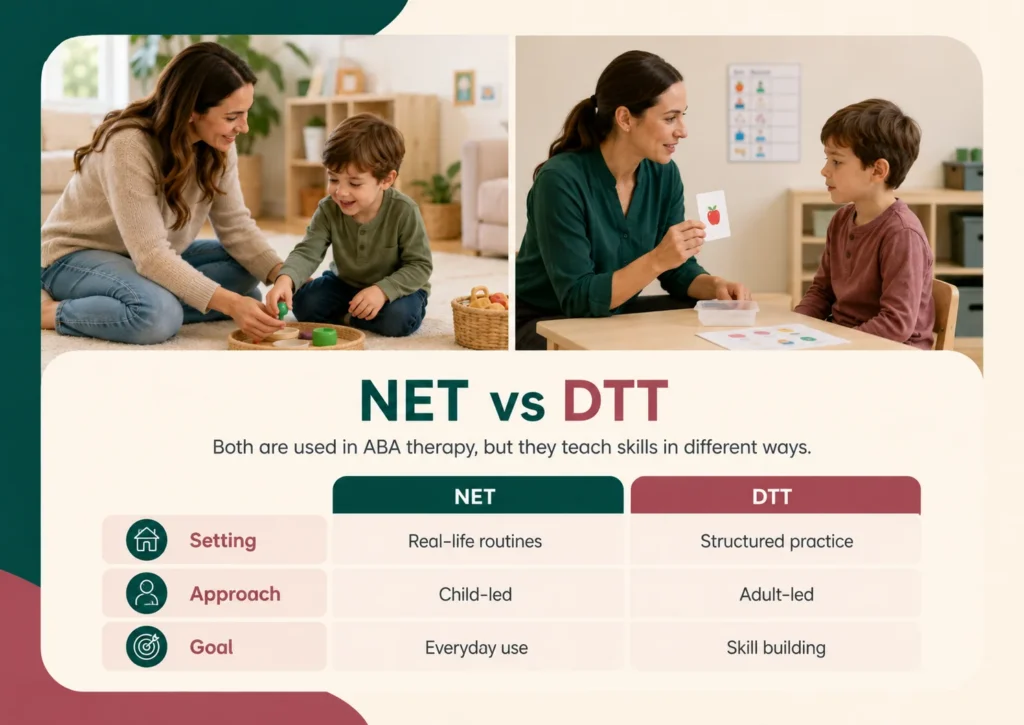
Parents sometimes compare Discrete Trial Training vs Natural Environment Teaching because they are both employed in ABA therapy. The biggest difference is how teaching happens.
What Is Discrete Trial Training?
Discrete Trial Training (DTT) is an ABA teaching method that is structured. Therapist provides a clear instruction, the child responds to the instruction, and the therapist gives a consequence, either praise or another reinforcer.
For learning simple basic skills over and over, DTT works well. This can frequently occur in a more controlled environment.
NET Vs DTT: Main Differences
| Feature | Natural Environment Teaching (NET) | Discrete Trial Training (DTT) |
| Teaching style | Flexible, naturalistic, and often child-led | Structured, adult-led, and planned in clear steps |
| Learning setting | Happens during play, home routines, school activities, or community settings | Often takes place in a controlled setting, such as a therapy table |
| Child motivation | Uses the child’s current interests, choices, and natural motivation | Uses planned tasks and reinforcement selected by the therapist |
| Reinforcement | Usually connected to the activity itself, such as receiving a toy after requesting it | Often uses external or planned reinforcement, such as praise, tokens, or preferred items |
| Skill focus | Helps children use skills in real-life situations | Helps children learn clear foundational skills through repeated practice |
| Generalization | Built into the teaching because skills are practiced in natural settings | May require extra practice in different settings to help skills carry over |
| Example | A child asks for crackers during snack time and receives crackers | A child names a picture card during a structured teaching trial |
Can NET and DTT Work Together?
Yes. NET and DTT can complement each other.
DTT can be used to teach a skill in a step-by-step and understandable manner. NET can then support the child to apply that skill in play, home tasks, school or community experiences.
A thoughtful ABA plan does not treat one method as automatically better. It’s best to match the right combination to the child.
Who Can Benefit From NET?
NET is usually employed with autistic children but it could be beneficial for developmental delay children or children that require assistance in applying skills to real-life situations.
Young Children in Early Intervention
Play, movement and routines are important ways in which young children learn. Early communication, imitation, joint attention, play skills, and basic daily living skills are all areas of functioning that can be addressed in NET.
School-Age Children Building Real-Life Skills
NET can be used to help school-age children practice and develop their skills in peer interaction, classroom behaviors, directions, problem-solving, and independence. The teaching can take place in homework times, games, chores or community activities.
Children Who Need Help Generalizing Skills
There are some kids who are able to do a skill in therapy, but not at home or school. Helped by NET, they get repeated practice in real situations.
Children Working on Communication or Social Goals
The word NET is frequently used to request, comment, greet, take turns, wait or talk. These goals are easily integrated into play and daily activities.
Role of Caregivers and Educators in NET
Parents, caregivers, teachers, therapists, and ABA teams all play an important role in NET. The consistent use of skills can facilitate the child’s use of them in various settings.
How Parents Can Support NET at Home
Parents can help NET during meal times, dressing, play, bath time, clean up, story time and trips. Simple things can help, for example, by giving choices, taking a break before helping or asking a child to ask for an object. The ABA team provides guidance to ensure these strategies are consistent with the child’s goals.
How Educators Can Support NET at School
Classroom routines can be used to aid in communication, social interaction and direction. Colors can be learned by using crayons. Circle time can be a useful aid to listening. Giving students supplies to use can foster independence.
Why Team Consistency Matters
A child may work with a BCBA, RBT, parents, teachers, and other providers. If all the members know the target and procedures, the child has greater opportunities to practise.
Parent Training and Collaboration
Parent training can help families feel more confident using NET strategies. The therapist can demonstrate the behavior, observe the parent role model and provide feedback.
This transforms normal activities into positive learning experiences—in a way that doesn’t create an atmosphere like a therapy clinic.
Tips for Implementing NET Successfully
NET is most effective when it is natural, positive and purposeful. The intent is not to make all moments demands. Their aim is to observe the positive opportunities and to help the child in small and meaningful ways.
Follow the Child’s Lead
Begin by using the child’s preferred playtime. Toys, foods, movement, music, books or a sensory activity can all be used as a teaching moment. Motivation brings about improved learning motivation.
Create Small Learning Opportunities
A parent or therapist could leave a toy in a position that the child can see but cannot reach. May pause before eating a snack or give 2 snack choices. Short breaks can be used to promote communication and problem-solving.
Use Everyday Language
Use words that the child will be able to use at home. Saying simple words such as ‘help’, ‘open’, ‘more’, ‘my turn’ and ‘all done’ can have a major impact.
Reinforce Naturally
Make the reward a part of the skill. If the child is requesting a book, read the book. If the child requests a turn, he or she gets a turn. Natural reinforcement for child to understand why behavior is occurring.
Keep It Positive and Flexible
Routines should not be stressful for NET. Some times are better than others. Flexibility enables adults to support progress and follow the needs of the child.
Work With a Qualified ABA Team
A team of professionals with expertise in ABA can support in selecting goals, training caregivers, monitoring progress, and fine-tuning strategies. A BCBA can help design the plan to ensure that NET is clinically appropriate, individualized, and safe.
The support of a professional is particularly important if goals are related to communication, behaviour or daily living skills.
Help Your Child Build Skills in Everyday Moments
Natural Environment Teaching can be used, to provide opportunities for children to practice areas of communication, social skills, independence and daily routines in a meaningful and real life way. Because ABA therapy can occur during behaviors that families observe every day, for many families NET makes this therapy easier to understand.
Alma Behavioral Solutions develops each child’s individualized ABA therapy plan considering his/her strengths, needs, interests and family goals. Our team can help you understand how NET may fit into your child’s care plan if your child is being worked on in a different area of therapy, such as communication, social interaction, daily living skills, or generalizing skills.
To learn more about NET ABA therapy and how Alma Behavioral Solutions can support your family, call (747) 250-8494 or email info@almabehavioralsolutions.com. We’re here to assist you with any questions you may have and help you make the next move confidently.
FAQs About Natural Environment Teaching in ABA Therapy
16.1 What is Natural Environment Teaching in ABA therapy?
Natural Environment Teaching is an ABA method that teaches skills during everyday routines, play, and real-life settings. The therapist follows the child’s interests and uses natural motivation to teach communication, social skills, daily living skills, and independence.
What is an example of Natural Environment Teaching?
One of the basic applications is to teach the child to ask for the bubbles when he is playing. Prior to blowing bubbles, the therapist pauses, instructs the child to say, point, sign or use AAC for “bubbles”, and then the therapist blows bubbles as the natural reward.
What skills can be taught using NET?
NET can teach communication, requesting, labeling, turn-taking, play skills, daily living skills, following directions, problem-solving, and social interaction. Skills are practised in routines in which they are needed naturally.
Is NET ABA therapy only for children with autism?
NET is typically used in ABA therapy for children with autism, but can also be helpful with children who have developmental delays or other learning needs. A qualified ABA provider can decide if NET fits the child’s goals.
How is NET different from traditional ABA?
NET is more naturalistic and flexible than a highly structured teaching. It involves more than just table based tasks, but play, routines, and real life activities. Emphasis is placed on motivation, natural reinforcement, and skill utilization in the real world.
What is the difference between NET and DTT?
Discrete Trial Training is broken up and repetitive, with often a controlled setting. Natural Environment Teaching is more flexible and teaches skills during real routines. Many ABA programs use both methods based on the child’s needs.
Can parents use Natural Environment Teaching at home?
Yes. NET strategies can be used throughout meal time, play, dressing up, washing up and shopping. ABA staff can guide parents about how to prompt and reinforce in a way that aligns with child’s treatment plan.
Is Natural Environment Teaching evidence-based?
NET is grounded in ABA principles and connected to naturalistic intervention, which has been identified as an evidence-based practice for autism by the National Clearinghouse on Autism Evidence and Practice.