
Does your child like deep pressure but not like sudden contact, is your child not sure what their body is doing during physical activity?
Families might encounter an autism steam roller sensory tool in the occupational therapy setting or sensory rooms. It is created to provide a certain type of physical feel.
Parents must be aware of how the device works, where there is limited evidence, and the importance of comfort and safety over popularity before using it.
This guide explains what sensory rollers are, what they might be used for, whether they are suitable for individuals, precautions to take, alternatives, and when to seek advice from an occupational therapist.
Key Takeaways
• Sensory steam rollers use padded rollers to apply pressure to the body.
• Some designs have variable pressure during motion.
• Sensory responses vary from child to child.
• Cooperation, careful supervision and manufacturer’s instructions are necessary.
• Occupational therapists can assess suitability and alternatives.
What Is an Autism Steam Roller?
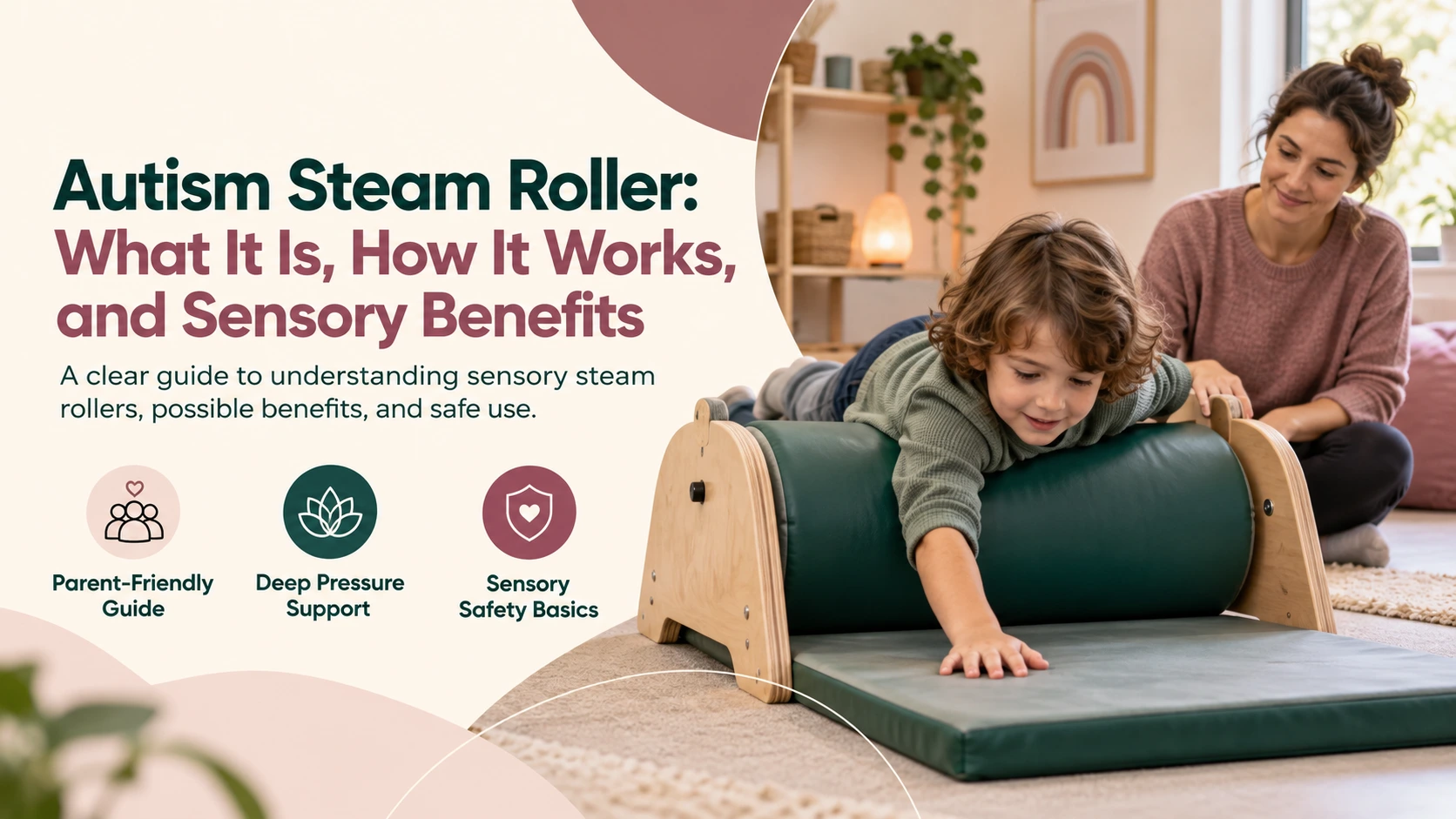
A sensory steam roller applies pressure through padded rollers positioned around part of the body. As it says in the name, it’s not a road roller, nor is it standard playground equipment. It is designed to be used with supervision for sensory activities. Rolling is actually a description of action, not steam.
Depending on the model, common characteristics include:
• Padded cylindrical rollers that contact the body as the user moves between them.
• A stable support frame that holds the rollers in position.
• A Model-Specific Tension Mechanism that may change the pressure delivered.
• Instructions and maintenance requirements that govern appropriate use.
It compresses in a specific area, as opposed to a therapy ball or cushion. There are many types of models and the characteristics are not comparable. This equipment is not a standard intervention for all children as some children don’t want to be firm with or enclosed in it.
How Does an Autism Sensory Steam Roller Work?
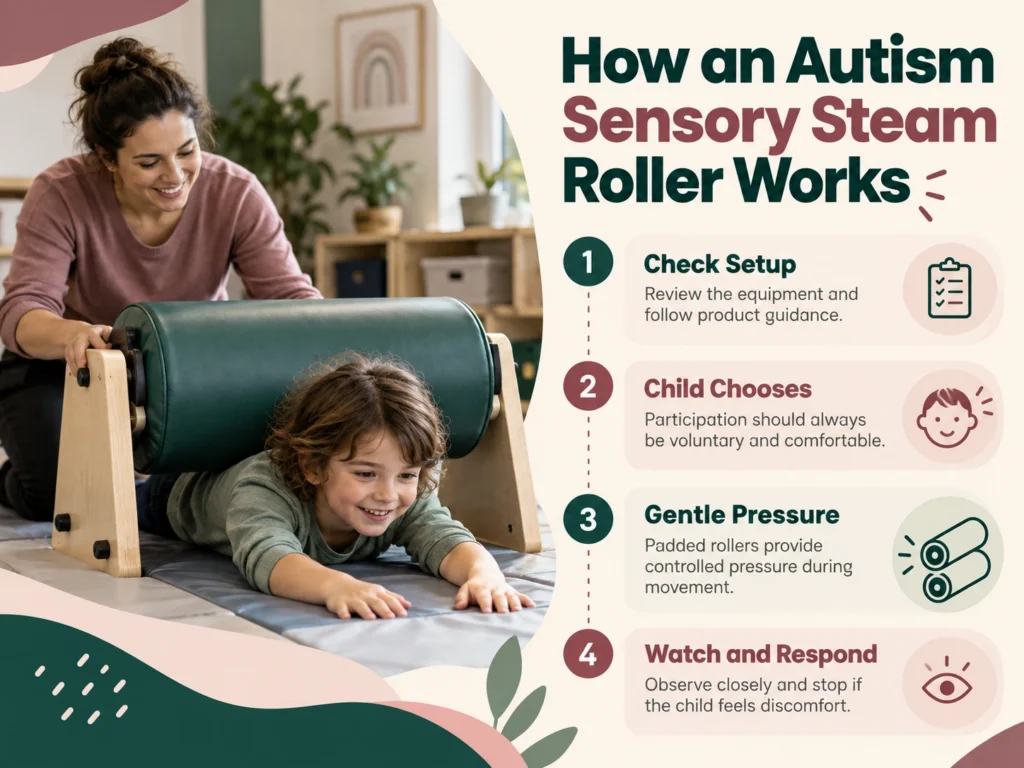
An autism sensory steam roller uses pads to press down on the body while the child decides when to move from roller to roller; setup and supervision will depend on model and child.
1. Check setup and guidance. An adult checks the equipment and instructions, consulting an occupational therapist when necessary. Adjustments should be made following the directions provided by the product.
2. Invite, rather than require, participation. The child chooses whether to try it and has an understood spoken or nonspoken way to stop. Hesitation is respected.
3. Allow supported movement. Some designs have child moving on cushioned rollers that press the child. Movement and mechanism will depend on the product.
4. Watch and respond. The child monitors their breathing, expression, movement and communication and the adult monitors them and exits or stops as soon as needed. Observations are closely conducted during the activity.
Deep pressure means firm contact. Proprioceptive input from muscles and joints also can be provided by moving in opposition to resistance. These feelings are not the same, and neither ensures a calm feeling.
What Are the Sensory Benefits of a Steam Roller?
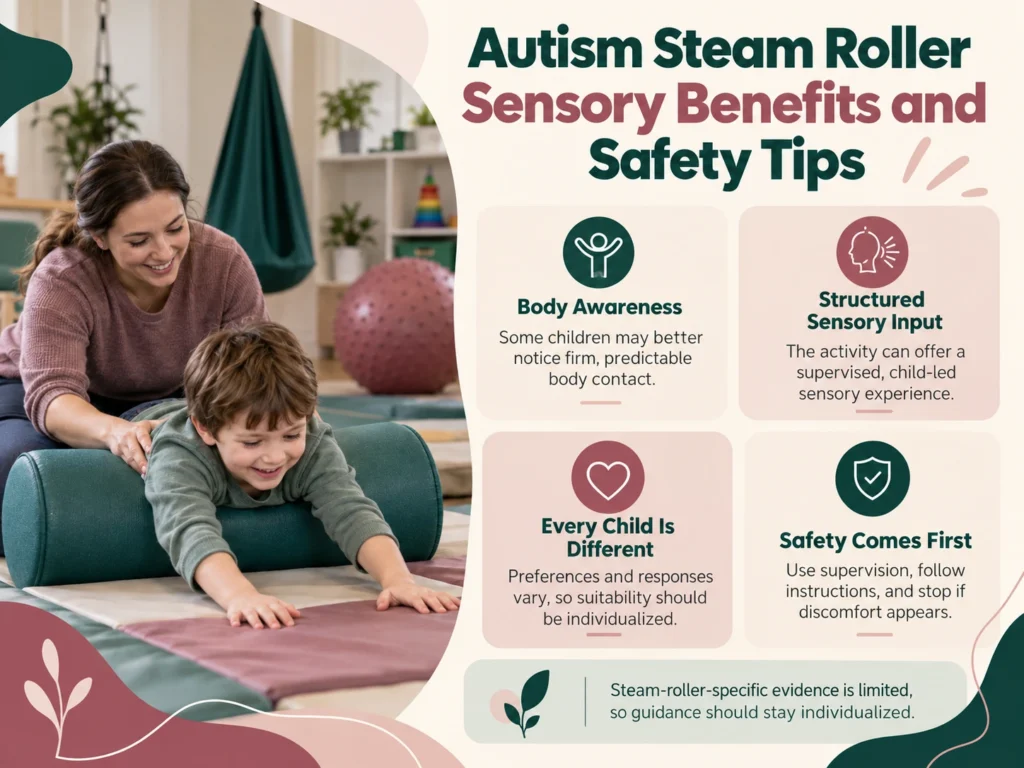
A deep pressure sensory tool for autism may offer experiences some children find useful, depending on individual preferences, the activity, and the equipment in a familiar, appropriately supervised setting.
• Noticeable body contact: Roller pressure may help a child notice body contact when the sensation is welcome.
• A potentially organizing experience: Some children report or show comfort with firm, predictable pressure; others find it unpleasant or overstimulating.
• Structured sensory exploration: Supervised exploration may be given the opportunity for choice with regard to pressure, movement and breaks at the child’s rate.
• A place in an individual routine: If a child’s goals include this activity, it may be included with other sensory supports, not as a daily activity.
Studies on deep pressure interventions such as massage and weighted items have not proven that steam rollers produce the same results. There is limited direct evidence of specific steam-roller benefits. The key question is, is this particular child enjoying it and can they do it safely and comfortably?
How Does Proprioceptive Input Relate to Autism?
Proprioception is the body’s awareness of position, movement and effort. Muscle, tendon and joint signals tell us about the position and force of our limbs when we do not look. This is the idea behind the search proprioceptive input autism. Proprioception is used along with vision and balance to coordinate activities and determine the space around us during normal activities.
Think about three real-life situations:
• Pushing a heavy door: Effort and resistance of the muscles and joints are registered.
• Moving onto a chair: The body changes its position while moving.
• Pencil holding: Hand’s sense of grip and pressure.
Pressure on skin is tactile input; muscle and joint activity provides proprioceptive information. They can happen at the same time, but they’re not the same. Enjoying pushing or climbing does not predict whether a child will like roller compression.
Who May Benefit From a Sensory Steam Roller?
Sensory tools for autistic children are appropriate based on sensory preference and need, not just diagnosis. A roller may be considered when a child:
• Prefers firm contact and welcomes this particular type of pressure.
• Shows curiosity about structured, supervised sensory exploration.
• Has body-awareness goals an occupational therapist considers appropriate.
• Can communicate choice or discomfort through speech, gestures, pictures, or other reliable methods.
Seeking pressure does not prove suitability. Medical and motor and communication needs are relevant and the child has the right to refuse. Sometimes a child’s change of heart happens after he or she has begun, so take note of nonverbal cues as well as verbal cues.
How to Use a Steam Roller Safely
Specialized autism sensory regulation tools require careful planning. Safety depends on the model, the child’s abilities, and their comfort and choice.
1. Follow the manufacturer’s directions. Inspect intended setting, assembly, adjustments, maintenance and warnings. Never improvise modifications. Stop using equipment if its covers or frame are damaged.
2. Get individualized advice when appropriate. Occupational therapist can do a trial assessment before the trial of preferences, movement, positioning and medical issues. They may suggest a different activity based on the child’s abilities.
3. Establish voluntary participation. Explain the activity accessibly. Agree on a stop signal; never restrain or pressure a child to continue. Pictures, gestures, or assistive communication may be needed.
4. Supervise directly. Remain close enough to continuously observe and help. Ensure stability, damage, positioning and suitability as per product instructions. Maintain an accessible, visible and open way of escape.
5. Stop for any warning sign. Stop for any stop request, pain, fear, difficulty breathing, distress or restricted movement. Never push through discomfort.
For complex physical needs, uncertain reactions, or difficulty exiting, seek professional advice first. This article does not substitute for manufacturer instructions or for a personal assessment.
Steam Roller Machine vs. Other Sensory Tools
Comparing steam roller sensory equipment to other alternatives assists families with each child to attend to the input desired, not the piece of equipment.
| Option | General sensory input or purpose | Key consideration |
| Sensory steam roller | Padded compression, sometimes with active movement | Requires appropriate fit, product instructions, and supervision |
| Therapy ball activities | Movement, balance, and muscle effort | Requires support matched to stability and movement abilities |
| Supportive cushions | Positioning and comfortable seating | Not a substitute for targeted pressure activities |
| Pushing or pulling activities | Muscle and joint effort | Choose safe tasks suitable for the child’s abilities |
Searches such as steam roller machine autism can show designs with different rollers and adjustments. None is universally better. Goals, preferences, safety, and family routines may be considered as occupational therapy goals.
How to Choose the Right Sensory Equipment
The first step in selecting autism sensory regulation tools is the needs for everyday life and not purchasing the most specialized device. Begin with a significant target, for example, to make play more comfortable or to facilitate participation in everyday activities. Think carefully before you buy equipment:
• What is the sensory preference or participation challenge are we trying to solve?
• Does my child actually want this activity, and can they opt out?
• Is the product suitable for their size, mobility and support requirements?
• What protection, upkeep, supervision and escape does it need?
• Does a qualified occupational therapist assess suitability if it is not certain?
The goal might be better for simpler activities. Review regularly due to changing needs.
An Occupational Therapist Assesses the impact of sensory experiences on participation in daily activities at home, school and play. Advice helps families choose sensory tools for autistic children appropriately.
Consider asking for guidance if:
• Sensory preferences frequently compromise dressing, mealtime, school or family activities.
• It is not possible to determine if a specific device is comfortable, appropriate, or safe.
• Your child repeatedly reacts negatively, avoids, or starts and stops during sensory activities.
At ALMA Behavioral Solutions, our Parent Support Services focus on family guidance and daily routines. For sensory equipment assessment or selection, seek a qualified occupational therapist rather than assuming ABA services include that expertise.
Frequently Asked Questions About Sensory Steam Rollers
What Is an Autism Steam Roller Used For?
It offers soft compression as part of sensory activities. A child can select this feeling in a plan but the treatment is not for autism. Suitability will depend on needs, preferences and design.
Does a Steam Roller Help With Sensory Regulation?
Some children may find the pressure comfortable; others dislike it. Other deep-pressure research does not establish improved regulation or attention from steam rollers. Data for these particular machines are sparse.
Is a Steam Roller Safe for Every Autistic Child?
No. Safety depends on the child’s needs and willingness, equipment safeguards, and supervision. Child must be able to refuse and stop. Consult occupational therapy for doubt of suitability.
What Is the Difference Between Deep Pressure and Proprioceptive Input?
Deep pressure is firm contact on the body. Proprioception is the use of the signals of muscles, joints and tendons to inform the body of its position, movement and effort. Activities may involve both but provide different types of sensory information.
Can Parents Use a Steam Roller at Home?
Reflect on the use of the product at home when and if allowed by the product and caregivers know what to do, how to do it, and how to stop. Consult with occupational therapist before purchasing compression equipment at home.
Conclusion: Understanding Steam Rollers and Sensory Support
A sensory steam roller is a pressure roller that can be padded or adjusted to pressure, during supervised activity. Some kids love it while others don’t. It can be used for sensory exploration, but doesn’t have to be for all autistic children. Preferences, communication, equipment fit, and safety guide decisions.
At ALMA Behavioral Solutions, we start support with each child’s needs and family goals. Explore our Family-Centered Autism Care and ABA Services for help with communication and daily routines, and consult an occupational therapist for specific sensory equipment recommendations.
Looking for Personalized Autism Support?
At ALMA Behavioral Solutions, we support families with individualized ABA therapy, parent guidance, and practical strategies for everyday routines. Contact our team to learn more about available services in Southern California.
Email: info@almabehavioralsolutions.com
Phone: (747) 250-8494