

PCIT is most commonly applied to children aged 2-7 and many families start to experience improvement with the help of a planned course of treatment that takes 12-20 sessions. Most of the time, sessions are approximately 60 minutes weekly, and the parents practice at home no more than 5 to 10 minutes per day.
What makes Parent Child Interaction therapy stand out is simple. The therapist does not simply give advice and send you home. Instead, the therapist coaches you to live, in the moment, while you interact with your child.
If you have been searching for answers, this guide will walk you through the parent-child interaction therapy process, the core PCIT techniques, what it can help with, how effective it is, and how to find the right support for your family.
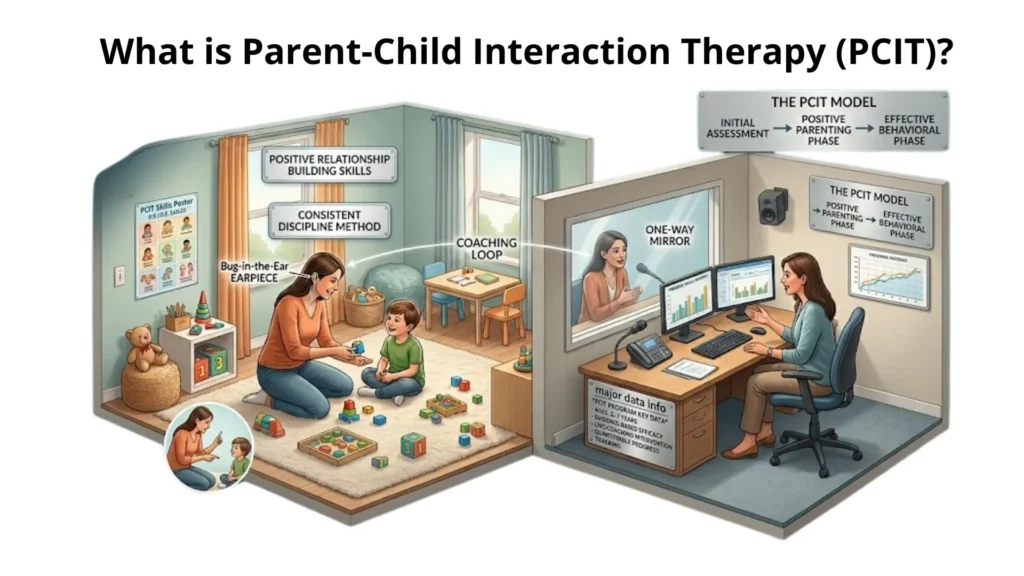
What is Parent-Child Interaction Therapy (PCIT)?
Parent-Child Interaction Therapy (PCIT) is an evidence-based treatment to young children, typically aged between 2 and 7 years who have issues with behavior or emotional difficulties. In parent child interaction therapy, the parent and the child sit together as a therapist provides live coaching to the real interactions. It is aimed at enhancing the behavior, bettering the parent-child bond, and helping caregivers to react more confidently, warmer, and reliably.
How the Parent-Child Interaction Therapy Process Works
Intake and Assessment
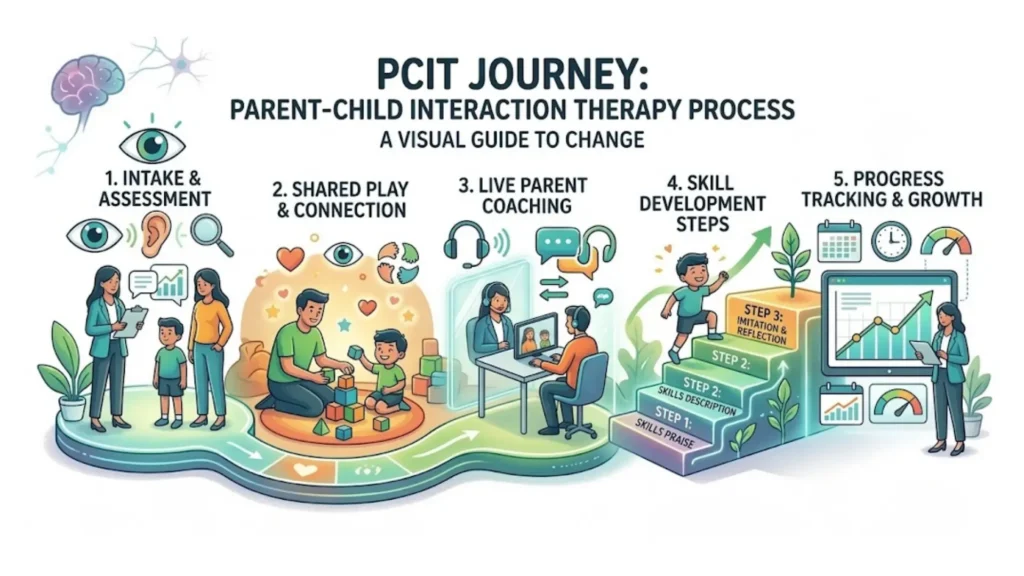
The process of parent-child interaction therapy normally starts with an intake. The therapist gets to know about your child behavior, daily activities, emotional stimuli, and house-school-preschool or daycare challenges. This step helps in determining the apparent behavioral issues as well as patterns of interaction that might be sustaining them.
Parent and Child Attend Together
In parent-child interaction therapy, the caregiver and child take part in sessions together. This is a key part of the process. The therapist observes the interaction between the parent and the child in real time rather than meeting the child in isolation. It makes the therapy practical, focused and directly related to daily family life.
The Therapist Coaches Live
One of the most important parts of PCIT is live coaching. The therapist can view the session either via a one-way mirror or telehealth video during the session. The parent usually has an earbud or tiny earpiece, so that the therapist can provide guidance at the time. This will help parents to react immediately with better, calmer, and more practical skills.
Sessions Build Skills Step by Step
The parent-child interaction therapy process is structured to build skills gradually. Parents get to know how they can make connections stronger, respond to behaviour in a better way, and establish clearer expectations. Since the skills are applied in sessions, parents are not left to work out everything by themselves later.
Progress Is Tracked Over Time
PCIT also includes ongoing progress tracking. The therapists consider how the caregivers are applying the techniques and how the behavior of the child is transforming. Some providers may also use weekly behavior questionnaires to measure growth and decide when the family is ready to move forward in treatment.
The Two Phases of PCIT Therapy
PCIT has two major stages. The goal behind each phase is different and they form the balance that families require the most: warmth and structure.
Child-Directed Interaction (CDI)
Child-Directed Interaction (CDI) is the initial stage of PCIT therapy. This phase is aimed at developing a closer parent-child relationship based on peaceful, positive and responsive communication. This is to enable the child to feel secure, observed and integrated as the parent learns how to make more positive moments.
During this stage, parents learn to follow the child during the play and apply the basic parent-child interaction therapy techniques referred to as PRIDE skills.
Key goals of CDI:
- enhance trust and attachment.
- increase positive attention
- relax tension in parent-child interaction.
- create a calmer emotional base before discipline work begins
What parents do in CDI:
- praise appropriate behavior
- reflect the child’s words
- imitate appropriate play
- describe what the child is doing
- be friendly and pleasant.
This stage helps in breaking the stressful cycles in which the child is acting out and responding to it in a manner that exacerbates the situation.
Parent-Directed Interaction (PDI)
The second phase of parent-child interaction therapy is Parent-Directed Interaction, or PDI. The relationship foundation is strengthened and the shift of treatment is made to behavior management, listening skills and regular discipline.
The most important aspect of PDI is assisting the parents in providing clear instructions and ensuring adherence to them in a non-stressful, predictable manner.
Key goals of PDI:
- improve child compliance
- minimize rebelliousness and antisocialness.
- inculcate peace and regular discipline.
- establish objectives and expectations.
What parents learn in PDI:
- how to make plain, straight forward instructions.
- how to respond when a child does not comply
- how to remain calm and unchangeable.
- how to make clear expectations both at home and in the world.
How Families Move Forward and Graduate
Families do not switch from CDI to PDI due to the passage of a specific number of weeks. PCIT tends to be mastery based, thus, it is based on the use of skills and improvement of the child.
Parents move ahead when they show that they can use the core CDI skills well. The therapy also requires the child to have improved to desired levels and the family to be able to use the tools confidently to graduate.
Parent-Child Interaction Therapy Techniques That Make PCIT Effective
The best aspect of PCIT is that it educates parents on what to do. These parent-child interaction therapy techniques are simple enough to practice at home, but powerful enough to change the tone of daily life. These most famous PCIT techniques are referred to as PRIDE. PRIDE stands for:
- Praise
- Reflection
- Imitation
- Description
- Enjoyment
These are not random tips. They are the building blocks of the first phase of PCIT.
Praise
Praise refers to observing and referring to what the child is doing well. Instead of saying only “good job,” parents learn to be specific. For example, “You are sharing so nicely,” or “I love how gently you are playing.” Specific praise makes children realize what type of behavior to repeat.
Reflection
Reflection refers to repeating what the child is saying. If a child says, “I made a big tower,” the parent might say, “You made a big tower.” This shows the child they are being heard. It also promotes language, attention as well as connection.
Imitation
Imitation means copying the child’s appropriate play. If the child pushes a toy car, the parent pushes a toy car too. This may seem small, but it sends a strong message: “I am with you.” It makes the child feel appreciated and becomes more collaborative.
Description
Description refers to simply stating what the child is doing. “You are stacking the blue block on the red block.” “You are drawing a circle.” This will keep the children attentive and make them feel that they are being noticed without being corrected all the time.
Enjoyment
Enjoyment means showing warmth and genuine interest. Such things as a smile, an encouraging voice, and an active participation are much more than many parents think. When children know that their parents genuinely enjoy spending time with them, they usually react intensely.
What Parents Learn to Reduce
During CDI, parents are usually taught to reduce three things during play:
- Too many questions
- Too many commands
- Negative verbal or criticism.
Why does that matter? Since the continuous correction, testing, or directing can make the play stressful. Children usually become more comfortable, more compliant, and even more interdependent when parents change their focus to PRIDE skills.
Why These PCIT Techniques Work
These PCIT strategies assist in transforming the emotional tone of the relationship. Research studies and clinical experience as found in your source material reveal that parents tend to be more positive and less critical, and children tend to be more compliant, with less behavior problems and better social behavior.
That is why Parent-Child Interaction Therapy techniques, along with Parents Counseling, are not just about manners or obedience. They promote attachment, emotional control, and trust—helping children feel safer and parents feel more capable.
What PCIT Can Help With
Common Behavior Challenges
Parent-Child Interaction Therapy (PCIT) is commonly applied to young children that have issues with everyday behavior that render home, school or outings to be stressful. It is particularly useful when the identical challenging patterns continue to occur and the parents are at a loss.
The issues that PCIT may be used to address:
- frequent tantrums
- aggression
- defiance
- refusing directions
- backtalk
- whining frequently, crying frequently.
- attention-seeking behavior
- interrupting others
- hyperactivity
- short attention span
Such behaviors might appear various among children, but parent child interaction therapy would make parents react in a more effective manner which is less aggressive.
Emotional and Relationship Concerns
PCIT does not merely emphasize on prevention of undesired behavior. It is also useful in enhancing the emotional aspect of the relationship between the parent and child. Most of the families enter into treatment when day-to-day interactions are strained, negative, or tiring.
It may help with:
- emotional dysregulation
- trouble calming down
- poor frustration tolerance
- constant power struggles
- stressful parent-child interactions
- low listening and teamwork factors.
This is at least one reason why parent-child interaction therapy is not considered merely as the assistance of behavior support.
Diagnoses and Clinical Concerns PCIT May Support
Studies and practice indicate that PCIT therapy has the potential to help children with multiple behavioral and developmental issues, particularly when the issues impact compliance, regulation, and family functioning.
The disorders that are usually associated with PCIT are:
- ADHD
- autism spectrum disorder
- Oppositional Defiant Disorder
- PTSD
- anxiety-related symptoms
- depression-related symptoms
Why PCIT Is Not Just a “Behavior Fix”
In essence, PCIT assists families to develop a superior behavior, improved communication, and a superior relationship. It is not only about being able to correct a child. It is concerned with educating parents on useful instruments that help them manage their daily routines and relationships with a relaxed and healthy environment.
How Effective Is Parent-Child Interaction Therapy?
Outcomes Reported in Children
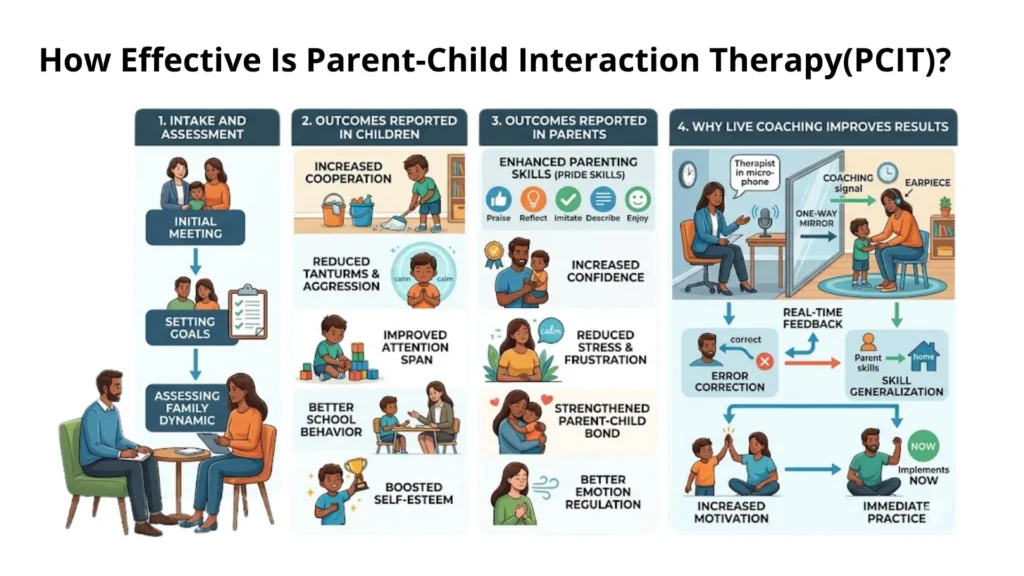
The studies and clinical evidence indicate that PCIT may result in significant changes in their daily life behavior and emotional functioning of children.
Common child outcomes include:
- fewer tantrums
- reduced disruptive behavior
- improved compliance
- better attention
- increased prosocial behavior
- improved self-esteem
Since parent child interaction therapy aims at correcting behavior as well as the pattern of relationships, the changes are likely to be outside the therapy room.
Outcomes Reported in Parents
The benefits of PCIT therapy are not limited to children. Parents have been known to feel more competent and less overwhelmed with the course of treatment.
The typical consequences of parenting are:
- increased praise
- less criticism
- reduced parental frustration
- more confidence
- improved interactions with the child.
This is important since more adequate parenting reactions tend to result in well-established and good family rituals.
Why Live Coaching Improves Results
One of the reasons that make Parent-Child Interaction Therapy effective is that it entails live coaching. Real time guidance of parents is enabled and this enables:
- immediate correction
- immediate reinforcement
- easier skill generalization
- not only listening, but learning by doing.
The majority of the treatment plans take 12-20 sessions with most of them taking 14-16 sessions per week. The sessions last an average of 60 minutes, and the home practice lasts 5 to 10 minutes daily that assist the families in developing consistent and long-term skills.
Who Is a Good Candidate for PCIT Therapy?
A family may be a good fit for PCIT therapy when daily life is regularly disrupted by behavior struggles that feel hard to manage. It is often considered when parents want a structured, research-based approach instead of trying random strategies that may not work consistently.
Signs a family may benefit include:
- frequent outbursts or meltdowns
- ongoing power struggles
- noncompliance with simple directions
- home stress in daily life.
- parent overwhelmed, frustrated, or not knowing what to do.
- behavior issues are observed in multiple places, like home and school.
When Parent Involvement Makes PCIT a Strong Option
PCIT can be a good alternative when:
- A caregiver is able to attend sessions regularly.
- The caregiver is ready to train skills at home.
- The family desires practical skill-training.
- Parents want help creating calmer routines and clearer responses
PCIT may be a powerful and very practical option to families who seek direct assistance and clear organization, as well as practical tools.
What to Expect From PCIT Week to Week
Weekly Session Schedule and Treatment Length
The majority of PCIT schedules are arranged weekly because families develop skills gradually with no significant periods between the sessions. The duration of an appointment is usually 60 minutes, which is sufficient to coach, observe, and practice. Parent-Child Interaction Therapy takes many families approximately 12 to 20 sessions to complete, although some families work through treatment quicker and others take longer based on the progress, routines, and the needs of the child.
Home Practice Between Sessions
The development of parent-child interaction therapy is not solely determined by the activities during appointments. The skills are typically practiced at home by parents over a period of 5 to 10 minutes a day. These brief training sessions assist in making new methods routine. Home practice is usually more frequent and promotes quicker improvement and more stable outcomes.
Parent Commitment and Participation
The PCIT therapy is effective where the caregiver is present throughout the process. That includes attendance, being active, and applying the tools beyond the therapy room. Consistency is important as children are more responsive to the same strategies in everyday activities such as playtime, transitions, mealtimes, and bedtime.
Emotional Readiness for the Process
Parents have absolutely nothing to be ashamed of feeling guilty, defensively, overwhelmed, or fearing judgment during the beginning of treatment. These reactions do not mean a parent is doing something wrong. They usually mean the family has been carrying stress for a long time. An effective Parent-Child Interaction Therapy process allows such feelings to be given room and assists the caregivers to gain confidence step-by-step.
How Long Does PCIT Take and How Much Does It Cost?
Parent-Child Interaction Therapy (PCIT) typically involves 12 to 20 sessions, but the number may be different in each family. Most of the families finish treatment within 14-16 sessions. PCIT tends to be mastery-based, meaning that the advancement is based on skill growth and behavior change, rather than the number of weeks during the treatment.
Session Frequency and Format
The majority of PCIT therapy programs are planned on a weekly basis, and the sessions take around 60 minutes. This consistent structure assists families to rehearse new competencies, establish regularity, and progress without protracted periods between sessions.
Average Cost of PCIT Therapy
According to the source material used, an average PCIT therapy costs about $150 per session. The real prices can fluctuate with the provider, location, and form of treatment.
Is PCIT Covered by Insurance?
In many cases, PCIT may be covered by Medicaid and private insurance plans when billed as family or individual therapy. Benefits may vary based on plan and provider so families must confirm benefits directly prior to beginning treatment.
How to Find Parent-Child Interaction Therapy Near Me
When parents search for parent-child interaction therapy near me or PCIT therapy near me, they are usually looking for one thing: real help that is close enough, practical enough, and trustworthy enough to start soon.
A good first step is to look for a therapist who is PCIT certified or formally trained in PCIT. Certification is important but formal training can be valuable too, particularly where the therapist has actual experience with young children and families.
It also helps to ask a few important questions before starting:
- Are you PCIT certified or formally trained in PCIT?
- How many PCIT cases do you usually work with at one time?
- Do you use textbook fidelity, flexible fidelity, or a mix based on the child’s needs?
- Do you provide face-to-face sessions, telehealth, or both?
- How do you measure progress during treatment?
- Are you trained in other evidence-based behavior approaches as well?
These questions will enable families to know not only whether the therapist provides PCIT, but also their level of knowledge of the model.
Location matters too. Since PCIT is usually a weekly therapy, convenience can affect consistency. This is why it is so popular to use near me searches. Families will usually require a provider that accommodates school times, work schedules and transportation realities.
At the same time, telehealth can open more options. If local providers are limited, a licensed therapist offering remote PCIT may still be a strong fit. To most families, this increase in access does not affect quality.
The best provider is not only trained. They also help the family feel supported, understood and can ask questions without feeling ashamed.
Adaptations and Related Forms of PCIT
Telehealth PCIT: Telehealth PCIT allows families to take part in treatment through live video sessions. This format may be particularly useful when getting to the location is challenging, time is of the essence, or local services are scarce. It maintains the live coaching model and opens up care to many families.
Home-Based PCIT: Home-based PCIT brings treatment into the child’s everyday environment. This format can make the coaching seem even more realistic and close to everyday life since most of the behavior issues occur in the actual routine at home.
Group-Based PCIT: In group-based PCIT, over one family is taught the model in a common environment. This will allow parents to feel supported and connected but still learn the same core strategies of interaction and behavior taught in normal PCIT.
Teacher-Child Interaction Training (TCIT): TCIT, also known as Teacher-Child Interaction Training, is a modification of these principles to use in classrooms. It assists teachers to develop more positive adult-child relationships, facilitate collaboration, and more appropriately address behavior issues within schools.
Intensive PCIT (I-PCIT): Intensive PCIT, or I-PCIT, is a shorter and more concentrated version of treatment. It aims to ensure that families develop their skills within a condensed time frame even though they remain to concentrate on the same fundamental goals of connection, structure, and behaviour enhancement.
Adaptations for Different Family Needs
PCIT has also been adapted for a wide range of family situations and clinical needs, including:
- culturally diverse families
- military families
- children with developmental or language delays
- children with hearing impairment
- children with autism
- children with ADHD
- families that have a history of maltreatment.
Such adaptations assist in making Parent-Child Interaction Therapy more applicable, flexible and useful in all environments and necessities.
Start Parent-Child Interaction Therapy With Alma Behavioral Solutions
Families are exhausted and feel at a cross-road when a child is experiencing tantrums, aggression, defiance, emotional dysregulation or a power struggle that cannot be overcome. It is where the appropriate support can come in handy.
At Alma Behavioral Solutions, families will be able to get acquainted with the evidence-based care, where both behavioral enhancement and improved parent-child relationships are considered. PCIT is not the blame of parents and labeling of children. It is concerned with assisting families to create more peaceful daily habits, better communication and gaining more confidence in their daily lives.
When you are seeking parent child interaction therapy, parent child interaction therapy near me, PCIT therapy near me, or the next step, it may be less challenging once you speak to someone who can offer an insight into what your family is experiencing.
To learn more or get started with support through Alma Behavioral Solutions, contact:
Phone: (747) 250-8494
Email: info@almabehavioralsolutions.com
Conclusion
One of the most evidence based and practical interventions to be used with young children with behavior and emotional issues is the Parent-Child Interaction Therapy. It assists children in learning to regulate and cooperate better, and the parents to react in a more relaxed, predictable, and confident manner.
The specialty of PCIT is that the relationship, not only the symptom, is treated. It imparts practical skills during practical times and provides families with the tools that they can continue to apply in their homes, in the outside world as well as with the growing child.
For parents who feel stuck, overwhelmed, or unsure what to do next, that can be life-changing. A calmer home is possible. A stronger connection is possible. And with the right guidance, families do not have to figure it out alone.
Common Questions Families Ask Before Starting PCIT
What age is best for PCIT?
PCIT is employed the most in children between 2 and 7. That is the age range that is most frequently associated with the most research base. The model mainly focuses on the early childhood and some providers are working with younger children or adjusting the model based on development.
Do both the parent and child attend every session?
Yes, in typical PCIT. The family member and child tend to participate in most of the treatment since the treatment becomes based on the coaching live when they are interacting. The fact that it is a joint effort is a key reason why the treatment is so effective.
Can PCIT be done online?
Yes. Telehealth PCIT has emerged as a significant alternative to a variety of families. Online PCIT can still be used to achieve good outcomes as long as the therapist is licensed in the area in which the family resides and the arrangement is correct.
What if my child already has another therapist?
That can happen. Children are provided with PCIT and other needs are supported. It may be useful frequently in situations when providers organize them in such a way that the family receives the same advice and a well-defined treatment plan.
What if I feel like I am failing as a parent?
That feeling is more common than many parents admit. You are not judged in PCIT. It is also about providing you with practical support, assisting you to gain confidence and demonstrating to you how to act in a manner that is more effective to you and your child.
Does PCIT only help with severe behavior problems?
No. PCIT is commonly applied in situations where behaviors are severe, although it may be applicable in milder patterns that are beginning to develop. Stress can be avoided at an early age and it can assist families in developing healthier ways of living at a younger age.
Is PCIT only about stopping bad behavior?
No. PCIT also enhances attachment, communication, parent confidence and educates children on how to react to warmth and structure. The creation of a calmer and healthier relationship and not merely the reducing of symptoms are about.