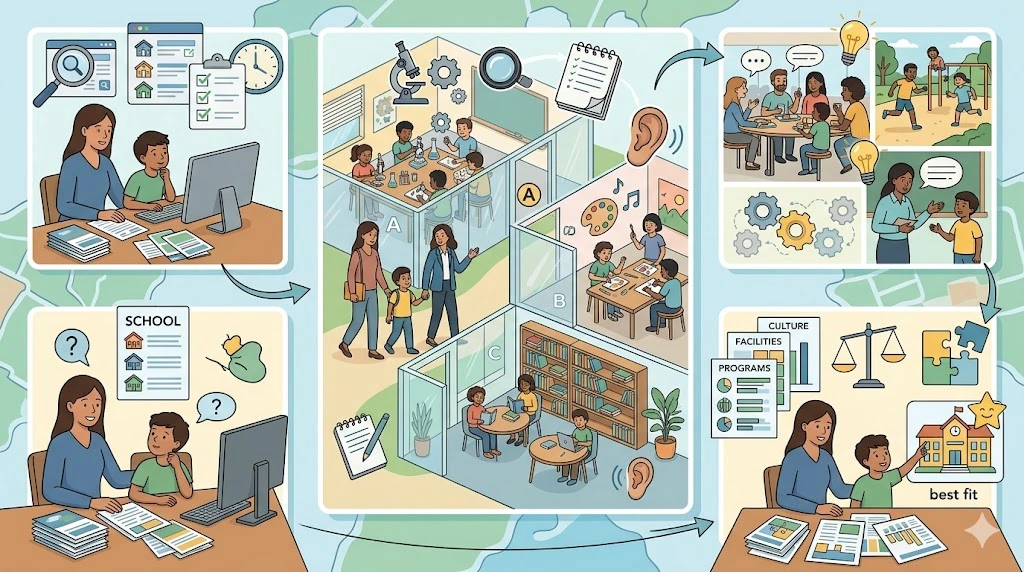

Why School Shadowing Matters When Choosing the Right School for Your Child
Choosing a school can feel bigger than choosing a program or a building. In the U.S., the number of public schools is approximately 98,600, and the number of private schools is approximately 30,500, so the number of possible choices and the stress to make a correct choice are great. Meanwhile, the latest NCES records indicate that there were 4.7 million students enrolled in private K to 12, indicating that many families are actively considering school choice, and fit.
And this is why School Shadowing is important. A website can show a mission statement. Smiling faces can be displayed in a brochure. A formal tour can show clean classrooms. However, a school shadow day will be able to demonstrate what it is like to be a school-going kid in real life.
That difference matters because schools are not just academic spaces. According to the CDC, students who feel that they belong in school are more likely to achieve higher grades, attendance and well being in general.
So if you are wondering how to choose the right school for your child, one of the smartest steps is to move beyond polished marketing and experience the school in action.
What is School Shadowing?
School shadowing refers to the act of getting to know or visiting a school in its normal operations to enable a family to have a glimpse of the real life in a school. Sometimes this happens through a classroom visit. Sometimes it happens through a school shadow day where a child follows part of the schedule. Some schools, particularly during a private school shadow day, might allow potential students to sit in a classroom, meet teachers, have lunch at school, and get a feel of the day.
It is easy to understand. You are not just looking at the school. You are viewing the school in action with actual students and teachers going through real activities.
Why a Shadow Day at School Gives Better Insight Than a Brochure Alone
A brochure may inform you about what a school would like to tell you about the school. A shadow day at school can help you to see what it is like when no one is reading off a piece of paper. You can observe whether students are relaxed or not, whether teachers are relaxed or in a hurry and whether the atmosphere is conducive or too stressed.
Start With Your Child: The First Step in Choosing the Right School
Before you compare schools, compare the schools to your child. It is the mistake of many parents. They begin with rankings, brand names or with the views of other families. All that can be beneficial, but only after that. A school may be a great school on paper yet not a good match with your child.
Understand Your Child’s Learning Style
Some children learn best by listening. Others need to see examples. Others need to move, build, discuss, or try things for themselves. It implies that what is the best classroom of one child might not necessarily be the best classroom of the other.
When you consider school shadowing, consider a few simple questions.
- Does your child do better with routine or flexibility?
- Do they enjoy discussion, or do they need more quiet time to process?
- Do they light up in hands-on settings?
The following questions will help you to evaluate whether the teaching nature of the school suits your child in the most natural way of learning.
Assess Social, Emotional, and Personality Fit
School is not just a place for lessons. It is a social and emotional environment. Other children perform well in active environments with plenty of activity and contact. Some require groups of fewer people, a more relaxed transition, and slower to feel safe.
Consider the temper of your child.
- Are they confident in groups, or do they warm up slowly?
- Are they sensitive to noise, pressure, or change?
- Do they need more reassurance from adults?
A child who feels outnumbered in the environment may not be able to enjoy the academics fully despite the seeming good curriculum.
Identify Strengths, Interests, and Areas Where Support May Be Needed
The best school fit often becomes clearer when you stop asking, “Which school is the best?” and start asking, “Which school is best for this child?”
Maybe your child is creative and needs a school that values arts and expression. Maybe they are curious and need teachers who welcome questions. Perhaps they require additional attention, confidence or transition support. Perhaps, they require a place where they get more challenged. All of that matters.
Why the Best School for Your Child Is Not Always the Highest Ranked School
A well-known school is not always the right school. An expensive school does not necessarily make the best school. Even a school with high scores might not be flexible enough, competitive enough or personal enough to suit your child.
When parents inquire about what they should do to get the right school in your child, you will be asked generally, about fit. The school which sees your child in the best perspective and which is in a position to help in both the learning and well being in the long run is the right school.
What Parents Should Look for During School Shadowing or a School Shadow Day
A good shadowing experience is not passive. It is a chance to obtain worthwhile information. You are in a quest to find out the safety, emotional, academic and practicality of the school to your family.
During school shadowing, focus on a few big areas. Look at safety and supervision. Watch how adults speak to children. Observations of classes tone. Consider teaching quality, curriculum, behavior, student support, and the overall atmosphere. Next consider real-life fit in terms of schedule, commute, communication and cost.
With such glasses to see the day through, the visit can be a lot more valuable.
Safety and Safeguarding: The First Thing to Evaluate During School Shadowing
Safety is the first non-negotiable. Academics, culture and enrichment can not be taken seriously by the parents unless they are sure that the child will be physically and emotionally safe.
Check Safety Systems Beyond Basic Compliance
On your visit, enquire about the practice of safety.
- Who handles student concerns?
- How are visitors managed?
- How are emergencies handled?
- How does the school communicate with families if there is a problem?
A good school ought to be capable of describing its systems easily. You should hear more than policy language. You should hear evidence that staff know the routines and that safety is part of how the school runs every day.
Observe Whether the School Feels Calm, Secure, and Well Managed
During a shadow day at school, look beyond formal answers. Notice how students move through hallways.
- Do transitions feel chaotic or organized?
- Are younger children supported?
- Are adults paying attention?
- Are the students relaxed or are they tense and restless?
Parents often sense safety through atmosphere before they can put it into words. That instinct matters.
Questions Parents Should Ask About Safety and Security
With a small series of questions, one can learn a lot:
- What do you do in case of an emergency or evacuation?
- What is the supervision of students during transition, recess, lunch and dismissal?
- What are the reactions of the school towards bullying, aggression or frequent behaviors?
- What can be done in case a child is worried, socially challenged or is finding it difficult to fit in?
School Culture, Values, and Ethics: What a Shadow Day at School Can Reveal
One of the most significant aspects of school quality is culture, and one of the most difficult aspects to consider based on a site. A school can talk all about goodness, respect, inclusion, and character.
Do the School’s Values Align With Your Family’s Values?
The majority of the families desire most of the same things. Respect. Safety. Responsibility. Good teaching. Clear expectations. But the way a school expresses those values can differ a lot.
There are schools which are very formal and strict. Some are warm and relational. Some prioritize independence early. Some emphasize collaboration and support. None of that is automatically right or wrong. The issue is whether the approach of the school suits your family and your child.
Compare the School’s Claimed Values With What You Actually See
Pay attention to the speech of adults towards students. Observes how students behave with one another. Indicate whether errors are dealt with in a dignified or mortifying way. Note the sound of leadership, is it an open and thoughtful or defensive and dismissive sound.
This information is important since posters on the wall do not prove values. They are established through tone, conduct, and steadiness.
Signs of a Positive School Culture
A healthy school culture can tend to be stable and inviting. Students seem like they belong. Staff appear respectful and present. Classrooms feel focused without feeling fearful. Problems are addressed without humiliation.
Such an environment supports school connectedness, improving attendance, academic performance, and well-being. Consider a School Consultation to choose the right fit.
Red Flags to Watch for During a School Shadow Day
Parents should take their time and beware of a few red flags. One is a school that seems obsessed with competition at the expense of belonging. The other is lack of communication or not providing clear answers to simple questions. Another is visible tension among staff or a school tone that feels overly harsh or impersonal.
All these indicators do not necessarily exclude a school, but they need to raise more questions.
Teaching Quality and Leadership: The Real Drivers of School Quality
Families often focus first on curriculum, brand, or facilities. Those things matter, but the daily school experience is shaped most strongly by people. Leaders and teachers create the atmosphere, control environment, drive the learning process, and create the relationships that either make the children flourish or make school a struggle day after day.
Why Great Teachers and Strong Leadership Matter More Than Marketing
A beautiful campus cannot make up for weak teaching. Responsive leadership can not be substituted with a strong reputation. This is normally experienced by parents as soon as they begin paying physical visits to schools.
The outstanding schools tend to shine due to the competence and articulateness, nurturing and discipline of the adults in them. It is difficult to play that during a real time visit.
What to Look for in Teachers During School Shadowing
Watch how teachers lead a room.
- Are they familiar with the way to engage students?
- Do they explain clearly?
- Do they respond with patience?
- Do they accommodate questions?
- Do students appear comfortable participating?
You are not looking for perfection or performance. You are looking for competence, warmth, and presence. The teacher should seem like someone who can hold standards while still helping students feel respected and supported.
What to Look for in School Leadership and Management
The good leadership usually manifests itself in straightforward means. The school is well organized. The admissions staff is receptive. Questions are answered directly. There is clarity about expectations. Staff appears to be aware of mission and day-to-day systems of the school.
Such a school with a strong leadership does not have to be defensive. It is able to clarify its decisions and recognize difficulties and manage to convey confidence.
Questions to Ask About Teacher Development, Retention, and Expertise
Ask how the school supports teacher growth. Ask how long teachers tend to stay. Ask what professional development looks like. Ask how the school supports new teachers and how it maintains instructional quality.
These questions are important since staff stability and continual training can significantly influence the student experience to a greater degree than is necessarily perceived by families. When the adults receive support, students tend to enjoy that support and consistency.
How the School Helps Children Learn and Grow
A good curriculum is important, but curriculum in itself does not inform you about how learning occurs. Parents should look at both the academic framework and the teaching methods used to deliver it.
Why Curriculum Is About More Than Academic Scores
The curriculum of a school must enable children to develop knowledge, yet more importantly aid communication, problem-solving, confidence, responsibility, and preparation to the next phase in life. Good education is not just what children are able to regurgitate on a test. It is also about what they can understand, apply, and carry forward.
Why Teaching Methodology Matters During a School Shadow Day
Methodology is about how learning is delivered.
- Do students listen, or do they think, discuss, practice, and get engaged?
- For younger children, is learning developmentally appropriate?
- For older students, are they being challenged to reason, communicate, and take ownership?
A shadow day at the school will enable you to observe how the teaching at the school is primarily passive, predominantly interactive or somewhere between the two. This in most instances is more significant than the official curriculum.
How Schools Should Support Different Types of Learners
Ask how the school supports students who struggle in certain subjects. Ask what happens if a child learns differently or needs more time. Inquire how the advanced learners are challenged. Inquire about the support available to children with executive functioning, behavior, confidence, or adjustment needs.
Curriculum Boards and School Fit: What Parents Need to Know
Numerous families compare school models, which include traditional college-prep, progressive, faith-based, charter, Montessori, classical or international models. It is not that one of the labels is always the best.
The right question is whether the school’s curriculum and daily teaching approach match your child’s needs, your family’s values, and your long-term goals.
School Discipline, Student Behavior, and Peer Environment
Behavior systems shape how a school feels. They also influence the way children feel safe, just and included. During school shadowing, look closely at how rules are enforced and how students behave when adults are nearby and when they are not.
What Healthy School Discipline Looks Like
Healthy discipline is calm, clear, and consistent. It is not chaotic. It is not fear-based. It does not rely on public embarrassment. Children are to be aware of what is expected, and adults are to discuss issues without making them bigger than they need to be.
According to CDC, the restorative practices may assist schools to establish respect, empathy, trust, and connectedness, which contribute to safer and healthier schools.
Why Peer Group and Class Culture Matter for Your Child
Children learn from one another all day long. They get to know what is usual, what is rewarded and what it is to be part of. This is the reason why peer environment is important.
Also know whether students are respectful. Notice whether they include one another. Notice whether classrooms feel cooperative or socially tense. The peer culture your child joins will influence both short and future development.
Student-Teacher Ratio and Individual Attention
Not only is class size an indicator of quality, but it is important. Generally, children tend to get personalized attention when adults can know them well.
When you come, pose yourself a question to ask. Does this school seem designed so my child can be seen, or is it easy for children to disappear into the crowd?
Student Well-Being, Staff Well-Being, and the Emotional Climate of the School
Parents often underestimate emotional climate because it is harder to measure than curriculum or facilities. But it does take a real toll on the school day life of the children.
Why Staff Well-Being Affects Student Experience
Supports increase the tolerance, energy, and emotional capacity of teachers towards students. Overwhelmed teachers can still be highly caring, but might not respond well to pressure.
How to Read the Emotional Climate During School Shadowing
Look around and listen. Are students feel safe and involved? Do adults appear respectful and calm? Does the school feel warm and steady, or tight and strained?
Connectedness is not a pleasant bonus. The CDC classifies it as a protective factor which is associated with improved academic performance, improved attendance and improved health and well being.
Extracurricular Activities and Whole-Child Development
Parents are right to care about enrichment. School does not necessarily involve basic academic classes. It is also where children find interests, make friends and also gain confidence and learn to be a team player.
Why Extracurriculars Matter When Choosing the Right School for Your Child
Sports, clubs, leadership, arts, and music, service opportunities, can significantly contribute to the growth of children. They also provide an alternative form of successful experience, particularly to students who might not necessarily shine in conventional classroom set-ups.
How to Judge Whether Activities Truly Fit Your Child
Do not inquire of a school how many activities there are. Ask whether the offerings are a realistic fit for your child’s interests and energy. A lengthy activity list is not necessarily constructive when the programs are poor, unavailable or unrelated to school culture.
Facilities, Infrastructure, Location, and Daily Practical Fit
The school can be nice on paper but can be rough in reality. This is why families need to consider infrastructure, location, transportation and budget and all the educational and emotional aspects.
What to Check in Classrooms, Libraries, Labs, Play Areas, and Shared Spaces
Look for spaces that are safe, clean, organized, and clearly used for learning. The classrooms must be practical and not adorned. Bathrooms and common rooms are to be clean. The libraries, laboratories, creative rooms, and outdoors must resemble the places where students can really develop and engage.
Function Matters More Than Fancy Buildings
It is easy to be impressed by appearance. Parents should resist that instinct. An impressive building does not make a good school. The real question is whether the environment supports learning, safety, inclusion, and daily ease for children and staff.
Why Location, Commute, and Transport Matter
Commute has an overall day impact. Long commute may imply early mornings, increased energy, increased stress and decreased time to take rest or family time. A school that is theoretically ideal may become harder to sustain if the daily logistics are too heavy.
Budget, Value, and Affordability
A higher tuition does not automatically mean better quality. Values are something families need to consider. What does the school really provide as regards to teaching, support, safety, culture and opportunity? Is it realistic and sustainable to your family in the long-term?
School Tour vs School Shadow Day: What Parents Can Learn From Each
Parents often ask whether a regular tour is enough. The answer is no, usually. A tour is useful, but it gives only one kind of information.
What a School Tour Can Show You
A school visit will give you an exploration of the campus, classes, facilities, admission procedure, and the general philosophy. It helps learn the structure of the school and asking initial questions.
What a School Shadow Day Can Show You
A school shadow day can provide you the reality of the school. It shows you classroom pacing, peer interactions, teacher personality, lunch culture, transitions and emotional tone of the day. In a private school shadow day, this can be especially useful because many independent schools emphasize community fit as much as academics.
Why Parents Should Use Both Before Enrolling
A tour shows the framework. Shadowing shows the experience. Together, they give parents a fuller picture. It is usually one of the most efficient ways of assessing a school in a considered manner.
A Step-by-Step Process for Choosing the Right School After School Shadowing
There is a tendency of families requiring a straightforward process after visiting because they would not get bogged down in emotion, comparison and information overload.
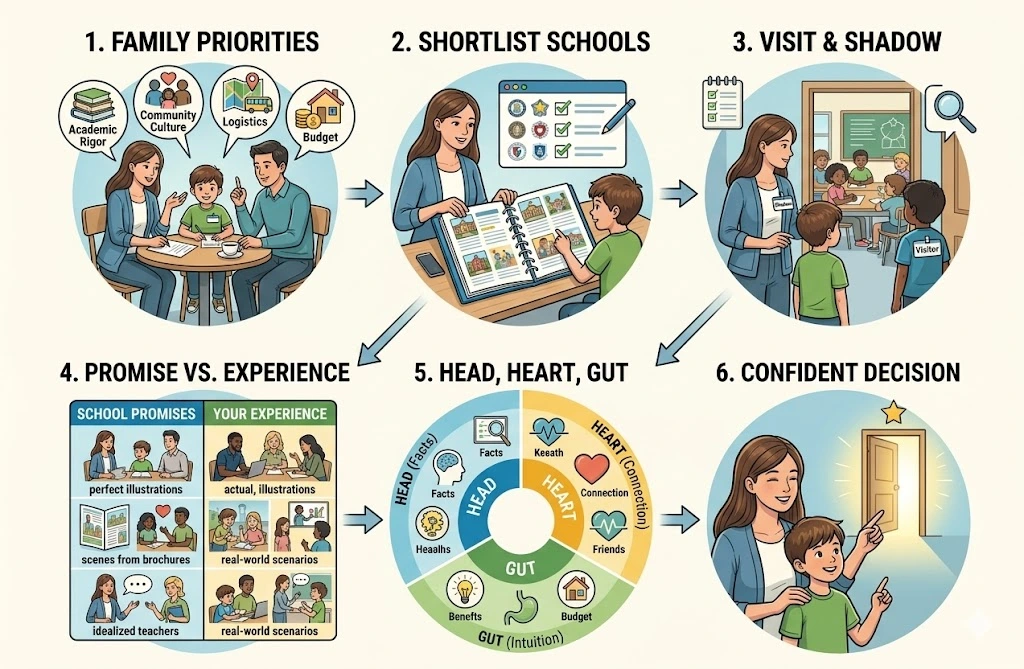
Define Your Family Priorities
Decide what matters most. Different families can have varying priorities on academic challenge, emotional support, behavior structure, commute, values, inclusion, cost or extracurricular opportunities.
Shortlist Schools Based on Child Fit and Practical Needs
Choose the schools that realistically match your child and your family’s day-to-day life. This helps you avoid chasing options that look strong but are not truly workable.
Visit, Observe, and Attend a School Shadow Day if Possible
Do not trust websites, rankings and second opinions only. A real visit and, if available, a real shadowing experience can change your perspective quickly.
Compare What the School Promises With What You Experienced
After each visit, ask yourself whether the lived experience matched the school’s message. Did the environment support the claims? Did the people, tone, and daily rhythm align with what you were told?
Use the Head, Heart, and Gut Framework
Use your head for practical and academic fit. Use your heart to fit emotionally and community. Apply your gut to the general trust. When all three line up, families often feel much more certain in the final decision.
Common Mistakes Parents Make When Evaluating Schools
Even wise parents may be drawn into the wrong choice, should they pay attention to the signals.
Choosing Based Only on Reputation, Rankings, or Big Names
A school’s reputation may tell you something, but it does not tell you everything. The fit, the environment and daily experience are equally important.
Overvaluing Fees, Branding, or Impressive Facilities
Price and presentation can create the illusion of quality. The actual quality typically manifests itself more in the teaching, climate, responsiveness and child support.
Ignoring Child Fit, School Culture, or Teaching Style
Mismatch in teaching style or culture may leave a school hard to endure every day, despite the respect of the school.
Not Visiting the School in Person
This is one of the biggest mistakes. Parents must be able to observe the school functioning in the real life, rather than in edited materials.
Focusing on School Type Before Culture and Methodology
Labels matter less than how the school actually functions. And the question is always, how the child will live, and learn there.
How to Involve Your Child in the School Decision
Children do not make the final decision, but their perspective matters. Engaging them in a manner that is age appropriate assists you to know what they observed and their perceptions.
Why Your Child’s Perspective Matters
Children often pick up on emotional details adults miss. They will be able to tell you whether a classroom was inviting, whether a lunch was intimidating or whether they could imagine being in a certain classroom.
Their POV is particularly useful when a shadow day at school has occurred and they had an opportunity to see the environment more closely.
What to Ask Your Child After a School Visit or Shadow Day
Keep the questions simple. Inquire about their feeling there. Ask what they liked. Ask what felt uncomfortable. Ask whether they could imagine learning there every day.
You are not asking them to solve the decision. You are asking them to help you see the school more clearly.
Preparing for a Smooth Transition After You Choose a School
Once the decision is made, families should think about transition. A good decision can be stressful when the change is in a hurry or when it is not supported by emotions.
Practical Preparation Before the First Day
Visit again if possible. Help your child understand the schedule, drop-off, pick-up, and daily routines. Meet key adults when you can. Make the first days feel familiar instead of abrupt.
Emotional Preparation for Children and Parents
Children can be excited or nervous or both. Parents are relieved, doubtful or guilty. All of that is normal. Talk openly. Keep routines steady. Give adjustment time. A thoughtful transition can make a strong start even stronger.
Conclusion: The Best School Is the One That Truly Sees Your Child
Choosing a school is not just about comparing programs. It is all about finding a place where your child can be secure, comprehended, challenged and assisted.
This is why school shadowing, a school shadow day, or even a carefully-organized personal school shadow day can prove so helpful. It assists families to get beyond the refined words and experience what schooling is all about.
When you are left wondering how to select the right school to take your child to, begin with your child, go and see schools with your own eyes, ask more appropriate questions, be mindful of facts and feel their way. The right school is not simply the one with the biggest name. It is the one that will really suit the child of which it will be daily the doors.
Need Support in Choosing the Right School for Your Child?
Choosing a school can feel overwhelming, especially when you are trying to balance learning style, emotional fit, safety, behavior support, daily logistics, and long-term goals.
Alma Behavioral Solutions can help families think more clearly about a child’s developmental, emotional, and behavioral needs as part of the school-selection process. Parents will get to know their child better, and it will be easier to rate schools based on this knowledge.
Call: (747) 250-8494
Email: info@almabehavioralsolutions.com
Frequently Asked Questions About School Shadowing
What happens during a school shadow day?
A school shadow day is typically a day when a potential student can be on campus during a typical school day. They can sit in classes, meet with teachers, have lunch or have part of the routine. It assists in evaluating the environment by the student and the parent to see whether it is a good fit.
How is a shadow day at school different from a school tour?
School tour typically involves an organized tour that is guided by the admissions personnel. A school shadow day is more of a reflection of the school daily routine, classroom culture and student experience. Families find a lot more out of seeing the school at work than they would have done in a presentation in isolation.
What should parents look for during a private school shadow day?
The safety, classroom tone, teacher quality, student behavior and how school values are manifested in day-to-day life are the aspects that parents should observe during a private school shadow day. They are also supposed to consider whether or not the school is emotionally and practically suitable to their child.
Can school shadowing really help me choose the right school for my child?
Yes. School shadowing may help to make the decision easier as it demonstrates a way of how the school works in reality. It assists parents to get out of the rankings, websites and brochures. This comes in handy particularly when attempting to determine how to select the appropriate school to your child in a considerate manner.
Is school shadowing only useful for private schools?
No. Though the term is often used, privatesch shadow day, school shadowing may come in handy in a variety of locations. Whenever a school provides you with a chance to look at actual classrooms and actual routines you can learn something useful regarding fit, climate and experience of everyday life.