

Does bedtime become a long struggle, even when your child seems exhausted?
A sleep consultation helps families understand their child’s sleep difficulties and determine the right support.
A child who resists bedtime needs different support from a child who snores, gasps, awakens, or moves unusually during sleep. Behavioral guidance cannot replace medical assessment.
Parents hear new words, such as sleep coaching, sleep testing and polysomnography. The right approach differs depending on your child’s age, development, symptoms and health history.
We will discuss how consultations work, who offers them, which tests doctors might suggest, and practical sleep support for autistic children and families at different ages.
Key Takeaways
- Sleep support starts with an understanding of the child’s patterns, health, environment, and developmental needs.
- Nonmedical consultants can teach a family sleep habits but cannot diagnose sleep disorders.
- Snoring, gasping, and breathing pauses require medical evaluation, not just bedtime coaching.
- An overnight sleep study will assess sleep physiology and a consultation will discuss any concerns and next steps.
- Personalized, caregiver-supported strategies can make sleep times easier to manage, but this varies by child.
What Is a Sleep Consultation for Babies and Children?
A child sleep consultation reviews concerns, routines, and potential influencing factors to determine the next steps. It is not a guarantee of a restful night’s sleep for any kid.
A professional will ask about sleeping schedules, night waking, naps, prescriptions, developmental progress and daytime functioning at a visit. A nonmedical coach does not diagnose medical problems, but instead looks at routines and caregiver instruction.
For example, if a toddler consistently gets out of bed, a routine before going to sleep might be useful. If a child has trouble breathing often at night, even if they have good sleep habits, they should see a doctor.
A useful first question: Do you have a main concern about your child settling or might a health problem be affecting sleep?
Who Provides Pediatric Sleep Consultation?
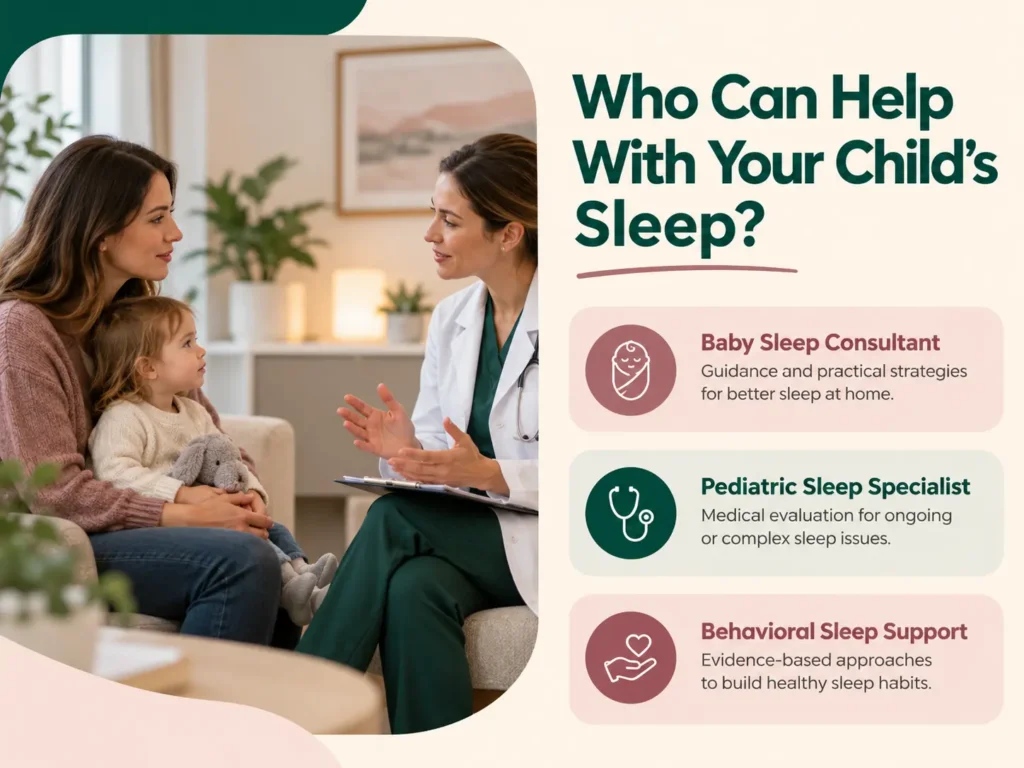
A pediatric sleep consultant can provide general advice based on the routine but it is not a specific medical credential. Families should distinguish sleep coaches, licensed clinicians, and behavioral professionals.
Sleep Coaches for Babies
A baby sleep consultant will work with caregivers to look at feeding and sleeping schedules, bed time routines, nap times, and how caregivers react when waking. Training and referral practices should be carefully questioned as qualifications vary.
A consultant can recommend regular changes and note them down with parents. They should not make diagnoses, prescribe medication or recommend practices that are contradictory to safe infant sleep practices.
Pediatric Sleep Specialists
A specialist for sleep disorders, such as a pediatric sleep physician, examines sleep concerns beyond bedtime habits. Medical specialists determine whether diagnostic testing or additional referrals are appropriate.
Pediatric sleep teams can consist of ear, nose and throat doctors, neurologists, pulmonologists and behavioral sleep clinicians. The child’s symptoms help determine which expertise is needed.
Behavioral Sleep Professionals
Behavioral sleep strategies for children address common bedtime resistance, learned sleep associations, and inconsistent schedules. Professional responsibilities depend on licensing and training.
Psychologists may address insomnia or bedtime anxiety, while behavior analysts may support relevant daily-living and caregiver goals within their scope. Neither role automatically replaces a medical sleep specialist.
When Should Parents Consider Professional Sleep Support?
A sleep consultation can be beneficial if sleep problems continue, interfere with the daily life or if caregivers are not sure what to do. Consult a pediatrician if symptoms indicate medical causes.
Potential signs of concern are:
- Bedtime resistance: Long, repeated struggles to settle despite an age-appropriate routine.
- Frequent waking: Repeated nighttime waking that seems unusual for the child’s developmental stage.
- Daytime changes: Fatigue, irritability, poor concentration, or difficulty engaging in activities.
- Unusual nighttime events: Excessive movement, confusion, or behaviors that may require medical evaluation.
- Breathing concerns: Habitual snoring, gasping, or observed pauses in breathing.
Seek prompt medical advice concerning breathing symptoms. If the child has severe difficulty breathing, turns blue or gray, or becomes unresponsive, seek emergency care. Sleep coaching isn’t an acceptable alternative.
What Sleep Problems Are Common in Babies and Kids?
Sleep problems vary across age groups and a kids sleep consultant should not use one set of sleep schedules for everyone. Developmental stage and medical needs matter as much as daily routines.
Babies and Toddlers
A baby sleep consultant can talk to you about short naps, difficulty settling, or waking frequently. Developmentally normal feeding needs and sleep patterns may also occur.
Common patterns include:
- Night waking: May be related to feeding, discomfort, sickness or developmental needs.
- Bedtime routines: For some toddlers, bedtime may be more difficult because of an unsuitable day schedule.
- Separation concerns: If the caregiver leaves the room, the toddler becomes upset.
The American Academy of Pediatrics recommends that infants sleep on their backs on a firm, flat surface in a separate infant sleep space without loose bedding throughout their first year. Talk about feeding issues before altering routines.
School-Age Children
During a child sleep consultation, persistent worry at bedtime, out-of-sync wake times, screen time or settling problems may all be discussed. School schedules also impact on sleep length and alertness.
Other concerns include nightmares, sleepwalking, restless sleep, and snoring. Repeated breathing symptoms or dangerous nighttime behaviors warrant medical assessment; a routine change alone may not address their cause.
What Happens During a Child Sleep Appointment?
A sleep consultant for children begins with the family’s experience and doesn’t impose a standard sleep routine. Medical evaluation consists of history, exam, and possibly testing as well.
Reviewing Sleep History
A specialist for sleep disorders examines sleep and wake patterns, naps, nighttime issues and daytime behavior. Families share their primary concerns and the steps they have taken.
Sensory preferences, illness, medications, and caregiver availability are some of the topics that may be included in questions. Details help identify issues needing another professional.
Using a Sleep Diary and Environment Review
A kids sleep consultant may recommend a simple diary before changing routines. Records show trends over a number of days rather than on a single tough night.
Note bedtime, sleep onset, awakenings, naps, wake time and observations. Also note lighting, noise, discomfort, or illness on the chart.
Creating an Individualized Plan
An individualized plan selects behavioral sleep strategies for children based on age, communication, sensory needs, and family habits. A plan might prioritize consistent wake times or calmer transitions.
Parents require clear objectives, answers to distress and cues to seek medical advice. Plans should remain adjustable.
Checking Progress and Adjusting Support
Follow-up may include a review by a pediatric sleep consultant of diaries, caregiver observations and changes in daytime functioning. Progress means realistic improvement, not a guarantee of perfect nights.
Medical review should be considered for persistent snoring, pain or severe fatigue. Follow-up also detects shifts which introduce greater stress than benefit.
What Behavioral Sleep Strategies May Help Children?
Behavioral sleep strategies for children encourage predictability and respect family and developmental preferences. Make small changes at first and adjust to the reactions of your child.
Build a Consistent, Age-Appropriate Routine
A kids sleep consultant might initially suggest sensible wake schedules and unwinding activities prior to sleep. While routine can minimize uncertainty not all awakenings can be avoided.
Try a simple routine: Put toys away, wash hands, get in bed, read a story, and go to bed. Set up a realistic schedule that will leave time for some daytime naps and plenty of sleep.
Use Visual and Sensory-Friendly Cues
For sleep problems in children with autism, visual schedules can clarify bedtime transitions and reduce repeated verbal cues. Use pictures, a simple checklist, or a first-then board.
When your child is distressed by sounds, scratchy clothing, or bright lights, try to decrease them. Inquire into their likes, not assuming that everything is dark and quiet for everyone.
Teach Changes Gradually and Reinforce Success
A child sleep consultation may help determine a single sleep goal at a time, such as a bedtime routine that requires less prompting. Reinforce cooperation without demanding immediate independence.
A child who requires a caregiver to be close by may have a familiar bedtime pattern. Changes should be gradual and account for distress; rigid sleep training is not suitable for newborns.
Practical principle: Change one part of your child’s routine at a time, observe their response, and seek support if distress increases or problems persist.
What Types of Sleep Tests May Be Recommended for Kids?
When parents ask “what is a sleep test?” it could refer to a number of assessment tools. Testing is chosen based on symptoms, clinical exam, and the clinical question that needs an answer.
| Test or tool | What it measures | When it may help |
|---|---|---|
| Sleep diary | Sleep and wake times, naps, nighttime waking | Identifying routine patterns |
| Sleep questionnaire | Parent-reported symptoms and sleep behavior | Determining concerns to evaluate |
| Actigraphy | Rest and activity over multiple days | Assessing sleep-wake timing |
| Overnight polysomnography | Brain activity, breathing, oxygen, heart rhythm, movements | Investigating suspected medical sleep disorders |
| Specialized daytime testing | Sleepiness under monitored conditions | Selected disorders when a clinician recommends it |
Sleep studies can collect more clinical information than diaries and consumer wearables. The American Academy of Sleep Medicine does not recommend that standard home apnea testing machines be used for diagnosing obstructive sleep apnea in children.
What Happens During a Pediatric Sleep Study?
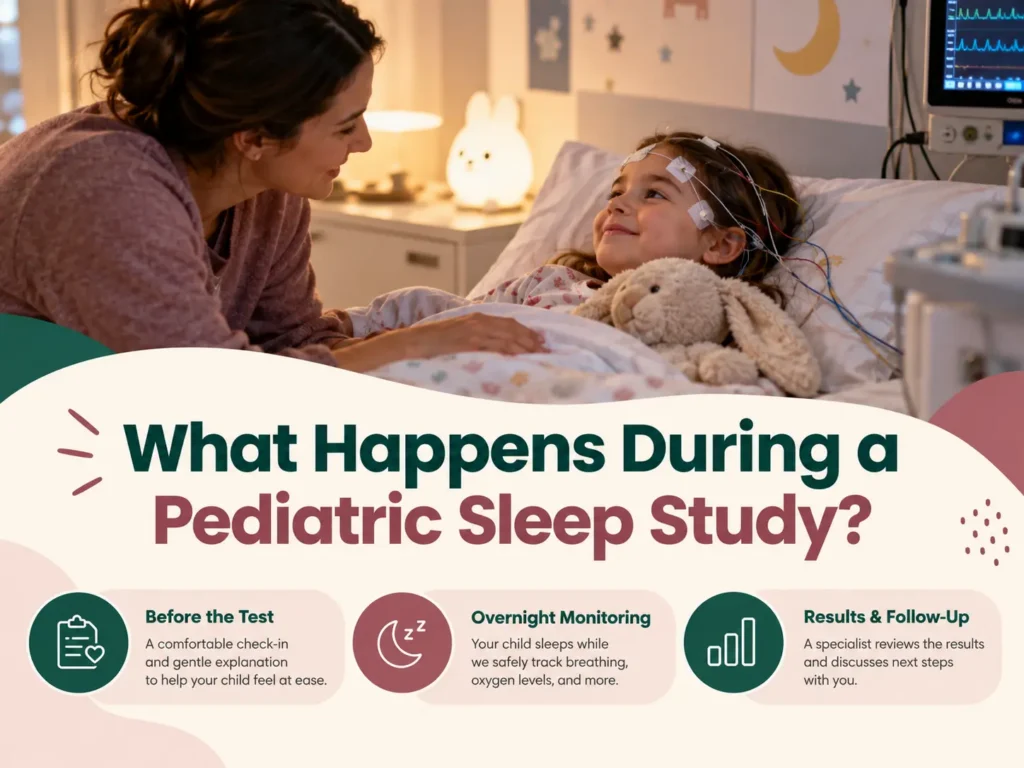
A sleep study for kids usually happens overnight in a child-friendly, pediatric-capable laboratory. Staff are trained to monitor sleep; a caregiver may remain in the room.
Preparing Before the Appointment
Clinical staff explain arrival, clothing, medication, and daytime naps before a pediatric sleep study. Never alter a child’s medication without medical advice.
Discuss sensitivities, communication requirements and concerns about equipment. Discuss caregiver arrangements and comfort items allowed.
Understanding Overnight Monitoring
During sleep studies, trained staff place sensors to track sleep stages, breathing, oxygen saturation, heart rhythms, and body movements. The sensors are not meant to be a painful treatment, but a means to gather data.
A technologist monitors the equipment and watches the recording all night. Children may sleep differently in a new setting – this is why the clinical team interprets the data with that in mind.
Receiving Results and Next Steps
A sleep study for kids needs clinical interpretation, not an immediate home diagnosis. A doctor reviews the recording and discusses whether follow-up is required.
Treatment conclusions may include recommendations for breathing intervention, further specialist evaluation or behavioral suggestions. Families should inquire about what was found, what to do, and what the next steps are.
Sleep Consultation vs. Sleep Study: What’s the Difference?
A sleep consultation discusses family concerns and potential next steps; if there is a medical concern that is suspected to be related to sleep, the provider could order lab tests to investigate.
| Question | Sleep consultation | Sleep study |
|---|---|---|
| Main purpose | Understand concerns and plan next steps | Collect physiological sleep data |
| Provider | Qualified coach or healthcare professional, depending on the concern | Medical sleep team |
| Typical approach | History, routine review, caregiver guidance, possible referral | Overnight monitoring using sensors |
| Diagnosis | Only qualified medical clinicians diagnose within their scope | Results support a clinician’s diagnosis |
Practical coaching might be suitable for a resistant child whose breathing is normal. Snoring or breathing pauses point toward medical assessment first.
How Are Sleep Problems Addressed in Autistic Children?
Sleep problems in children with autism should be addressed with attention to communication, sensory needs, health conditions, and family priorities. The intent is to achieve improved sleep, not a specific sleep pattern.
A family centered plan can involve:
- Visual sequence: Picture sequence for pajamas, brushing teeth, calming activity, bedtime.
- Sensory accommodation: response to fabric, sound, temperature, lighting and transitions according to the child’s preference.
- Functional communication: Support the child to communicate their needs, e.g. water, discomfort, reassurance, break.
- Consistent responses: Agree with caregivers about responses to requests and distress; respect safety and care concerns.
- Seek medical help for persistent snoring, pain, unusual movements or excessive daytime sleepiness.
Consider a child who becomes overstimulated when playtime ends. Instead of repeated verbal commands, a caregiver can use a countdown and bedtime sequence, then track which transitions become easier. Our family-based ABA services can be utilized in Glendale and Burbank to support appropriate daily-living objectives for the child’s individualized care plan.
Sleep medication or melatonin should be discussed with the child’s prescribing clinician and not started solely because maintaining a routine is difficult.
What Are the Benefits of Sleep Support?
A sleep consultation can help families understand nighttime challenges, identify practical goals, and build routines that fit their child’s developmental needs. Improvements vary between children and over time.
Potential benefits include:
- Clearer patterns: Sleep monitoring allows caregivers to detect patterns of sleep problems.
- Predictable bedtime steps: This can help decrease uncertainty and resistance.
- Improved teamwork: Caregivers can coordinate their responses and adjust strategies thoughtfully.
- Appropriate referrals: Concerning symptoms may prompt timely medical evaluation.
Diagnostic testing may be helpful if a clinician thinks a patient may have a sleep disorder. Progress could mean quieter nights, fewer bedtime struggles, or better daytime functioning rather than uninterrupted sleep.
What Are the Limitations of Sleep Support?
A pediatric sleep study may assist the practitioner in addressing specific medical issues, but will not address all sleep problems. Similarly, behavioral coaching has clear clinical boundaries.
Important limitations include:
- No medical diagnosis: Nonmedical consultants cannot diagnose sleep apnea, seizures, or other health conditions.
- No guarantees: Progress will vary with age, development, discomfort, family situation and consistency.
- Different goals: Testing collects medical information, coaching concentrates on routine and caregiver reactions.
- Continuous changes: Any plan can be revised if there are changing needs or symptoms.
Persistent snoring, breathing pauses, or severe sleepiness should be evaluated by a qualified healthcare professional rather than managed with routine changes alone.
How Can Parents Choose and Prepare for a Sleep Professional?
Searching sleep consultant near me is a first step, but not evidence of qualifications. Look for clear credentials, age-appropriate practices, transparent fees, and willingness to coordinate with your pediatrician.
Before booking, consider these questions:
- Training and scope: What training or qualifications does the professional possess and what areas of concern lie outside of their expertise?
- Individualisation: How do age, disability, feeding, communication and family preferences feature in the recommendations?
- Safety and referrals: Will the provider direct breathing problems or suspected medical conditions to a physician?
- Process and costs: what is the assessment, how is follow-up done, and what is the total cost?
- Preparation: Should you bring a sleep diary, medication list, school feedback, or previous medical reports?
Families comparing options in Pasadena or Los Angeles can also ask whether the professional offers in-person or virtual appointments and how care is coordinated with existing providers.
How Can Alma Behavioral Solutions Support Bedtime Challenges?
When families experience sleep problems in children with autism, we can consider relevant routines and communication goals within individualized ABA support, not as medical sleep testing.
Our Parent Support Service allows us to collaborate with caregivers to implement consistent responses, practice reinforcement, and set up goals that help daily life to be more manageable. Our Direct Therapy services also emphasize individualized skill development and family collaboration.
Families in Northridge and Studio City can ask us about ABA support available in their area. Concerns about breathing, seizures, or other possible medical sleep disorders should be discussed with a pediatric healthcare professional.
Conclusion: Helping Your Child Sleep With the Right Support
Sleep issues can impact the whole family, and the first step is to tackle your child’s sleep. Coaching for some families is about bedtime routines. Others need a sleep study for kids when a physician suspects a disorder, particularly with snoring, breathing pauses, or unusual nighttime events.
Our approach at Alma Behavioral Solutions centers on individualized behavioral support, family collaboration, and realistic goals. We can support caregivers with routine-related challenges that are part of ABA care and encourage medical evaluation when symptoms extend beyond behavioral support.
Families in Granada Hills and Beverly Hills can contact us for more information about our services and next steps. To discuss your child’s developmental and behavioral needs, Call (747) 250-8494 or email info@almabehavioralsolutions.com. You can also contact our team to ask about parent support and individualized ABA services.
Frequently Asked Questions About Children’s Sleep
When parents are looking for sleep consultant near me, they typically have questions regarding cost, training, evaluation, and realistic expectations. These answers give you some direction on where to start.
Is Hiring a Baby Sleep Coach Worth It?
A baby sleep consultant may help caregivers organize routines and understand age-related sleep patterns. Value depends on training, individualized advice, and reasonable expectations. A pediatrician should always be consulted about medical issues.
What Is a Sleep Test for a Child?
A sleep test evaluates a child’s sleep patterns and possible disorders. An overnight sleep study records breathing, oxygen levels, brain activity, and body movements to help diagnose conditions such as sleep apnea.
When Does a Child Need a Sleep Specialist?
A specialist for sleep disorders may be appropriate for persistent snoring, breathing pauses, severe daytime sleepiness, or concerning nighttime events. Your pediatrician can assess symptoms and make the proper referral.
Can a Sleep Study Diagnose Sleep Apnea in Children?
A pediatric sleep study involves monitoring breathing and other indicators of the body while the child sleeps. Those findings are analyzed with the child’s symptoms by a qualified clinician to diagnose or rule out conditions, such as obstructive sleep apnea.
How Much Does a Kids’ Sleep Consultation Cost?
The cost will depend on the clinician, assessment, location, and insurance. When considering a sleep consultant near me, ask for written fees and follow up information. Ask your insurer separately about medically indicated specialist visits or testing.