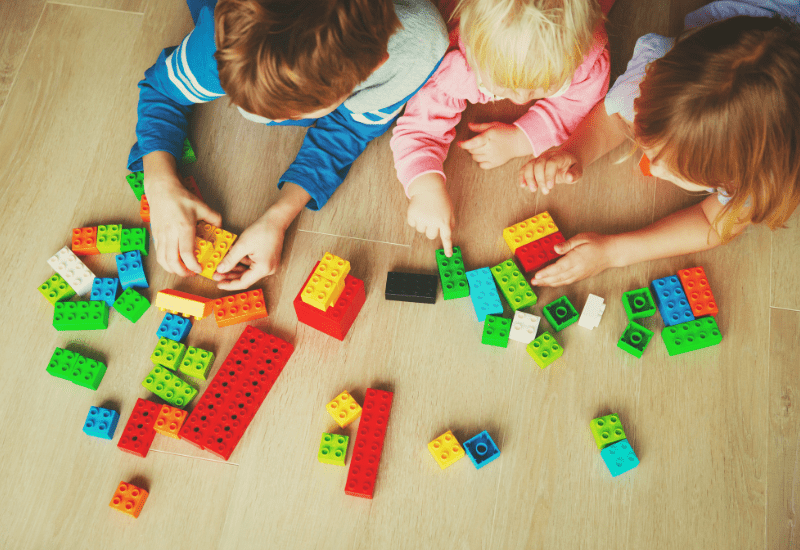
Imagine your child lining up toy animals, assigning each one a personality, a voice, and a role in their tiny imagined world.
Or maybe they’re building a blanket fort — complete with rules, rituals, and a sign that says “Keep Out.”
It may look simple. It may even look like “just fun.”
But beneath the giggles and make-believe, something profound is happening.
Your child is practicing emotional regulation, problem-solving, confidence, and communication — all through the language most natural to them: play.
At Alma Behavioral, we see play not as a break from learning, but as the heart of it. Play based therapy helps children express emotions, build self-awareness, and learn new skills in a way that feels safe, joyful, and accessible.
How does play-based therapy work?
Play based therapy works by giving children a developmentally-appropriate way to express what they think, feel, and experience — without the pressure of adult language. For many kids, speaking directly about emotions is overwhelming.
But through dolls, blocks, sand trays, and imaginative scenes, their inner world becomes much easier to share.
In play based therapy, the therapist observes how the child engages with the materials and steps into their rhythm rather than forcing conversation. At Alma Behavioral, this might look like:
- Symbolic play: letting characters act out emotions the child doesn’t have words for yet.
- Sensory play: helping children regulate through textures, movement, or calming materials.
- Role-play: practicing communication, boundaries, and emotional expression in a safe, playful format.
- Open-ended storytelling: where toys become anchors for understanding fears, hopes, and challenges.
Play based therapy works because it meets the child’s nervous system where it is. Instead of asking a child to adapt to therapy, therapy adapts to the child.
According to the Association for Play Therapy, children naturally use play to process emotional and behavioral challenges, and therapeutic play gives them a structured opportunity to do so more effectively.
What are the 5 stages of play therapy?
While each child’s journey is unique, most play based therapy follows five broad stages. These stages help us understand how children move from exploration to emotional growth:
1. Exploration and Engagement
The child becomes familiar with the playroom, toys, and therapist.
They test boundaries, explore materials, and figure out, “Is this a safe place for me?”
2. Expression
Emotions begin to emerge — sometimes subtly, sometimes dramatically.
Through play based therapy, fears, frustrations, and hopes show up in symbolic play, stories, and character interactions.
3. Testing and Processing
The child reenacts themes repeatedly: conflict, separation, bravery, frustration, loss.
This is where the therapeutic work deepens. According to developmental psychology research, repetitive play is the brain’s way of integrating overwhelming experiences.
4. Insight and Growth
The child begins to try new strategies, experiment with solutions, and show greater emotional regulation.
You may notice fewer outbursts, more communication, or better problem-solving at home.
5. Consolidation
New skills solidify.
The child understands their emotional patterns, feels more confident navigating challenges, and trusts their connection with the therapist.
At Alma Behavioral, play based therapy never rushes a child through these stages — each one unfolds at the pace their nervous system can hold.
What is a play therapy approach?
A play therapy approach is a structured therapeutic method that uses play as the primary way to support emotional, social, and behavioral growth. The approach centers on one key belief: children communicate most honestly through play.
There are two major types of play based therapy approaches:
1. Child-Centered Play Therapy
Rooted in the work of Virginia Axline, this approach allows children to lead the session entirely.
The therapist offers empathy, reflection, and emotional safety, letting the child guide the themes and direction.
2. Directive Play Therapy
Here, the therapist gently introduces activities with a specific therapeutic purpose — such as practicing frustration tolerance, supporting transitions, or building communication skills.
At Alma Behavioral, we use both approaches depending on the child’s age, history, and support needs. Whether structured or open-ended, play based therapy honors the child’s voice and autonomy.
This approach is evidence-supported and widely used for children with anxiety, trauma histories, sensory differences, ADHD, and behavioral challenges.
What is an example of a play therapy session?
A play based therapy session often looks like imagination and creativity on the surface — but underneath, every moment is intentional.
Here’s an example:
A Play Based Therapy Session at Alma Behavioral
A child arrives feeling overwhelmed after a difficult morning at school.
They head straight for the sand tray — a classic tool in play based therapy — and begin burying toy figures under the sand.
The therapist gently joins the play.
“It looks like some of the characters feel hidden today.”
The child nods and adds more sand. Soon, one figure emerges from the pile.
“This one got out,” the child says.
The therapist reflects,
“It seems like even when things feel heavy, part of them still wants to come up and breathe.”
From the outside, this looks like simple play.
Inside the child’s nervous system, something powerful is happening:
- They’re expressing overwhelm without needing to speak it.
- They’re practicing mastery and control.
- They’re receiving co-regulation and emotional naming.
- They’re rehearsing resilience — symbolically, safely, and creatively.
This is play based therapy in action. Therapy that speaks the child’s language. Therapy that builds behavioral skills not through lectures, but through experience.
Bringing It All Together
Play is not a distraction from emotional growth — it is emotional growth.
When we view behavior through the lens of play based therapy, we begin to understand what a child’s inner world is trying to communicate.
At Alma Behavioral, we use play based therapy to help children explore feelings, build resilience, and develop new behavioral skills in a way that feels safe, natural, and deeply empowering.
Because when therapy meets a child where they are — in imagination, creativity, and curiosity — that’s when real healing begins.
And that’s when children discover something extraordinary: they already have everything inside them to grow, adapt, and thrive.