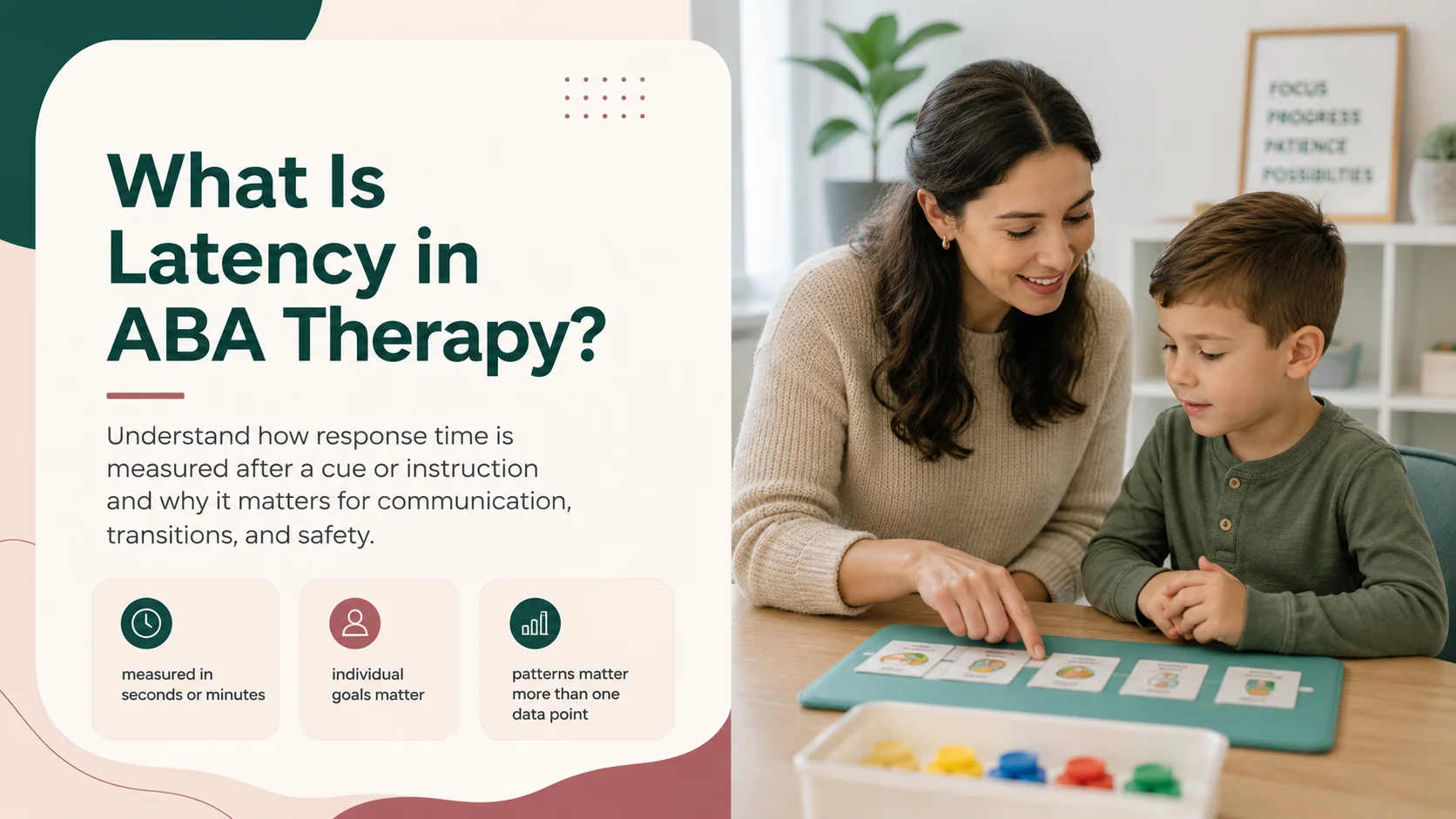

How long does it take a child to begin a response after a clear instruction, cue, or event? During that delay, Applied Behavior Analysis measures latency, which can provide information that accuracy alone would not capture. Latency may play a role in communication, transitions, daily activities, learning activities and safety responses. This guide will discuss the definition of latency in the context of ABA, how it differs from other measures, when it’s relevant, how it’s recorded, and how families can interpret the data without reading one number as the complete answer.
Key takeaways
- Latency measures time before a defined response begins.
- It is different from duration, frequency, rate or IRT.
- Latency is not necessarily the end goal.
- Latency data is more reliable if there are clear start and stop points.
- The results have to be interpreted in the context and repeated data.
What Is Latency in ABA Therapy?
Latency in ABA refers to the amount of time that elapses between a clearly stated cue or instruction and the initiation of a stated behaviour. While ABA deals with observable, operationally defined behavior, the general term in psychology for this is latency.
If the therapist says, “Put the block in the box?” and the child starts moving the block after five seconds, the response latency ABA measure is 5 seconds. Latency is a timing issue, not an attitude or a motivation or willingness issue.
How Latency Differs From Other ABA Measurements
Behavior analysts choose a measure based on the question they need to answer. In ABA latency measures the time it takes for a response to start, and other measures describe length, repetition, spacing. The wrong measurement can obscure useful information. This table shows the difference.
| Measurement | Main Question | Example |
| Latency | How long until the behavior starts? | 8 seconds before homework begins |
| Duration | How long does the behavior last? | 20 minutes working on homework |
| Frequency | How many times does the behavior occur? | 4 requests |
| Rate | How often does the behavior occur per unit of time? | 4 requests in 30 minutes |
| IRT | How long between two responses? | 3 minutes between requests |
Latency Vs Duration in ABA
Latency Vs duration ABA measurements use different timing points. Latency is from the defined antecedent to onset of response, and duration is from onset to offset of behavior. If a child begins homework 10 seconds after a homework direction, and works for 15 minutes, their homework latency is 10 seconds and duration is 15 minutes.
Latency Vs Interresponse Time in ABA
Latency vs interresponse time describes cue-to-response time versus response-to-response time. It is important to note that a student may raise his hand and raise it again four minutes later, which is IRT ABA data, not latency. IRT may be helpful when the interval between repeated responses is important.
Latency Frequency and Rate Answer Different Questions
Frequency describes how many occurrences; rate describes how many per unit time. Instead, latency refers to the time lapse between an established cue and onset of behavior. A learner may get the answer right all the time but have variable response times, so the timing needs to be analysed.
When Latency Recording Is Useful in ABA Therapy
In some situations, a delay to a behavior is important either practically or clinically, and latency recording will be useful. Task initiation, transitions, communication, social responses, safety directions and onset of challenging behavior after a specified antecedent are common examples. It can identify changes that might go undetected by accuracy or frequency.
A systematic review was conducted on latency-based functional analysis and treatment research in 27 empirical articles in 2024, comprising 79 cases. The review identified that latency may increase options for assessment when repeatedly triggering a target behavior may be impractical or undesirable. Previous experimental studies also demonstrated an inverse relationship between latency and response rate in functional analyses.
When Shorter Latency May Be the Goal
A shorter latency may be important if a learned response must start quickly to safeguard or be independent. This could mean “Stop”, initiating a familiar routine, initiating a transition or using an established response to communicate. Strategy needs to be tailored to the student, not aimed at making the child react quicker in any instance. Options may include:
- clearer cues;
- appropriate prompting and prompt fading;
- meaningful reinforcement;
- practice with familiar tasks;
- visual supports or reduced distractions.
When Increasing Latency May Be Helpful
When an impulsive or unsafe response occurs too rapidly, additional time may be warranted and be appropriate. For skills such as communication, coping, replacement skills, or aggression, a plan could involve an increase in delay before the behavior occurs before it is taught. The goal is to support safety and function, not simply slow behavior. Latency-based assessment has been investigated in situations where repeated instances of problem behavior might be a risk or impractical.
How to Measure Latency in ABA
The first two observable anchors in reliable latency recording in ABA are the start of timing and what constitutes response onset. Vague directions create inconsistent data. If a better plan is in place it specifies what it is and what the first action is, and the time unit. Direct timing then captures the time (in seconds or minutes) between these points.
Define the Cue and Target Behavior
An operational definition should enable different observers to observe the same event in the same way.
For the cue, it could be “put your shoes on,” and the response onset could be “the child reaches toward either shoe.”
That is clearer than “the child starts getting ready.” Clear definitions enhance consistency among therapists, caregivers and settings.
Record Latency Step by Step
To understand how to measure latency in ABA, use a consistent procedure:
- Specify the cue or antecedent.
- Explain the first observable reaction.
- Make a timer or use an approved data tool.
- Be consistent with the cue.
- Start timing at the predetermined point.
- Stop at the start of the defined response.
- Record the elapsed time.
- Make note of significant context when applicable.
- Repeat throughout similar situations.
Whole-interval, partial-interval, and momentary time-sampling systems do not provide exact cue-to-response time. Those methods are used to answer different measurement questions.
How to Calculate Latency in ABA
The basic formula is:
Latency = response onset time − defined antecedent time
Three comparable trials of 4, 6, and 5 seconds produce an average latency of (4 + 6 + 5) ÷ 3 = 5 seconds. Individual values, the median, range and trends can also be viewed in the case of an average that obscures unusually long or short trials. While calculating latency in ABA is easy mathematically, it still needs to be interpreted in context.
Examples of Latency in ABA Therapy
Latency in ABA is better understood when the onset of the cue and response can be seen. This can be used when teaching structured, at home, in-school communication and in safety situations.
| Situation | Cue or Antecedent | What Counts as Response Onset | Recorded Latency |
| Learning task | Therapist says, “Point to the blue card” | Child begins reaching toward the blue card | 4 seconds |
| School transition | Teacher says, “Please line up” | Student starts walking toward the line | 6 seconds |
| Home routine | Parent says, “Put your shoes on” | Child reaches for a shoe | 9 seconds |
| Communication | Adult asks, “What would you like?” | Child begins the defined communication response | 5 seconds |
| Safety skill | Adult says, “Stop” | Child stops moving forward | 2 seconds |
A useful non-example is total task completion time. If it takes 10 seconds for a child to start brushing, and then brush for 2 minutes, 10 seconds is the latency and two minutes is the duration. IRT would be time between two repeated responses, where the responses are part of the same defined response class. These timing measures are distinct due to clear definitions.
How Behavior Analysts Interpret Latency Data
Clinicians make sense of latency data, making comparisons on similar opportunities and linking the pattern to the learner’s goals. A BCBA can examine baseline data, trends, task differences, prompt levels, accuracy, and others. Five-second latency can be fine in some applications, but essential in others. Interpretation should focus on what the pattern means for this learner and goal.
Look for Patterns Across Multiple Opportunities
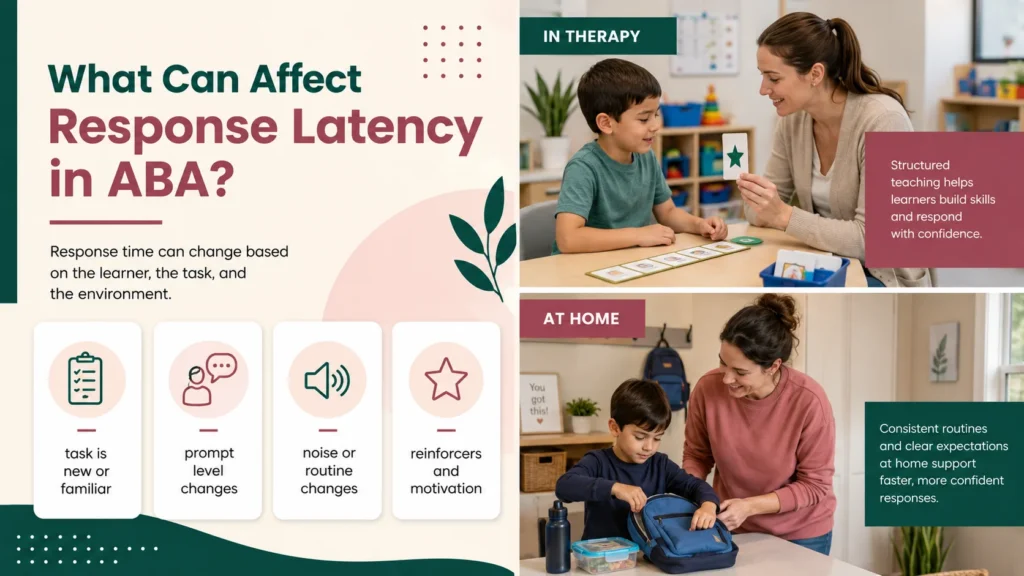
An abnormally swift or slow response is not always the key. Repeated changes are identified and the difficulty of the task, cue wording, reinforcement, prompts, noise, routines, and learning history are considered. Useful questions include:
- Is latency changing consistently?
- Does the pattern exist across persons or situations?
- Has accuracy changed with response speed?
- Did prompt level or task difficulty change?
- Does another option provide context?
What Latency Cannot Tell You by Itself
Latency does not mean poor comprehension, low motivation, refusing, anxiety, slow processing, prompt dependency or lack of mastery. A shorter latency does not necessarily mean more independence and more learning.
Recent 2025 studies on conversational response timing identified latency as a function of interaction and developmental factors; these studies were not ABA treatment trials but further emphasizes the need for context.
Latency can help infer a hypothesis, but on its own cannot establish behavioral function or an internal cause. Use of the term “may indicate” or “warrants further assessment” is more accurate than stating that the number is the reason for a response. As of
No universal benchmark for response latency to be used for all children, skills, or settings exists in August 2026. Individualized goals remain essential.

Common Mistakes in Latency Recording
- Clear Definitions: Give clear instructions on the exact cue and when the response is to be initiated, clearly defining the onset of the cue and response.
- Consistent Timing: Ensure that the timer is started and stopped in the same way in each trial, so that the latency measurements are not incorrect or unreliable.
- Comparable Opportunities: To assess latency, only compare between comparable tasks, instructions, settings and skill levels to provide meaningful comparisons.
- Contextual Awareness: Consider prompts, changes in the environment, the difficulty of the task, and familiarity, because the same latencies can be different situations.
- Balanced Interpretation: Incorporate latency data with professional judgment, family priorities, communication, assent, and the learner’s well being to make decisions.
Individualized ABA Support With Alma Behavioral Solutions
While latency can provide informative timings, there is no one number that can dictate a child’s development. Measurement is linked with communication, safety, independence and family priorities in a meaningful way with ABA care.
Alma Behavioral Solutions offers individualized evidence-based treatment planning and BCBA supervision and monitoring. We work towards practical objectives in everyday life as the focus of our care. Goals are reviewed over time as the child’s needs, skills, routines and family priorities evolve.
Families seeking ABA services throughout Southern California will be able to connect with our team about an assessment, treatment planning, and what steps to take next. Call (747) 250-8494 or email info@almabehavioralsolutions.com to connect with Alma Behavioral Solutions.
Frequently Asked Questions About Latency in ABA
Is Latency a Continuous Measurement in ABA?
Yes. Latency is a direct measurement as the time interval between the onset of an antecedent and the onset of a response is measured for the opportunity. Unlike discontinuous systems like partial-interval or momentary time sampling.
Is There an Ideal Latency for a Child to Respond?
There is no universal optimum latency for all children. A helpful target is based on the skill, baseline, setting, safety requirements, communication style and treatment objective. The clinical team should set their expectations rather than give one standard ‘time to respond’.
Should a Delayed Response Be Considered Noncompliance?
No. A delayed response does not automatically mean that the agency is in noncompliance nor does it explain the delay. When making decisions or altering an individualized treatment plan, the clinician should look at the skills, communication, task conditions, prompting history, environment and other data.
Can Parents Track Latency at Home?
Latency can be recorded at home by parents, if it facilitates a mutually agreed treatment outcome, it is clearly explained, and parents can be helped to do this. The same cue, response, and timing are used with each home observation to increase consistency and usefulness of clinical observations.
Who Decides When Latency Should Be Measured?
When response timing is relevant to the learner’s goals, the BCBA selects latency. The decision should be based on assessment, baseline data, safety, family priorities and if another measure would better answer the clinical question.