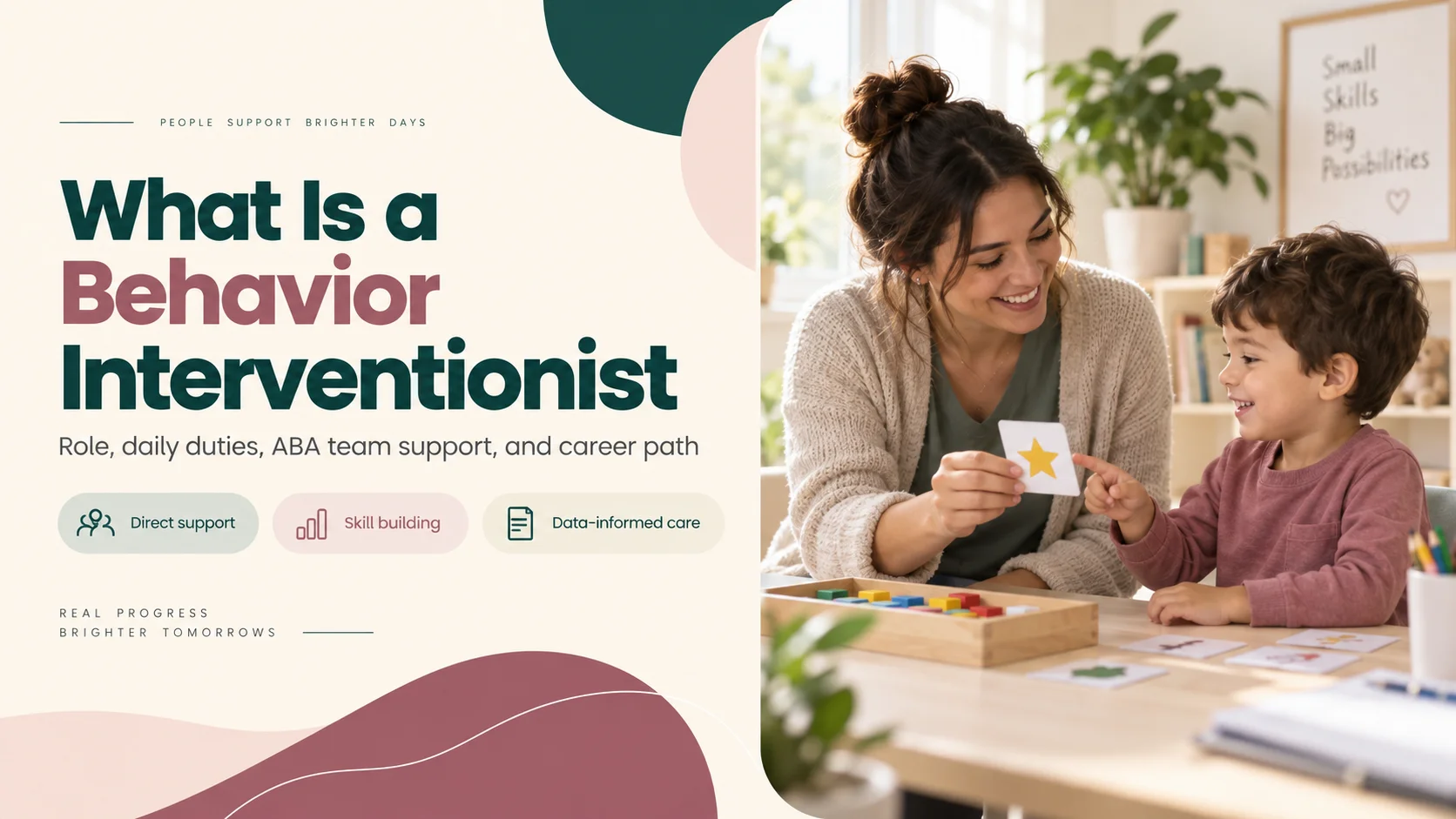

Who is the person who makes a behavior support plan a real learning opportunity in the child’s daily activities?
A behavior interventionist frequently has direct contact with children or other clients to teach beneficial skills, facilitate communication, gather data, and implement individualized behavioral strategies.
The term behavior interventionist can be confusing as it is not a guarantee that this person will be a BCBA, BCaBA, or Registered Behavior Technician. Responsibilities and qualifications may vary among employers, settings, states, and services offered.
Those differences are important to know to parents when deciding on behavioral support and to professionals thinking about this career. This guide explains what a behavior interventionist is, typical behavior interventionist duties, their place on an ABA team, commonly used strategies, training requirements, salary considerations, and possible career pathways.
Introduction to Behavioral Interventions
What Are Behavioral Interventions?
Behavioral intervention is personalized, evidence-based support that allows individuals to learn useful skills, express their needs, process their routines, and respond more effectively in their everyday lives. In Applied Behavior Analysis, interventions are based on observable behavior, environmental context, learning history, and meaningful goals.
They may support:
- Functional communication
- Social and play skills
- Daily living and self-care
- Transitions and routines
- Learning readiness
- Safer replacement behaviors
- Greater independence
Effective intervention will teach how to do something different, reinforce their progress, and measure whether changes enhance quality of life.
What Is a Behavior Interventionist?
A behavior interventionist, also called a behavioral interventionist, is a direct-care professional who implements individualized behavioral and skill-building programs. In ABA settings, they may provide one-to-one teaching, use approved strategies, collect session data, and share observations with a supervising clinician.
Generally, the term behavior interventionist refers to a job position and not a nationally standardized certification. Employers can refer to the job position using other terms, such as behavior technician, ABA therapist, behavioral therapist, or direct interventionist.
There are some behaviour interventionists who are qualified to be an RBT, although the terms are not equivalent. RBT is a formal BACB certification with specific training, competency, and supervision requirements.
What Does a Behavior Interventionist Do?
The behavior interventionist is the person who takes the written plan to real life. The professional guides the client in the practice of focused skills regularly and documents outcomes to allow the supervising team to assess progress.
Common behavior interventionist job duties include:
- Implementing approved skill-acquisition and behavior-support programs
- Teaching communication, social, adaptive, and learning skills
- Using reinforcement, prompting, modeling, and other trained strategies
- Supporting functional alternatives to challenging or unsafe behavior
- Collecting objective behavioral and learning data
- Preparing materials and arranging learning opportunities
- Documenting sessions accurately
- Sharing relevant observations with supervisors
- Collaborating appropriately with caregivers and other team members
The exact duties of a behavior interventionist will depend on the setting. The work of school-based, clinic-based, and home-based professionals can be similar, have different documentation systems, supervision systems, and goals for clients, and even work on different schedules.
The Behavior Interventionist’s Role on the ABA Team
Implementing the Plan Without Independently Redesigning It
A behavior interventionist usually carries out goals, teaching procedures, and behavior support protocols that have been determined by a qualified behavior supervisor.
A Behavior Intervention Plan (BIP) might include information about proactive supports, replacement skills, reinforcement procedures, responses to specific behaviors. The interventionist follows the plan as written, takes objective data, and makes observations.
Clinical assessment, programming and key changes to the program continue to be done by professionals who have credentials and scope of practice for that.
Working With Supervisors Families and Other Professionals
Support for behavior is not typically provided in isolation. An interventionist can connect with a BCBA or other qualified supervisor, parents, teachers and allied professionals working with the individual.
Teamwork aids in the solution of practical problems like:
- Is the skill being exhibited in the outside therapy?
- Are prompts being faded successfully?
- Is it getting easier to do the routine?
- Are the patterns being observed by caregivers?
- Do additional data need to be collected by the supervising clinician?
Behavior Interventionist Duties During a Typical Workday
Preparing for a Session
Preparation begins before direct teaching starts. The interventionist can check current programs, collect teaching materials, verify data goals, set up reinforcers and record what instructions are given by the supervising clinician.
Working Directly With the Client
Direct work for each child, goal and setting may differ significantly. Teaching and learning can occur at table, and can be embedded in play, conversation, at meals, in community outings, within classroom routines and as a natural part of happenings.
The Behavior interventionist may:
- Present learning opportunities
- Prompt a response when needed
- Reinforce progress
- Gradually reduce unnecessary assistance
- Practice skills across activities
- Follow established procedures when challenging behavior occurs
Consistency is important but repeating the same interaction is not. Highly effective interventionists master the program and remain responsive, respectful, and practical in teaching.
Recording Progress
Data transforms individual sessions into information which the clinical team can use. An interventionist could record frequency, duration, independence, prompting levels, other defined measures, or any combination of these.
Session documentation should detail what was observed, not assumptions about what was going on in a child’s mind or feelings. Accurate records enable supervisors to know when a skill is being developed, upheld or requires further clinical review.
Communicating Progress
A behavior interventionist communicates pertinent observations to the supervising clinician, and, if applicable, to the caregivers and other support-team members. Updates can be patterns of performance, changes in independence, rapid responses, effective reinforcers, or session issues. Communication must be objective, timely, private, and helpful for providing care and/or the need for clinical review.
What a Behavior Interventionist Session Can Look Like
Think about a child who is upset when an activity they enjoy is finished. The treatment goal should not simply be “stop protesting.” A useful plan might be to teach the child how to ask for more time, ask for a break or transition with an appropriate communication response.
During the session, the interventionist might:
- Give a clear transition cue.
- Prompt the child to request more time when appropriate.
- Reinforce functional communication.
- Help the child complete the transition.
- Fade assistance as independence develops.
- Document the events and the level of support needed.
The interventionist doesn’t have to speculate on the rationale behind the strategy. Reliable data and observations can be brought back to the supervising clinician, who can determine whether the program should remain the same or be clinically adjusted.
Where Behavior Interventionists Work
Home-Based Services
Home sessions allow skills to be taught where many daily routines naturally occur. Interventionists can address communication, dressing, mealtimes, play, transitions, following home routines, or independence.
Home based work can also provide a chance to apply the skills that are taught in structured therapy in everyday family life.
ABA Clinics and Treatment Centers
Clinic-based services can include a space for controlled teaching as well as opportunities for natural play and social interaction. Interventionists are able to provide one-to-one services for clients and have access to supervision, teaching resources, peers and structured programming.
Schools and Community Settings
School-based behavior intervention may be used to facilitate classroom participation, communication, transitions, interactions, learning routines, and access to instruction. Services can be based in an IEP, behavior plan, PBIS framework or school procedures.
Community sessions are used to practice skills within parks, stores, recreational activities, etc., and in day-to-day activities. School support is different than medically funded ABA and check each program’s role and needs.
ABA Techniques a Behavior Interventionist May Use
Teaching and Skill-Building Strategies
An interventionist makes decisions on procedures not based on what is popular. Strategies must be individualized in harmony with learner, goals, professional training and authorized treatment program.
Common ABA teaching tools can include:
- Positive reinforcement to strengthen useful behaviors
- Prompting and prompt fading to provide help and gradually reduce it
- Modeling to demonstrate a skill
- Shaping to reinforce progressively closer versions of a target response
- Task analysis and chaining to teach multi-step skills
- Functional Communication Training to build practical ways of expressing needs
- Discrete Trial Training for structured learning opportunities
- Natural Environment Teaching for instruction within naturally occurring activities
The technique is only applicable if it leads to the person’s meaningful learning.
Behavior Support Strategies
Effective behavior support looks at triggering, clarity of expectations, the use of visual supports, offers choices, task modification, and the teaching of functional communication. Differential reinforcement increases the frequency of appropriate alternatives. Interventionists use approved procedures, record observations, seek guidance from supervisors and do not use procedures that are not a part of their training or job.
Prevention Strategies
Prevention strategies minimize the risk of challenging or unsafe behavior by modifying environments, planning for transitions, giving choices, providing visual supports, giving breaks and simplifying tasks. Interventionists use approved procedures, observe the responses, record objectively, and discuss changes to treatment plan with supervisors.
Generalization
The greatest value of a skill is when the person can apply it to others, materials, setting, and time. Interventionists might then execute a skill in different situations rather than demonstrating success in just one very controlled setting.
Ongoing Measurement
The collected data will be used to assess the progress of skills and how independent students are becoming, as well as whether skills are being transferred between individuals, environment, resources, and daily activities.
Behavior Interventionist vs RBT vs BCaBA vs BCBA
The titles that come before a B.A. in ABA seem interchangeable, but have varying meanings in professional terms. This data indicated that as of July 1, 2026, there are 260,174 RBTs, 5,246 BCaBAs, and 85,587 BCBAs in the credentialed behavior-analysis workforce.
| Role | Title or Credential | Typical Role | Supervision |
| Behavior Interventionist | Usually employer-defined job title | Direct intervention and skill support | Depends on job and setting |
| RBT | BACB paraprofessional certification | Delivers behavior-analytic services | Close ongoing supervision required |
| BCaBA | BACB undergraduate-level certification | Behavior-analytic services and possible RBT supervision | Must work under BCBA supervision |
| BCBA | BACB graduate-level certification | Assessment, program design, analysis, and supervision | Independent behavior-analytic practitioner |
The BACB defines the RBT as a paraprofessional certification whose holders work under close supervision. It describes BCaBA as an undergraduate-level certificate supervised by a BCBA, and BCBAs are independent practising graduate-level clinicians that can supervise BCaBAs, RBTs, and other implementers.
Behavior Interventionist Vs RBT
The key behavior interventionist vs RBT difference is title versus certification. “Behavior interventionist” may be an employer’s job title, while RBT is a credential issued by the Behavior Analyst Certification Board.
Their everyday duties can be interwoven. Some companies provide interventionists and then help these individuals become certified as RBTs; others, after or during hire, mandate certification as an RBT.
Behavior Interventionist Vs BCaBA
A BCaBA holds a formal undergraduate-level behavior-analysis certification and can provide behavior-analytic services only under BCBA supervision. The BACB also allows BCaBAs to supervise RBTs. These responsibilities do not automatically accrue to a behavior interventionist due to their job title.
Behavior Interventionist Vs BCBA
A BCBA has a very different clinical position. BCBAs can practice independently within behavior analysis and supervise professionals implementing behavior-analytic interventions.
A direct-care interventionist is more likely to implement assigned programming, collect data, and document observations than to complete the entire clinical process.
Education and Training for Behavior Interventionists
Entry-Level Education Requirements
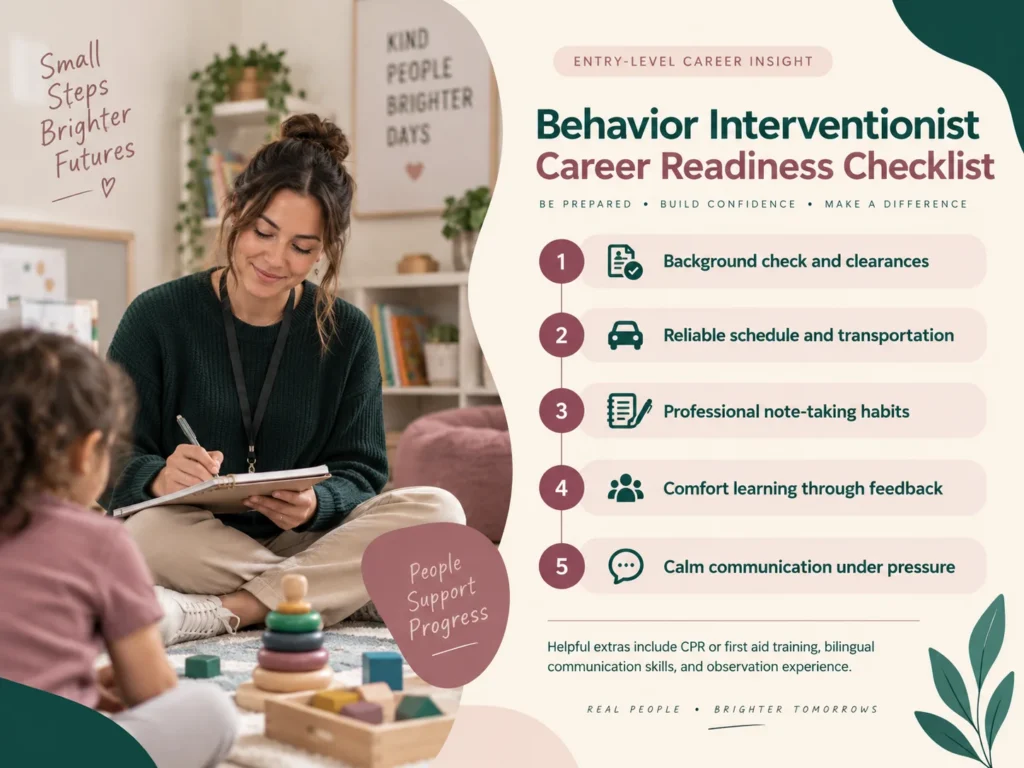
There are no national requirements for the job title behavior interventionist. Requirements may be related to employer policy, funding rules, state regulations, population served, and requiring an additional certification.
Employers may consider candidates with:
- For some entry-level positions, a high school diploma or equivalent may be required.
- College psychology or education courses, child development or human services.
- An associate or bachelor’s degree for positions with higher requirements
- Relevant experience supporting children or people with developmental needs
Candidates need to read the specific job posting and not take it for granted that the requirements of one employer are the same for all.
Training and Certification Requirements
In the workplace training, documentation, data collection, teaching procedures, ethics, safety, confidentiality, and implementing behavior-support programs are often taught. Employers may also require or prefer RBT certification.
Current RBT rules are important because of the BACB’s new requirements in 2026. Applicants following the 2026 pathway must be trained to satisfy the current 40-hour training requirement as well as an updated Initial Competency Assessment, and the BACB sees ongoing supervision as the core of RBT practice.
How to Become a Behavior Interventionist
There is no single national pathway to becoming a behavior interventionist, as the path differs based on the desired job.
Check Requirements for the Jobs You Want
Review job postings in public, private, school, behavioral health, and community agencies that offer ABA services. Pay attention to education, background checks, driving requirements, desired experience, certification and supervision. Job titles alone can hide meaningful differences.
Complete the Required Education
Meet the minimum education required by your target employer. Courses in psychology, behavior analysis, special education, communication, or child development can be helpful and depending on the course, the requirements may be different.
Relevant training should supplement competency in hands-on work not replace supervised practical work.
Build Foundational ABA Skills
Entry-level professionals benefit from learning how to observe behavior objectively, collect reliable data, follow written protocols, reinforce skills, communicate professionally, and maintain appropriate boundaries.
Highly successful candidates also recognise that “following the plan” involves seeking advice if the task is beyond their training.
Earn an RBT Credential When Required or Helpful
An RBT credential is also a formal credential for paraprofessional training in behavior analysis and is mandated by some employers or service models. Candidates should not refer to the older online checklists from BACB as the training and competency requirements for the 2026 RBT Handbook have changed. Certification does not eliminate the requirement for ongoing supervision.
Apply for Supervised Direct-Care Roles
Look for jobs like behavior interventionist, behavior technician, RBT, behavioral therapist, or ABA technician. Describe how responsibilities, supervision, training, travel, hours and populations served are similar and different.
A good first job should help a professional develop the competency, not just drop them off with a client in hand and assume he will figure it out on his own.
Skills a Good Behavior Interventionist Needs
Practical and Technical Skills
Technical competence is more than just knowing the terms of ABA. A successful interventionist is aware of the information that a supervisor requires in order to make effective decisions.
Important skills include:
- Objective observation
- Reliable data collection
- Accurate documentation
- Reinforcement and prompting skills
- Following treatment protocols
- Organizing teaching materials
- Recognizing changes worth reporting
- Knowing when to seek supervision
Interpersonal and Professional Skills
This also relies on the professional’s interactions with people, as direct support. The quality of a session can be impacted by patience, reliability, flexibility, listening, team work, communication and emotional management.
Respect is equally important. There should be good practice that safeguards privacy, dignity, cultural differences, communication preferences and suitable opportunities to have choices and autonomy.

Benefits and Challenges of Working as a Behavior Interventionist
What Makes the Role Rewarding
Behavior intervention work provides first-hand experience to professionals in working with people to teach skills that can have a real-world impact. Progress can include self-expression, helping to perform a daily routine with less support, being able to go to peers, allow a transition, or find an alternative method of asking for assistance that is safe.
The job can also be a good introduction into data-based decision making and supervised ABA practice for individuals who are interested in pursuing long-term careers in behavior analysis.
Challenges Behavior Interventionists Should Expect
The work can be demanding. Difficult sessions may require interventionists to remain calm and patient, adhere to detailed documentation guidelines, repeat learning opportunities, be flexible across settings, manage travel, and be consistent when progress is slow.
In some instances, safety issues may occur, and direct-care work can be emotionally or physically challenging. As regards the workplace, it is important to consider factors such as quality supervision, expectations of workload, continuous training, and clear escalation practices.
Behavior Interventionist Salary and Career Progression
Behavior Interventionist Salary
A single national behavior interventionist salary figure can be misleading because the title covers different settings and qualification levels. The issue is well illustrated in recent posts on the 2026 salary sites.
As of August 29, 2026, ZipRecruiter reported an average U.S. salary of $47,731 per year, or $22.95 per hour, and Salary.com reported a $68,367 per year salary as of September 1, 2026. This may be a result of varying datasets, employers, job descriptions, geographic areas and methods, and should not be interpreted as an absolute figure for either the current job posting or for the current year.
Pay can vary with:
- Geographic location
- Education
- RBT or other credentials
- Experience
- Employer type
- School-year versus year-round work
- Hourly versus salaried status
- Travel requirements
The U.S. Bureau of Labor Statistics does not have an occupation specifically categorized as “behavior interventionist. Currently, the BLS predicts that employment of psychiatric technicians and aides will increase by 18% from 2025 to 2035, with an estimated 21,900 jobs being created annually. These numbers are for the behavioral-health workforce and are not a direct prediction of behavior interventionist employment.
Career Growth From Interventionist to Behavior Analyst
Direct-care experience is a stepping stone to a career in behavior analysis, but not an automatic one. A possible path may look like Behavior Interventionist → RBT → BCaBA → BCBA, depending on the person’s education and goals.
Future applicants should also pay attention to credential changes. Significant BCBA and BCaBA eligibility and maintenance changes take effect January 1, 2027, and the BACB states that BCBA Pathway 1 will become the only eligibility pathway in 2032.
Current BACB requirements should be used for making educational decisions for anyone considering graduate studies or supervised fieldwork.
Questions Parents Should Ask About a Behavior Interventionist
Parents don’t have to be familiar with all of the acronyms for all of the ABA terms to ask good questions about their child’s care. Families can be better informed about who is making clinical decisions, and who is working directly with their child, with clear answers.
Useful questions include:
- What training has this interventionist completed?
- Who supervises the interventionist?
- How frequently is supervision provided?
- Who developed my child’s goals and behavior plan?
- How is progress measured and shared with us?
- Which skills, communication or replacement, are emphasized?
- How are our child’s preferences and dignity respected?
- What to do when the strategy is not showing results?
- How will skills be practiced in real world contexts?
Take the Next Step With Alma Behavioral Solutions
Knowing more about those who provide care and support through the ABA can help you ask the right questions and select support that is suitable for your child. Alma Behavioral Solutions offers individual ABA services tailored to practical skills, communication, independence, and family involvement throughout Southern California.
Families who want to discuss ABA services or learn what support may look like for their child can Call (747) 250-8494 or email info@almabehavioralsolutions.com. The Alma team can explain the intake process, available service settings, and appropriate next steps based on your family’s needs.
Frequently Asked Questions About Behavior Interventionist Careers
How Long Does It Take to Become a Behavior Interventionist?
There is no fixed sequence as all employer needs are different. Some entry-level positions provide workplace training, while jobs requiring RBT certification involve additional training, competency assessment, application, examination, and supervision requirements.
Can Behavior Interventionist Experience Count Toward BCBA Fieldwork?
Maybe, but not all hours are eligible for employment. All BCBA field work activities must meet current BACB requirements, such as activities eligible for accreditation, documentation, supervision, and other requirements in force during the time of the experience.
Can You Work as a Behavior Interventionist While Studying Psychology or ABA?
Yes, some employers hire students who meet their entry requirements. The role can offer practical experience relevant to the role, but college enrollment does not grant the freedom to make clinical decisions on one’s own and cannot substitute for supervision.
Is a Behavior Interventionist the Same as a Behavior Intervention Specialist?
Not necessarily. Behavioral job titles are not synonymous between employers, so look at the job description, qualifications, duties, level of supervision, and credentials, not at the job title alone.
What Should an Interventionist Do When a Strategy Is Not Working?
The interventionist should be accurate in recording what is occurring, be following safety procedures and communicating concerns with the appropriate supervisor. The clinical changes should be made under proper supervision and not by the worker with ad hoc supervision.