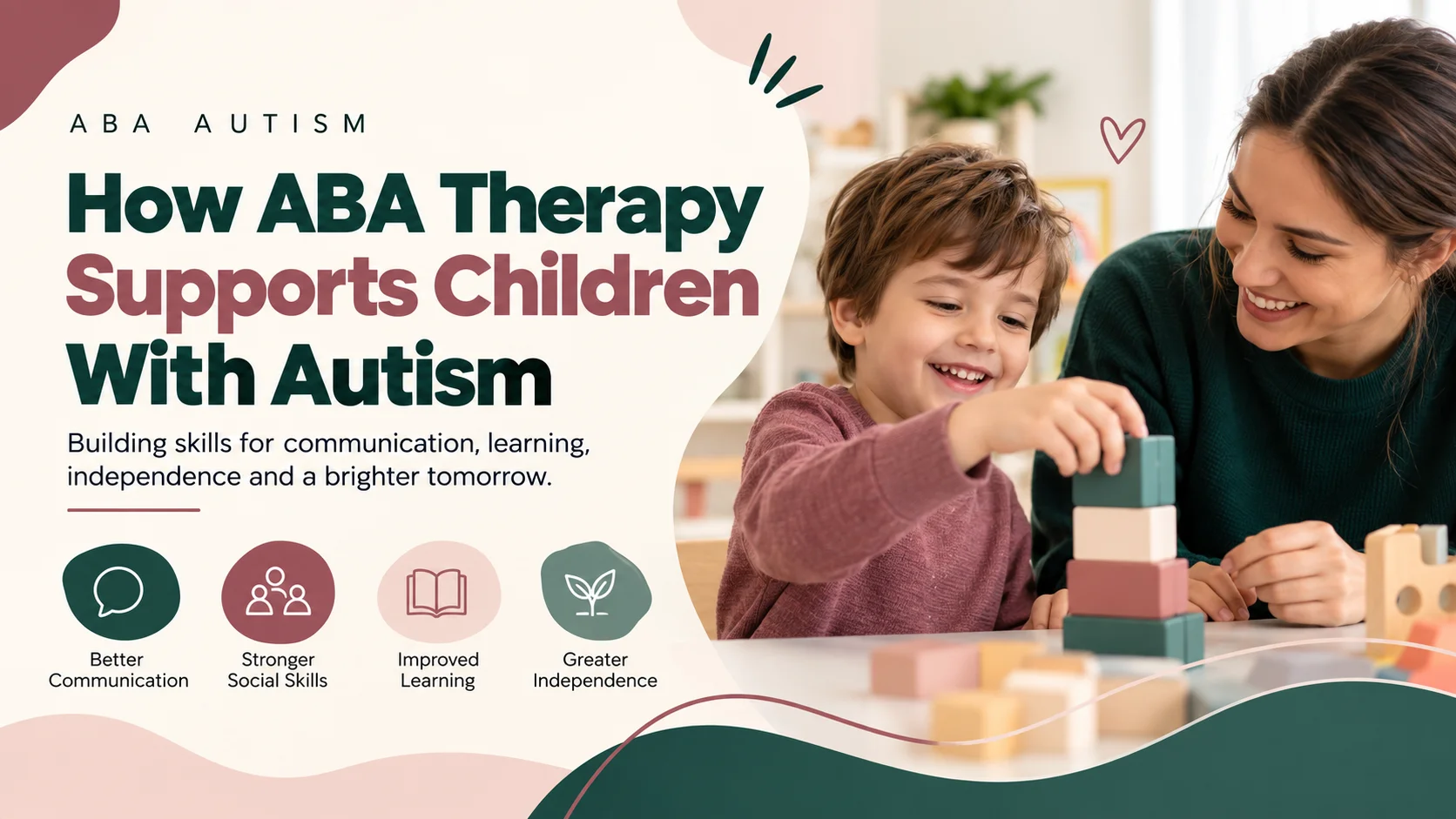

Can daily communication, routine, learning or independence be made easier for a child with autism? ABA therapy for autism can offer structured support around skills of importance in real life.
Parents will hear of ABA without understanding what ABA therapy entails, what skills it can target, or how clinicians determine progress in their child.
This guide explains how ABA works, its benefits, common techniques, everyday applications, individualized planning, parent participation, and progress measurement.
The emphasis is on action: how families can learn what evidence-based, thoughtful ABA support might look like before deciding on services.
Key Takeaways
- ABA therapy for autism uses principles of learning and behavior to teach meaningful, functional skills.
- ABA therapy benefits can include communication, socialization, learning, daily functioning and independence.
- ABA therapy techniques vary according to the child’s goals, environment, strengths, and learning needs.
- Individual programs are tailored to individual children by employing measurable goals and regular review.
- Children can practice what they have learned out of therapy setting with parents’ help.
What Is ABA Therapy for Autism?
When families are researching autism services, they often hear the term ABA autism, however, ABA is more accurately defined as an individualized approach to learning, behavior, and skill development.
What Applied Behavior Analysis Means
Applied behavior analysis for autism is a practice that uses the principles of learning and behavior to teach skills and decrease behaviors that disrupt communication, learning, safety, or participation.
The view is on what is happening before, during and after a behavior, and what a child is saying or doing to support a more useful behavior, and what teaching strategies may be useful.
ABA may focus on:
· Communication
· Social interaction
· Learning readiness
· Daily living
· Functional behavior
· Independence
What ABA Therapy Can Target
The goals for ABA therapy for autism vary from child to child, depending on the child’s current skills, communication needs, developmental priorities, and family concerns.
It can be a child’s request for assistance, learning to follow a routine, joining play, doing self-care tasks, making transitions, or doing more independently in school or community activities.
The diagnosis is to give context but the focus of the treatment plan should be on the individual child.
How ABA Therapy Works
A good aba intervention autism program has a logical sequence: Assess the child’s needs, set meaningful goals, teach skills, evaluate progress, and modify supports as necessary.
Assessment
ABA therapy for autism begins with gathering information about the child’s current abilities, strengths, communication, behavior patterns, routines, and support needs.
Assessment may include:
· Caregiver interviews
· Direct observation
· Skill assessment
· Review of relevant information
· Functional behavior assessment, as needed,
The intent is to determine effective treatment priorities and to get a starting point right.
Individualized Goals
ABA for autism treatment should translate assessment findings into observable goals that have practical value.
A goal might involve independently requesting assistance, completing several steps of a routine, responding to a social cue, or transitioning between activities.
Family priorities are important because parents experience the impact of skills on their family mornings, meals, school readiness, play, bedtime, and community involvement.
Teaching Practice
ABA therapy techniques provide different ways to teach skills depending on the child and the goal.
A clinician can divide a skill down into smaller steps and model a response, give an appropriate prompt, reinforce successful responses and then fade assistance as independence increases.
Activities, play, routine, and naturally occurring opportunities are all ways the teaching can happen.
ABA Therapy Benefits for Children With Autism
The best meaning of the ABA therapy benefits is specific to the individual child, and should be targeted to functional skills that will enhance participation, communication, learning or independence.
Communication Skills
ABA therapy for autism may support functional communication such as requesting, asking for help, making choices, responding to others, or communicating the need for a break.
Communication can be through spoken language, gestures, pictures, sign, AAC or through another appropriate system.
Example: A child who previously pushed materials away when frustrated may learn a reliable way to communicate “break” or “help.”
Social Skills
ABA therapy benefits may include structured opportunities to practice useful social skills within play, routines, and group activities.
Relevant goals may include:
· Taking turns
· Responding to another person
· Joining an activity
· Requesting participation
· Following simple social routines
The aim should be to encourage meaningful interaction rather than for a child to mimic actions that have no real function.
Daily Living Skills
ABA intervention autism programs may address routines involving hygiene, dressing, toileting, mealtime, cleaning up, organizing belongings, or preparing for an activity.
Task analysis can be used to break down a complex sequence of activities into smaller actions. Prompting can then be faded as child is able to perform the sequence independently.
Example: You can teach handwashing as a series of steps rather than a child learning all the steps at once.
Learning Skills
Learning readiness goals for ABA therapy for autism might include attention, imitation, following directions, matching, finishing activities, or joining in with classroom routines.
Learning goals should relate to what the child has to do in order to participate successfully.
Useful practice can occur during:
· Structured activities
· Play
· Classroom routines
· Table work
· Everyday instructions
Emotional Regulation
The benefits of ABA therapy may be helping a child learn how to express their frustration, seek help, plan for transitions and request a timeout.
A behavior should be considered within its context. If a child has a transition difficulty, this may be a sign that his/her expectations need to be clarified, that the child needs more support on the level of communication, that a visual preparation is needed or any other practical solution.
Functional replacement skills, participation should be emphasized in support.
Independence
Applied behavior analysis for Autism can support the children to learn to perform familiar routines with fewer cues and prompts.
Independence may involve:
· Communicating a need
· Completing routine steps
· Making appropriate choices
· Managing personal belongings
· Using learned skills across settings
Progress is meaningful when the child is able to use skills more independently in activities that are meaningful to the child and family.
ABA Therapy Techniques
The most appropriate ABA therapy techniques depend on the skill being taught, the learning environment, and the child’s individual response to intervention.
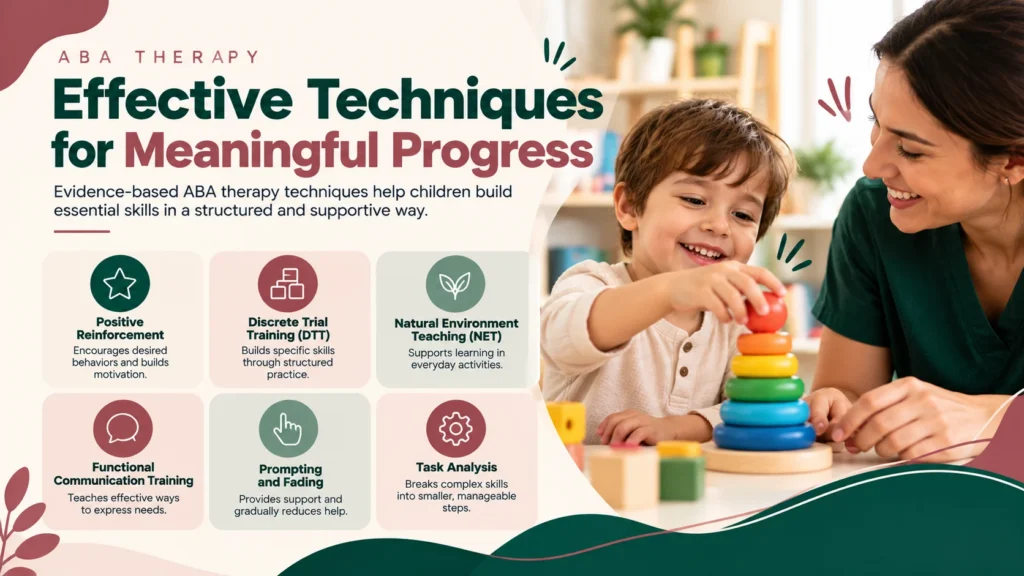
Positive Reinforcement
Positive reinforcement can be employed in ABA therapy for autism by giving something of value following a desired behavior, which increases the likelihood of the behavior being repeated.
Reinforcement is individualized and may include:
· Praise
· Access to a preferred activity
· Social interaction
· Access to an item
· Another meaningful consequence
The important principle is identifying what is genuinely reinforcing for that child.
Discrete Trial Training
ABA therapy techniques might also involve Discrete Trial Training (DTT), which works best when a skill benefits from structured practice.
A simplified learning opportunity may involve:
· A clear instruction or cue
· The child’s response
· Feedback or reinforcement
· Another opportunity to practice
DTT is not a teaching format of ABA, but a description of one teaching format.
Natural Environment Teaching
ABA intervention autism can occur during everyday activities rather than only in highly structured lessons.
Natural Environment Teaching can involve learning in play, during meals, in daily activities, in activities children like to do, or in community settings.
A child may be practicing asking for a toy in play, but not in teaching, when in fact they need to do both.
Functional Communication Training
ABA for autism treatment may use Functional Communication Training to teach an effective communication response for a need that may otherwise be expressed through behavior that interferes with participation.
For instance, a child can ask for “help,” “finished,” or “break” with an appropriate communication method.
The exact communication response should fit the child’s abilities and existing communication system.
Prompting
ABA therapy for autism may involve prompts that temporarily help a child perform a skill successfully.
Prompts can be:
· Verbal
· Visual
· Gestural
· Modeled
· Physical when clinically appropriate
Prompt fading is important because the aim is not permanent assistance. Support should be reduced as the child becomes more independent.
Task Analysis
ABA therapy techniques can help to simplify the routine into smaller, teachable steps.
This approach can be useful for:
· Getting dressed
· Brushing teeth
· Handwashing
· Cleaning up
· Classroom routines
The clinician can determine areas with independent attainment and those that require further instruction.
Functional Behavior Assessment
If a behavior needs to be examined in greater detail, Applied behavior analysis for autism can take advantage of a Functional Behavior Assessment.
The team may examine:
· Actions that precede a behavior.
· What the behavior looks like
· What happens afterward
· Environmental factors
· Communication needs
ABA Therapy in Everyday Life
When children are able to apply skills in their regular routines, as well as therapy activities, the therapy becomes more meaningful for autism.
Communication During Daily Routines
ABA therapy benefits can be observed when a child uses functional communication to request, select, refuse or seek assistance during meals, dressing, play or preparing for school.
Example: A child learns to ask for a chosen food instead of using a demanding behavior to ask for food.
Learning During Play
Play may be used to include ABA therapy techniques for imitation, requesting, responding, waiting, turn taking or simple game routines.
Play can provide motivating opportunities to practice skills in a naturally meaningful context.
Independence During Self-Care
Task analysis, prompting, reinforcement, and repeated practice skills used in ABA intervention for autism can be used to support self-care skills.
A child may be able to dress or care for him or herself more steps at a time, and require less help as they become more independent.
Transitions Between Activities
ABA for autism treatment may support transitions through visual cues, predictable routines, functional communication, preparation, and appropriate reinforcement.
The goal is to teach the child what will come next and provide a way to communicate during transitions and changes.
| Setting | Skill focus | Example |
| Home | Communication | Requesting help |
| School | Participation | Following a classroom routine |
| Community | Independence | Making a choice |
| Play | Social interaction | Taking turns |
Individualized ABA Therapy
Every child is unique, and autism must be treated in the context of meaningful goals instead of a list of behaviors to eliminate.
Objectives Based on the Child
The most relevant goals for ABA therapy reflect the child’s developmental level, communication style, strengths, interests, and current abilities.
Individualized planning may consider:
- Skills the child already has
- Skills that are emerging
- Communication preferences
- Areas requiring additional support
- Family priorities
The same diagnosis can lead to very different treatment priorities.
Goals Based on Everyday Needs
ABA intervention autism goals should connect to situations that affect the child’s participation at home, school, or in the community.
The goals of function may be communication, self-care, safety, school, social, or independence.
Adjusting the Treatment Plan
ABA therapy techniques should change when the child’s needs or progress change.
Teaching procedures, prompts, reinforcement, goals, and/or level of assistance may be adjusted by clinical teams as they receive data through treatment.
A program should remain relevant as the child develops.
What Parents Can Expect From ABA Therapy
When families are researching ABA autism services, they are looking for information about the clinical team, the setting, the role of the family, and what it’s like to be in the program.
Who Oversees ABA Therapy?
Autism treatment can be provided by a Board Certified Behavior Analyst (BCBA), who initiates or coordinates goals and clinical programming.
Team members can provide direct support that is supervised by a Registered Behavior Technician or other trained team member.
ALMA employs behavior technicians, support staff, and BCBAs who are working in individual care plans. Learn about ALMA’s ABA services
Where ABA Therapy Can Take Place
ABA therapy benefits can be supported in settings where children naturally learn and participate.
ALMA refers to services that could be provided in the home, school, clinic, or community based on the child’s needs and service plan. Learn about ALMA’s ABA services for children.
An effective setting is one that fosters the objectives being met, not just a convenient place.
Parent Participation
ABA intervention autism is reinforced when parents know how to support the use of skills beyond sessions.
Parent participation may include:
· Learning practical strategies
· Supporting communication
· Practicing routines
· Using reinforcement appropriately
· Observing and reporting to the clinical team
As part of this care, ALMA offers support and parent coaching for the family. See ALMA’s parent support services
How ABA Progress Is Measured
ABA therapy for autism is based on data that can be measured to determine if treatment is making any measurable difference in targeted skills or behaviors.
Measurable Goals
Goals that define observable behaviors are easier to assess for benefits of ABA therapy.
A goal like “improve communication” could be more useful if it specifies a behavior in communication, a situation, degree of independence, or expected response.
Presented goals provide families with an understanding of what the treatment team is aiming for.
Data Collection
ABA therapy techniques may use different measures depending on the goal.
Common measures include:
· Frequency
· Duration
· Accuracy
· Independence
· Prompt level
The selected measure should be consistent with the skill or behavior to be assessed.
Progress Review
Applied behavior analysis for autism is a process that uses gathered data to inform clinical decisions.
A team can sustain a winning plan, tweak a plan, add a new objective, or shed support as they gain independence.
Individualized assessment, continuous progress monitoring, and treatment plan modification are part of ALMA’s approach to care. Read ALMA’s ABA assessment guide
Choosing ABA Therapy for Your Child
Families researching aba for autism treatment can look beyond the service label and ask how a provider creates goals, measures progress, involves caregivers, and adapts treatment.
Questions to Ask an ABA Provider
ABA therapy for autism should be described in a way that is easy for parents to understand so that they know the purpose of therapy and what their part is in the treatment.
Useful questions include:
1. How are my child’s goals selected?
2. What are the measures of progress?
3. Who is responsible for the treatment plan?
4. How are parents involved?
5. What do strategies look like when things don’t go as planned?
6. How is the use of skills reinforced in different settings?
7. How are my child’s preferences and communication needs considered?
Signs of an Individualized Program
ABA therapy benefits are more meaningful when services are focused on the child’s needs.
Look for:
· Assessment-based goals
· Measurable targets
· Family input
· Regular clinical review
· Functional skill development
· Appropriate prompt fading
· Opportunities for generalization
ALMA explains its care model as individualized, evidence-based, family-centered support led by qualified clinical professionals. Learn about ALMA Behavioral Solutions
ABA Therapy in Southern California
Families who are looking into ABA therapy in southern California may require services that are tailored to their family’s needs, while also fitting into the community and school routines and routines, and individual clinical needs.
Local ABA Support
ABA therapy for autism should be practical for the family as well as relevant to the child’s goals.
ALMA offers autism and ABA support throughout Southern California and offers individual services based on the needs and family priorities of the child. Explore ALMA’s Southern California services
ALMA Behavioral Solutions
Applied behavior analysis for autism is one of the many components of ALMA’s family-focused approach, targeting meaningful skills, communication, independence, and everyday functioning.
ALMA serves families in communities such as Los Angeles and its environs. ALMA’s Los Angeles ABA services are available.
Take the Next Step With ALMA Behavioral Solutions
The first step in ABA therapy for autism is to understand the child, determine what is important and draw up a plan that is practical in a real family.
ALMA Behavioral Solutions offers individualized, evidence-informed ABA support in the areas of communication, independence, daily living, social participation, learning and functional behavior. Families will be able to discuss assessment, goals of treatment, role of parents, treatment environments, and what happens next with the clinical team. Explore ALMA’s ABA Therapy for Families
If families in Southern California are interested in services for their child, they can call ALMA to talk about their needs and options. Call (747) 250-8494 or email info@almabehavioralsolutions.com to start a conversation.
A thoughtful first step is simply understanding your child’s needs and identifying which goals could make everyday life more manageable, meaningful, and independent.
Frequently Asked Questions About ABA Therapy for Autism
At What Age Can ABA Therapy Begin?
ABA treatment for autism may be considered throughout childhood when behaviors or skills can be targeted and personalized. Goals and teaching strategies should be based on the child’s developmental level, communication ability, family priorities and present needs.
How Many Hours of ABA Therapy Does a Child Need?
There is no universal schedule for aba for autism treatment. The level of service intensity will vary depending on the child and family, goals, clinical recommendations, progress, and available supports.
How Long Does ABA Therapy Last?
The length of ABA therapy for autism varies. A child’s need for support might decrease as skills grow independent, or it might vary as the child’s developmental and daily needs shift.
Can a Non-Speaking Child Benefit From ABA?
Yes. ABA therapy techniques can support functional communication through speech, gestures, pictures, AAC, signs, or other appropriate methods. The emphasis is on assisting the child to express needs, wants, requests and important messages.
Can ABA Therapy Work With Other Autism Services?
ABA intervention autism services can be coordinated with other appropriate supports when clinically indicated. Teams can share common goals, communication approaches and patterns throughout the child’s wider care and learning setting through collaboration.