

How can you determine which local ABA provider is best for your child? Distance is a part of the equation, but it’s not all. Credentials, clinical supervision, family involvement and individual care are all important. A good clinical fit is still necessary for a convenient provider.
When looking for an Applied Behavior Analysis therapist near me, one can get a lot of results easily. The differences between providers are not always obvious from their websites. If you know what to look for, it can be a lot easier to find.
A strong ABA provider near you should explain who oversees treatment, how goals are selected, and how progress is measured. Parents should also be familiar with the therapy environment, insurance procedures, therapy schedule, and level of involvement of the therapist.
This guide walks through those questions so you can compare local providers with greater confidence.
Key Takeaways
- Focus on more than distance and credentials, supervision, treatment quality, availability, and family fit.
- Find out who will draw up the treatment plan, and who will undertake your child’s daily treatment.
- Select care that is based on specific, measurable, meaningful goals instead of a typical program.
- Discuss the impact of progress data, caregiver input, comfort, communication and changing needs on treatment.
- Research home, center, school, community, insurance and scheduling options before selecting a provider.
What Does an Applied Behavior Analysis Therapist Do?
What does ABA stand for?
ABA stands for Applied Behavior Analysis, a science that examines how behavior and learning are influenced by the environment. Applied behavior analysis therapy involves assessment, observation, teaching, reinforcement, and data to develop meaningful skills and to reduce barriers to daily functioning.
An ABA professional may support skills such as:
- Functional communication
- Daily routines and independence
- Social participation and play
- Learning and school-related skills
- Safer, more effective alternatives to challenging behavior
For example, if a child is having trouble with a challenging task, they can learn to say they need support or to take a break, rather than crying or taking avoidance strategies.
One of the more common needs parents have when they are looking for an applied behavioral analysis therapist near me is to find someone who can offer individualized, measurable support that is tailored to their needs.
Learn more about Alma Behavioral Solutions’ ABA therapy services.
BCBA Vs RBT Vs Behavior Technician: Who Will Work With Your Child?
The term “ABA therapist” is a helpful everyday term, but also, the team delivering “ABA care” may have varying roles. Parents may be better informed about who is involved in making clinical decisions and who works directly with their child by understanding those roles.
The BACB reported 85,587 BCBAs, 5,246 BCaBAs, and 260,174 RBTs as of July 1, 2026. They are not the same things, so it’s important to understand the meaning of each role while evaluating providers.
| Role | Typical Responsibility | Can Practice Independently? |
| BCBA | Assessment, treatment design, clinical decisions, data review, supervision | Yes, within professional scope |
| BCaBA | Supports behavior-analytic services under qualified supervision | No |
| RBT | Helps implement behavior-analytic services under ongoing supervision | No |
| Behavior Technician | Provides direct support according to the provider’s role requirements | Depends on credentials and applicable requirments |
Board Certified Behavior Analyst (BCBA): Who Designs and Oversees Treatment?
BCBA is a Board Certified Behavior Analyst, which is a graduate-level certification with the BACB. BCBAs can independently provide behavior-analytic services and supervise RBTs, BCaBAs, and other professionals implementing behavior-analytic interventions.
During child-focused ABA services, a BCBA can perform or supervise assessment, create treatment objectives, evaluate data, modify intervention, coordinate services, and counsel staff. Parents need to know the name of the clinician responsible for these decisions and how he or she stays in touch with them during treatment.
RBT and Behavior Technician: Who Provides Direct ABA Sessions?
A Registered Behavior Technician (RBT) is a paraprofessional credential from the BACB. RBTs assist with behavior-analytic services under the direction and close supervision of an appropriate supervisor rather than independently designing treatment.
Current BACB requirements include ongoing RBT supervision equal to at least 5% of monthly behavior-analytic service hours, along with required supervision contacts.
A behavior technician can do similar direct service work, but not all behavior technicians will have an RBT credential.
Where Does a BCaBA Fit on an ABA Care Team?
A Board Certified Assistant Behavior Analyst (BCaBA) is a professional who can help with assessments, data review, implementation, staff guidance and other behavior analysis-related tasks they are qualified for. BACB rules state that BCaBAs may not practice independently and must receive appropriate supervision.
Alma also provides a deeper guide to the BCaBA role in ABA therapy.
How to Find a Qualified ABA Therapist Near You
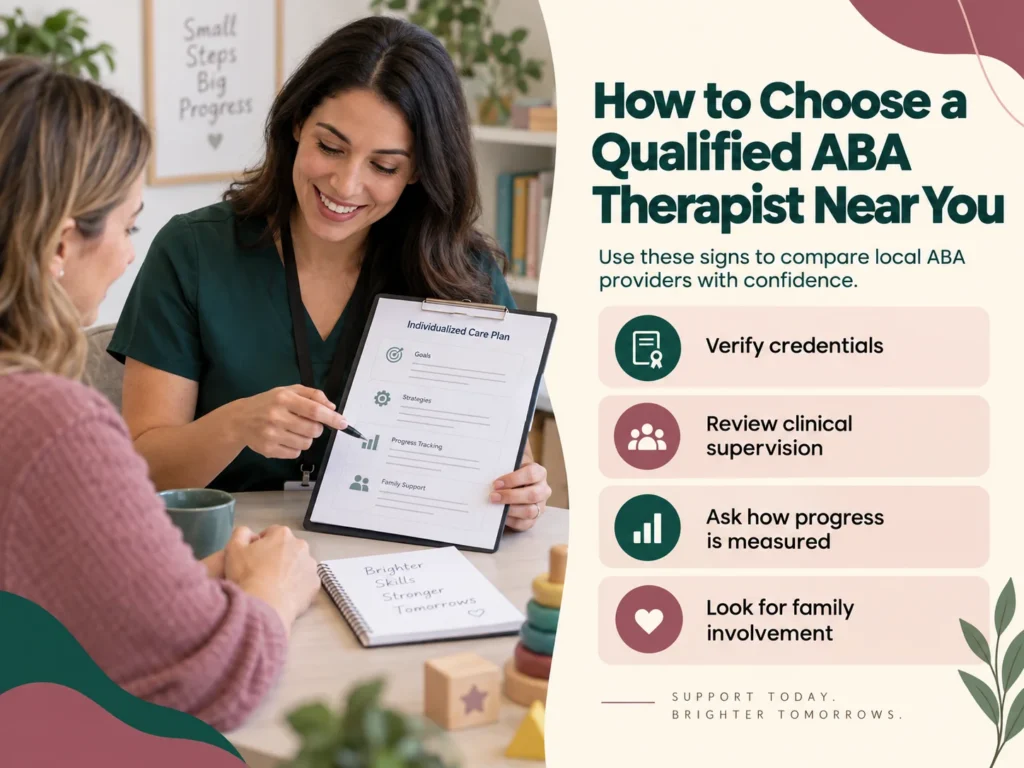
Finding a nearby provider is only the first step. A qualified ABA therapist will utilize a clear clinical system in which supervision, treatment goals, progress, communication with families and responsibilities are easily understood. Compare providers on the following factors as well as location.
Confirm Service Area, Setting, Availability, and Schedule
Start with practical fit. Ask if they will work in your area and if therapy can be performed at home, center, school or community.
Also confirm:
- Current openings or waitlist length in the last calendar year.
- Available session times
- Travel or service-radius limitations
- Compatibility with school and family schedules
Families in Glendale, for example, can review Alma’s ABA therapy services for Glendale families when comparing local options.
Verify Credentials and Clinical Supervision
Discuss with them who will be responsible for your child’s program, who will deliver direct sessions and how often clinical supervision will take place. Parents can independently verify BACB credentials through the BACB Certificant Registry.
An outdated staff biography or third-party directory is less reliable than the current registry, as information can change over time.
Look for Individualized Assessment and Treatment Goals
Quality ABA should start with understanding the individual child, not a standard programme. Communication skills, adaptive functioning, behaviour patterns, strengths, family priorities, learning environment, barriers to daily living may be included.
Treatment goals should be specific, measurable, meaningful, and relevant. Inquire about the criteria for choosing goals, the frequency of review, and when they might be phased out, transitioned, or phased down as appropriate.
Ask How Progress Is Measured and Shared
A provider should give specific information about progress rather than feel good phrases like ‘your child is improving’.
Depending on the goal, progress may be measured through:
- Skill accuracy or independence
- Frequency or duration
- Prompt levels
- Functional communication
- Performance across different settings
Parents should also be aware of the frequency of progress checks and the impact of data on the modifications to treatment.
Evaluate Parent and Caregiver Involvement
Find a provider who encourages caregiver involvement in assessment, goal setting, progress monitoring and treatment updates. Parent coaching can also be used to extend skills into the meal, bedtime, play, school preparation and community routines.
Alma’s family-centered ABA resource explains how caregiver participation can support consistency beyond therapy sessions.
Consider Your Child’s Comfort, Communication, Choice, and Needs
A good fit involves more than completing tasks. Observe how the team establishes rapport, responds to communication, considers preference, provides meaningful choices, and responds when a child looks distressed or in need of a break.
A good idea is to ask yourself: “What if my child always demonstrated that an approach was uncomfortable or ineffective?” The response can provide insight into the provider’s ability to consider the needs, safety, communication, and data of the individual.
Questions to Bring to Your First ABA Provider Call
- Who will oversee my child’s treatment?
- What are the qualifications of the clinical staff?
- How often will the program be reviewed?
- How are goals selected?
- How will our family’s priorities be included?
- What will be done to measure and share progress?
- What happens if the current approach is not working?
- How do therapists respond to signs of distress or requests for breaks?
- How does the organisation deal with staff turnover?
- Why are you recommending this particular setting and level of service?
Green Flags and Red Flags When Choosing an ABA Provider
Good providers should be able to give reasons for caring. When treatment recommendations are general, standard, challenging to question, or not tied to measurable goals, warning signs are likely to be present.
| Green Flags | Red Flags |
| Supervising clinician is clearly identified | Clinical responsibility is unclear |
| Assessment guides recommendations | Same plan is suggested for everyone |
| Goals relate to meaningful daily skills | Goals focus mainly on conformity |
| Progress data are explained | Improvement is described vaguely |
| Family input is welcomed | Parents are discouraged from questioning decisions |
| Treatment changes when evidence indicates | An ineffective plan continues unchanged |
| Recommended hours have an individualized rationale | A fixed schedule is prescribed before assessment |
| Transition or discharge is discussed | No explanation of when services may decrease |
| Outcomes are discussed realistically | Results are guaranteed |
No single checklist replaces clinical judgment, but these questions can reveal how transparent and individualized a provider’s approach really is.
What Types of ABA Therapy Are Available Near Me?
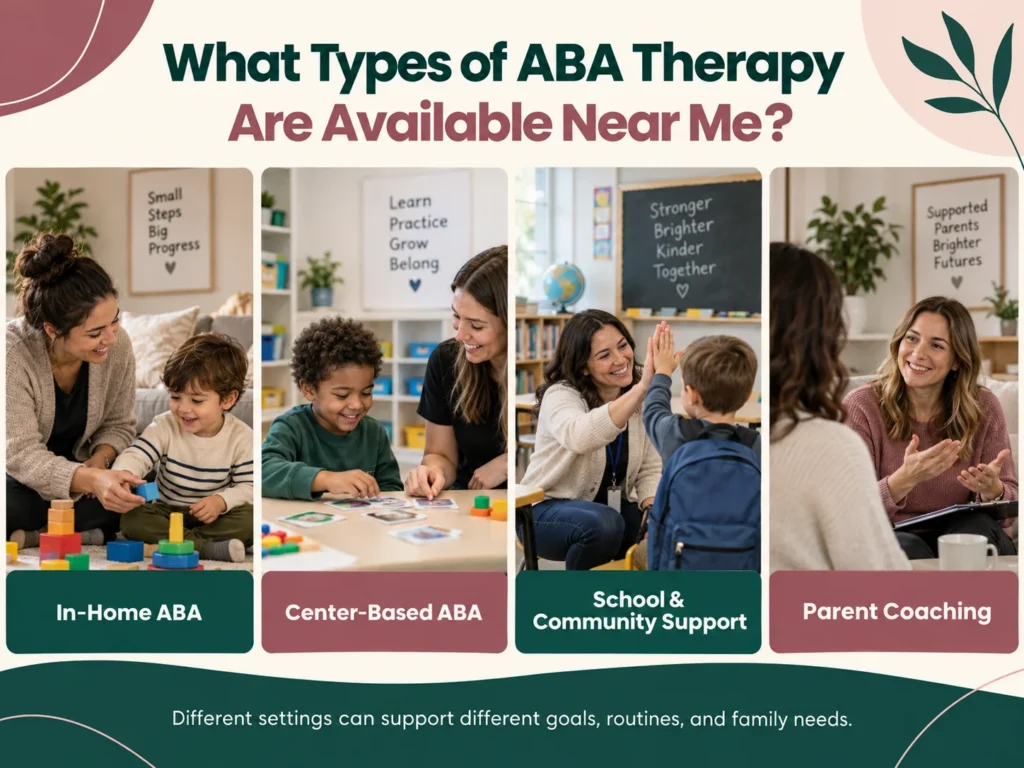
ABA can be provided in multiple settings. The appropriate setting is influenced by the child’s objectives, learning needs, family schedule, opportunities for generalizing, clinical recommendation, and needs of payers.
In-Home ABA Therapy Near Me: When Home-Based Care May Fit
Parents who are looking for in-home ABA therapy near me typically want help in the routines where issues or opportunities for learning exist. Home sessions can provide opportunities to practice dressing, eating, playing, communication, transitions and family routines in the comfort of home.
Caregivers might also notice and practice strategies between sessions. Home-based therapy does not always equate to the best place for the child to receive treatment, and the best place depends on the child’s needs and treatment goals.
Families can review Alma’s Burbank ABA therapy options, including in-home services.
Center-Based ABA Therapy: When a Structured Setting May Fit
Center-based ABA can provide a predictable learning space with materials, structured activities, clinical resources, and opportunities for carefully planned teaching.
There are some children who might need fewer distractions at home or easier access to activities to be set-up at the center. Other children may require further practice beyond the center to ensure that skills are transferred naturally across home, school and community.
School and Community-Based ABA Support
Children can practice skills in the context where they are needed in school and the community. Goals can include transition, participation in class, functional communication, peer interaction, safety, and increased independence.
Consistency can also be improved if there is some coordination with educator and caregiver. Alma discusses this principle in its guide to generalizing skills across school and everyday settings.
Parent Coaching and Caregiver Support
Parent coaching teaches what the treatment goals are and which strategies to apply while engaging in everyday activities, and not during a therapy session.
Coaching can include reinforcement, communication, opportunity, transition, independence, or response to challenging situations. Guidance is to be tailored to the child’s individual plan, not a standard set of techniques.
What Happens After You Contact an ABA Provider?
When you know what to expect, calling a provider seems like a much less daunting task. The sequence may differ depending on the organization and insurance plan but the process often involves the following steps:
- Initial consultation: The provider gets to know your child’s strengths, needs, routines, priorities, location, schedule and services.
- Eligibility check and insurance review: The team might confirm the benefits, referrals, authorizations, and network status prior to the start of treatment.
- Assessment: A qualified clinician collects data in various ways such as interviews, observation, records and appropriate assessment procedures.
- Individual treatment plan: Goals, teaching strategies, measurement procedures, recommended setting, and service intensity are chosen during assessment.
- Therapy begins: Direct sessions start once clinical and funding requirements are in place.
- Progress review and adjustment: Data, caregiver feedback, child response, generalization, and changing priorities will help identify what to continue or change.
Alma’s existing step-by-step guide to starting ABA therapy provides more detail about consultation, assessment, treatment planning, sessions, and progress monitoring.
Parents should also inquire about how long it takes to take in and what they can do to prepare during the wait.
What Skills Can ABA Therapy Support?
ABA goals should be individualized, so two children receiving therapy may work on very different skills. Treatment can focus on enhancing participation, communication, safety, independence or functioning in everyday life.
Common goal areas include:
- Functional communication: requests for assistance, breaks, preferred items, information or attention.
- Daily activities: dressing up, dealing with hygiene, eating, social organization, or carrying out steps without assistance.
- Transitions: moving between activities with appropriate preparation and communication.
- Social participation and play: turn-taking, joint activities, conversation, or participating with peers.
- Learning participation: attending to instructions, completing relevant tasks, or requesting clarification.
- Safety and independence: learning functional responses that support safer participation at home or in the community.
One child may practice requesting a break before frustration escalates. One might be able to do one part of the morning routine without as many reminders.
The aim is not just to get a different-looking behavior out. Quality treatment relates teaching to skills that have meaning in the person’s actual life.
Common ABA Strategies Your Child’s Therapy Team May Use
A skilled provider chooses strategies according to assessment, goals, behavior function, learning history, preferences, and ongoing data. Techniques should not be copied just because they have worked for another child.
| ABA Strategy | Parent-Friendly Meaning | Simple Example |
| Positive Reinforcement | A meaningful consequence increases a useful behavior | A child appropriately requests a toy and receives access |
| Functional Communication Training (FCT) | Teaches communication that can serve the same function as an interfering behavior | Learning to request a break during a difficult task |
| Natural Environment Teaching (NET) | Teaching is embedded into everyday interests and activities | Practicing requests while playing with preferred toys |
| Discrete Trial Teaching (DTT) | A skill is taught through clearly structured learning opportunities | Practicing identification of familiar objects |
| Shaping | Reinforces closer steps toward a target skill | Gradually building clearer communication |
| Chaining | Teaches steps within a larger routine | Learning the sequence for getting dressed |
| Prompting and Fading | Provides temporary help and systematically reduces it | Moving from a verbal reminder toward independent responding |
| Antecedent Strategies | Changes conditions before a situation to make successful responding more likely | Giving a transition warning before an activity ends |
Parents do not need to become behavior analysts to evaluate these methods. They should at least be able to question why a strategy is being used, how success will be measured and what will happen if it is not successful.
Alma provides deeper resources on Natural Environment Teaching, Discrete Trial Teaching, and antecedent interventions in ABA.
Does Insurance Cover ABA Therapy?
The insurance coverage is a great factor in determining which provider is actually accessible to your family. Insurance coverage for autism or pervasive developmental disorder (PDD) under the California Health and Safety Code must include ABA as a form of behavioral health treatment. Actual benefits, authorizations and networks and cost sharing remain plan-specific.
Parents should confirm:
- whether the ABA provider is in-network;
- deductible, copay, or coinsurance responsibilities;
- referral or diagnostic requirements;
- prior authorization requirements;
- which settings are covered;
- approved service amounts and authorization periods.
Medi-Cal rules are also important. DHCS currently acknowledges that medically necessary behavioral health treatment, including ABA, is covered for Medi-Cal members under the age of 21, both with and without an autism diagnosis, where applicable medical-necessity requirements have been met.
Never trust just a website logo that indicates an insurance company. Before treatment, check your benefits with the provider and your health plan.
Finding Applied Behavior Analysis Therapists in Southern California
Selecting an applied behavior analysis therapist Southern California or ABA therapist Southern California isn’t simply about picking the one that is closest to you. Families should consider if the provider is located in their area, if the provider provides the right kind of treatment setting, if the provider is accepting insurance, and if the provider is available when school and family schedules allow.
When comparing local ABA therapy, check:
- Service area and travel radius
- In-home, center, school, or community options
- Current openings and waitlist
- Insurance participation
- Scheduling flexibility
- BCBA supervision and clinical fit
Provider availability can vary across California. California represented approximately 15% of the total number of jobs posted that wanted BCBA or BCBA-D professionals in 2025, according to the BACB’s 2026 workforce report, which showed that demand for qualified behavior analysts is high.
Families near Pasadena can explore Alma’s Pasadena ABA therapy services, while families closer to Northridge can review ABA therapy options in Northridge.
The best local provider is one that combines accessibility with qualified, individualized care.
Why Families Choose Alma Behavioral Solutions
Alma Behavioral Solutions offers individualized ABA services to children and families throughout the Southern California community with services tailored to each child’s needs, goals, and everyday life.
Alma’s strategy may appeal to families because it includes:
- BCBA-led clinical oversight
- Individualized assessment and treatment planning
- Direct ABA therapy with trained behavior technicians
- In-home and school-related support
- Parent and caregiver involvement
- Continuing process monitoring and treatment modifications
Alma’s family-centered care model is built upon the long experience of its founder and Clinical Director, Alisa Badryan, in Applied Behavior Analysis since 2008.
Families in Studio City and Granada Hills can also review local service information based on their area.
The best match will be determined by your child’s needs, schedule, insurance, setting, and clinical objectives.
Find the Right ABA Support for Your Family
Finding ABA services near you should lead to more than the closest name on a map. Find a qualified supervisor, clear communication, personalized objectives, tangible progress, family engagement, and an environment that is a good fit for your child.
Alma Behavioral Solutions supports families throughout Southern California, including communities such as Beverly Hills and Los Angeles, with individualized ABA care and guidance through the intake process.
To discuss your child’s needs, insurance, availability or next steps, please call (747) 250-8494 or email info@almabehavioralsolutions.com. A conversation can help you determine which services and setting may be appropriate for your family.
FAQs About Finding an ABA Therapist Near You
Do I Need an Autism Diagnosis or Referral Before Contacting an ABA Provider?
An ABA provider can be contacted before all clinical and insurance requirements are met. Ask the provider and your health plan what is needed to ensure coverage, as this may be diagnostic data, medical-necessity documentation, or referrals.
How Many Hours of ABA Therapy Does My Child Need?
There is no appropriate universal number of ABA hours for every child. Service Intensity should be based on individual assessment, treatment objectives, functioning needs, clinical judgment, progress, circumstances of the family, and applicable payer requirements.
Can ABA Therapy Be Coordinated With Speech Therapy, Occupational Therapy, or School Services?
Yes, proper collaboration can help to achieve common objectives and minimize competing strategies. BACB ethics standards encourage collaboration with professionals from other disciplines when doing so serves the client’s best interests.
Can I Switch ABA Therapists or Providers if the Fit Is Not Right?
Yes. Families may voice concerns regarding rapport, communication, staffing, progress, scheduling, and treatment approach; and discuss possible changes. If any concerns don’t get resolved, it’s fair to check out other services that are qualified.
What if ABA Providers Near Me Have a Waitlist?
Find out from multiple providers when they can start, cancel, what service areas they provide, insurance networks, and alternative settings. Sometimes a provider that is a little further away with suitable in-home care services is more convenient than the closest unavailable provider.
What Information Should I Have Ready When I Contact an ABA Provider?
Assemble insurance information, child’s age, location, schedule, current issues, priorities, and prior diagnosis or referral information (if available), and prior relevant services. This makes it easier for the provider to communicate intake needs.